PUBLISHER: Mordor Intelligence | PRODUCT CODE: 2117284

PUBLISHER: Mordor Intelligence | PRODUCT CODE: 2117284
Next-Generation Antibody Therapeutics - Market Share Analysis, Industry Trends & Statistics, Growth Forecasts (2026 - 2031)
According to Mordor Intelligence, the next-generation antibody therapeutics market size in 2026 is estimated at USD 3.09 billion, growing from 2025 value of USD 2.88 billion with 2031 projections showing USD 4.35 billion, growing at 7.12% CAGR over 2026-2031.
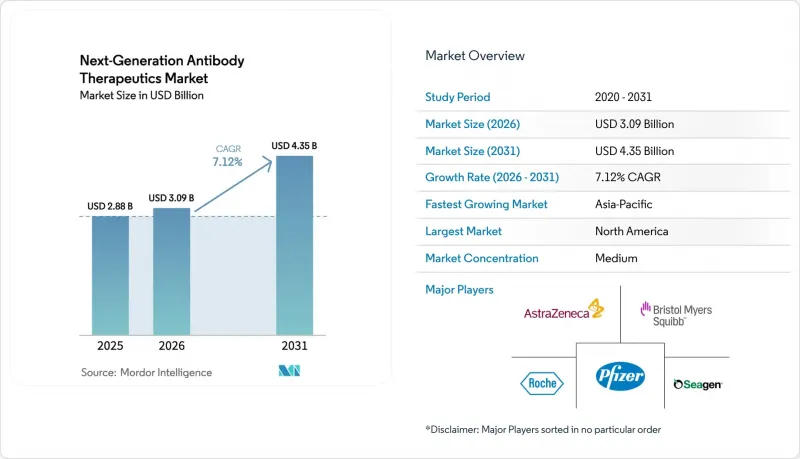
This report is Segmented by Therapeutic Area (Oncology, and More), Technology (Antibody-Drug Conjugates (ADCs), and More), Route of Administration (Intravenous, and More), Distribution Channel (Hospital Pharmacies, and More), Geography (North America, Europe, Asia-Pacific, The Middle East and Africa, and South America). The Market Forecasts are Provided in Terms of Value (USD).
Global Next-Generation Antibody Therapeutics Market Trends and Insights
Rising Global Cancer Incidence & Unmet Need in Solid Tumors
Escalating global cancer incidence intensifies the call for targeted therapeutics. More than 600 ADC candidates are in active trials for solid tumors, with breast and lung indications leading enrollment. Recent regulatory nods for HER2-low breast-cancer ADCs in 2024-2025 have energized development programs for gastric and ovarian malignancies, strengthening the clinical case for the next-generation antibody therapeutics market. Community oncology practices are adopting these agents earlier in treatment algorithms, driving a redistribution of infusion resources and accelerating patient access through 2030.
Growing Prevalence of Autoimmune Disorders Worldwide
Autoimmune diseases are emerging as the fastest-expanding opportunity segment. Bispecific constructs that can dampen multiple inflammatory pathways while sparing broad immunosuppression display high response durability in Phase 2 trials for rheumatoid arthritis and inflammatory bowel disease. Self-administrable subcutaneous formulations reduce clinic visits, supporting chronic disease management and broadening the commercial horizon for the next-generation antibody therapeutics market.
Stringent Regulatory & Analytical Requirements
Novel formats such as bispecifics and ADCs require extensive characterization of critical quality attributes. The FDA's focus on interstitial lung disease risks in ADCs mandates additional pulmonary monitoring, delaying pivotal studies fda.gov. While the 2025 elimination of mandatory animal testing cuts some timelines, it simultaneously necessitates sophisticated in-vitro and computational assays, challenging resource-constrained developers.
Other drivers and restraints analyzed in the detailed report include:
- Rapid Advancements in Antibody-Engineering Technologies
- Increasing Venture Capital & Big-Pharma Investments
- High Development & Manufacturing Costs
For complete list of drivers and restraints, kindly check the Table Of Contents.
Segment Analysis
Oncology retained 66.58% of the next-generation antibody therapeutics market in 2025, reflecting the transformative effect of ADCs and bispecific T-cell engagers in refractory tumors. Recent approvals for HER2-low breast cancer and small-cell lung cancer entrench these modalities in first-line regimens. Novel targets such as Claudin-18.2 and c-Met broaden the patient base, sustaining oncology's revenue lead.
Non-oncology indications are forecast to log a 9.38% CAGR, anchored by autoimmune and respiratory infectious-disease programs. Precision immune modulation via bispecific constructs offers prolonged remission without systemic toxicity, a compelling proposition for disorders requiring lifelong management.
ADCs generated 43.52% of 2025 revenue. Homogeneous conjugation techniques and radio-payload innovation are extending applicability into hematology and solid-tumor niches. The next-generation antibody therapeutics market size tied to ADCs is set to expand as radioimmunoconjugates gain traction in difficult-to-resect tumors.
Bispecific and multispecific antibodies advance at an 10.92% CAGR, validated by approvals such as tarlatamab for small-cell lung cancer. Modular platforms ease construction of dual-specific binders, accelerating pipeline diversity. Fc-engineered IgGs enhance antibody-dependent cellular cytotoxicity, offering differentiated competitive positioning.
Complete Report Scope:
- By Therapeutic Area
- Oncology
- Autoimmune & Inflammatory
- Other Therapeutic Areas
- By Technology
- Antibody-Drug Conjugates (ADCs)
- Bispecific & Multispecific Antibodies
- Fc-Engineered & Glyco-Engineered IgGs
- Antibody Fragments & Antibody-Like Proteins
- Engineered Full-Length mAbs (IgG4, IgG1? Variants)
- Biosimilar Next-Gen Antibody Products
- By Route of Administration
- Intravenous
- Subcutaneous
- Localized Administration (Intratumoral, Intravitreal)
- By Distribution Channel
- Hospital Pharmacies
- Specialty Clinics & Cancer Centers
- Retail & Online Pharmacies
- Geography
- North America
- United States
- Canada
- Mexico
- Europe
- Germany
- United Kingdom
- France
- Italy
- Spain
- Rest of Europe
- Asia-Pacific
- China
- Japan
- India
- Australia
- South Korea
- Rest of Asia-Pacific
- Middle East & Africa
- GCC
- South Africa
- Rest of Middle East & Africa
- South America
- Brazil
- Argentina
- Rest of South America
- North America
Geography Analysis
North America commanded 47.56% of 2025 revenue, driven by high cancer prevalence, favorable reimbursement, and a rich concentration of biotech innovation. The U.S. leads on expedited pathways and advanced manufacturing tax credits that mitigate capital outlay for new plants. The 2025 regulatory shift away from animal testing is expected to shave months off pre-clinical timelines, sustaining the regional lead fda.gov.
Asia Pacific delivers the fastest growth at 10.08% CAGR. China's high-profile biotech subsidies and Singapore's best-in-class manufacturing incentives draw multinationals to establish regional supply hubs, anchoring the next-generation antibody therapeutics market there. Japan and South Korea leverage mature regulatory frameworks to speed conditional approvals for life-saving biologics. Expanded patient access programs and rising middle-class healthcare spending further boost uptake.
Europe maintains strong scientific infrastructure and reimbursement systems yet contends with rigorous price-value assessments. Recent EMA procedural reforms shorten clock-stop period for priority medicines, encouraging earlier filings. National health systems prioritize therapies with robust survival benefits, compelling developers to generate real-world evidence packages at launch. Germany, France, and the Nordics demonstrate the highest per-capita usage of next-generation antibody therapeutics.
- Amgen
- AstraZeneca
- Bayer
- Biogen
- Bristol-Myers Squibb
- Roche
- GlaxoSmithKline
- Pfizer
- Seagen
- Xencor
- ImmunoGen
- Kyowa Kirin
- Genmab
- Regeneron Pharmaceuticals
- Abbvie
- Gilead Sciences
- MacroGenics Inc.
- ADC Therapeutics
- Zymeworks Inc.
- Sanofi
- Merck
Additional Benefits:
- The market estimate (ME) sheet in Excel format
- 3 months of analyst support
TABLE OF CONTENTS
1 Introduction
- 1.1 Study Assumptions & Market Definition
- 1.2 Scope of the Study
2 Research Methodology
3 Executive Summary
4 Market Landscape
- 4.1 Market Overview
- 4.2 Market Drivers
- 4.2.1 Rising Global Cancer Incidence & Unmet Need in Solid Tumors
- 4.2.2 Growing Prevalence of Autoimmune Disorders Worldwide
- 4.2.3 Rapid Advancements in Antibody-Engineering Technologies (ADCs, Bispecifics, Fc-Engineering)
- 4.2.4 Increasing Venture Capital & Big-Pharma Investments in Next-Gen Antibody Pipelines
- 4.2.5 Expansion of Biomanufacturing Capacity & Specialized CDMO Capabilities
- 4.2.6 Favorable Regulatory Designations (BTD, PRIME, RMAT) Accelerating Approvals
- 4.3 Market Restraints
- 4.3.1 Stringent Regulatory & Analytical Requirements for Novel Antibody Formats
- 4.3.2 High Development & Manufacturing Costs for Complex Biologics
- 4.3.3 Safety and Off-Target Toxicity Concerns with Potent Antibody Constructs
- 4.3.4 Pricing Pressures & Biosimilar Competition Post-Patent Expiry
- 4.4 Regulatory & Technological Outlook
- 4.5 Porter's Five Forces Analysis
- 4.5.1 Threat of New Entrants
- 4.5.2 Bargaining Power of Buyers
- 4.5.3 Bargaining Power of Suppliers
- 4.5.4 Threat of Substitutes
- 4.5.5 Intensity of Competitive Rivalry
5 Market Size & Growth Forecasts (Value, USD)
- 5.1 By Therapeutic Area
- 5.1.1 Oncology
- 5.1.2 Autoimmune & Inflammatory
- 5.1.3 Other Therapeutic Areas
- 5.2 By Technology
- 5.2.1 Antibody-Drug Conjugates (ADCs)
- 5.2.2 Bispecific & Multispecific Antibodies
- 5.2.3 Fc-Engineered & Glyco-Engineered IgGs
- 5.2.4 Antibody Fragments & Antibody-Like Proteins
- 5.2.5 Engineered Full-Length mAbs (IgG4, IgG1? Variants)
- 5.2.6 Biosimilar Next-Gen Antibody Products
- 5.3 By Route of Administration
- 5.3.1 Intravenous
- 5.3.2 Subcutaneous
- 5.3.3 Localized Administration (Intratumoral, Intravitreal)
- 5.4 By Distribution Channel
- 5.4.1 Hospital Pharmacies
- 5.4.2 Specialty Clinics & Cancer Centers
- 5.4.3 Retail & Online Pharmacies
- 5.5 Geography
- 5.5.1 North America
- 5.5.1.1 United States
- 5.5.1.2 Canada
- 5.5.1.3 Mexico
- 5.5.2 Europe
- 5.5.2.1 Germany
- 5.5.2.2 United Kingdom
- 5.5.2.3 France
- 5.5.2.4 Italy
- 5.5.2.5 Spain
- 5.5.2.6 Rest of Europe
- 5.5.3 Asia-Pacific
- 5.5.3.1 China
- 5.5.3.2 Japan
- 5.5.3.3 India
- 5.5.3.4 Australia
- 5.5.3.5 South Korea
- 5.5.3.6 Rest of Asia-Pacific
- 5.5.4 Middle East & Africa
- 5.5.4.1 GCC
- 5.5.4.2 South Africa
- 5.5.4.3 Rest of Middle East & Africa
- 5.5.5 South America
- 5.5.5.1 Brazil
- 5.5.5.2 Argentina
- 5.5.5.3 Rest of South America
- 5.5.1 North America
6 Competitive Landscape
- 6.1 Market Concentration
- 6.2 Market Share Analysis
- 6.3 Company Profiles (includes Global level Overview, Market level overview, Core Business Segments, Financials, Headcount, Key Information, Market Rank, Market Share, Products and Services, and analysis of Recent Developments)
- 6.3.1 Amgen Inc.
- 6.3.2 AstraZeneca plc
- 6.3.3 Bayer AG
- 6.3.4 Biogen Inc.
- 6.3.5 Bristol-Myers Squibb Company
- 6.3.6 F. Hoffmann-La Roche Ltd
- 6.3.7 GlaxoSmithKline plc
- 6.3.8 Pfizer Inc.
- 6.3.9 Seagen Inc.
- 6.3.10 Xencor, Inc.
- 6.3.11 ImmunoGen Inc.
- 6.3.12 Kyowa Kirin Co., Ltd.
- 6.3.13 Genmab A/S
- 6.3.14 Regeneron Pharmaceuticals Inc.
- 6.3.15 AbbVie Inc.
- 6.3.16 Gilead Sciences, Inc.
- 6.3.17 MacroGenics Inc.
- 6.3.18 ADC Therapeutics SA
- 6.3.19 Zymeworks Inc.
- 6.3.20 Sanofi SA
- 6.3.21 Merck & Co., Inc.
7 Market Opportunities & Future Outlook
- 7.1 White-space & Unmet-Need Assessment

