PUBLISHER: Mordor Intelligence | PRODUCT CODE: 2117301

PUBLISHER: Mordor Intelligence | PRODUCT CODE: 2117301
Diabetic Foot Ulcer Treatment - Market Share Analysis, Industry Trends & Statistics, Growth Forecasts (2026 - 2031)
According to Mordor Intelligence, the diabetic foot ulcer treatment market size is expected to grow from USD 10.82 billion in 2025 to USD 11.43 billion in 2026 and is forecast to reach USD 15.01 billion by 2031 at 5.61% CAGR over 2026-2031.
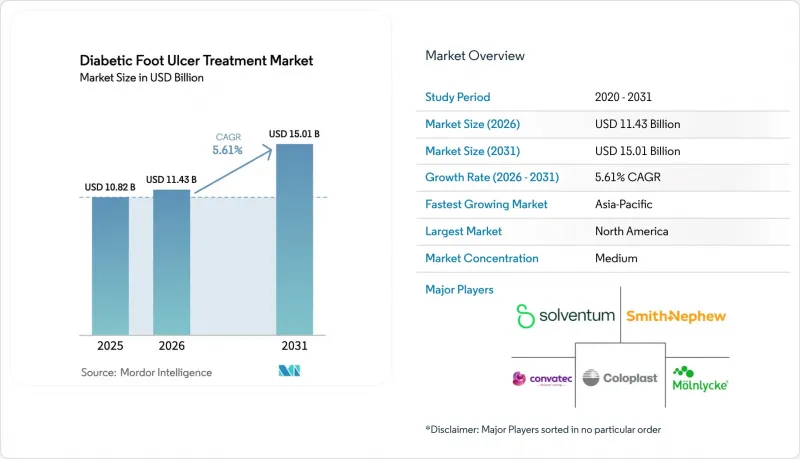
This report is Segmented by Treatment Type (Advanced Wound Dressings [Foam Dressings, Alginate Dressings, and More], Therapy Devices, and More), Ulcer Type (Neuropathic Ulcers, Ischemic Ulcers, and More), End-User (Hospitals & Specialty Clinics, Ambulatory Surgery Centers, and More), and Geography (North America, Europe, and More). The Market Forecasts are Provided in Terms of Value (USD).
Global Diabetic Foot Ulcer Treatment Market Trends and Insights
Rising Prevalence of Diabetes & Obesity
Escalating diabetes cases add the largest absolute patient pool to the diabetic foot ulcer treatment market. Roughly 15-25% of adults with diabetes develop foot ulcers in their lifetime, making ulcer management a critical component of chronic-disease care. Unmet need is highest in low- and middle-income economies where 59% of diabetics remain untreated, prompting health ministries to subsidize advanced dressings and NPWT kits. Obesity intensifies wound-healing delays via systemic inflammation, pushing providers toward bioactive products that improve oxygenation. Asia-Pacific's urban diet transitions and sedentary lifestyles fuel the fastest incremental growth in new ulcer cases through 2030, anchoring long-term demand.
Growing Adoption of Advanced Wound Dressings and NPWT
Meta-analyses confirm that NPWT shortens closure time in diabetic ulcers from a historical 29.8 days to roughly 15 days and improves infection-resolution rates from 68% to 89%. Next-generation systems such as RENASYS EDGE combine mobility-focused design with real-time pressure feedback, making them attractive for outpatient and home-care use. Smart bioactive dressings, which release antimicrobials in response to local pH or glucose changes, align with stewardship rules that aim to curb blanket antibiotic exposure. Clinical evidence shows a 61% reduction in nursing application time and 41% cost savings when next-generation NPWT kits replace older multi-component sets, reinforcing hospital ROI.
High Cost of Advanced Therapies & Patchy Coverage
Hospitalization accounts for 88% of total treatment expenditure, with multicenter data placing per-patient costs near EUR 2.06 million (USD 2.37 million) for large cohorts. Out-of-pocket payments remain substantial in markets such as India, undermining adherence to optimal protocols. Medicare's evidence-based approach further narrows access to only a fraction of available skin-substitute products, prolonging standard-care dependence and elevating amputation risk. Cost-utility analyses flag heterogenous value profiles: platelet-rich plasma shows cost-effectiveness superiority, while other cell-based options fail to meet willingness-to-pay thresholds.
Other drivers and restraints analyzed in the detailed report include:
- Government Reimbursement Programmes for Chronic Wounds
- 3-D Bioprinted Skin Substitutes Pipeline Maturation
- Shortage of Trained Wound-Care Specialists
For complete list of drivers and restraints, kindly check the Table Of Contents.
Segment Analysis
Advanced dressings held 42.68% of diabetic foot ulcer treatment market share in 2025, owing to clinical familiarity, broad-spectrum applicability, and the strong performance of foam platforms such as ALLEVYN LIFE that remain effective 1.92 times longer than gauze. Therapy devices register the fastest 11.74% CAGR as compact NPWT pumps and oxygen-diffusion patches prove compatible with home-care workflows. Regulatory scrutiny intensifies for antimicrobial coatings after the FDA proposed reclassifying certain products into higher risk classes.
Biologics and skin substitutes generate the highest revenue per case; Organogenesis advanced-wound sales rose 27% to USD 118.6 million in Q4 2024. Growth-factor gels and stem-cell suspensions post 86.41% success in Wagner II lesions, but heterogeneity across cell sources complicates broad reimbursement. Breakthrough therapy status for SkinTE, which achieved 70% closure versus 34% for standard care, signals regulatory willingness to fast-track regenerative innovations.
Complete Report Scope:
- By Treatment Type
- Advanced Wound Dressings
- Foam Dressings
- Hydrocolloid Dressings
- Alginate Dressings
- Hydrogel Dressings
- Film Dressings
- Antimicrobial/Active Dressings
- Therapy Devices
- Negative-Pressure Wound Therapy (NPWT)
- Oxygen & Hyperbaric Therapy
- Electrical / Ultrasound Stimulation
- Light & Laser Therapy
- Biologics & Skin Substitutes
- Growth-Factor Therapies
- Tissue-Engineered Skin & Grafts
- Stem-cell & Acellular Therapies
- Others (Debridement, Dressings Fixation, etc.)
- Advanced Wound Dressings
- By Ulcer Type
- Neuropathic Ulcers
- Ischemic Ulcers
- Neuro-Ischemic Ulcers
- By End-User
- Hospitals & Specialty Clinics
- Ambulatory Surgery Centres
- Home-Care Settings
- Long-Term Care Facilities
- Geography
- North America
- United States
- Canada
- Mexico
- Europe
- Germany
- United Kingdom
- France
- Italy
- Spain
- Rest of Europe
- Asia-Pacific
- China
- Japan
- India
- South Korea
- Australia
- Rest of Asia-Pacific
- Middle East and Africa
- GCC
- South Africa
- Rest of Middle East and Africa
- South America
- Brazil
- Argentina
- Rest of South America
- North America
Geography Analysis
North America retained leadership with 38.35% revenue share in 2025. Extensive Medicare and private-payer coverage, early FDA breakthrough designations, and military contracts such as the USD 75 million Department of Defense award to Smith+Nephew prove the region's high purchasing power. The United States treats roughly 8.2 million chronic-wound patients annually, translating into a USD 33 billion burden that keeps advanced therapies in demand.
Asia-Pacific is forecast to rise at a 9.41% CAGR through 2031, propelled by China's 233 million diabetics and rapid telehealth adoption. Integrated digital-health pilots in Tianjin cut post-prandial glucose by 3.4% and improved adherence, indirectly reducing ulcer incidence. Yet reimbursement disparities persist; many provincial schemes cap the number of NPWT dressings reimbursed per episode, steering clinicians toward lower-cost standard care for modest lesions.
Europe shows steady expansion under strict health-technology-assessment paradigms. NICE's late-stage review of topical antimicrobials will influence 2025 procurement and could shift formulary choices toward evidence-backed products. Middle East and Africa record rising diabetes rates but limited specialized staff, fostering opportunities for mobile wound-care hubs. South America remains an intermediate market; Brazil's public system funds basic dressings yet leans on private insurers for biologics, compelling manufacturers to craft tiered pricing.
- Solventum Corporation
- Smiths Group
- Coloplast
- Convatec
- Molnlycke Health Care
- Cardinal Health
- Integra LifeSciences
- Organogenesis
- Medline Industries
- MiMedx
- Urgo Medical
- Kerecis
- Acelity (KCI)
- Tissue Regenix
- Aroa Biosurgery
- Derma Sciences
- South West Technologies
Additional Benefits:
- The market estimate (ME) sheet in Excel format
- 3 months of analyst support
TABLE OF CONTENTS
1 Introduction
- 1.1 Study Assumptions & Market Definition
- 1.2 Scope of the Study
2 Research Methodology
3 Executive Summary
4 Market Landscape
- 4.1 Market Overview
- 4.2 Market Drivers
- 4.2.1 Rising Prevalence Of Diabetes & Obesity
- 4.2.2 Growing Adoption Of Advanced Wound Dressings and NPWT
- 4.2.3 Government Reimbursement Programmes For Chronic Wounds
- 4.2.4 3-D Bioprinted Skin Substitutes Pipeline Maturation
- 4.2.5 Stem-Cell & Exosome-Based Topical Formulations
- 4.3 Market Restraints
- 4.3.1 High Cost Of Advanced Therapies & Patchy Coverage
- 4.3.2 Shortage Of Trained Wound-Care Specialists
- 4.3.3 Antibiotic-Stewardship Limits On Antimicrobial Dressings
- 4.4 Supply-Chain Analysis
- 4.5 Porter's Five Forces Analysis
- 4.5.1 Threat of New Entrants
- 4.5.2 Bargaining Power of Buyers
- 4.5.3 Bargaining Power of Suppliers
- 4.5.4 Threat of Substitutes
- 4.5.5 Intensity of Competitive Rivalry
5 Market Size & Growth Forecasts (Value, USD)
- 5.1 By Treatment Type
- 5.1.1 Advanced Wound Dressings
- 5.1.1.1 Foam Dressings
- 5.1.1.2 Hydrocolloid Dressings
- 5.1.1.3 Alginate Dressings
- 5.1.1.4 Hydrogel Dressings
- 5.1.1.5 Film Dressings
- 5.1.1.6 Antimicrobial/Active Dressings
- 5.1.2 Therapy Devices
- 5.1.2.1 Negative-Pressure Wound Therapy (NPWT)
- 5.1.2.2 Oxygen & Hyperbaric Therapy
- 5.1.2.3 Electrical / Ultrasound Stimulation
- 5.1.2.4 Light & Laser Therapy
- 5.1.3 Biologics & Skin Substitutes
- 5.1.3.1 Growth-Factor Therapies
- 5.1.3.2 Tissue-Engineered Skin & Grafts
- 5.1.3.3 Stem-cell & Acellular Therapies
- 5.1.4 Others (Debridement, Dressings Fixation, etc.)
- 5.1.1 Advanced Wound Dressings
- 5.2 By Ulcer Type
- 5.2.1 Neuropathic Ulcers
- 5.2.2 Ischemic Ulcers
- 5.2.3 Neuro-Ischemic Ulcers
- 5.3 By End-User
- 5.3.1 Hospitals & Specialty Clinics
- 5.3.2 Ambulatory Surgery Centres
- 5.3.3 Home-Care Settings
- 5.3.4 Long-Term Care Facilities
- 5.4 Geography
- 5.4.1 North America
- 5.4.1.1 United States
- 5.4.1.2 Canada
- 5.4.1.3 Mexico
- 5.4.2 Europe
- 5.4.2.1 Germany
- 5.4.2.2 United Kingdom
- 5.4.2.3 France
- 5.4.2.4 Italy
- 5.4.2.5 Spain
- 5.4.2.6 Rest of Europe
- 5.4.3 Asia-Pacific
- 5.4.3.1 China
- 5.4.3.2 Japan
- 5.4.3.3 India
- 5.4.3.4 South Korea
- 5.4.3.5 Australia
- 5.4.3.6 Rest of Asia-Pacific
- 5.4.4 Middle East and Africa
- 5.4.4.1 GCC
- 5.4.4.2 South Africa
- 5.4.4.3 Rest of Middle East and Africa
- 5.4.5 South America
- 5.4.5.1 Brazil
- 5.4.5.2 Argentina
- 5.4.5.3 Rest of South America
- 5.4.1 North America
6 Competitive Landscape
- 6.1 Market Concentration
- 6.2 Market Share Analysis
- 6.3 Company Profiles (includes Global level Overview, Market level overview, Core Segments, Financials as available, Strategic Information, Market Rank/Share for key companies, Products & Services, and Recent Developments)
- 6.3.1 Solventum Corporation
- 6.3.2 Smith+Nephew
- 6.3.3 Coloplast
- 6.3.4 Convatec
- 6.3.5 Molnlycke Health Care
- 6.3.6 Cardinal Health
- 6.3.7 Integra LifeSciences
- 6.3.8 Organogenesis
- 6.3.9 Medline Industries
- 6.3.10 MiMedx
- 6.3.11 Urgo Medical
- 6.3.12 Kerecis
- 6.3.13 Acelity (KCI)
- 6.3.14 Tissue Regenix
- 6.3.15 Aroa Biosurgery
- 6.3.16 Derma Sciences
- 6.3.17 South West Technologies
7 Market Opportunities & Future Outlook
- 7.1 White-Space & Unmet-Need Assessment

