PUBLISHER: Mordor Intelligence | PRODUCT CODE: 2117333

PUBLISHER: Mordor Intelligence | PRODUCT CODE: 2117333
Supermarkets - Market Share Analysis, Industry Trends & Statistics, Growth Forecasts (2026 - 2031)
According to Mordor Intelligence, the supermarkets market size is projected to expand from USD 1 trillion in 2025 and USD 1.04 trillion in 2026 to USD 1.22 trillion by 2031, registering a CAGR of 3.16% between 2026 to 2031.
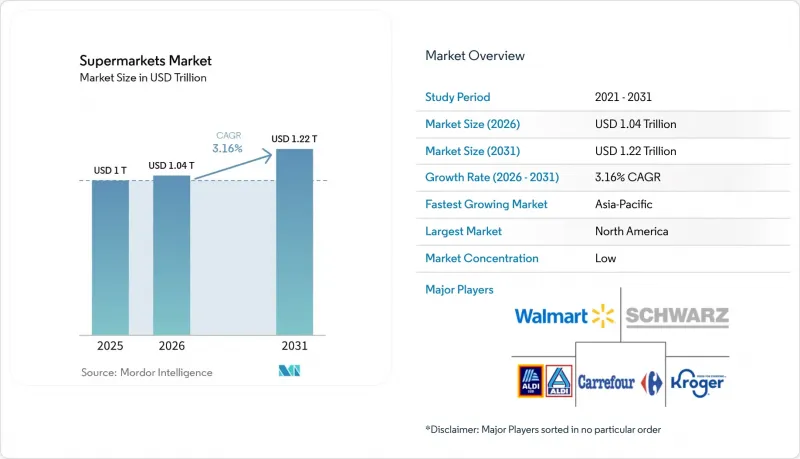
This report is Segmented by Product Category (Fresh Food, Packaged Food, Beverages, Household Products, Personal Care, Ready-To-Eat, and Others), Sales Channel (Offline and Online), Ownership (Retail Chains and Independent), and Geography (North America, Europe, Asia-Pacific, South America, and Middle East & Africa). The Market Forecasts are Provided in Terms of Value (USD).
Global Supermarkets Market Trends and Insights
Rapid Urbanization Fueling Demand for One-Stop Grocery Shopping in Asia-Pacific Megacities
Urban population growth and rising household incomes in Asia-Pacific continue to reshape grocery habits toward modern formats and one-stop stock-up trips that favor the Supermarket market. Operators are clustering stores in dense corridors and layering membership and fresh counters to draw larger baskets and recurring visits, which strengthens the Supermarket market in urban nodes. Sam's Club China has scaled its warehouse grocery base and expanded assortments that fit apartment-living constraints while appealing to family needs. AEON plans to triple its Vietnamese footprint by 2030 with a mix of large-format stores and supermarkets, supported by ongoing investment and format localization. Vietnam's Ministry of Industry and Trade has eased retail licensing processes and supported cold-chain upgrades that improve food safety and reduce losses, which further supports modern trade expansion.
Rise of Private-Label Penetration Increasing Basket Margin in European Discount Supermarkets
Private label has gained scale and depth in Europe, lifting the Supermarket market through better price-value and broader coverage of consumer needs across tiers. PLMA reported private-label sales reached USD 369.23 billion (EUR 354.5 billion) in the 52 weeks to July 2024, with a market share of nearly 39% across tracked markets, indicating continued consumer acceptance in core categories. Carrefour lifted private-label mix to 37% of food sales in 2025 and reiterated targets to grow the share further to reinforce price competitiveness and shopper loyalty. Tesco continued to scale its Finest premium range and broaden everyday value tiers, consistent with a portfolio strategy that anchors the Supermarket market across income bands. AEON's TOPVALU reported solid growth in 2025, underscoring how large retailers use private label to strengthen margin structure and improve bargaining leverage with suppliers within the Supermarket market. EU food-safety frameworks and national certifications support trust in store brands and help narrow any perceived gap with multinational labels, improving conversion at the shelf.
High Operating and Infrastructure Costs
Operating expenses in food retail remain elevated, pressuring profits and limiting the pace of reinvestment even as operators modernize supply chains in the Supermarket market. Tesco reported lower free cash flow in FY2024/25 as working capital normalized after prior input inflation, and investment priorities focused on pricing and renewal programs. Kroger recognized a USD 2.6 billion impairment related to automated fulfillment, highlighting execution risk in large-scale automation projects in grocery. Walmart reiterated that mix shifts into lower-margin categories can offset parts of gross profit gains in some quarters within the Supermarket market. Costco announced hourly pay increases for frontline roles in March 2026, which lifts wage costs while improving retention in tight labor markets. These dynamics push retailers to sharpen productivity and reallocate capital toward programs that raise availability, reduce shrink, and differentiate value.
Other drivers and restraints analyzed in the detailed report include:
- Digital Loyalty Apps Driving Higher Visit Frequency in North American Chains
- AI-Powered Shelf Optimization Reducing Stock-outs in High-Throughput Stores
- Supply-Chain Volatility for Fresh Produce Due to Climate Disruptions
For complete list of drivers and restraints, kindly check the Table Of Contents.
Segment Analysis
Packaged and processed food held 38.37% of the Supermarket market share in 2025, reflecting the broad availability, long shelf-life, and efficient distribution that center-store categories provide. Ready-to-eat and prepared foods are the fastest-growing category at a 7.74% CAGR through 2031 as time-pressed households shift to fresh convenience at the perimeter. Supermarket market operators are investing in in-store kitchens and daily-prepared assortments to increase meal occasions and lunch trips, while maintaining staples that anchor weekly baskets. Mercadona's "Listo para Comer" program demonstrates how a prepared-foods zone pulls incremental demand within a full-basket destination. AEON Vietnam reports prepared and bakery ranges now represent a sizable portion of food sales in newer stores, which supports growth in urban markets.
The global ready-to-eat category has healthy momentum, and supermarkets capture a significant share of that channel flow, which reinforces category breadth that supports the Supermarket market. Cold-chain uplift and automated facilities improve service levels and freshness, helping retailers expand perimeter categories at scale. Health and personal care ranges continue to benefit from co-location strategies and pharmacy adjacencies that drive cross-shopping, which broadens trip missions in the Supermarket market. Household and cleaning products remain steady with private-label penetration, particularly as vertically integrated programs improve cost control and speed to shelf. Food labeling rules such as the United States Nutrition Facts panel update and EU front-of-pack guidance continue to shape product development and shelf presentation across formats.
Complete Report Scope:
- By Product Category
- Fresh Food
- Packaged / Processed Food
- Beverages
- Household & Cleaning Products
- Health & Personal Care Products
- Ready-to-Eat / Prepared Foods
- Others
- By Sales Channel
- Offline / Brick-and-Mortar
- Online / E-commerce
- By Ownership Type
- Retail Chains
- Independent / Stand-alone Stores
- By Geography
- North America
- Canada
- United States
- Mexico
- Europe
- United Kingdom
- Germany
- France
- Spain
- Italy
- BENELUX (Belgium, Netherlands, Luxembourg)
- NORDICS (Denmark, Finland, Iceland, Norway, Sweden)
- Rest of Europe
- Asia-Pacific
- India
- China
- Japan
- Australia
- South Korea
- South-East Asia (Singapore, Malaysia, Thailand, Indonesia, Vietnam, Philippines)
- Rest of Asia Pacific
- South America
- Brazil
- Peru
- Chile
- Argentina
- Rest of South America
- Middle East and Africa
- United Arab Emirates
- Saudi Arabia
- South Africa
- Nigeria
- Rest of Middle East and Africa
- North America
Geography Analysis
North America captured 40.66% of the Supermarket market share in 2025, supported by the scale of national operators and active expansion programs. Walmart's results highlight consistent comparable growth and stronger digital adoption that feeds a larger ecosystem around grocery. Loblaw accelerated store openings, pharmacy clinics, and a major new automated distribution center, which supports availability and convenience in Canada. Kroger continues to expand e-commerce and remodels, and expects digital profitability as it optimizes fulfillment and pickup operations. Costco plans dozens of new warehouses, including large projects in North America and Mexico, that expand fresh and essentials reach within the Supermarket market. Publix grew sales and continued its remodel cadence in the Southeast, which supports larger baskets and stronger fresh presentation. Food-safety oversight, organic standards, and federal nutrition programs shape assortments and promotions, while state-level waivers guide specific product eligibility under benefits.
Europe's leaders sustained pricing discipline, private-label growth, and selective consolidation that reinforce the Supermarket market. Schwarz Gruppe reported revenue growth supported by Lidl and Kaufland, showing how a dual-banner approach enables reach across price points. Carrefour completed the Cora and Match acquisition and expanded its purchasing alliance, targeting efficiencies and a higher private-label share across food. Spain's Mercadona increased sales and profitability and continued to expand in Portugal, supported by prepared foods and store modernization. European environmental goals and labeling pilots are shaping procurement and shelf signals as retailers move toward lower-impact products and transparent nutrition indicators. Frameworks that standardize sustainability disclosures are broadening, aiding suppliers and brands in reporting progress to stakeholders.
Asia-Pacific is the fastest-growing region at a 7.87% CAGR through 2031, anchored by large markets that continue to formalize food retail. Hema and Sam's Club China expanded quickly in 2025 and raised the bar on membership value and convenience formats in major cities. Reliance Retail added thousands of stores in India and expanded gross revenue, reflecting momentum in organized grocery. AEON increased private-brand penetration and detailed plans to scale convenience banners and supermarkets in Japan and Southeast Asia. Australia's Woolworths and Coles invested in large automated facilities that improve service levels and order accuracy for fresh categories across the Supermarket market. Food-safety compliance across the region remains strict, with agencies in China, India, and Japan governing labeling and hygiene protocols for retail. These regulatory and infrastructure shifts support a rapid shift toward organized retail and omnichannel grocery in fast-growing cities.
- Walmart Inc.
- Schwarz Gruppe (Lidl & Kaufland)
- Carrefour SA
- Aldi Sud & Nord
- The Kroger Co.
- Tesco PLC
- Costco Wholesale Corp.
- Ahold Delhaize
- Edeka-Zentrale
- Rewe Group
- Auchan Holding
- Publix Super Markets Inc.
- Mercadona SA
- Migros-Genossenschafts-Bund
- Loblaw Companies Ltd.
- Woolworths Group (Australia)
- Coles Group
- Reliance Retail (Smart Bazaar)
- Avenue Supermarts (DMart)
- Seven & i Holdings (Ito Yokado)
- AEON Co. Ltd.
- Casino Guichard-Perrachon
- CP ALL Public Co.
- Sainsbury's PLC
- Waitrose Ltd.
Additional Benefits:
- The market estimate (ME) sheet in Excel format
- 3 months of analyst support
TABLE OF CONTENTS
1 Introduction
- 1.1 Study Assumptions & Market Definition
- 1.2 Scope of the Study
2 Research Methodology
3 Executive Summary
4 Market Landscape
- 4.1 Market Overview
- 4.2 Market Drivers
- 4.2.1 Rapid Urbanization Fueling Demand for One-Stop Grocery Shopping in Asia-Pacific Megacities
- 4.2.2 Rise of Private-Label Penetration Increasing Basket Margin in European Discount Supermarkets
- 4.2.3 Digital Loyalty Apps Driving Higher Visit Frequency in North American Chains
- 4.2.4 AI-Powered Shelf Optimization Reducing Stock-outs in High-Throughput Stores
- 4.2.5 Expansion of Fresh Convenience Zones Capturing Time-Starved Consumers
- 4.2.6 Government Food-Subsidy Vouchers Channeling Spend Through Supermarkets (e.g., Brazil)
- 4.3 Market Restraints
- 4.3.1 High Operating and Infrastructure Costs
- 4.3.2 Intensifying Competition from Quick-Commerce Dark Stores in Urban Hubs
- 4.3.3 Supply-Chain Volatility for Fresh Produce Due to Climate Disruptions
- 4.3.4 Thin Profit Margins
- 4.4 Value / Supply-Chain Analysis
- 4.5 Regulatory or Technological Outlook
- 4.6 Porter's Five Forces
- 4.6.1 Threat of New Entrants
- 4.6.2 Bargaining Power of Suppliers
- 4.6.3 Bargaining Power of Buyers
- 4.6.4 Threat of Substitutes
- 4.6.5 Competitive Rivalry
5 Market Size & Growth Forecasts
- 5.1 By Product Category
- 5.1.1 Fresh Food
- 5.1.2 Packaged / Processed Food
- 5.1.3 Beverages
- 5.1.4 Household & Cleaning Products
- 5.1.5 Health & Personal Care Products
- 5.1.6 Ready-to-Eat / Prepared Foods
- 5.1.7 Others
- 5.2 By Sales Channel
- 5.2.1 Offline / Brick-and-Mortar
- 5.2.2 Online / E-commerce
- 5.3 By Ownership Type
- 5.3.1 Retail Chains
- 5.3.2 Independent / Stand-alone Stores
- 5.4 By Geography
- 5.4.1 North America
- 5.4.1.1 Canada
- 5.4.1.2 United States
- 5.4.1.3 Mexico
- 5.4.2 Europe
- 5.4.2.1 United Kingdom
- 5.4.2.2 Germany
- 5.4.2.3 France
- 5.4.2.4 Spain
- 5.4.2.5 Italy
- 5.4.2.6 BENELUX (Belgium, Netherlands, Luxembourg)
- 5.4.2.7 NORDICS (Denmark, Finland, Iceland, Norway, Sweden)
- 5.4.2.8 Rest of Europe
- 5.4.3 Asia-Pacific
- 5.4.3.1 India
- 5.4.3.2 China
- 5.4.3.3 Japan
- 5.4.3.4 Australia
- 5.4.3.5 South Korea
- 5.4.3.6 South-East Asia (Singapore, Malaysia, Thailand, Indonesia, Vietnam, Philippines)
- 5.4.3.7 Rest of Asia Pacific
- 5.4.4 South America
- 5.4.4.1 Brazil
- 5.4.4.2 Peru
- 5.4.4.3 Chile
- 5.4.4.4 Argentina
- 5.4.4.5 Rest of South America
- 5.4.5 Middle East and Africa
- 5.4.5.1 United Arab Emirates
- 5.4.5.2 Saudi Arabia
- 5.4.5.3 South Africa
- 5.4.5.4 Nigeria
- 5.4.5.5 Rest of Middle East and Africa
- 5.4.1 North America
6 Competitive Landscape
- 6.1 Market Concentration
- 6.2 Strategic Moves
- 6.3 Market Share Analysis
- 6.4 Company Profiles (includes Global-level Overview, Market-level Overview, Core Segments, Financials, Strategic Information, Market Rank/Share, Products & Services, Recent Developments)
- 6.4.1 Walmart Inc.
- 6.4.2 Schwarz Gruppe (Lidl & Kaufland)
- 6.4.3 Carrefour SA
- 6.4.4 Aldi Sud & Nord
- 6.4.5 The Kroger Co.
- 6.4.6 Tesco PLC
- 6.4.7 Costco Wholesale Corp.
- 6.4.8 Ahold Delhaize
- 6.4.9 Edeka-Zentrale
- 6.4.10 Rewe Group
- 6.4.11 Auchan Holding
- 6.4.12 Publix Super Markets Inc.
- 6.4.13 Mercadona SA
- 6.4.14 Migros-Genossenschafts-Bund
- 6.4.15 Loblaw Companies Ltd.
- 6.4.16 Woolworths Group (Australia)
- 6.4.17 Coles Group
- 6.4.18 Reliance Retail (Smart Bazaar)
- 6.4.19 Avenue Supermarts (DMart)
- 6.4.20 Seven & i Holdings (Ito Yokado)
- 6.4.21 AEON Co. Ltd.
- 6.4.22 Casino Guichard-Perrachon
- 6.4.23 CP ALL Public Co.
- 6.4.24 Sainsbury's PLC
- 6.4.25 Waitrose Ltd.
- 6.5 Market Opportunities & Future Outlook
- 6.5.1 White-Space & Unmet-Need Assessment

