PUBLISHER: Mordor Intelligence | PRODUCT CODE: 2117335

PUBLISHER: Mordor Intelligence | PRODUCT CODE: 2117335
North America Financial Advisory Services - Market Share Analysis, Industry Trends & Statistics, Growth Forecasts (2026 - 2031)
According to Mordor Intelligence, the North America financial advisory market size is expected to grow from USD 58.65 billion in 2025 to USD 61.93 billion in 2026 and is forecast to reach USD 81.33 billion by 2031 at 5.59% CAGR over 2026-2031.
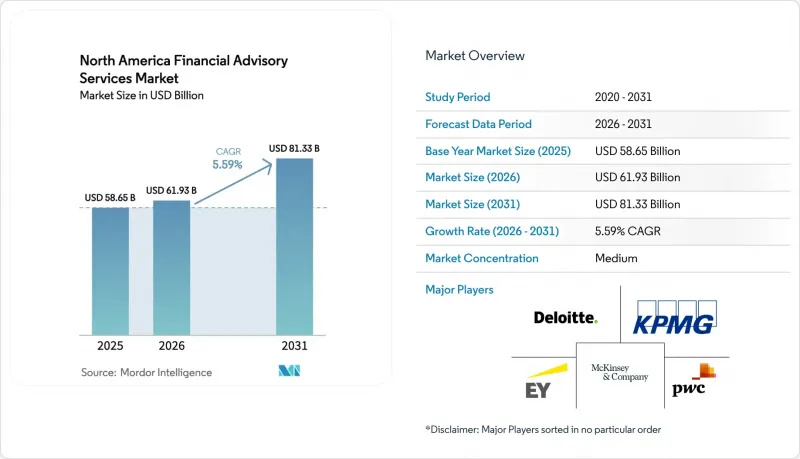
This report is Segmented by Service Type (Corporate Finance, and More), by Organization Size (Large Enterprises, Small and Medium-Sized Enterprises), by Industry Vertical (BFSI, and More), by Service Channel (Human Advisory, and More), by Delivery Mode (On-Site Consulting, and More), and by Country (USA, Canada, Mexico). The Market Forecasts are Provided in Terms of Value (USD).
North America Financial Advisory Services Market Trends and Insights
Rising Adoption of Robo- & AI-Enabled Advisory Tools
Robo services now manage multi-hundred-billion portfolios, with Vanguard at USD 206.6 billion and Schwab at USD 65.8 billion. Agentic AI engines already automate personalized advice for numerous households, promising significant value for the banking sector each year. Although 96% of advisers believe generative AI will transform service, only 41% currently scale deployments, giving early adopters a cost advantage. Platforms such as Range have raised USD 28 million to deliver AI-guided wealth plans for affluent clients, signaling investor confidence in digital-first models. The strategic imperative across the North America financial advisory market is to blend human empathy with machine efficiency.
Accelerating HNWI Population & Investable Assets
North America added a record number of high-net-worth individuals in 2025, outpacing every other region. More than half now demand ESG filters, and an even larger share plan to increase ESG allocations within two years. Ultra-wealthy households prioritize private equity, sustainable funds, and concierge-style services that carry premium fees. Wealth concentration lifts revenue per client, but younger heirs prefer tech-centric, purpose-driven advice, pressuring legacy engagement formats. Advisors successful in the North America financial advisory market, therefore, integrate family-office, tax, and digital delivery capabilities.
Fee Compression from Passive & Digital Competitors
Schwab's June 2025 decision to slash ETF fees by up to 50% underscores accelerating price competition. Passive investing's share of U.S. fund assets continues to climb, forcing advisers to defend pricing through holistic planning and alternative-asset access. Hybrid fee structures combining flat retainers and outcome-based incentives gain traction across the North America financial advisory market.
Other drivers and restraints analyzed in the detailed report include:
- Surge in PE-Backed Mid-Market M&A Deal Volume
- Regulatory Shift Toward Fiduciary Duty (SEC Reg-BI)
- Aging Advisor Workforce & Talent Pipeline Gaps
For complete list of drivers and restraints, kindly check the Table Of Contents.
Segment Analysis
Investment services held the largest share at 36.02% in the North America financial advisory market in 2025 and are projected to expand at 6.95% CAGR through 2031, anchoring the North America financial advisory market. Multi-asset mandates now include private equity feeders, ESG overlays, and direct-indexing portfolios attractive to digital-native investors. The North America financial advisory market size for investment services is projected to swell as rising alternative allocations demand tailored structuring.
Corporate finance advisory remains resilient on mid-market M&A and succession deals, while accounting and tax advice scales with cross-border complexity. Other services- estate planning, philanthropy, and concierge support- grow fastest as wealthy families seek comprehensive stewardship. Advisers coupling investment depth and lifestyle capabilities therefore secure a higher wallet share in the North America financial advisory market.
Large enterprises controlled 65.62% of the North America financial advisory market in 2025, wielding deep compliance and technology budgets that defend mass-affluent franchises. Yet SMEs are expected to outpace at 6.25% CAGR, aided by cloud tools and AI-based productivity that minimize scale disadvantages. The North America financial advisory market size tied to SMEs is set to widen as boutique firms carve niches in ESG consulting and crypto tax planning.
Personalized engagement, transparent pricing, and quick innovation cycles bolster SME appeal among younger investors. However, mid-sized firms face a squeeze: they must either specialize or merge upward to keep pace with widening compliance and cybersecurity demands in the North America financial advisory market.
Complete Report Scope:
- By Service Type
- Corporate Finance
- Accounting And Tax Advisory
- Investment
- Other Services
- By Organization Size
- Large Enterprises
- Small & Medium-sized Enterprises (SMEs)
- By Industry Vertical
- Banking, Financial Services, Insurance (BFSI)
- IT & Telecommunication
- Manufacturing
- Retail And E-Commerce
- Public Sector
- Healthcare And Pharmaceuticals
- Other Industry Verticals
- By Service Channel
- Human Advisory
- Hybrid Advisory
- Robo-Advisory
- By Delivery Mode
- On-site Consulting
- Remote / Virtual Consulting
- By Country
- USA
- Canada
- Mexico
List of Companies Covered in this Report:
- Deloitte
- PwC
- Ernst & Young
- KPMG
- McKinsey & Company
- Bain & Company
- Boston Consulting Group
- BlackRock
- Vanguard
- Fidelity Investments
- State Street Global Advisors
- J.P. Morgan Asset Management
- Lazard
- Houlihan Lokey
- Evercore
- Grant Thornton
- BDO
- RBC Capital Markets
- Kroll
- Piper Sandler
Additional Benefits:
- The market estimate (ME) sheet in Excel format
- 3 months of analyst support
TABLE OF CONTENTS
1 Introduction
- 1.1 Study Assumptions & Market Definition
- 1.2 Scope of the Study
2 Research Methodology
3 Executive Summary
4 Market Landscape
- 4.1 Market Overview
- 4.2 Market Drivers
- 4.2.1 Rising adoption of robo- & AI-enabled advisory tools
- 4.2.2 Accelerating HNWI population & investable assets
- 4.2.3 Surge in PE-backed mid-market M&A deal volume
- 4.2.4 Regulatory shift toward fiduciary duty (SEC Reg-BI)
- 4.2.5 ESG-linked mandates reshaping advisory propositions
- 4.2.6 Generational wealth transfer to digital-first investors
- 4.3 Market Restraints
- 4.3.1 Fee compression from passive & digital competitors
- 4.3.2 Escalating compliance & audit-trail costs
- 4.3.3 Aging advisor workforce & talent pipeline gaps
- 4.3.4 Rising cyber-risk undermining client trust
- 4.4 Value / Supply-Chain Analysis
- 4.5 Regulatory Landscape
- 4.6 Technological Outlook
- 4.7 Porter's Five Forces
- 4.7.1 Bargaining Power of Buyers
- 4.7.2 Bargaining Power of Suppliers
- 4.7.3 Threat of New Entrants
- 4.7.4 Threat of Substitutes
- 4.7.5 Intensity of Competitive Rivalry
5 Market Size & Growth Forecasts (Value)
- 5.1 By Service Type
- 5.1.1 Corporate Finance
- 5.1.2 Accounting And Tax Advisory
- 5.1.3 Investment
- 5.1.4 Other Services
- 5.2 By Organization Size
- 5.2.1 Large Enterprises
- 5.2.2 Small & Medium-sized Enterprises (SMEs)
- 5.3 By Industry Vertical
- 5.3.1 Banking, Financial Services, Insurance (BFSI)
- 5.3.2 IT & Telecommunication
- 5.3.3 Manufacturing
- 5.3.4 Retail And E-Commerce
- 5.3.5 Public Sector
- 5.3.6 Healthcare And Pharmaceuticals
- 5.3.7 Other Industry Verticals
- 5.4 By Service Channel
- 5.4.1 Human Advisory
- 5.4.2 Hybrid Advisory
- 5.4.3 Robo-Advisory
- 5.5 By Delivery Mode
- 5.5.1 On-site Consulting
- 5.5.2 Remote / Virtual Consulting
- 5.6 By Country
- 5.6.1 USA
- 5.6.2 Canada
- 5.6.3 Mexico
6 Competitive Landscape
- 6.1 Market Concentration
- 6.2 Strategic Moves
- 6.3 Market Share Analysis
- 6.4 Company Profiles (includes Global Level Overview, Market Level Overview, Core Segments, Financials as available, Strategic Information, Market Rank/Share for Key Companies, Products & Services, and Recent Developments)
- 6.4.1 Deloitte
- 6.4.2 PwC
- 6.4.3 Ernst & Young
- 6.4.4 KPMG
- 6.4.5 McKinsey & Company
- 6.4.6 Bain & Company
- 6.4.7 Boston Consulting Group
- 6.4.8 BlackRock
- 6.4.9 Vanguard
- 6.4.10 Fidelity Investments
- 6.4.11 State Street Global Advisors
- 6.4.12 J.P. Morgan Asset Management
- 6.4.13 Lazard
- 6.4.14 Houlihan Lokey
- 6.4.15 Evercore
- 6.4.16 Grant Thornton
- 6.4.17 BDO
- 6.4.18 RBC Capital Markets
- 6.4.19 Kroll
- 6.4.20 Piper Sandler
7 Market Opportunities & Future Outlook
- 7.1 White-space & Unmet-Need Assessment

