PUBLISHER: Mordor Intelligence | PRODUCT CODE: 2117340

PUBLISHER: Mordor Intelligence | PRODUCT CODE: 2117340
United Kingdom Barbeque Grill - Market Share Analysis, Industry Trends & Statistics, Growth Forecasts (2026 - 2031)
According to Mordor Intelligence, the United Kingdom barbeque grill market size in 2026 is estimated at USD 360.28 million, growing from 2025 value of USD 348.7 million with 2031 projections showing USD 423.58 million, growing at 3.32% CAGR over 2026-2031.
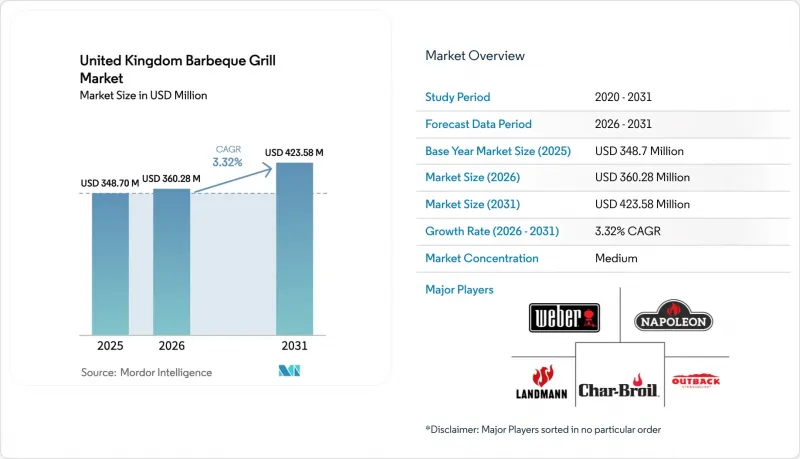
This report is Segmented by Fuel Type (Gas, Charcoal, Electric, Pellet, Hybrid/Alternative Fuel, Infrared), Product Design (Built-In, Freestanding, Portable/Table-top, Disposable/Single-use), Technology (Conventional, Smart/Connected), End-User (Residential, Commercial), Distribution Channel (B2B/Direct, B2C/Retail), and Geography. The Market Forecasts are Provided in Terms of Value (USD).
United Kingdom Barbeque Grill Market Trends and Insights
Growing Outdoor-Dining & Staycation Trend
The United Kingdom barbeque grill market continues to reap benefits from a shift toward domestic leisure as 26% of consumers remained loyal to barbecuing even during record rainfall and 40% simply moved grills indoors, proving weather resilience. London exemplifies the cultural turn, where 18% of residents barbecue monthly, normalizing year-round usage that underpins equipment replacement cycles. Staycation budgets redirect holiday outlays into patio refurbishments, stimulating sales of premium freestanding islands and complementary accessories that anchor the United Kingdom barbeque grill market. Garden centres pivoted from seasonal racks to permanent grill showrooms, leveraging footfall from landscape shoppers to upselling higher-margin smart units. The net effect is a durable structural uplift expected to sustain segmental expansion beyond macro-economic turbulence.
Rising Disposable Income & Home-Improvement Spend
Garden centre turnover reached GBP 5 billion (USD 6.5 billion) in 2024 as households allocated discretionary cash to property enhancements, reaffirming grills as durable assets rather than impulse purchases. Gender analysis shows women scrutinize costs more closely, prompting brands to blend advanced features with affordability to widen penetration. Disposable-income disparities foster tiered demand: England adopts smart infra-red burners, while Scotland and Northern Ireland favor cost-efficient gas carts, yet both cohorts feed the broader United Kingdom barbeque grill market. Manufacturers tailoring SKUs to these income gradients maximize regional conversion.
Unpredictable UK Weather Shortens Grilling Season
Britain logged its wettest summer on record, eroding spontaneous weekend grilling yet users adapted: 40% relocated cookouts under patio canopies or indoors, cushioning the blow. Manufacturers responded with water-resistant lids, fast-heat burners, and fold-up frames that deploy quickly during dry intervals. Retailers synchronized promotions with meteorological apps, accelerating sales spikes once sunshine was forecasted. Regional variance is stark; Scotland endures longer rain spells and hence favors weather-proof portable units that store neatly in sheds. Resultant CAGR drag is moderate and partially balanced by accessory upsells such as gazebo kits across the United Kingdom barbeque grill market.
Other drivers and restraints analyzed in the detailed report include:
- Product Innovation Toward Hybrid & Multi-Fuel Grills
- Expansion of E-Commerce Retail for BBQ Equipment
- Strict Smoke-Emission & Food-Safety Rules
For complete list of drivers and restraints, kindly check the Table Of Contents.
Segment Analysis
Gas retained 42.10% of 2025 revenue as dependable ignition, controllable flames, and affordable LPG cylinders suit Britain's changeable climate. Electric variants record the fastest 4.18% CAGR because landlords and Clean Air Zones restrict open-flame devices, positioning plug-in formats as the compliance standard for flats. Charcoal holds nostalgic appeal yet cedes share to pellet models that marry hardwood aroma with automated augers, courting connoisseurs seeking hands-off smoking. Hybrid carts incorporating dual burners and storage for briquettes liberate users from single-fuel dependency-an edge in regions where fuel choice fluctuates with local regulation. Smart gas launches like Weber's SUMMIT fortify gas leadership by layering Wi-Fi precision onto proven burners, ensuring the United Kingdom barbeque grill market remains multi-fuel rather than single fuel dominated.
Electric adoption does face electricity tariff questions, but total-cost parity improves once gas cylinder delivery fees and charcoal waste disposal are counted. Pellet supply chains mature as domestic sawmills divert residues into food-grade pellets, reducing import reliance. Future product roadmaps show infrared electric coils approaching charcoal sear temperatures, likely narrowing performance perception gaps. Consequently, fuel diversification is both a regulatory hedge and consumer empowerment lever that underpins category vibrancy.
Freestanding islands still wield 47.65% share, admired for side tables, warming racks, and cabinetry intuitive for suburban gardens. Yet portable grills escalate at 3.21% CAGR amid rising apartment stock and campsite tourism. Foldable legs, 12 kg carry weights, and integrated butane canisters target balcony dwellers in Manchester high-rises and glamping enthusiasts in Welsh hills. Built-in modules populate outdoor kitchens, reflecting property-value confidence among southern English homeowners. Disposable foil pans ebb under green scrutiny, nudging casual users toward reusable tabletop electrics priced below GBP 100 (USD 130).
Brands now market "mobile freestanding" hybrids, full-size cooking decks atop detachable wheelbases, letting owners winter-store units in sheds. Table-height portables featuring clamp-on legs upgrade picnic ergonomics, opening the United Kingdom barbeque grill market to audiences with physical-comfort needs. Materials innovation sees powder-coated steel swapped for aluminium composites, shaving weight and rust-risk simultaneously. In-store planograms shift to showcase portability solutions adjacent to trunk-friendly coolers, feeding impulse purchases as spring bank holiday road-trips approach.
Complete Report Scope:
- By Fuel Type
- Gas Grills
- Charcoal Grills
- Electric Grills
- Pellet Grills
- Hybrid/Alternative Fuel
- Infrared
- By Product Design
- Built-In
- Freestanding
- Portable / Table-top
- Disposable / Single-use
- By Technology
- Conventional
- Smart/Connected
- By End-User
- Residential
- Commercial
- By Distribution Channel
- B2B/Direct from the Manufacturers
- B2C/Retail
- Specialty Stores
- Home Centers & DIY Stores
- Mass Merchandisers
- Online
- Other Distribution Channels
- By Geography
- England
- Scotland
- Wales
- Northern Ireland
List of Companies Covered in this Report:
- Big Green Egg
- Broil King (Onward Manufacturing)
- Cadac BBQ
- Campingaz
- Char-Broil (W.C. Bradley)
- Cuisinart Grills
- Everdure by Heston Blumenthal
- George Foreman Grills (Spectrum Brands)
- Gozney
- Kamado Joe
- Landmann
- LotusGrill
- Masterbuilt Manufacturing
- Monolith Kamadi
- Napoleon Grills
- Outback International UK
- Outdoorchef
- Pit Boss
- Rosle
- Tepro
- Traeger Grills
- Weber-Stephen Products LLC
Additional Benefits:
- The market estimate (ME) sheet in Excel format
- 3 months of analyst support
TABLE OF CONTENTS
1 Introduction
- 1.1 Study Assumptions & Market Definition
- 1.2 Scope of the Study
2 Research Methodology
3 Executive Summary
4 Market Landscape
- 4.1 Market Overview
- 4.2 Market Drivers
- 4.2.1 Growing Outdoor-Dining & Staycation Trend
- 4.2.2 Rising Disposable Income & Home-Improvement Spend
- 4.2.3 Product Innovation Toward Hybrid & Multi-Fuel Grills
- 4.2.4 Expansion Of E-Commerce Retail For Bbq Equipment
- 4.2.5 Shift To Electric & Pellet Grills Driven By Clean-Air Zones
- 4.2.6 Smart-Connected (Iot) Grill Adoption
- 4.3 Market Restraints
- 4.3.1 Unpredictable Uk Weather Shortens Grilling Season
- 4.3.2 Strict Smoke-Emission & Food-Safety Rules
- 4.3.3 Higher Steel/Aluminium Costs Post-Brexit
- 4.3.4 Meal-Kit/Delivery Services Limiting At-Home Grilling
- 4.4 Industry Value Chain Analysis
- 4.5 Porter's Five Forces Analysis
- 4.5.1 Threat of New Entrants
- 4.5.2 Bargaining Power of Suppliers
- 4.5.3 Bargaining Power of Buyers
- 4.5.4 Threat of Substitutes
- 4.5.5 Competitive Rivalry
- 4.6 Insights into the Latest Trends and Innovations in the Market
- 4.7 Insights on Recent Developments (New Product Launches, Strategic Initiatives, Investments, Partnerships, JVs, Expansion, M&As, etc.) in the Market
- 4.8 Insights on Regulatory Framework and Energy-Efficiency Standards for BBQ Grill in the UK
5 Market Size & Growth Forecasts (Value in USD)
- 5.1 By Fuel Type
- 5.1.1 Gas Grills
- 5.1.2 Charcoal Grills
- 5.1.3 Electric Grills
- 5.1.4 Pellet Grills
- 5.1.5 Hybrid/Alternative Fuel
- 5.1.6 Infrared
- 5.2 By Product Design
- 5.2.1 Built-In
- 5.2.2 Freestanding
- 5.2.3 Portable / Table-top
- 5.2.4 Disposable / Single-use
- 5.3 By Technology
- 5.3.1 Conventional
- 5.3.2 Smart/Connected
- 5.4 By End-User
- 5.4.1 Residential
- 5.4.2 Commercial
- 5.5 By Distribution Channel
- 5.5.1 B2B/Direct from the Manufacturers
- 5.5.2 B2C/Retail
- 5.5.2.1 Specialty Stores
- 5.5.2.2 Home Centers & DIY Stores
- 5.5.2.3 Mass Merchandisers
- 5.5.2.4 Online
- 5.5.2.5 Other Distribution Channels
- 5.6 By Geography
- 5.6.1 England
- 5.6.2 Scotland
- 5.6.3 Wales
- 5.6.4 Northern Ireland
6 Competitive Landscape
- 6.1 Market Concentration
- 6.2 Strategic Moves
- 6.3 Market Share Analysis
- 6.4 Company Profiles {(includes Global level Overview, Market level overview, Core Segments, Financials as available, Strategic Information, Market Rank/Share for key companies, Products & Services, and Recent Developments)}
- 6.4.1 Big Green Egg
- 6.4.2 Broil King (Onward Manufacturing)
- 6.4.3 Cadac BBQ
- 6.4.4 Campingaz
- 6.4.5 Char-Broil (W.C. Bradley)
- 6.4.6 Cuisinart Grills
- 6.4.7 Everdure by Heston Blumenthal
- 6.4.8 George Foreman Grills (Spectrum Brands)
- 6.4.9 Gozney
- 6.4.10 Kamado Joe
- 6.4.11 Landmann
- 6.4.12 LotusGrill
- 6.4.13 Masterbuilt Manufacturing
- 6.4.14 Monolith Kamadi
- 6.4.15 Napoleon Grills
- 6.4.16 Outback International UK
- 6.4.17 Outdoorchef
- 6.4.18 Pit Boss
- 6.4.19 Rosle
- 6.4.20 Tepro
- 6.4.21 Traeger Grills
- 6.4.22 Weber-Stephen Products LLC
7 Market Opportunities & Future Outlook
- 7.1 Premium Electric-Smart Grills Aligned With Uk Net-Zero Goals
- 7.2 Urban Balcony-Sized Smokeless Grills For Apartment Dwellers

