PUBLISHER: Mordor Intelligence | PRODUCT CODE: 2117361

PUBLISHER: Mordor Intelligence | PRODUCT CODE: 2117361
Automotive Surround View Systems - Market Share Analysis, Industry Trends & Statistics, Growth Forecasts (2026 - 2031)
According to Mordor Intelligence, the automotive surround view systems market size was valued at USD 4.20 billion in 2025, and is projected to grow from USD 4.75 billion in 2026 to USD 9.06 billion by 2031, registering a 13.79% CAGR from 2026 to 2031.
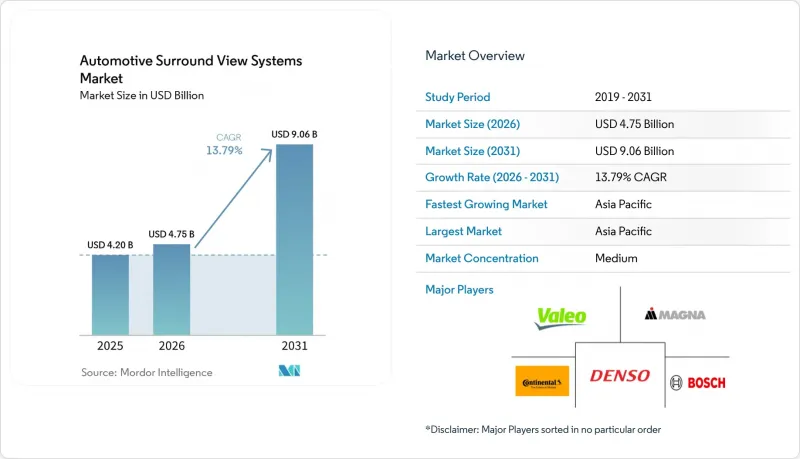
This report is Segmented by Camera Count (4-Camera Systems, More Than 4-Camera (6, 8, 12) Systems), Camera Functioning (Automatic (auto Switching/AI), Manual), Vehicle Type (Passenger Cars, Commercial Vehicles), Sales Channel (OEM-Fitted, Aftermarket Retrofit), Sensor Technology, Display Type, and Geography. Market Forecasts are Provided in Terms of Value (USD).
Global Automotive Surround View Systems Market Trends and Insights
Integration of 3-D Surround-View in ADAS Domain Controllers
Centralized domain controllers running shared SoCs enable parking assistance, lane-keeping, and traffic-jam pilot to reuse a single multi-camera suite, dramatically lowering per-feature cost. Qualcomm, Bosch, and Mobileye demonstrate that four high-resolution feeds can be stitched and evaluated for object detection on the same silicon that executes emergency braking logic, thereby reducing wiring harnesses and cooling hardware. In 2025, new vehicles in China adopted Level 2+ features, with mid-tier electric models incorporating advanced eight-camera setups. As domain controllers become the global standard for safety-compute architecture, the Automotive Surround View Systems market continues to experience significant growth.
Mandated Rear-Visibility Regulations
Rear-view camera mandates in the United States, Europe, China, and India have transformed optional systems into baseline safety equipment, compressing OEM decision cycles and accelerating production volumes. Between 2008 and 2021, NHTSA noted a significant drop in back-over fatalities for children under five. This success has prompted regulators to expand safety requirements to encompass full 360-degree coverage. In India, the Bharat NCAP 2.0 is incentivizing automakers with higher safety scores for features such as blind-spot detection and rear cross-traffic alerts . As a result, automakers are increasingly adopting multi-camera systems to achieve coveted 4- and 5-star ratings. Meanwhile, China's GB standards and Europe's General Safety Regulation are harmonizing on visibility criteria, bolstering growth in the Asia-Pacific region. Additionally, insurance companies are offering discounts to compliant commercial fleets, further driving the demand.
ECU Heat-Dissipation and In-Vehicle Networking Bottlenecks
Consolidating domain controllers with high power densities significantly increases enclosure temperatures, necessitating active cooling solutions for automakers. This approach raises module costs and impacts overall efficiency. In hotter climates, certain OEMs reduce frame rates to prevent thermal shutdowns, which negatively affects driver perception. At the same time, while modern data streams demand higher bandwidth, many vehicle architectures still rely on older Ethernet standards. Upgrading to advanced technologies introduces additional costs per node.
Other drivers and restraints analyzed in the detailed report include:
- Generative-AI Based Stitching Boosting Perception Accuracy
- Falling Multi-Camera ASPs
- Cyber-Security Certification Delays (UNECE R155/R156)
For complete list of drivers and restraints, kindly check the Table Of Contents.
Segment Analysis
4-camera setups held 66.15% of the Automotive Surround View Systems market share in 2025, yet more-than-4-camera arrays are forecast to post an 18.33% CAGR as Level 2+ autonomy spreads. The automotive surround-view systems market for eight-camera configurations is projected to expand rapidly. In China, as economies of scale continue to advance, vehicles are now being equipped with six-camera systems, a trend that has been evolving over recent years.
Redundant viewpoints feed into generative AI models that resolve occlusions, producing cleaner bird's-eye imagery and enabling junction navigation. Bosch's six-camera video belt enhances roundabout handling, and NEVs in China already average eight to thirteen cameras, cementing a trend toward higher counts in the Automotive Surround View Systems market.
Automatic operation commanded 74.36% of the Automotive Surround View Systems market share in 2025 and is growing at 15.03% CAGR through 2031. AI algorithms embedded in domain controllers trigger the proper view based on speed and gear position, eliminating driver distraction.
Manual systems cling to the retrofit niche but face obsolescence as augmented-reality overlays need seamless viewpoint changes. BMW's Panoramic Vision and Volvo's EX60 embed trajectory lines directly in the 3-D surround display, reinforcing automatic control as the mainstream experience in the Automotive Surround View Systems market .
Complete Report Scope:
- By Camera Count
- 4-Camera Systems
- More than 4-Camera (6, 8, 12) Systems
- By Camera Functioning
- Automatic (Auto-Switching / AI)
- Manual
- By Vehicle Type
- Passenger Cars
- Commercial Vehicles
- By Sales Channel
- Original Equipment Manufacturer (OEM)-fitted
- Aftermarket Retrofit
- By Sensor Technology
- CMOS (Complementary Metal-Oxide-Semiconductor)
- CCD (Charge-Coupled Device)
- By Display Type
- 2-D
- 3-D / Augmented
- By Geography
- North America
- United States
- Canada
- Rest of North America
- South America
- Brazil
- Argentina
- Rest of South America
- Europe
- Germany
- France
- United Kingdom
- Italy
- Spain
- Rest of Europe
- Asia-Pacific
- China
- Japan
- India
- South Korea
- Rest of Asia-Pacific
- Middle East and Africa
- Saudi Arabia
- United Arab Emirates
- South Africa
- Rest of Middle East and Africa
- North America
Geography Analysis
Asia-Pacific contributed 48.17% of the Automotive Surround View Systems market share in 2025 and is growing at a 14.45% CAGR through 2031. China's NEV boom, with vehicles averaging eight or more cameras, anchors regional demand, while India's Bharat NCAP 2.0 ties higher safety ratings to 360-degree visibility. Bosch's China-first ADAS suite, beginning serial production in mid-2025, underscores the region's testbed status for cost-efficient innovation.
By 2026, North America and Europe are expected to collectively account for a significant share of total sales. Mobileye's U.S. contract and Volkswagen's European deal underscore the growing integration of surround-view technology across mass-market platforms. Regulatory mandates for lane keeping, driver monitoring, and emergency braking are driving the adoption of multi-camera systems. However, delays in cybersecurity certifications are extending product cycles, temporarily slowing growth.
South America, the Middle East, and Africa remain smaller but are catching up as Euro-style safety norms spread. Urban delivery fleets in Brazil retrofit kits to reduce insurance premiums, and Gulf consumers favor premium SUVs that already include 3-D surround-view. High ambient temperatures in the Middle East stress thermal design, yet robust purchasing power sustains adoption, ensuring that the Automotive Surround View Systems market gains a diversified global footprint.
- Magna International Inc.
- Valeo SA
- Continental AG
- Denso Corporation
- Robert Bosch GmbH
- Texas Instruments Inc.
- Renesas Electronics Corporation
- Aisin Corporation
- Mobileye NV
- Aptiv PLC
- NVIDIA Corporation
- ON Semiconductor Corporation
- Sunny Optical Technology
- OmniVision Technologies
- Stonkam Co. Ltd.
- STMicroelectronics
- NXP Semiconductors N.V.
- Hikvision Automotive
Additional Benefits:
- The market estimate (ME) sheet in Excel format
- 3 months of analyst support
TABLE OF CONTENTS
1 Introduction
- 1.1 Study Assumptions and Market Definition
- 1.2 Scope of the Study
2 Research Methodology
3 Executive Summary
4 Market Landscape
- 4.1 Market Overview
- 4.2 Market Drivers
- 4.2.1 Integration of 3-D Surround-View in ADAS Domain Controllers
- 4.2.2 Mandated Rear-Visibility Regulations
- 4.2.3 Generative-AI Based Stitching Boosting Perception Accuracy
- 4.2.4 Falling Multi-Camera ASPs
- 4.2.5 OTA-Driven Feature Unlocks for Dormant Hardware
- 4.2.6 Urban Logistics Fleets Adopting Retrofit Kits
- 4.3 Market Restraints
- 4.3.1 ECU Heat-Dissipation and In-Vehicle Networking Bottlenecks
- 4.3.2 Cyber-Security Certification Delays (UNECE R155/R156)
- 4.3.3 Price Sensitivity in Entry-Level Passenger Cars
- 4.3.4 Shortage of Automotive-Grade Wide-Angle Lens Suppliers
- 4.4 Value / Supply-Chain Analysis
- 4.5 Regulatory Landscape
- 4.6 Technological Outlook
- 4.7 Porter's Five Forces Analysis
- 4.7.1 Bargaining Power of Suppliers
- 4.7.2 Bargaining Power of Buyers
- 4.7.3 Threat of New Entrants
- 4.7.4 Threat of Substitutes
- 4.7.5 Competitive Rivalry
5 Market Size and Growth Forecasts (Value, USD)
- 5.1 By Camera Count
- 5.1.1 4-Camera Systems
- 5.1.2 More than 4-Camera (6, 8, 12) Systems
- 5.2 By Camera Functioning
- 5.2.1 Automatic (Auto-Switching / AI)
- 5.2.2 Manual
- 5.3 By Vehicle Type
- 5.3.1 Passenger Cars
- 5.3.2 Commercial Vehicles
- 5.4 By Sales Channel
- 5.4.1 Original Equipment Manufacturer (OEM)-fitted
- 5.4.2 Aftermarket Retrofit
- 5.5 By Sensor Technology
- 5.5.1 CMOS (Complementary Metal-Oxide-Semiconductor)
- 5.5.2 CCD (Charge-Coupled Device)
- 5.6 By Display Type
- 5.6.1 2-D
- 5.6.2 3-D / Augmented
- 5.7 By Geography
- 5.7.1 North America
- 5.7.1.1 United States
- 5.7.1.2 Canada
- 5.7.1.3 Rest of North America
- 5.7.2 South America
- 5.7.2.1 Brazil
- 5.7.2.2 Argentina
- 5.7.2.3 Rest of South America
- 5.7.3 Europe
- 5.7.3.1 Germany
- 5.7.3.2 France
- 5.7.3.3 United Kingdom
- 5.7.3.4 Italy
- 5.7.3.5 Spain
- 5.7.3.6 Rest of Europe
- 5.7.4 Asia-Pacific
- 5.7.4.1 China
- 5.7.4.2 Japan
- 5.7.4.3 India
- 5.7.4.4 South Korea
- 5.7.4.5 Rest of Asia-Pacific
- 5.7.5 Middle East and Africa
- 5.7.5.1 Saudi Arabia
- 5.7.5.2 United Arab Emirates
- 5.7.5.3 South Africa
- 5.7.5.4 Rest of Middle East and Africa
- 5.7.1 North America
6 Competitive Landscape
- 6.1 Market Concentration
- 6.2 Strategic Moves
- 6.3 Market Share Analysis
- 6.4 Company Profiles (Includes Global Level Overview, Market Level Overview, Core Segments, Financials as Available, Strategic Information, Market Rank/Share for Key Companies, Products and Services, SWOT Analysis, and Recent Developments)
- 6.4.1 Magna International Inc.
- 6.4.2 Valeo SA
- 6.4.3 Continental AG
- 6.4.4 Denso Corporation
- 6.4.5 Robert Bosch GmbH
- 6.4.6 Texas Instruments Inc.
- 6.4.7 Renesas Electronics Corporation
- 6.4.8 Aisin Corporation
- 6.4.9 Mobileye NV
- 6.4.10 Aptiv PLC
- 6.4.11 NVIDIA Corporation
- 6.4.12 ON Semiconductor Corporation
- 6.4.13 Sunny Optical Technology
- 6.4.14 OmniVision Technologies
- 6.4.15 Stonkam Co. Ltd.
- 6.4.16 STMicroelectronics
- 6.4.17 NXP Semiconductors N.V.
- 6.4.18 Hikvision Automotive
7 Market Opportunities and Future Outlook
- 7.1 White-space and Unmet-Need Assessment

