PUBLISHER: Mordor Intelligence | PRODUCT CODE: 2117362

PUBLISHER: Mordor Intelligence | PRODUCT CODE: 2117362
Automotive Over-the-Air Updates - Market Share Analysis, Industry Trends & Statistics, Growth Forecasts (2026 - 2031)
According to Mordor Intelligence, the automotive over-the-air updates market size was valued at USD 4.90 billion in 2025, is estimated at USD 5.90 billion in 2026, and is forecast to reach USD 14.55 billion by 2031 at a 19.79% CAGR over 2026-2031.
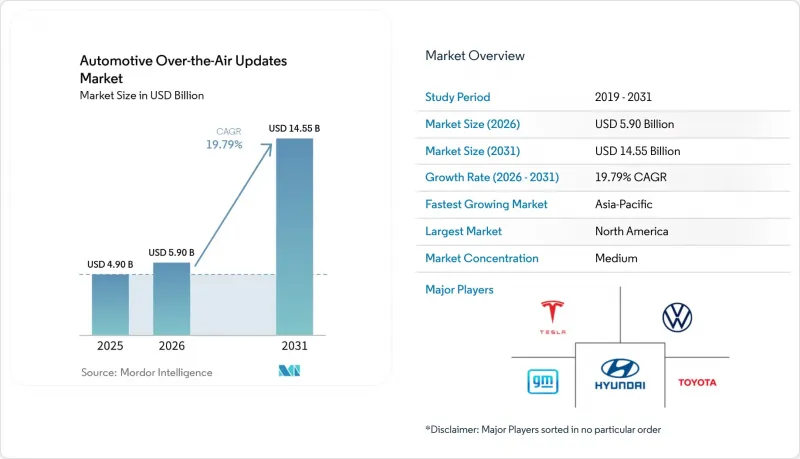
This report is Segmented by Technology (Software Over-The-Air Technology (SOTA), Firmware Over-The-Air Technology (FOTA)), Application (Electronic Control Unit (ECU), Infotainment, and More), Propulsion (Internal Combustion Engine (ICE), Electric Vehicle), Vehicle Type, Communication Type, and Geography. Market Forecasts are Provided in Value (USD).
Global Automotive Over-the-Air Updates Market Trends and Insights
Electrification and SDV Architectures Demanding Frequent Updates
Battery electric vehicles rely on sophisticated software to manage energy use, thermal behavior, and regenerative braking. Tesla's early 2025 range-recalibration update illustrated how post-sale firmware can resolve consumer concerns without hardware modification . Domain-controller topologies that replace dozens of discrete electronic control units streamline validation, shorten test cycles, and enable weekly release cadences. Volkswagen's zonal architecture rollout in 2026 reduced wiring harness weight, lowering bill-of-materials cost while supporting faster integration. Automakers adopting virtualization tools report shorter development programs because software and hardware tasks progress in parallel. The cumulative effect is higher feature velocity, which strengthens customer retention and supports subscription revenue.
Widespread Connected-Car and Telematics Penetration
Telematics control units act as gateways for cellular, Wi-Fi, and satellite data, holding a notable share of 2025 application revenue. Volvo Trucks delivered about 10,000 updates per day in 2025, cutting unplanned maintenance and bringing 80% of its global fleet to the same software baseline within six months . eSIM technology empowers automakers to dynamically negotiate carrier terms, significantly reducing firmware push costs in competitive markets. Passenger vehicles featuring native Google infotainment platforms are required to keep pace with smartphone ecosystems, leading to an increased baseline update frequency. As connectivity tariffs continue to decline, it paves the way for more extensive service bundles, encompassing navigation refreshes, diagnostics, and in-car commerce.
Legacy ECU Architectures and Fragmented Software Stacks
Many vehicles built before 2020 contain over 100 electronic control units that communicate via CAN or LIN buses, each running proprietary code. Comprehensive remote update coverage would require exhaustive integration testing across thousands of software combinations, a process that can take months. The eSync Alliance is promoting standardized packaging and delta-update formats that reduce payload size, yet adoption remains voluntary. Volkswagen's internal Cariad unit encountered multi-year delays while attempting to unify disparate platforms, ultimately moving to incremental controller upgrades. As a result, legacy fleets often restrict OTA to infotainment modules, forfeiting opportunities for safety or emissions improvements.
Other drivers and restraints analyzed in the detailed report include:
- Regulatory Push on Safety-Recall and Cyber-Security Compliance
- Feature-as-a-Service Monetization Models for OEMs
- Cyber-Security and Data-Privacy Vulnerabilities
For complete list of drivers and restraints, kindly check the Table Of Contents.
Segment Analysis
Firmware deliveries reached deeper vehicle layers once considered untouchable through wireless means. The automotive over-the-air updates market size for firmware is projected to register a 22.74% CAGR because powertrain, battery, and chassis controllers shift to centralized architectures that simplify validation. Automakers benefit from field calibrations that extend component life, such as thermal-management tweaks that improve fast-charging durability.
Software over-the-air remains essential for infotainment and navigation, and held 68.14% revenue share in 2025 as consumer expectations make many updates free. The coexistence of both pathways obliges manufacturers to maintain two toolchains: one with safety-critical sign-off gates and another tuned for rapid user-experience enhancements. As containerization matures, firmware modules may adopt partial virtualization, further blurring lines between the two methods. Developers emphasize delta-file packaging and staged rollouts, moving away from monolithic images to reduce cellular cost and downtime. Autonomous-driving feature stacks exemplify the converging paths, where perception algorithms update weekly while actuator firmware follows a quarterly rhythm.
Telematics gateways generated the largest 36.25% slice of 2025 application revenue, reflecting their role as data conduits. Safety and security updates now show the fastest 21.34% CAGR because regulators demand prompt remediation of potential hazards. The automotive over-the-air updates market share attributable to safety patches is set to climb sharply through 2031 as cyber-incident disclosure obligations tighten. Remote diagnostics let fleet managers apply predictive analytics that cut downtime, proving the economic value of always-connected systems. Infotainment updates maintain high transaction counts, yet average revenue per event is modest because consumers expect map refreshes at no cost.
OEMs integrate intrusion-detection agents inside gateways, feeding cloud dashboards that can isolate anomalies and trigger targeted patching within hours. Joint ventures between automakers and cybersecurity specialists aim to operationalize ISO 24089 validation flows, ensuring audit-ready evidence for type-approval authorities. Over time, safety and convenience domains will converge, with driver-monitoring algorithms updating as frequently as playlist curators.
Complete Report Scope:
- By Technology
- Software Over-The-Air Technology (SOTA)
- Firmware Over-The-Air Technology (FOTA)
- By Application
- Electronic Control Unit (ECU)
- Infotainment
- Safety and Security
- Telematics Control Unit (TCU)
- Others
- By Propulsion
- Internal Combustion Engine (ICE)
- Electric Vehicle
- Battery Electric Vehicle (BEV)
- Hybrid Electric Vehicle (HEV)
- Plug-In Hybrid Electric Vehicle (PHEV)
- By Vehicle Type
- Passenger Car
- Light Commercial Vehicle
- Heavy Commercial Vehicle
- By Communication Type
- Cellular (3G, 4G LTE, 5G)
- Wi-Fi
- Satellite
- Dedicated Short-Range Communication (DSRC)
- Vehicle-to-Everything (V2X)
- By Geography
- North America
- United States
- Canada
- Rest of North America
- South America
- Brazil
- Argentina
- Rest of South America
- Europe
- Germany
- United Kingdom
- France
- Italy
- Spain
- Rest of Europe
- Asia-Pacific
- China
- Japan
- India
- South Korea
- Rest of Asia-Pacific
- Middle East and Africa
- Saudi Arabia
- United Arab Emirates
- Turkey
- South Africa
- Rest of Middle East and Africa
- North America
Geography Analysis
North America accounted for 44.12% of the 2025 market value, anchored by Tesla's vertically integrated software stack and by subscription rollouts from Ford, General Motors, and Stellantis. The U.S. Auto Data Privacy and Autonomy Act under debate in Congress would formalize breach-reporting timelines, raising compliance expenditure yet protecting consumers . Canada's patchy cellular coverage is spurring early satellite trials, with Subaru partnering with Starlink for map updates in remote provinces. The FCC finalized Cellular-V2X spectrum in 2024, supporting corridor pilots where infrastructure pushes micro updates to passing vehicles. Competitive tension encourages domestic semiconductor suppliers to prioritize automotive cybersecurity features in new telematics chipsets.
Asia-Pacific is projected to post a 20.15% CAGR during 2026-2031, driven by China's rapid EV penetration and weekly release cadences at NIO, XPeng, and BYD. China's GB 44495-2024 embeds secure update capability into all new vehicle approvals, ensuring uniform adoption by both state-owned and private brands. Japan's Mobility DX Platform promotes common APIs but focuses on domestic use cases, while South Korea leverages national 5G buildout to position itself as a tier-1 hardware hub. India's AIS 189 and AIS 190 make secure update systems mandatory, and domestic automakers cooperate with cloud hyperscalers to host regional edge nodes that cut bandwidth cost. Growing two-wheel EV fleets also demand lightweight update mechanisms, opening adjacent segments.
Europe's regulatory framework is stringent, but legacy systems slow progress. UNECE WP.29 regulations are in place, yet historic manufacturers face challenges with outdated wiring and supplier networks. Volkswagen prioritized supply-chain readiness by introducing zonal architecture in China before Europe. The EU's Cyber Resilience Act will enforce accountability for insecure code, driving brands to adopt penetration testing and continuous monitoring. Satellite providers view Arctic transport corridors as opportunities to showcase non-terrestrial reliability. South America, the Middle East, and Africa, though smaller in market value, leverage hybrid connectivity to address remote coverage gaps. Brazilian regulators promote domestic cloud hosting to reduce cross-border data costs, while the Gulf states' growing EV adoption supports premium OTA services with localized features. In Australia and South Africa, mining companies use satellite-backed telematics in heavy trucks, ensuring over-the-air calibrations for autonomous haulage certifications.
- Tesla, Inc.
- Volkswagen AG
- General Motors Co.
- Hyundai Motor Company
- Toyota Motor Corp.
- BMW AG
- Mercedes-Benz Group AG
- Ford Motor Co.
- Stellantis N.V.
- Volvo Car Corp.
- Renault Group
- Nissan Motor Co., Ltd.
- SAIC Motor Corp.
- Geely Automobile Holdings
- Continental AG
- Robert Bosch GmbH
- Harman International
- Aptiv PLC
- Sibros Technologies Inc.
- Sonatus Inc.
- Excelfore Corp.
- Wind River Systems
- NXP Semiconductors N.V.
Additional Benefits:
- The market estimate (ME) sheet in Excel format
- 3 months of analyst support
TABLE OF CONTENTS
1 Introduction
- 1.1 Study Assumptions and Market Definition
- 1.2 Scope of the Study
2 Research Methodology
3 Executive Summary
4 Market Landscape
- 4.1 Market Overview
- 4.2 Market Drivers
- 4.2.1 Electrification and SDV Architectures Demanding Frequent Updates
- 4.2.2 Widespread Connected-Car and Telematics Penetration
- 4.2.3 Regulatory Push on Safety-Recall and Cyber-Security Compliance
- 4.2.4 Feature-as-a-Service Monetization Models for OEMs
- 4.2.5 Satellite-Enabled Coverage for Remote OTA Delivery
- 4.2.6 OTA Off-Load via EV-Charging Hubs Lowers Cellular Costs
- 4.3 Market Restraints
- 4.3.1 Legacy ECU Architectures and Fragmented Software Stacks
- 4.3.2 Cyber-Security and Data-Privacy Vulnerabilities
- 4.3.3 High Backend-Cloud Bandwidth Cost in Emerging Markets
- 4.3.4 Slow Multi-Brand Certification of Update Standards
- 4.4 Value / Supply-Chain Analysis
- 4.5 Regulatory Landscape
- 4.6 Technological Outlook
- 4.7 Porter's Five Forces Analysis
- 4.7.1 Bargaining Power of Suppliers
- 4.7.2 Bargaining Power of Buyers
- 4.7.3 Threat of New Entrants
- 4.7.4 Threat of Substitutes
- 4.7.5 Intensity of Competitive Rivalry
- 4.8 Cyber-Security Landscape
5 Market Size and Growth Forecasts
- 5.1 By Technology
- 5.1.1 Software Over-The-Air Technology (SOTA)
- 5.1.2 Firmware Over-The-Air Technology (FOTA)
- 5.2 By Application
- 5.2.1 Electronic Control Unit (ECU)
- 5.2.2 Infotainment
- 5.2.3 Safety and Security
- 5.2.4 Telematics Control Unit (TCU)
- 5.2.5 Others
- 5.3 By Propulsion
- 5.3.1 Internal Combustion Engine (ICE)
- 5.3.2 Electric Vehicle
- 5.3.2.1 Battery Electric Vehicle (BEV)
- 5.3.2.2 Hybrid Electric Vehicle (HEV)
- 5.3.2.3 Plug-In Hybrid Electric Vehicle (PHEV)
- 5.4 By Vehicle Type
- 5.4.1 Passenger Car
- 5.4.2 Light Commercial Vehicle
- 5.4.3 Heavy Commercial Vehicle
- 5.5 By Communication Type
- 5.5.1 Cellular (3G, 4G LTE, 5G)
- 5.5.2 Wi-Fi
- 5.5.3 Satellite
- 5.5.4 Dedicated Short-Range Communication (DSRC)
- 5.5.5 Vehicle-to-Everything (V2X)
- 5.6 By Geography
- 5.6.1 North America
- 5.6.1.1 United States
- 5.6.1.2 Canada
- 5.6.1.3 Rest of North America
- 5.6.2 South America
- 5.6.2.1 Brazil
- 5.6.2.2 Argentina
- 5.6.2.3 Rest of South America
- 5.6.3 Europe
- 5.6.3.1 Germany
- 5.6.3.2 United Kingdom
- 5.6.3.3 France
- 5.6.3.4 Italy
- 5.6.3.5 Spain
- 5.6.3.6 Rest of Europe
- 5.6.4 Asia-Pacific
- 5.6.4.1 China
- 5.6.4.2 Japan
- 5.6.4.3 India
- 5.6.4.4 South Korea
- 5.6.4.5 Rest of Asia-Pacific
- 5.6.5 Middle East and Africa
- 5.6.5.1 Saudi Arabia
- 5.6.5.2 United Arab Emirates
- 5.6.5.3 Turkey
- 5.6.5.4 South Africa
- 5.6.5.5 Rest of Middle East and Africa
- 5.6.1 North America
6 Competitive Landscape
- 6.1 Market Concentration
- 6.2 Strategic Moves
- 6.3 Market Share Analysis
- 6.4 Company Profiles (includes Global Level Overview, Market Level Overview, Core Segments, Financials as Available, Strategic Information, Market Rank/Share for Key Companies, Products and Services, SWOT Analysis, and Recent Developments)
- 6.4.1 Tesla, Inc.
- 6.4.2 Volkswagen AG
- 6.4.3 General Motors Co.
- 6.4.4 Hyundai Motor Company
- 6.4.5 Toyota Motor Corp.
- 6.4.6 BMW AG
- 6.4.7 Mercedes-Benz Group AG
- 6.4.8 Ford Motor Co.
- 6.4.9 Stellantis N.V.
- 6.4.10 Volvo Car Corp.
- 6.4.11 Renault Group
- 6.4.12 Nissan Motor Co., Ltd.
- 6.4.13 SAIC Motor Corp.
- 6.4.14 Geely Automobile Holdings
- 6.4.15 Continental AG
- 6.4.16 Robert Bosch GmbH
- 6.4.17 Harman International
- 6.4.18 Aptiv PLC
- 6.4.19 Sibros Technologies Inc.
- 6.4.20 Sonatus Inc.
- 6.4.21 Excelfore Corp.
- 6.4.22 Wind River Systems
- 6.4.23 NXP Semiconductors N.V.
7 Market Opportunities and Future Outlook
- 7.1 White-space and Unmet-Need Assessment

