PUBLISHER: Mordor Intelligence | PRODUCT CODE: 2117391

PUBLISHER: Mordor Intelligence | PRODUCT CODE: 2117391
Laser-Induced Breakdown Spectroscopy - Market Share Analysis, Industry Trends & Statistics, Growth Forecasts (2026 - 2031)
According to Mordor Intelligence, the laser-Induced breakdown spectroscopy market size is expected to increase from USD 218.33 million in 2025 to USD 229.08 million in 2026 and reach USD 307.54 million by 2031, growing at a CAGR of 6.07% over 2026-2031.
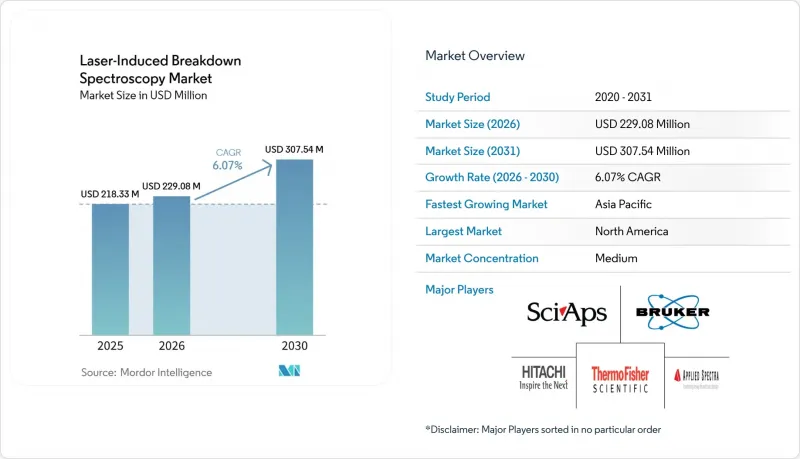
This report is Segmented by Product Type (Benchtop Systems, Handheld/Portable Analyzers, Stand-off/Remote LIBS, Integrated LIBS-Raman Systems, and More), End-User Industry (Metals & Mining, Industrial Manufacturing & Scrap-Recycling, Environmental & Agriculture Monitoring, and More), and Geography (North America, Europe, Asia Pacific, Middle East, and More). The Market Forecasts are Provided in Terms of Value (USD).
Global Laser-Induced Breakdown Spectroscopy Market Trends and Insights
Growing Need for Real-Time, In-Situ Elemental Testing Across Industrial Value Chains
Instantaneous compositional feedback is now critical for process optimization, quality assurance, and resource estimation. A 65 g LIBS payload on NASA's Mars 2020 rover shows that robust analysis can occur in extreme environments after an 87% weight reduction versus earlier designs. Steelmakers deploy similar handheld units on shop floors to curb off-spec alloy batches that once triggered re-melts. Mining companies gain weeks of cycle-time savings when downhole LIBS probes replace laboratory assay chains that relied on shipping core samples off-site. Scrap yards use the same portability to classify complex alloys in seconds, a shift that boosts margin as metal-price volatility magnifies the expense of mis-sorted feedstock. As value chains run leaner, the window for corrective action shrinks, creating a structural pull on the LIBS market for real-time analytics.
Intensifying Regulatory Oversight on Hazardous Elements in Environment, Food, and Consumer Goods
In 2024, the U.S. Environmental Protection Agency designated PFOA and PFOS as hazardous substances, triggering deeper site-monitoring mandates. European directives demand recovery of 25% of key raw materials from recycled waste streams by 2030. These edicts raise sample volumes and shorten reporting timetables, favoring field-deployable LIBS tools that can screen soils, plastics, or food powders without laboratory backlogs. Researchers demonstrated cadmium quantification from 70 ppm to 5,000 ppm in cocoa powder within minutes, underscoring how LIBS aligns with farm-to-fork traceability pressures. Faster compliance checks lower the risk of shipment holds and recalls, reinforcing adoption.
Established Dominance of XRF and ICP Methods in Core Laboratories
X-ray fluorescence and ICP-MS amassed decades of method validation and entrenched capital bases, so labs hesitate to overhaul workflows. Comparative trials reveal ICP-MS still holds lower detection limits for trace metals such as strontium or chromium. Regulatory auditors are comfortable with established protocols, generating compliance inertia. LIBS suppliers respond by positioning instruments as frontline screeners that triage samples before confirmatory ICP runs, thereby creating coexistence rather than direct substitution. Over time, combined workflows shorten turnaround time and reduce consumables, nudging labs toward broader LIBS adoption.
Other drivers and restraints analyzed in the detailed report include:
- Miniaturization and Cost Decline of Solid-State Lasers and Spectrometers
- Rising Investments in Critical Mineral Exploration and Battery Supply Chains
- Accuracy Variability Due to Matrix Effects and Calibration Complexity
For complete list of drivers and restraints, kindly check the Table Of Contents.
Segment Analysis
Handheld / Portable Analyzers controlled 48.09% of 2025 revenue as users prioritized mobility and instant decision-making, a dominance that underscores how portability shapes the modern LIBS market size for front-line tasks. Thermo Fisher Scientific's Niton Apollo exemplifies the category by offering Wi-Fi-enabled carbon equivalency analysis inside a 2 kg, IP54-rated shell. Stand-off and remote systems are projected to deliver the highest 7.55% CAGR, as industries ranging from nuclear decommissioning to deep-sea mining adopt non-contact inspection to balance worker safety with analytical reach.
Benchtop instruments continue to serve labs that need greater spectral resolution, while OEM modules let machine builders weave LIBS into robotics and manufacturing cells. The LIBS industry's shift toward integrated LIBS-Raman devices hints at a post-instrument era where multi-modal sensors are embedded within production lines. Double-pulse underwater variants have analyzed minerals at 6,000 m depth, eliminating core-sample retrieval delays. Whether strapped to Mars rovers or recycling robots, versatility cements the LIBS market's expansion path.
Complete Report Scope:
- By Product Type
- Benchtop Systems
- Handheld / Portable Analyzers
- Stand-off / Remote LIBS
- Integrated LIBS-Raman Systems
- OEM / Module Components
- By End-User Industry
- Metals & Mining
- Industrial Manufacturing & Scrap-Recycling
- Environmental & Agriculture Monitoring
- Research & Academia
- Pharmaceuticals
- Others (Forensics and Defense, among others)
- Geography
- North America
- United States
- Canada
- Mexico
- Europe
- Germany
- United Kingdom
- France
- Italy
- Spain
- Rest of Europe
- Asia-Pacific
- China
- Japan
- India
- South Korea
- Australia
- Rest of Asia-Pacific
- Middle East and Africa
- GCC
- South Africa
- Rest of Middle East and Africa
- South America
- Brazil
- Argentina
- Rest of South America
- North America
Geography Analysis
North America commanded 40.37% of 2025 revenue on the back of federal funding, thriving aerospace-defense ecosystems, and a resilient mining sector. The Department of Energy's loan-guarantee program funnels capital toward critical-mineral processing, giving domestic suppliers an incentive to adopt LIBS for real-time impurity detection. NASA's SuperCam success maintains technology prestige, and Canada's nickel-rich Sudbury Basin mines increasingly deploy LIBS probes to guide selective extraction. Mexico's automotive supply chain follows suit, adding portable units to assure alloy conformity.
Asia-Pacific represents the fastest 6.82% CAGR trajectory through 2030, led by China's rare-earth monopoly and battery gigafactories that need rapid elemental balance checks. Beijing's scrap-steel tonnage is forecast to triple by 2050, spotlighting LIBS-enabled sorting as a linchpin in sustainable steelmaking. Japan and South Korea apply the technology to semiconductor precursor purity, while India's mining surge adapts handheld units for grade control. Australia leverages field-portable LIBS to speed lithium brine characterization across its emerging spodumene projects.
Europe shows balanced uptake driven by tight environmental statutes demanding rapid in-situ verification of WEEE and scrap streams. Germany integrates LIBS into automated production lines, and Norway pilots offshore LIBS for subsea mineral scouting. EU grants targeting >90% critical-raw-material recovery fuel commercialization of LIBS-AI-robotics platforms. Secondary markets in the Middle East, Africa, and South America gradually scale as exploration and environmental monitoring budgets expand, rounding out a truly global LIBS market.
- Avantes BV
- AMETEK, Inc. (SPECTRO Analytical Instruments GmbH)
- Applied Photonics Ltd
- Applied Spectra
- B&W Tek (Metrohm)
- Bruker
- Halma Plc (Ocean Optics)
- Hitachi High-Tech Corporation (Hitachi, Ltd)
- HORIBA
- Keyence Corporation
- Lightigo s.r.o.
- LTB Lasertechnik Berlin GmbH
- Optosky
- Rigaku Holdings Corporation
- SciAps, Inc.
- Secopta (IMS Messsysteme GmbH)
- Thermo Fisher Scientific
- TSI Incorporated
- Vela Instruments LLC
- Wuxi Jinyibo Instrument Technology Co., Ltd
Additional Benefits:
- The market estimate (ME) sheet in Excel format
- 3 months of analyst support
TABLE OF CONTENTS
1 Introduction
- 1.1 Study Assumptions & Market Definition
- 1.2 Scope of the Study
2 Research Methodology
3 Executive Summary
4 Market Landscape
- 4.1 Market Overview
- 4.2 Market Drivers
- 4.2.1 Growing Need For Real-Time, In-Situ Elemental Testing Across Industrial Value Chains
- 4.2.2 Intensifying Regulatory Oversight On Hazardous Elements In Environment, Food, And Consumer Goods
- 4.2.3 Miniaturization and Cost Decline of Solid-State Lasers and Spectrometers
- 4.2.4 Rising Investments in Critical Mineral Exploration and Battery Supply Chains
- 4.2.5 Circular Economy Policies Fueling Metal Recycling and Scrap Sorting Automation
- 4.2.6 Government-Funded Space and Defense Programs Validating LIBS Technology
- 4.3 Market Restraints
- 4.3.1 Established Dominance of X-ray Fluorescence and ICP Methods in Core Laboratories
- 4.3.2 Accuracy Variability Due to Matrix Effects and Calibration Complexity
- 4.3.3 Workplace Laser-Safety Regulations Increasing Certification Costs
- 4.3.4 Limited Availability of Skilled Personnel for Advanced Spectroscopic Data Interpretation
- 4.4 Supply-Chain Analysis
- 4.5 Regulatory Landscape
- 4.6 Technological Outlook
- 4.7 Porter's Five Forces
- 4.7.1 Threat of New Entrants
- 4.7.2 Threat of Substitutes
- 4.7.3 Bargaining Power of Buyers
- 4.7.4 Bargaining Power of Suppliers
- 4.7.5 Competitive Rivalry
5 Market Size & Growth Forecasts
- 5.1 By Product Type
- 5.1.1 Benchtop Systems
- 5.1.2 Handheld / Portable Analyzers
- 5.1.3 Stand-off / Remote LIBS
- 5.1.4 Integrated LIBS-Raman Systems
- 5.1.5 OEM / Module Components
- 5.2 By End-User Industry
- 5.2.1 Metals & Mining
- 5.2.2 Industrial Manufacturing & Scrap-Recycling
- 5.2.3 Environmental & Agriculture Monitoring
- 5.2.4 Research & Academia
- 5.2.5 Pharmaceuticals
- 5.2.6 Others (Forensics and Defense, among others)
- 5.3 Geography
- 5.3.1 North America
- 5.3.1.1 United States
- 5.3.1.2 Canada
- 5.3.1.3 Mexico
- 5.3.2 Europe
- 5.3.2.1 Germany
- 5.3.2.2 United Kingdom
- 5.3.2.3 France
- 5.3.2.4 Italy
- 5.3.2.5 Spain
- 5.3.2.6 Rest of Europe
- 5.3.3 Asia-Pacific
- 5.3.3.1 China
- 5.3.3.2 Japan
- 5.3.3.3 India
- 5.3.3.4 South Korea
- 5.3.3.5 Australia
- 5.3.3.6 Rest of Asia-Pacific
- 5.3.4 Middle East and Africa
- 5.3.4.1 GCC
- 5.3.4.2 South Africa
- 5.3.4.3 Rest of Middle East and Africa
- 5.3.5 South America
- 5.3.5.1 Brazil
- 5.3.5.2 Argentina
- 5.3.5.3 Rest of South America
- 5.3.1 North America
6 Competitive Landscape
- 6.1 Market Concentration
- 6.2 Market Share Analysis
- 6.3 Company Profiles {(includes Global level Overview, Market level overview, Core Segments, Financials as available, Strategic Information, Market Rank/Share for key companies, Products & Services, and Recent Developments)}
- 6.3.1 Avantes BV
- 6.3.2 AMETEK, Inc. (SPECTRO Analytical Instruments GmbH)
- 6.3.3 Applied Photonics Ltd
- 6.3.4 Applied Spectra
- 6.3.5 B&W Tek (Metrohm)
- 6.3.6 Bruker
- 6.3.7 Halma Plc (Ocean Optics)
- 6.3.8 Hitachi High-Tech Corporation (Hitachi, Ltd)
- 6.3.9 Horiba, Ltd
- 6.3.10 Keyence Corporation
- 6.3.11 Lightigo s.r.o.
- 6.3.12 LTB Lasertechnik Berlin GmbH
- 6.3.13 Optosky
- 6.3.14 Rigaku Holdings Corporation
- 6.3.15 SciAps, Inc.
- 6.3.16 Secopta (IMS Messsysteme GmbH)
- 6.3.17 Thermo Fisher Scientific Inc.
- 6.3.18 TSI Incorporated
- 6.3.19 Vela Instruments LLC
- 6.3.20 Wuxi Jinyibo Instrument Technology Co., Ltd
7 Market Opportunities & Future Outlook
- 7.1 White-space & unmet-need assessment

