PUBLISHER: Mordor Intelligence | PRODUCT CODE: 2117396

PUBLISHER: Mordor Intelligence | PRODUCT CODE: 2117396
United States EV Charging As A Service - Market Share Analysis, Industry Trends & Statistics, Growth Forecasts (2026 - 2031)
According to Mordor Intelligence, the United States EV charging as a service market size was valued at USD 82.70 million in 2025 and estimated to grow from USD 100.89 million in 2026 to reach USD 263.01 million by 2031, at a CAGR of 21.12% during the forecast period (2026-2031).
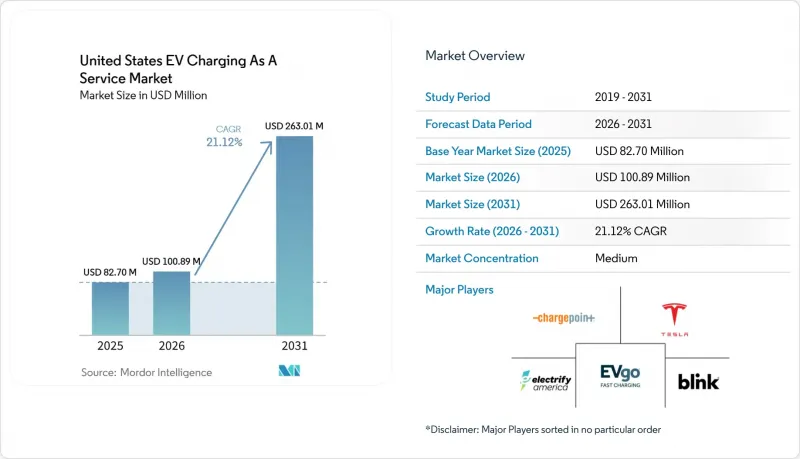
This report is Segmented by Charger Type (AC Chargers, DC Fast Chargers), Power Output (Level 1/AC (Less Than 22 KW), Level 2 (22-50 KW), and More), Fleet Service Type (Company Vehicles and Motor Pools, Delivery and Logistics, and More), End-Use, Customer Business Model, and Region. Market Forecasts are Provided in Terms of Value (USD).
United States EV Charging As A Service Market Trends and Insights
NEVI Federal-State Funding Roll-Out
The NEVI program allocates USD 5 billion and requires each funded site to offer four 150 kW ports, 24/7 access, and 97% uptime, accelerating project schedules and excluding vendors without remote-monitoring depth. By early 2026, Texas allocated significant funding across numerous corridor locations, with several active sites and many more under development. Similarly, Ohio, New York, and Michigan established comparable targets, frequently linking awards to equity metrics to direct funds into underserved neighborhoods.
Corporate ESG Fleet-Electrification Mandates
Amazon, UPS, and DB Schenker have committed to electrifying their last-mile fleets by 2030. This move is spurring a demand for depot-charging solutions, particularly those that offer bundled services encompassing hardware, software, and maintenance. In California, WattEV's truck hubs are successfully recharging Class 8 tractors within a short time frame, underscoring the viability of high-power models for regional hauling.
High Grid-Upgrade Costs for DC Fast Sites
In California, interconnection queues can take several years to process, and upgrading transformers involves significant financial and logistical challenges. These factors often lead to increased budgets and a focus on investments in areas with higher capacity. However, FreeWire's battery-integrated chargers, developed as part of a collaboration with BP Pulse, address some of these challenges by providing an efficient solution to manage peak demand and reduce dependency on extensive infrastructure upgrades.
Other drivers and restraints analyzed in the detailed report include:
- Declining Battery-Pack Costs Reach TCO Parity
- Utility Subscription-Ready Tariffs Cut Capex
- Interoperability and Payment-Standard Fragmentation
For complete list of drivers and restraints, kindly check the Table Of Contents.
Segment Analysis
AC Level 2 units supplied 72.31% of 2025 revenue in the United States EV Charging As A Service market, anchored in workplaces and multi-family garages where 6-hour dwell times align with usage patterns. DC fast systems, however, are projected for a 25.36% CAGR as logistics fleets and corridor travelers demand sub-30-minute stops. Tesla's 2025 decision to open NACS and its Supercharger network diverted differentiation toward software-layer services that optimize energy loads .
In semi-public lots, hardware economics continue to favor AC charging, which remains more cost-effective compared to DC fast charging. However, battery-integrated DC solutions from companies like FreeWire and Voltera are reducing grid footprints. This innovation allows for new deployment sites without the added expense of transformers. Consequently, the United States EV Charging As A Service market is seeing established players, such as ChargePoint, pivoting their strategies. ChargePoint has placed orders for advanced Omni Port units, targeting fleet customers.
Level 2 chargers rated 22-50 kW held 67.04% share of the United States EV Charging As A Service market size in 2025, driven by lower capex and grid friendliness. Chargers above 150 kW will post a 29.45% CAGR because battery-electric trucks must match diesel dwell times; WattEV's 350 kW truck stops already replenish 80% SOC in 90 minutes.
Mid-range 50-150 kW systems appeal to light-commercial fleets where 15-45-minute sessions are acceptable. Rivian's network, spanning multiple sites, recorded high reliability in 2025, underscoring the importance of reliability alongside brand strength. With the evolution of battery chemistries, the United States EV Charging As A Service market is poised to harmonize ultra-high power installations with intelligent load sharing, optimizing site throughput.
Complete Report Scope:
- By Charger Type
- AC Chargers (Level 2 Service)
- DC Fast Chargers
- By Power Output
- Level 1/AC (Less than 22 kW)
- Level 2 (22 to 50 kW)
- Fast (50 to 150 kW)
- High-Power (More than 150 kW)
- By Fleet Service Type
- Company Vehicles and Motor Pools
- Delivery and Logistics
- Passenger Transportation Fleets
- By End-Use
- Semi-Public Charging Setup
- Public Charging Setup
- By Customer Business Model
- Subscription-based (CaaS)
- Pay-per-Use
- Hybrid Models
- By Region
- Northeast
- Midwest
- South
- West
List of Companies Covered in this Report:
- ChargePoint, Inc.
- Tesla, Inc.
- Electrify America
- EVgo Inc.
- Blink Charging Co.
- Shell Recharge
- BP Pulse
- FLO Services USA Inc.
- EV Connect
- Rivian Adventure Network
- IONNA
- Francis Energy
- Voltera
- Tritium Charging
- Enel Group
Additional Benefits:
- The market estimate (ME) sheet in Excel format
- 3 months of analyst support
TABLE OF CONTENTS
1 Introduction
- 1.1 Study Assumptions and Market Definition
- 1.2 Scope of the Study
2 Research Methodology
3 Executive Summary
4 Market Landscape
- 4.1 Market Overview
- 4.2 Market Drivers
- 4.2.1 NEVI Federal-State Funding Roll-Out
- 4.2.2 Corporate ESG Fleet-Electrification Mandates
- 4.2.3 Declining Battery-Pack Costs Reach TCO Parity
- 4.2.4 Utility Subscription-Ready Tariffs Cut Capex
- 4.2.5 AI-Driven Predictive Maintenance Boosts Uptime
- 4.2.6 Emerging Idle-Fee Revenue-Sharing Models
- 4.3 Market Restraints
- 4.3.1 High Grid-Upgrade Costs for DC Fast Sites
- 4.3.2 Interoperability and Payment-Standard Fragmentation
- 4.3.3 Soaring Demand Charges in Key Utility Territories
- 4.3.4 Reliability-Penalty Clauses in NEVI Contracts
- 4.4 Value/Supply-Chain Analysis
- 4.5 Regulatory Landscape (Federal and Leading States)
- 4.6 Technological Outlook (V2G, NACS, Plug-and-Charge)
- 4.7 Porter's Five Forces
- 4.7.1 Threat of New Entrants
- 4.7.2 Bargaining Power of Suppliers
- 4.7.3 Bargaining Power of Buyers
- 4.7.4 Threat of Substitutes
- 4.7.5 Competitive Rivalry
5 Market Size and Growth Forecasts (Value, USD)
- 5.1 By Charger Type
- 5.1.1 AC Chargers (Level 2 Service)
- 5.1.2 DC Fast Chargers
- 5.2 By Power Output
- 5.2.1 Level 1/AC (Less than 22 kW)
- 5.2.2 Level 2 (22 to 50 kW)
- 5.2.3 Fast (50 to 150 kW)
- 5.2.4 High-Power (More than 150 kW)
- 5.3 By Fleet Service Type
- 5.3.1 Company Vehicles and Motor Pools
- 5.3.2 Delivery and Logistics
- 5.3.3 Passenger Transportation Fleets
- 5.4 By End-Use
- 5.4.1 Semi-Public Charging Setup
- 5.4.2 Public Charging Setup
- 5.5 By Customer Business Model
- 5.5.1 Subscription-based (CaaS)
- 5.5.2 Pay-per-Use
- 5.5.3 Hybrid Models
- 5.6 By Region
- 5.6.1 Northeast
- 5.6.2 Midwest
- 5.6.3 South
- 5.6.4 West
6 Competitive Landscape
- 6.1 Market Concentration
- 6.2 Strategic Moves
- 6.3 Market Share Analysis
- 6.4 Company Profiles (Includes Global Level Overview, Market Level Overview, Core Segments, Financials as Available, Strategic Information, Market Rank/Share for Key Companies, Products and Services, SWOT Analysis, and Recent Developments)
- 6.4.1 ChargePoint, Inc.
- 6.4.2 Tesla, Inc.
- 6.4.3 Electrify America
- 6.4.4 EVgo Inc.
- 6.4.5 Blink Charging Co.
- 6.4.6 Shell Recharge
- 6.4.7 BP Pulse
- 6.4.8 FLO Services USA Inc.
- 6.4.9 EV Connect
- 6.4.10 Rivian Adventure Network
- 6.4.11 IONNA
- 6.4.12 Francis Energy
- 6.4.13 Voltera
- 6.4.14 Tritium Charging
- 6.4.15 Enel Group
7 Market Opportunities and Future Outlook
- 7.1 White-space and Unmet-Need Assessment

