PUBLISHER: Mordor Intelligence | PRODUCT CODE: 2117416

PUBLISHER: Mordor Intelligence | PRODUCT CODE: 2117416
Japan Aftermarket TPMS - Market Share Analysis, Industry Trends & Statistics, Growth Forecasts (2026 - 2031)
According to Mordor Intelligence, the Japan aftermarket TPMS market size is projected to expand from USD 139.95 million in 2025 and USD 160.58 million in 2026 to USD 319.35 million by 2031, registering a CAGR of 14.74% between 2026 to 2031.
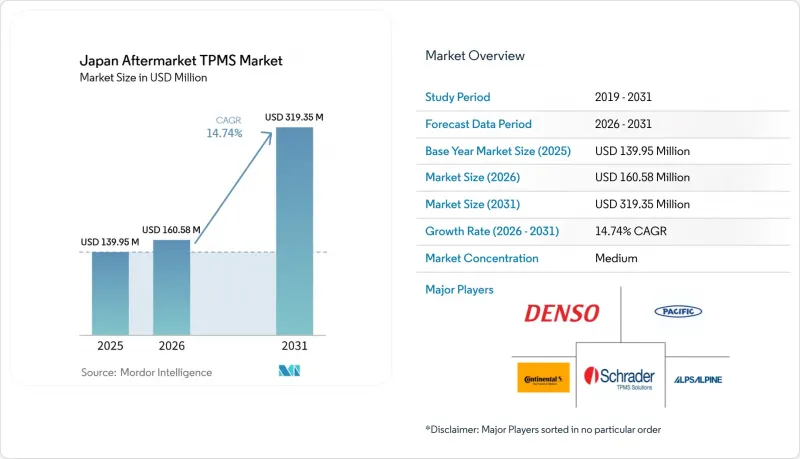
This report is Segmented by Type (Direct TPMS, Indirect TPMS), Technology Integration (Stand-Alone TPMS Units, Smart/Connected TPMS), Vehicle Type (Passenger Cars, Commercial Vehicles), and Distribution Channel (Offline, Online). The Market Forecasts are Provided in Terms of Value (USD) and Volume (Units).
Japan Aftermarket TPMS Market Trends and Insights
Mandatory TPMS Fitment Drives Regulatory Compliance Wave
All new passenger cars must now be equipped with TPMS under a mandate from the MLIT . This ruling not only brings the technology into the mainstream but also ignites interest in retrofitting older models, particularly those flagged during Shaken inspections. The retrofitting market is expected to grow as vehicle owners seek to comply with regulations and enhance safety features. Meanwhile, the Ministry of Internal Affairs and Communications has approved a shift in radio-frequency standards. This change enables suppliers to optimize operations with a standardized global sensor design, significantly reducing re-engineering expenses and broadening SKU availability. Additionally, this shift supports the development of more advanced TPMS solutions, fostering innovation in the market. As consumers become more familiar with TPMS, the educational hurdles that once slowed its adoption fade, accelerating its adoption. Service centers are increasingly treating TPMS as a standard safety feature, seamlessly integrating it during tire changes. The growing emphasis on safety and regulatory compliance is expected to further drive TPMS adoption across various vehicle segments.
Aging Vehicle Fleet Intensifies Replacement Cycles
Households often keep cars for extended periods, leading to many sensors nearing battery exhaustion. Pacific Industrial designs its sensors with a set lifespan. Yet, in hotter climates and on busier routes, this lifespan diminishes, frequently resulting in replacements during routine tire rotations. This issue is particularly significant as sensors play a critical role in vehicle safety and performance, making timely replacements essential. In rural regions, where households typically own multiple vehicles, this trend boosts recurring revenue, as each car's sensor replacement occurs at staggered intervals. Additionally, the growing adoption of advanced driver-assistance systems (ADAS) further emphasizes the importance of maintaining functional sensors, as these systems rely heavily on sensor accuracy and reliability.
High Retrofit Costs Create Market Access Barriers
Sensor kits for vehicles without existing TPMS wiring can cost a significant outlay for cash-strapped owners, especially in rural prefectures where disposable incomes lag national averages. The price burden is heavier on fleet operators managing dozens of aging trucks: aggregate retrofit costs quickly climb into millions of yen, delaying widespread adoption. Some workshops offset expenses through government subsidies, but the overall headwind still trims the Japan aftermarket TPMS market growth rate, particularly in segments dominated by price-sensitive customers.
Other drivers and restraints analyzed in the detailed report include:
- E-commerce Transformation Reshapes Distribution Dynamics
- Consumer Safety Consciousness Drives Premium Adoption
- Import Competition Intensifies Pricing Pressures
For complete list of drivers and restraints, kindly check the Table Of Contents.
Segment Analysis
Direct systems captured 80.33% of the Japanese aftermarket TPMS market in 2025, reflecting owner demand for precise per-wheel readings. The Japan aftermarket TPMS market size for direct solutions is forecast to expand at a 14.62% CAGR between 2026 and 2031. While indirect TPMS remains a cost-effective retrofit for cars equipped with ABS, its appeal diminishes for fleets prioritizing accuracy and visibility across multiple tires.
Denso's targeting additional vehicles with its "First Time Fit" initiative highlights OEM suppliers' shift towards replacement cycles amidst stagnating new-car volumes. The introduction of universal programmable sensors has further reduced per-unit prices, challenging the historical cost advantage of indirect systems.
In 2025, stand-alone units accounted for 68.22% of the revenue. However, connected variants are set to surge at a 15.83% CAGR, buoyed by innovations like Sumitomo Rubber's ESP 3.0 and Schrader's AirCheck BLE. These advancements are driving the adoption of connected technologies in the market, offering enhanced functionality and real-time data insights.
Commercial operators already using 4G telematics modules can seamlessly stream tire data with only minor hardware additions, speeding up upgrades. This capability reduces operational downtime and improves fleet management efficiency. While smartphone pairing clarifies the value of these sensors for consumers, a growing subscription fatigue limits deeper market penetration. Despite this, the convenience and accessibility provided by smartphone integration continue to attract a significant portion of the consumer base.
Complete Report Scope:
- By Type
- Direct TPMS
- Indirect TPMS
- By Technology Integration
- Stand-alone TPMS Units
- Smart/Connected TPMS
- By Vehicle Type
- Passenger Cars
- Hatchbacks
- Sedans
- SUVs and MUVs
- Commercial Vehicles
- Light Commercial Vehicles
- Medium and Heavy Commercial Vehicles
- Buses and Coaches
- Passenger Cars
- By Distribution Channel
- Offline (Auto-parts stores, specialty shops, service centers)
- Online (OEM websites/Apps, e-commerce platforms)
List of Companies Covered in this Report:
- Denso Corporation
- Pacific Industrial Co., Ltd.
- Alps Alpine Co., Ltd.
- Continental AG
- Schrader TPMS Solutions (Sensata Technologies, Inc.)
- Huf Hulsbeck & Furst GmbH & Co. KG
- CUB Elecparts Inc.
- NXP Semiconductors N.V.
- ATEQ TPMS Tools
- Steelmate Co., Ltd.
- Orange Electronic Co., Ltd.
- Salutica Allied Solutions (FOBO)
- Bartec Auto ID Ltd.
- Bridgestone Corporation
- Autobacs Seven Co., Ltd.
- Yellow Hat Ltd.
Additional Benefits:
- The market estimate (ME) sheet in Excel format
- 3 months of analyst support
TABLE OF CONTENTS
1 Introduction
- 1.1 Study Assumptions & Market Definition
- 1.2 Scope of the Study
2 Research Methodology
3 Executive Summary
4 Market Landscape
- 4.1 Market Overview
- 4.2 Market Drivers
- 4.2.1 Mandatory TPMS Fitment on New Cars
- 4.2.2 Aging Vehicle Parc Increasing Replacement Demand
- 4.2.3 Expansion of E-Commerce Auto-Parts Platforms
- 4.2.4 Rising Consumer Focus on Fuel Efficiency and Safety
- 4.2.5 Smart-City Parking Systems Using TPMS Data
- 4.2.6 Subscription-Based Telematics Bundles Incl. TPMS
- 4.3 Market Restraints
- 4.3.1 High Retrofit Costs for Older Vehicles
- 4.3.2 Intense Price Competition from Low-Cost Imports
- 4.3.3 Proliferation of Counterfeit Sensors
- 4.3.4 MLIT Spectrum Re-Allocation Compliance Costs
- 4.4 Value / Supply-Chain Analysis
- 4.5 Regulatory Landscape
- 4.6 Technological Outlook
- 4.7 Porter's Five Forces
- 4.7.1 Threat of New Entrants
- 4.7.2 Bargaining Power of Suppliers
- 4.7.3 Bargaining Power of Buyers
- 4.7.4 Threat of Substitutes
- 4.7.5 Competitive Rivalry
5 Market Size & Growth Forecasts (Value (USD) and Volume (Units))
- 5.1 By Type
- 5.1.1 Direct TPMS
- 5.1.2 Indirect TPMS
- 5.2 By Technology Integration
- 5.2.1 Stand-alone TPMS Units
- 5.2.2 Smart/Connected TPMS
- 5.3 By Vehicle Type
- 5.3.1 Passenger Cars
- 5.3.1.1 Hatchbacks
- 5.3.1.2 Sedans
- 5.3.1.3 SUVs and MUVs
- 5.3.2 Commercial Vehicles
- 5.3.2.1 Light Commercial Vehicles
- 5.3.2.2 Medium and Heavy Commercial Vehicles
- 5.3.2.3 Buses and Coaches
- 5.3.1 Passenger Cars
- 5.4 By Distribution Channel
- 5.4.1 Offline (Auto-parts stores, specialty shops, service centers)
- 5.4.2 Online (OEM websites/Apps, e-commerce platforms)
6 Competitive Landscape
- 6.1 Market Concentration
- 6.2 Strategic Moves
- 6.3 Market Share Analysis
- 6.4 Company Profiles (Includes Global Level Overview, Market Level Overview, Core Segments, Financials as Available, Strategic Information, Market Rank/Share for Key Companies, Products and Services, SWOT Analysis, and Recent Developments)
- 6.4.1 Denso Corporation
- 6.4.2 Pacific Industrial Co., Ltd.
- 6.4.3 Alps Alpine Co., Ltd.
- 6.4.4 Continental AG
- 6.4.5 Schrader TPMS Solutions (Sensata Technologies, Inc.)
- 6.4.6 Huf Hulsbeck & Furst GmbH & Co. KG
- 6.4.7 CUB Elecparts Inc.
- 6.4.8 NXP Semiconductors N.V.
- 6.4.9 ATEQ TPMS Tools
- 6.4.10 Steelmate Co., Ltd.
- 6.4.11 Orange Electronic Co., Ltd.
- 6.4.12 Salutica Allied Solutions (FOBO)
- 6.4.13 Bartec Auto ID Ltd.
- 6.4.14 Bridgestone Corporation
- 6.4.15 Autobacs Seven Co., Ltd.
- 6.4.16 Yellow Hat Ltd.
7 Market Opportunities & Future Outlook
- 7.1 White-space & Unmet-need Assessment

