PUBLISHER: Mordor Intelligence | PRODUCT CODE: 2117425

PUBLISHER: Mordor Intelligence | PRODUCT CODE: 2117425
India SUV - Market Share Analysis, Industry Trends & Statistics, Growth Forecasts (2026 - 2031)
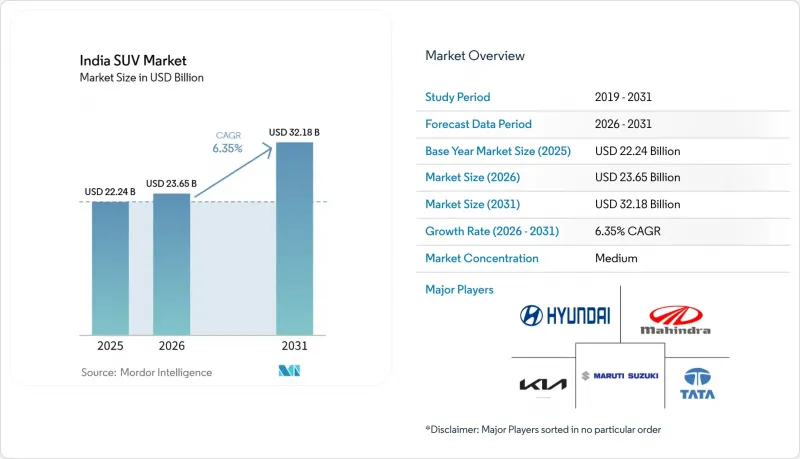
According to Mordor Intelligence, the India SUV market size is expected to increase from USD 22.24 billion in 2025 to USD 23.65 billion in 2026 and reach USD 32.18 billion by 2031, growing at a CAGR of 6.35% over 2026-2031.
This report is Segmented by Vehicle Size (Compact, Mid-Size, and Full-Size), Fuel Type (Petrol, Diesel, Hybrid, and Electric), Drivetrain (2WD, 4WD, and AWD), End-User (Personal Use and Commercial Use), and Seating Capacity (5-Seater and 7-Seater and Above). The Market Forecasts are Provided in Terms of Value (USD) and Volume (Units).
India SUV Market Trends and Insights
Surging Middle-Class Disposable Income and Urbanization
India's middle class is set to boost discretionary spending, particularly on aspirational purchases like SUVs. The Prime Minister's Economic Advisory Council noted a significant uptick in vehicle ownership across both rural and urban landscapes. As urbanization progresses, there's a discernible shift towards vehicles that seamlessly blend city agility with recreational versatility. Compact SUVs are now favored for their elevated ground clearance, status enhancement, and shorter loan tenures. Moreover, younger first-time buyers, buoyed by attractive interest rates, are bypassing hatchbacks altogether.
Favorable GST Structure for Sub-4-Meter "Compact" SUVs
The GST Council reduced the compensation cess on sub-4-meter SUVs, lowering the effective tax burden and narrowing the price gap with hatchbacks. Compact SUV retail volumes grew significantly, according to the Federation of Automobile Dealers Associations . OEMs with strong sub-4-meter portfolios, such as Maruti, Tata, Hyundai, and Mahindra, passed savings to consumers or reinvested in additional features, reinforcing the India SUV market's shift toward compact models.
Volatile Fuel Prices and Subsidy Withdrawal on Diesel
Fuel price fluctuations and the slow phasing out of diesel subsidies are casting a shadow of uncertainty over SUV purchases, especially for diesel models that have long been the segment's frontrunners. While recent trends have shown a rise in diesel car sales, the Energy Transition Advisory Committee's push to ban diesel vehicles in cities with large populations is already swaying consumer choices. With the impending withdrawal of diesel subsidies, running costs are poised to climb, prompting fleet operators to reconsider their powertrain selections. Even though diesel continues to benefit high-mileage users, its market share is poised to dwindle as cleaner alternatives gain traction.
Other drivers and restraints analyzed in the detailed report include:
- OEM Localization Lowering Sticker Prices & TCO
- Growing Affinity For ADAS And Connected-Car Features
- Stringent CAFE II and RDE Emission Norms Escalating Production Cost
For complete list of drivers and restraints, kindly check the Table Of Contents.
Segment Analysis
Compact SUVs generated 49.33% of the Indian SUV market share in 2025, and the Indian SUV market size for this segment is projected to rise at a 7.35% CAGR through 2031. A recent cess cut gave COMPACT SUVs a price edge. This advantage allowed Tata's Nexon, Maruti's Brezza, and Hyundai's Venue to dominate, clinching a significant share of the top retail positions. With Bharat NCAP awarding 5-star ratings to leading models, safety features like side- and pole-impact protection have become essential for buyers. As a result, mid-cycle facelifts are now standardizing six airbags and electronic stability control.
Even with aspirations for a premium image, mid-size SUVs find themselves in a higher tax bracket, stunting their volume growth. Meanwhile, full-size models face limitations due to their high entry prices. In metro India, where parking is a premium, there's a noticeable shift in demand towards sub-4-meter models, which conveniently fit into standard parking spaces. Consequently, OEM engineering strategies focus on optimizing interior space, enhancing infotainment, and bolstering safety features within the 4-meter limit, while safeguarding profit margins and avoiding higher GST brackets.
Petrol units accounted for 61.11% of the 2025 revenue share, benefiting from lower entry prices and extensive service networks. As the retail price gap between diesel and petrol tightened, diesel's share dropped significantly. Additionally, the inclusion of selective catalytic reduction hardware increased the cost of each vehicle. The Indian SUV market for electric variants remains small in absolute terms, yet electric SUVs are projected to post an 11.65% CAGR through 2031, as state subsidies and battery costs decline significantly.
Hybrid SUVs hold a niche market share and are priced higher than their petrol counterparts, yet they offer significantly better fuel economy. Looking ahead, decreasing battery costs and OEMs' adoption of skateboard platforms are expected to reduce acquisition premiums. This development is likely to make total cost of ownership (TCO) calculations more favorable for electric powertrains, particularly in high-mileage scenarios.
Complete Report Scope:
- By Vehicle Size
- Compact (Up to 4 m)
- Mid-size (4 to 4.6 m)
- Full-size (Above 4.6 m)
- By Fuel Type
- Petrol
- Diesel
- Hybrid
- Electric
- By Drivetrain
- 2WD
- 4WD
- AWD
- By End-User
- Personal Use
- Commercial Use
- By Seating Capacity
- 5-Seater
- 7-Seater and above
List of Companies Covered in this Report:
- Maruti Suzuki India Ltd.
- Hyundai Motor India Ltd.
- Tata Motors Ltd.
- Mahindra & Mahindra Ltd.
- Kia India Pvt. Ltd.
- Toyota Kirloskar Motor Pvt. Ltd.
- JSW MG Motor India Pvt. Ltd.
- Renault India Pvt. Ltd.
- Honda Cars India Ltd.
- Jeep India (Stellantis)
- Skoda Auto Volkswagen India Pvt. Ltd.
- Nissan Motor India Pvt. Ltd.
- BYD India Pvt. Ltd.
- Citroen India (Stellantis)
- Volvo Car India Pvt. Ltd.
- Mercedes-Benz India Pvt. Ltd.
- BMW India Pvt. Ltd.
- Audi India Pvt. Ltd.
- Jaguar Land Rover India Ltd.
- Isuzu Motors India Pvt. Ltd.
Additional Benefits:
- The market estimate (ME) sheet in Excel format
- 3 months of analyst support
TABLE OF CONTENTS
1 Introduction
- 1.1 Study Assumptions and Market Definition
- 1.2 Scope of the Study
2 Research Methodology
3 Executive Summary
4 Market Landscape
- 4.1 Market Overview
- 4.2 Market Drivers
- 4.2.1 Surging Middle-Class Disposable Income And Urbanization
- 4.2.2 Favorable GST Structure for Sub-4-Meter "Compact" SUVs
- 4.2.3 OEM Localisation Lowering Sticker Prices and TCO
- 4.2.4 Rapid Expansion of National Highway and Expressway Network
- 4.2.5 New-Age Digital Retail Channels Widening Rural Reach
- 4.2.6 Growing Affinity for ADAS and Connected-Car Features As Differentiators
- 4.3 Market Restraints
- 4.3.1 Volatile Fuel Prices and Subsidy Withdrawal On Diesel
- 4.3.2 Stringent CAFE II and RDE Emission Norms Escalating Production Cost
- 4.3.3 Under-Developed High-Power Public EV Charging Backbone
- 4.3.4 Persistent Semiconductor Shortages Limiting Trim Availability
- 4.4 Value / Supply-Chain Analysis
- 4.5 Regulatory Landscape
- 4.6 Technological Outlook
- 4.7 Porter's Five Forces Analysis
- 4.7.1 Threat of New Entrants
- 4.7.2 Bargaining Power of Suppliers
- 4.7.3 Bargaining Power of Buyers
- 4.7.4 Threat of Substitutes
- 4.7.5 Intensity of Competitive Rivalry
5 Market Size and Growth Forecasts (Value (USD) and Volume (Units))
- 5.1 By Vehicle Size
- 5.1.1 Compact (Up to 4 m)
- 5.1.2 Mid-size (4 to 4.6 m)
- 5.1.3 Full-size (Above 4.6 m)
- 5.2 By Fuel Type
- 5.2.1 Petrol
- 5.2.2 Diesel
- 5.2.3 Hybrid
- 5.2.4 Electric
- 5.3 By Drivetrain
- 5.3.1 2WD
- 5.3.2 4WD
- 5.3.3 AWD
- 5.4 By End-User
- 5.4.1 Personal Use
- 5.4.2 Commercial Use
- 5.5 By Seating Capacity
- 5.5.1 5-Seater
- 5.5.2 7-Seater and above
6 Competitive Landscape
- 6.1 Market Concentration
- 6.2 Strategic Moves
- 6.3 Market Share Analysis
- 6.4 Company Profiles (Includes Global Level Overview, Market Level Overview, Core Segments, Financials as Available, Strategic Information, Market Rank/Share for Key Companies, Products and Services, and Recent Developments)
- 6.4.1 Maruti Suzuki India Ltd.
- 6.4.2 Hyundai Motor India Ltd.
- 6.4.3 Tata Motors Ltd.
- 6.4.4 Mahindra & Mahindra Ltd.
- 6.4.5 Kia India Pvt. Ltd.
- 6.4.6 Toyota Kirloskar Motor Pvt. Ltd.
- 6.4.7 JSW MG Motor India Pvt. Ltd.
- 6.4.8 Renault India Pvt. Ltd.
- 6.4.9 Honda Cars India Ltd.
- 6.4.10 Jeep India (Stellantis)
- 6.4.11 Skoda Auto Volkswagen India Pvt. Ltd.
- 6.4.12 Nissan Motor India Pvt. Ltd.
- 6.4.13 BYD India Pvt. Ltd.
- 6.4.14 Citroen India (Stellantis)
- 6.4.15 Volvo Car India Pvt. Ltd.
- 6.4.16 Mercedes-Benz India Pvt. Ltd.
- 6.4.17 BMW India Pvt. Ltd.
- 6.4.18 Audi India Pvt. Ltd.
- 6.4.19 Jaguar Land Rover India Ltd.
- 6.4.20 Isuzu Motors India Pvt. Ltd.
7 Market Opportunities and Future Outlook
- 7.1 White-space and Unmet-Need Assessment

