PUBLISHER: Mordor Intelligence | PRODUCT CODE: 2117428

PUBLISHER: Mordor Intelligence | PRODUCT CODE: 2117428
Automotive Regenerative Braking System - Market Share Analysis, Industry Trends & Statistics, Growth Forecasts (2026 - 2031)
According to Mordor Intelligence, the automotive regenerative braking system market size reached USD 7.43 billion in 2025 and is expected to reach USD 8.29 billion in 2026 and USD 14.28 billion by 2031, registering a CAGR of 11.51% during the forecast period (2026-2031).
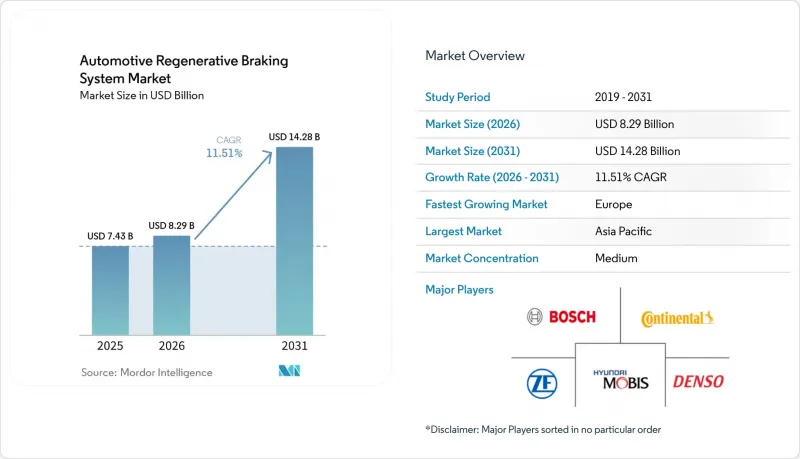
This report is Segmented by Technology Type (Electromechanical Braking and More), Component Type (Battery Packs and More), Vehicle Type (Passenger Cars and More), Distribution Channel (OEM and Aftermarket), and Geography. The Market Forecasts are Provided in Terms of Value (USD) and Volume (Units).
Global Automotive Regenerative Braking System Market Trends and Insights
Surge in Electric and Hybrid Vehicle Sales
Growing deliveries of battery-electric and plug-in hybrids translate almost one-for-one into demand for advanced recuperation hardware, as these drivetrains rely on regenerative braking to meet advertised range targets. ZF and Tevva documented up to 180 kW of regenerative power on a 7.5-ton truck, quadrupling energy capture versus legacy air systems and extending operating range to 227 km . Permanent-magnet synchronous motors dominate traction because their high power density enables compact packaging, and 2026 test work confirmed that adaptive brake-force allocation achieves 95% recovery efficiency in rear-drive layouts. OEMs that map motor efficiency in real time and optimize torque distribution deliver measurable range gains in a market where every extra kilometer influences purchase decisions. Fleet operators, focused on brake-wear savings and fuel offsets, now specify regen-capable systems at the ordering stage, shifting share from retrofit aftermarket kits to factory-installed solutions.
Stringent Global Emission Norms and Incentives
UN Regulation No. 179, which takes effect in March 2026, introduced brake-dust coefficients that credit vehicles with high regenerative-brake shares, effectively reducing reported PM10 emissions by up to 85% for battery-electric platforms. Bosch internal tests show that vacuum-independent regen systems can cut brake dust by more than 95% because generator torque replaces friction in most deceleration events . Euro 7 is set to embed the same methodology across the European Union by year-end 2026, prompting OEMs to maximize recuperation percentages rather than redesign friction materials. In North America, California Air Resources Board proposals mirror European drafts, signaling convergence that accelerates global adoption.
High Upfront Cost of Regen Hardware
Electromechanical actuators, high-voltage harnesses, and ECUs significantly increase the bill of materials, making it more challenging for low-mileage commuters to achieve cost-effectiveness. In mid-2025, Continental divested its Italian drum-brake plant, emphasizing the declining profitability of traditional friction products and the company's strategic shift towards electric braking systems. The trajectory of cost reduction is closely tied to scaling up the production of permanent-magnet motors and silicon carbide inverters. Until production volumes reach a higher level, entry-level vehicles in markets sensitive to pricing are expected to continue opting for more economical hydraulic alternatives.
Other drivers and restraints analyzed in the detailed report include:
- OEM Migration to Brake-by-Wire Architectures
- Rapid Battery-Cost Declines Boosting ROI
- Rare-Earth Magnet and SiC Chip Supply Risks
For complete list of drivers and restraints, kindly check the Table Of Contents.
Segment Analysis
Electromechanical braking accounted for 57.83% of revenue in 2025 as OEMs adopted dry brake-by-wire to eliminate fluid and residual drag, boosting coast-down range and lowering service costs. This share of the automotive regenerative braking system market reflects structural advantages in sealed actuators that eliminate lines and fluid bleeding while enabling finer torque modulation. Electromechanical units meet new UN Regulation No. 13 predictive energy-management mandates through integrated ECUs, sustaining adoption momentum. Hydraulic designs remain on front axles of hybrids to guarantee low-temperature bite at minimal incremental cost. Pneumatic braking systems, favored on Class 8 tractors, will post the fastest 11.53% CAGR because compressed-air infrastructure already exists, lowering integration complexity.
Integration of automated torque blending keeps stability systems active during ABS events, recovering 0.26-1.01% SOC per stop even under slip control. Suppliers benchmark regenerative smoothness using torque-ripple metrics; Halbach motors reduce ripple by 16.6%, minimizing pedal-feel anomalies. The automotive regenerative braking system market size for electromechanical platforms will therefore expand in line with BEV output spikes across China and Europe, with regulatory credits further tilting fleet economics toward dry-brake solutions.
Electric motors account for 44.57% of component revenue in 2025 and advance at a CAGR of 11.57% through 2031, driven by investments in high-density permanent-magnet synchronous machines that support generator torque. Variable-voltage control increases inverter efficiency by 12.8% and motor efficiency by 0.77%, improving net energy recovery per mile. Axial-flux topologies deliver 30-40% higher torque density than radial units, making them ideal for wheel-end packaging. Battery packs remain the costliest line item, followed by ECUs that manage torque split. Brake pads and calipers continue to serve as safety redundancies, although their duty cycle is declining.
Dual-skewed Halbach arrays enhance thermal robustness and demagnetization resistance at 120 °C, critical for repeated high-power events. The pace of innovation keeps the automotive regenerative braking system market size weighted toward motor and inverter lines. At the same time, flywheel modules enter niche bus programs that require instant megawatt-scale pulses on steep grades.
Complete Report Scope:
- By Technology Type
- Electromechanical Braking
- Hydraulic Braking
- Pneumatic Braking
- By Component Type
- Battery Packs
- Electric Motor
- Brake Pads and Calipers
- Electronic Control Unit (ECU)
- Flywheel
- By Vehicle Type
- Passenger Cars
- Light Commercial Vehicles (LCVs)
- Medium and Heavy Commercial Vehicles (MHCVs)
- By Distribution Channel
- OEM
- Aftermarket
- By Geography
- North America
- United States
- Canada
- Rest of North America
- South America
- Brazil
- Argentina
- Rest of South America
- Europe
- United Kingdom
- Germany
- Spain
- Italy
- France
- Russia
- Rest of Europe
- Asia-Pacific
- India
- China
- Japan
- South Korea
- Rest of Asia-Pacific
- Middle East and Africa
- United Arab Emirates
- Saudi Arabia
- Turkey
- Egypt
- South Africa
- Rest of Middle East and Africa
- North America
Geography Analysis
Asia-Pacific generated 45.41% global revenue in 2025, underpinned by China's BEV volume and vertically integrated rare-earth supply. ZF began producing electric park brakes in India in July 2025 to serve a domestic OEM's new EV line, signaling momentum in localization. Japan and South Korea contribute to leading silicon-carbide fabrication and algorithm research, which is disseminated globally via platform exports. In contrast, emerging Southeast Asian markets focus on cost-optimized hydraulic assist systems that meet baseline regen targets.
Europe will advance at an 11.67% CAGR through 2031, the fastest pace among regions, propelled by UN Regulation No. 179's brake-dust coefficients, which reward high regen shares. Germany, France, and the U.K. attract early brake-by-wire launches; Bosch's 2,050-mile Arctic Circle test in late 2025 validated hydraulic-less control stacks across extreme climates. Eastern Europe lags as EV affordability curbs penetration, though component plants in Poland and Hungary ramp export kits for Western OEMs.
North America ranks second in value, favoring hybrid setups that pair rear electromechanical modules with front hydraulic calipers to satisfy parking-brake torque on pickups. California incentive frameworks allow fleets to monetize CO2 savings, accelerating Class 8 retrofits. South America and the Middle East & Africa remain nascent but post double-digit growth as local assembly attracts tax credits. Overall, the automotive regenerative braking system market sees regional revenue converge by 2031 as regulations harmonize and supply chains globalize.
- Robert Bosch GmbH
- Continental AG
- ZF Friedrichshafen AG
- DENSO Corporation
- Hyundai Mobis Co., Ltd.
- Aisin Corporation
- Advics Co., Ltd.
- BorgWarner Inc.
- Eaton Corporation plc
- Valeo SA
- Hitachi Astemo Ltd.
- Knorr-Bremse AG
- Skeleton Technologies Group OU
- Brembo SpA
- Toyota Motor Corporation
- Tesla Inc.
Additional Benefits:
- The market estimate (ME) sheet in Excel format
- 3 months of analyst support
TABLE OF CONTENTS
1 Introduction
- 1.1 Study Assumptions & Market Definition
- 1.2 Scope of the Study
2 Research Methodology
3 Executive Summary
4 Market Landscape
- 4.1 Market Overview
- 4.2 Market Drivers
- 4.2.1 Surge in Electric and Hybrid Vehicle Sales
- 4.2.2 Stringent Global Emission Norms and Incentives
- 4.2.3 OEM Migration to Brake-by-Wire Architectures
- 4.2.4 Rapid Battery-Cost Declines Boosting ROI
- 4.2.5 Data-Driven Fleet Optimization via Regen-Brake Telemetry
- 4.2.6 Integration with Carbon-Credit Trading Platforms
- 4.3 Market Restraints
- 4.3.1 High Upfront Cost of Regen Brake Hardware
- 4.3.2 Rare-Earth Magnet and SiC Chip Supply Risks
- 4.3.3 Thermal-Load Limits in Heavy-Duty Duty-Cycles
- 4.3.4 Added Vehicle Weight/Packaging Complexity
- 4.4 Value / Supply-Chain Analysis
- 4.5 Regulatory Landscape
- 4.6 Technological Outlook
- 4.7 Porter's Five Forces
- 4.7.1 Threat of New Entrants
- 4.7.2 Bargaining Power of Suppliers
- 4.7.3 Bargaining Power of Buyers
- 4.7.4 Threat of Substitutes
- 4.7.5 Competitive Rivalry
5 Market Size & Growth Forecasts (Value (USD) and Volume (Units))
- 5.1 By Technology Type
- 5.1.1 Electromechanical Braking
- 5.1.2 Hydraulic Braking
- 5.1.3 Pneumatic Braking
- 5.2 By Component Type
- 5.2.1 Battery Packs
- 5.2.2 Electric Motor
- 5.2.3 Brake Pads and Calipers
- 5.2.4 Electronic Control Unit (ECU)
- 5.2.5 Flywheel
- 5.3 By Vehicle Type
- 5.3.1 Passenger Cars
- 5.3.2 Light Commercial Vehicles (LCVs)
- 5.3.3 Medium and Heavy Commercial Vehicles (MHCVs)
- 5.4 By Distribution Channel
- 5.4.1 OEM
- 5.4.2 Aftermarket
- 5.5 By Geography
- 5.5.1 North America
- 5.5.1.1 United States
- 5.5.1.2 Canada
- 5.5.1.3 Rest of North America
- 5.5.2 South America
- 5.5.2.1 Brazil
- 5.5.2.2 Argentina
- 5.5.2.3 Rest of South America
- 5.5.3 Europe
- 5.5.3.1 United Kingdom
- 5.5.3.2 Germany
- 5.5.3.3 Spain
- 5.5.3.4 Italy
- 5.5.3.5 France
- 5.5.3.6 Russia
- 5.5.3.7 Rest of Europe
- 5.5.4 Asia-Pacific
- 5.5.4.1 India
- 5.5.4.2 China
- 5.5.4.3 Japan
- 5.5.4.4 South Korea
- 5.5.4.5 Rest of Asia-Pacific
- 5.5.5 Middle East and Africa
- 5.5.5.1 United Arab Emirates
- 5.5.5.2 Saudi Arabia
- 5.5.5.3 Turkey
- 5.5.5.4 Egypt
- 5.5.5.5 South Africa
- 5.5.5.6 Rest of Middle East and Africa
- 5.5.1 North America
6 Competitive Landscape
- 6.1 Market Concentration
- 6.2 Strategic Moves
- 6.3 Market Share Analysis
- 6.4 Company Profiles (includes Global Level Overview, Market Level Overview, Core Segments, Financials as Available, Strategic Information, Market Rank/Share for Key Companies, Products and Services, SWOT Analysis, and Recent Developments)
- 6.4.1 Robert Bosch GmbH
- 6.4.2 Continental AG
- 6.4.3 ZF Friedrichshafen AG
- 6.4.4 DENSO Corporation
- 6.4.5 Hyundai Mobis Co., Ltd.
- 6.4.6 Aisin Corporation
- 6.4.7 Advics Co., Ltd.
- 6.4.8 BorgWarner Inc.
- 6.4.9 Eaton Corporation plc
- 6.4.10 Valeo SA
- 6.4.11 Hitachi Astemo Ltd.
- 6.4.12 Knorr-Bremse AG
- 6.4.13 Skeleton Technologies Group OU
- 6.4.14 Brembo SpA
- 6.4.15 Toyota Motor Corporation
- 6.4.16 Tesla Inc.
7 Market Opportunities & Future Outlook
- 7.1 White-space & Unmet-Need Assessment

