PUBLISHER: Mordor Intelligence | PRODUCT CODE: 2117440

PUBLISHER: Mordor Intelligence | PRODUCT CODE: 2117440
Hyper Car - Market Share Analysis, Industry Trends & Statistics, Growth Forecasts (2026 - 2031)
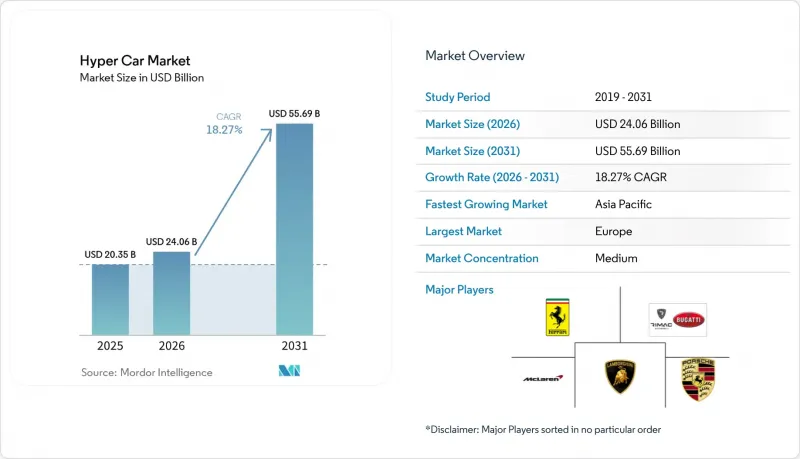
According to Mordor Intelligence, the hyper car market size is expected to increase from USD 20.35 billion in 2025 to USD 24.06 billion in 2026 and reach USD 55.69 billion by 2031, growing at a CAGR of 18.27% during the forecast (2026-2031).
This report is Segmented by Propulsion Type (ICE and More), End Use (Private and Racing), Vehicle Type (Coupe, Convertible, and Roadster), Engine Capacity (Compact, Mid-Size, and Full-Size), and Geography. The Market Forecasts are Provided in Terms of Value (USD) and Volume (Units).
Global Hyper Car Market Trends and Insights
Surge in Ultra-High-Net-Worth Individuals in Asia-Pacific & Middle East
In the Gulf and prominent Asian financial hubs, liquid wealth is reshaping strategies for limited-run flagship allocations. Recently, the United Arab Emirates has seen a significant influx of new millionaires and is positioned at the center of a substantial intergenerational wealth transfer projected over the coming decades. In response, brands have unveiled bespoke showrooms in Dubai and Riyadh, featuring gold inlay packages and upholstery tailored to regional tastes. Per-capita luxury car penetration in the UAE now surpasses that of North America, as evidenced by the region's higher deliveries compared to the United States. Additionally, final-assembly satellites have emerged in regional free-trade zones, capitalizing on import-duty savings and fostering closer ties with customers .
Rapid Electrification & Hybridization of Hypercars
Hybrid systems have evolved from mere compliance measures to pivotal performance enhancers. Ferrari's F80 pairs a powerful twin-turbo V6 engine with a high-performance electric motor. Meanwhile, Bugatti's Tourbillon integrates an advanced electric drivetrain with its formidable V16 engine. This synergy allows instant electric torque to mitigate turbo lag and enables sophisticated software-controlled torque vectoring. As of late 2026, Euro 7 regulations will mandate real-world particle-number testing, pushing automakers towards plug-in platforms capable of completing city cycles without activating the engine. While charging infrastructure is still catching up, the advent of advanced battery technology offers the tantalizing prospect of rapid top-ups, but only at select high-capacity charging stations .
Extremely High R&D and Manufacturing Cost Base
Crafting a hypercar is a capital-intensive endeavor, often not recouped over limited production runs. Czinger's 21C, which requires extensive hand assembly and incorporates numerous 3D-printed parts, commands a significant entry price. Bugatti's Tourbillon, with plans for modest annual production through the end of the decade, finds itself vulnerable to currency and interest-rate fluctuations on its income statement. Meanwhile, Porsche faced a substantial impairment in the mid-2020s due to setbacks with its dedicated BEV platform, highlighting the inherent risks even established brands encounter.
Other drivers and restraints analyzed in the detailed report include:
- Breakthroughs in Lightweight Composite & Carbotanium Structures
- AI-Driven Aerodynamic and Digital-Twin Optimization Shortening Development Cycles
- Supply-Chain Scarcity of Aerospace-Grade Composites & Titanium
For complete list of drivers and restraints, kindly check the Table Of Contents.
Segment Analysis
Battery-electric variants are projected to log an 18.29% CAGR to 2031, the fastest climb among powertrains. Internal-combustion architectures still held 58.71% Hypercar market share in 2025, yet momentum favors hybrids that add electric torque for lap-time gains without retiring signature V8 or V12 soundtracks. Ferrari and Bugatti now publish combined system horsepower rather than engine figures alone, signaling the strategic pivot.
Pure BEV flagships like Rimac's Nevera remain niche at 150 units each, but record laps and 800-volt fast-charge capability demonstrate that silence no longer means slower. Infrastructure coverage and silicon-carbide inverter costs moderate near-term uptake, yet Euro 7 compliance pressures ensure dual-motor or tri-motor setups appear in every new product plan through 2031.
Private collectors accounted 83.37% of 2025 deliveries. They value provenance and scarcity, prompting OEMs to cap production runs at below 500 units and to request multi-year deposits. McLaren's W1 allocation closed inside 48 hours, validating the approach.
Racing applications, however, are forecast to increase at an 18.31% CAGR. Updated FIA Le Mans Hypercar rules require road-legal counterparts, moving power-unit learning straight from the 24-hour circuit to suburban garages. Fourteen makers now contest the World Endurance grid, up from eight in 2023, and revenue streams from spare parts and technical updates turn motorsport into a self-funding laboratory.
Complete Report Scope:
- By Propulsion Type
- ICE
- Hybrid
- Battery Electric
- By End Use
- Private
- Racing
- By Vehicle Type
- Coupe
- Convertible
- Roadster
- By Engine Capacity
- Compact (Less than 1500 cc)
- Mid-size (1500-2500 cc)
- Full-size (More than 2500 cc)
- By Geography
- North America
- United States
- Canada
- Rest of North America
- South America
- Brazil
- Argentina
- Rest of South America
- Europe
- United Kingdom
- Germany
- Spain
- Italy
- France
- Russia
- Rest of Europe
- Asia-Pacific
- India
- China
- Japan
- Indonesia
- Malaysia
- Singapore
- Vietnam
- Philippines
- South Korea
- Rest of Asia-Pacific
- Middle East and Africa
- United Arab Emirates
- Saudi Arabia
- Turkey
- Egypt
- South Africa
- Rest of Middle East and Africa
- North America
Geography Analysis
Europe accounted for 36.56% of 2025 revenue, anchored by Italy's Motor Valley and the United Kingdom's advanced composite hubs. Euro 7 implementation in November 2026 adds new durability and particulate requirements on top of existing tailpipe limits, raising per-unit compliance costs by up to 20%. Heritage factories in Maranello and Sant'Agata respond by shifting to plug-in architectures that allow zero-emission city cruising while retaining trademark exhaust notes on alpine passes. British engineering remains resilient despite Brexit friction, leveraging university clusters to feed skilled labor to McLaren and Aston Martin. German OEMs exploit parent-group scale by sharing 800-volt platforms across volume models to amortize research costs.
Asia-Pacific is on track for an 18.37% CAGR to 2031, the fastest of any region. New millionaires in China, Singapore, and the Gulf funnel deposits toward hypercar allocations for years in advance. Dedicated boutiques in Shanghai and Dubai now feature region-specific configurations, including gold-leaf interiors and local language infotainment skins. Import duties in China hover at 25% for engines above 3.0 liters, nudging some makers to explore bonded-zone assembly to shave tariff exposure. Singapore's zero-growth vehicle policy forces astronomical certificate costs, yet electric hypercars escape surtax, giving Rimac and Pininfarina a unique tailwind.
North America remains the single largest country market, with California, Florida, and Texas leading registrations. Silicon Valley liquidity swings can whiplash allocation schedules, but established collector culture supports steady secondary pricing. South America remains small, constrained by high duties and currency volatility, while Africa, excluding South Africa, contributes negligible volume. The Middle East continues to over-index on a per-capita basis, and showroom expansions in Riyadh and Doha are timed to major motorsport events to attract traveling buyers.
- Ferrari N.V.
- Automobili Lamborghini S.p.A.
- Bugatti Rimac
- McLaren Group Ltd.
- Porsche AG
- Koenigsegg Automotive AB
- Pagani Automobili S.p.A.
- Aston Martin Lagonda Global Holdings plc
- Rimac Automobili
- Mercedes-AMG GmbH
- Lotus Cars
- Automobili Pininfarina
- Zenvo Automotive A/S
- Czinger Vehicles
- SSC North America
- W Motors
- Aspark Co. Ltd.
- Hennessey Special Vehicles
- Apollo Automobil GmbH
- Hispano-Suiza Cars
Additional Benefits:
- The market estimate (ME) sheet in Excel format
- 3 months of analyst support
TABLE OF CONTENTS
1 Introduction
- 1.1 Study Assumptions & Market Definition
- 1.2 Scope of the Study
2 Research Methodology
3 Executive Summary
4 Market Landscape
- 4.1 Market Overview
- 4.2 Market Drivers
- 4.2.1 Surge In Ultra-High-Net-Worth Individuals In Apac & Middle East
- 4.2.2 Rising Demand For Ultra-Luxury High-Performance Vehicles
- 4.2.3 Rapid Electrification & Hybridization Of Hypercars
- 4.2.4 Breakthroughs In Lightweight Composite & Carbotanium Structures
- 4.2.5 AI-Driven Aerodynamic / Digital-Twin Optimisation Shortening Development Cycles
- 4.2.6 Crypto-Wealth & NFT-Linked Limited Editions Unlocking New Buyer Pools
- 4.3 Market Restraints
- 4.3.1 Extremely High R&D And Manufacturing Cost Base
- 4.3.2 Supply-Chain Scarcity Of Aerospace-Grade Composites & Titanium
- 4.3.3 Stringent Global Emissions / Noise Regulations
- 4.3.4 Immature Ultra-Fast-Charging Infrastructure For BEV Hypercars
- 4.4 Value / Supply-Chain Analysis
- 4.5 Regulatory Landscape
- 4.6 Technological Outlook
- 4.7 Porter's Five Forces
- 4.7.1 Threat of New Entrants
- 4.7.2 Bargaining Power of Suppliers
- 4.7.3 Bargaining Power of Buyers
- 4.7.4 Threat of Substitutes
- 4.7.5 Competitive Rivalry
5 Market Size & Growth Forecasts (Value (USD) and Volume (Units))
- 5.1 By Propulsion Type
- 5.1.1 ICE
- 5.1.2 Hybrid
- 5.1.3 Battery Electric
- 5.2 By End Use
- 5.2.1 Private
- 5.2.2 Racing
- 5.3 By Vehicle Type
- 5.3.1 Coupe
- 5.3.2 Convertible
- 5.3.3 Roadster
- 5.4 By Engine Capacity
- 5.4.1 Compact (Less than 1500 cc)
- 5.4.2 Mid-size (1500-2500 cc)
- 5.4.3 Full-size (More than 2500 cc)
- 5.5 By Geography
- 5.5.1 North America
- 5.5.1.1 United States
- 5.5.1.2 Canada
- 5.5.1.3 Rest of North America
- 5.5.2 South America
- 5.5.2.1 Brazil
- 5.5.2.2 Argentina
- 5.5.2.3 Rest of South America
- 5.5.3 Europe
- 5.5.3.1 United Kingdom
- 5.5.3.2 Germany
- 5.5.3.3 Spain
- 5.5.3.4 Italy
- 5.5.3.5 France
- 5.5.3.6 Russia
- 5.5.3.7 Rest of Europe
- 5.5.4 Asia-Pacific
- 5.5.4.1 India
- 5.5.4.2 China
- 5.5.4.3 Japan
- 5.5.4.4 Indonesia
- 5.5.4.5 Malaysia
- 5.5.4.6 Singapore
- 5.5.4.7 Vietnam
- 5.5.4.8 Philippines
- 5.5.4.9 South Korea
- 5.5.4.10 Rest of Asia-Pacific
- 5.5.5 Middle East and Africa
- 5.5.5.1 United Arab Emirates
- 5.5.5.2 Saudi Arabia
- 5.5.5.3 Turkey
- 5.5.5.4 Egypt
- 5.5.5.5 South Africa
- 5.5.5.6 Rest of Middle East and Africa
- 5.5.1 North America
6 Competitive Landscape
- 6.1 Market Concentration
- 6.2 Strategic Moves
- 6.3 Market Share Analysis
- 6.4 Company Profiles (includes Global Level Overview, Market Level Overview, Core Segments, Financials as Available, Strategic Information, Market Rank/Share for Key Companies, Products and Services, SWOT Analysis, and Recent Developments)
- 6.4.1 Ferrari N.V.
- 6.4.2 Automobili Lamborghini S.p.A.
- 6.4.3 Bugatti Rimac
- 6.4.4 McLaren Group Ltd.
- 6.4.5 Porsche AG
- 6.4.6 Koenigsegg Automotive AB
- 6.4.7 Pagani Automobili S.p.A.
- 6.4.8 Aston Martin Lagonda Global Holdings plc
- 6.4.9 Rimac Automobili
- 6.4.10 Mercedes-AMG GmbH
- 6.4.11 Lotus Cars
- 6.4.12 Automobili Pininfarina
- 6.4.13 Zenvo Automotive A/S
- 6.4.14 Czinger Vehicles
- 6.4.15 SSC North America
- 6.4.16 W Motors
- 6.4.17 Aspark Co. Ltd.
- 6.4.18 Hennessey Special Vehicles
- 6.4.19 Apollo Automobil GmbH
- 6.4.20 Hispano-Suiza Cars
7 Market Opportunities & Future Outlook
- 7.1 White-space & Unmet-Need Assessment

