PUBLISHER: Mordor Intelligence | PRODUCT CODE: 2117441

PUBLISHER: Mordor Intelligence | PRODUCT CODE: 2117441
Circuit Breaker - Market Share Analysis, Industry Trends & Statistics, Growth Forecasts (2025 - 2030)
According to Mordor Intelligence, the circuit breaker market size is estimated at USD 21.61 billion in 2025, and is expected to reach USD 28.36 billion by 2030, at a CAGR of 5.59% during the forecast period (2025-2030).
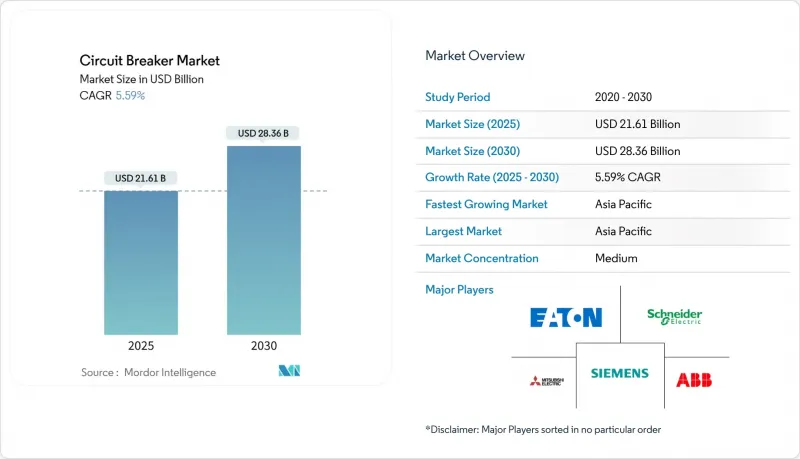
This report is Segmented by Type (Air, Vacuum, SF6, Oil, Hybrid, and Solid-State), Voltage (Low, Medium, High, and Extra/Ultra-High), Mounting (Fixed, Withdrawable, Live Tank, and Dead Tank), End-User (Commercial, Residential, Industrial, and Utility), and Geography (North America, Asia-Pacific, Europe, South America, and Middle East and Africa). The Market Sizes and Forecasts are Provided in Terms of Value (USD).
Global Circuit Breaker Market Trends and Insights
Grid-Modernization Investments Drive Infrastructure Renewal
Utility companies are overhauling substation assets that have operated for over 25 years, funneling budget into digital protection devices supporting automated fault location and remote re-closing. FirstEnergy's USD 1.42 billion Pennsylvania plan is emblematic, focusing on vacuum breakers fitted with fiber-optic sensors that signal real-time condition anomalies.(1) U.S. federal funding of USD 2.2 billion for grid resilience catalyzes similar projects, while China's State Grid earmarked USD 83 billion for transmission expansion, enlarging the procurement pipeline for 72.5 kV-245 kV switchgear.(2) These initiatives favor vacuum designs because of their maintenance-free operating profile, reinforcing the 39.5% segment share captured in the circuit breaker market.
Distributed Renewables Integration Accelerates Technology Evolution
Surging rooftop solar and onshore wind additions subject distribution feeders to fluctuating fault currents and voltage swings, spurring utilities to specify breakers with fast recovery characteristics. Medium-voltage interrupters rated 15 kV-38 kV enable the disconnection of inverter-based generation that can feed faults from both the grid and the renewable side. Solid-state devices switch within microseconds, preventing arc re-ignition during asymmetrical fault currents, a performance trait underpinning their 8.6% CAGR outlook in the circuit breaker market.(3) European procurement frameworks that tie tariff eligibility to fault-ride-through compliance are hastening the transition toward fully digital breakers.
High Capital Expenditure Challenges Adoption in Cost-Sensitive Applications
Contactors that start and stop motors at a fraction of breaker cost continue to displace circuit breakers in basic switching roles. Eaton's study shows contactors rated 800 A offer higher mechanical endurance and a smaller footprint, reducing installed cost by up to 70% relative to breaker-centric panels. Emerging-market industrial clients often combine fuses for fault isolation with contactors for operation, postponing investment in full-featured breakers until tariffs incentivize power-quality compliance in the circuit breakers market.
Other drivers and restraints analyzed in the detailed report include:
- Industrial Electrification Expands High-Voltage Motor Applications
- Data-Center Zero-Downtime Requirements Drive Premium Switching Solutions
- Semiconductor Price Volatility Pressures Manufacturing Margins
For complete list of drivers and restraints, kindly check the Table Of Contents.
Segment Analysis
The circuit breaker industry continues to be led by vacuum technology, which delivered 39.5% of 2024 revenue owing to its sealed design and suitability for 1 kV-72.5 kV grids. By contrast, though presently niche, solid-state devices are tracking an 8.6% CAGR through 2030 thanks to their microsecond clearing and negligible mechanical wear. ABB claims its new silicon-carbide platform slashes power losses 70% relative to air-magnetic units and supports fully digital coordination. The market devoted to SF6 units is contracting as EU rules enforce phase-out deadlines, accelerating migration to vacuum and g3-gas hybrids. Oil and air breakers persist in cost-oriented installations but face gradual displacement.
Market adoption patterns reveal installers favor hybrid air-vacuum modules to balance capex and environmental targets. Hitachi Energy's 550 kV SF6-free GIS supplied to China's grid confirms high-voltage viability of alternative media. Patent filing trends within IEC working groups highlight active R&D in solid-dielectric interrupters able to substitute SF6 at 245 kV and above, suggesting long-term erosion of legacy gas-filled designs within the industry.
Medium-voltage assemblies captured 42.2% revenue because factories, campuses, and wind parks operate within the 1 kV-38 kV envelope. Nevertheless, the extra/ultra-high-voltage category surpasses all others with a projected 9.5% CAGR as countries build 500 kV-800 kV corridors to move renewable energy from remote regions to load centers. Japan's 1,100 kV gas breaker development set the performance benchmark for transient recovery voltage handling.
Within transmission projects, utilities demand circuit breaker market size allocations that factor in higher per-unit pricing: a single 550 kV dead-tank breaker can cost 30 times a 15 kV vacuum unit, inflating vendor revenue despite lower shipment volumes. GE Vernova's latest platform supports 5,000 A continuous current at 550 kV, reflecting ruggedization needs for bulk power corridors.
Complete Report Scope:
- By Type
- Air
- Vacuum
- SF6
- Oil
- Hybrid (Air-Vacuum, Vacuum-SF6)
- Solid-State
- By Voltage
- Low (Below 1 kV)
- Medium (1 to 72.5 kV)
- High (72.5 to 245 kV)
- Extra/Ultra-High (Above 245 kV)
- By Mounting
- Fixed
- Withdrawable
- Live Tank
- Dead Tank
- By End-User
- Commercial
- Residential
- Industrial
- Utility
- By Geography
- North America
- United States
- Canada
- Mexico
- Europe
- Germany
- United Kingdom
- France
- Italy
- NORDIC Countries
- Russia
- Rest of Europe
- Asia-Pacific
- China
- India
- Japan
- South Korea
- ASEAN Countries
- Rest of Asia-Pacific
- South America
- Brazil
- Argentina
- Rest of South America
- Middle East and Africa
- Saudi Arabia
- United Arab Emirates
- South Africa
- Egypt
- Rest of Middle East and Africa
- North America
Geography Analysis
Asia-Pacific held 45.7% of global revenue in 2024 and is pacing at 6.6% CAGR through 2030, propelled by Chinese and Indian grid extensions that award bulk contracts for 72.5 kV and 252 kV breakers. GE Vernova's USD 16 million investment in Indian manufacturing denotes regional supply localization in the circuit breakers market. Japanese innovations at 1,100 kV illustrate APAC technological leadership, reinforcing equipment exports to Southeast Asian projects.
North America circuit breaker market expands on a foundation of stimulus-supported resilience programs. The circuit breaker market gains from USD 2.2 billion in U.S. federal grants that leverage nearly USD 10 billion in utility matching funds. Data-center projects add premium demand: 2024 construction spending climbed 43.1%, leading to design-build contracts that specify breaker cybersecurity and real-time harmonic analytics.
Europe remains a regulatory bellwether, enforcing SF6 bans by 2026 for <=24 kV equipment and by 2031 for higher voltages. Manufacturers such as Siemens Energy and Hitachi Energy are racing to commercialize g3 and vacuum solutions to safeguard European revenue streams. South America, the Middle East & Africa represent emergent frontiers where hydro project build-outs and industrial diversification sustain double-digit volume growth despite smaller absolute bases.
- ABB
- Schneider Electric
- Siemens
- Mitsubishi Electric
- Eaton
- Legrand
- LS Electric
- Toshiba Energy Systems
- Hitachi Energy
- CG Power & Industrial
- Fuji Electric
- Rockwell Automation
- Terasaki Electric
- Powell Industries
- NOJA Power
- Meidensha
- Huayi Electric
- Xi'an Shaanxi West
- Hyundai Electric
- Larsen & Toubro
- Delixi Electric
Additional Benefits:
- The market estimate (ME) sheet in Excel format
- 3 months of analyst support
TABLE OF CONTENTS
1 Introduction
- 1.1 Study Assumptions & Market Definition
- 1.2 Scope of the Study
2 Research Methodology
3 Executive Summary
4 Market Landscape
- 4.1 Market Overview
- 4.2 Market Drivers
- 4.2.1 Grid-modernization investments (utilities)
- 4.2.2 Distributed-renewables integration push
- 4.2.3 Industrial electrification (HV motors, EV chargers)
- 4.2.4 Datacenter "zero-downtime" switching demand
- 4.2.5 OEM shift to solid-state breakers in EV platforms
- 4.2.6 Mandatory SF?-free replacements in EU & Japan
- 4.3 Market Restraints
- 4.3.1 High capex vs. contactors & fuses
- 4.3.2 Semiconductor & copper price volatility
- 4.3.3 Supply-chain lead-time spikes for vacuum interrupters
- 4.3.4 Lengthy certification cycles for eco-design breakers
- 4.4 Supply-Chain Analysis
- 4.5 Regulatory Landscape
- 4.6 Technological Outlook
- 4.7 Porter's Five Forces
- 4.7.1 Threat of New Entrants
- 4.7.2 Bargaining Power of Buyers
- 4.7.3 Bargaining Power of Suppliers
- 4.7.4 Threat of Substitutes
- 4.7.5 Competitive Rivalry
5 Market Size & Growth Forecasts
- 5.1 By Type
- 5.1.1 Air
- 5.1.2 Vacuum
- 5.1.3 SF6
- 5.1.4 Oil
- 5.1.5 Hybrid (Air-Vacuum, Vacuum-SF6)
- 5.1.6 Solid-State
- 5.2 By Voltage
- 5.2.1 Low (Below 1 kV)
- 5.2.2 Medium (1 to 72.5 kV)
- 5.2.3 High (72.5 to 245 kV)
- 5.2.4 Extra/Ultra-High (Above 245 kV)
- 5.3 By Mounting
- 5.3.1 Fixed
- 5.3.2 Withdrawable
- 5.3.3 Live Tank
- 5.3.4 Dead Tank
- 5.4 By End-User
- 5.4.1 Commercial
- 5.4.2 Residential
- 5.4.3 Industrial
- 5.4.4 Utility
- 5.5 By Geography
- 5.5.1 North America
- 5.5.1.1 United States
- 5.5.1.2 Canada
- 5.5.1.3 Mexico
- 5.5.2 Europe
- 5.5.2.1 Germany
- 5.5.2.2 United Kingdom
- 5.5.2.3 France
- 5.5.2.4 Italy
- 5.5.2.5 NORDIC Countries
- 5.5.2.6 Russia
- 5.5.2.7 Rest of Europe
- 5.5.3 Asia-Pacific
- 5.5.3.1 China
- 5.5.3.2 India
- 5.5.3.3 Japan
- 5.5.3.4 South Korea
- 5.5.3.5 ASEAN Countries
- 5.5.3.6 Rest of Asia-Pacific
- 5.5.4 South America
- 5.5.4.1 Brazil
- 5.5.4.2 Argentina
- 5.5.4.3 Rest of South America
- 5.5.5 Middle East and Africa
- 5.5.5.1 Saudi Arabia
- 5.5.5.2 United Arab Emirates
- 5.5.5.3 South Africa
- 5.5.5.4 Egypt
- 5.5.5.5 Rest of Middle East and Africa
- 5.5.1 North America
6 Competitive Landscape
- 6.1 Market Concentration
- 6.2 Strategic Moves (M&A, Partnerships, PPAs)
- 6.3 Market Share Analysis (Market Rank/Share for key companies)
- 6.4 Company Profiles (includes Global level Overview, Market level overview, Core Segments, Financials as available, Strategic Information, Products & Services, and Recent Developments)
- 6.4.1 ABB
- 6.4.2 Schneider Electric
- 6.4.3 Siemens
- 6.4.4 Mitsubishi Electric
- 6.4.5 Eaton
- 6.4.6 Legrand
- 6.4.7 LS Electric
- 6.4.8 Toshiba Energy Systems
- 6.4.9 Hitachi Energy
- 6.4.10 CG Power & Industrial
- 6.4.11 Fuji Electric
- 6.4.12 Rockwell Automation
- 6.4.13 Terasaki Electric
- 6.4.14 Powell Industries
- 6.4.15 NOJA Power
- 6.4.16 Meidensha
- 6.4.17 Huayi Electric
- 6.4.18 Xi'an Shaanxi West
- 6.4.19 Hyundai Electric
- 6.4.20 Larsen & Toubro
- 6.4.21 Delixi Electric
7 Market Opportunities & Future Outlook
- 7.1 White-space & Unmet-Need Assessment

