PUBLISHER: Mordor Intelligence | PRODUCT CODE: 2117467

PUBLISHER: Mordor Intelligence | PRODUCT CODE: 2117467
Aircraft Windows and Windshields - Market Share Analysis, Industry Trends & Statistics, Growth Forecasts (2025 - 2030)
According to Mordor Intelligence, the aircraft windows and windshields market size reached USD 0.96 billion in 2025 and is forecasted to expand at a 4.56% CAGR to USD 1.20 billion by 2030, reflecting persistent growth in global commercial aviation and the robust replacement cycle of aging fleets.
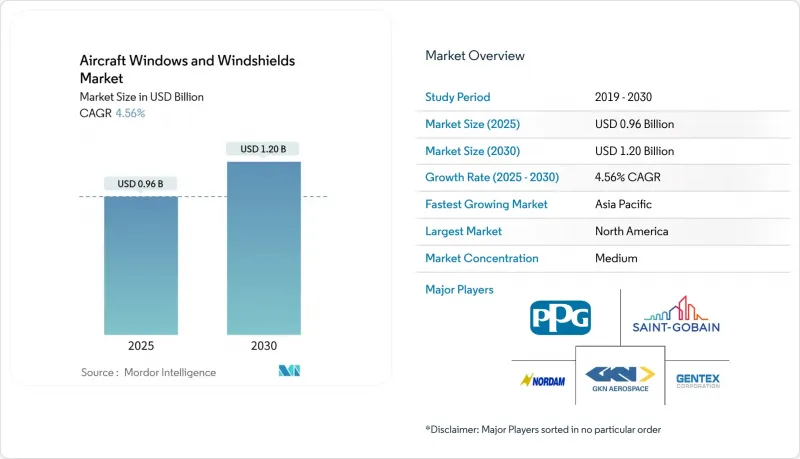
This report is Segmented by Aircraft Type (Commercial Aviation, Military Aviation, and More), Transparency Type (Cabin Windows, Cockpit Windshields, and Others), Material (Glass Laminates, Acrylic, Polycarbonate, and Hybrid), End Market (OEM and Aftermarket), and Geography (North America, Europe, Asia-Pacific, and More). The Market Forecasts are Provided in Terms of Value (USD).
Global Aircraft Windows and Windshields Market Trends and Insights
Expansion of the Global Commercial Aircraft Fleet
Surging fleet requirements are the primary engine for the aircraft windows and windshields market. Airbus estimates 19,500 new jets for Asia-Pacific alone by 2043, equal to 46% of global demand. Boeing's corresponding global forecast of 43,975 deliveries underlines a decade-long production boom that lifts transparency volumes across narrowbody and widebody categories. Narrowbody programs account for roughly 68% of projected deliveries, locking in high-volume demand for standard cabin windows. Meanwhile, Middle East carriers are expanding fleets at 5.1% annually through 2035, adding further weight to OEM orderbooks. These trajectories create a durable supplier baseline, especially those aligned with Airbus and Boeing single-aisle build-rates.
Replacement Demand from Aging Narrowbody Aircraft Platforms
Airlines are cycling out older narrowbody variants to capture up to 25% fuel-burn savings available from next-generation models. Airbus projects 18,930 aircraft will replace legacy jets through 2044, ensuring a large pool of aftermarket transactions for certified transparencies. Component MRO revenue is already running ahead of pre-pandemic levels, rising at 4.3% CAGR compared with 0.6% for airframe heavy checks, a trend that elevates demand for cockpit windshield repairs and cabin-window retrofits. Programs like PPG's FAA-approved A320 sliding-window repair service illustrate how incumbents retain share by bundling certification expertise with cost-saving solutions.
Prolonged Certification and Regulatory Approval Timelines
Extended certification loops slow product refresh cycles and raise development costs, reducing the velocity at which innovations penetrate the aircraft windows and windshields market. Documentation for Supplemental Type Certificates (STCs) can stretch 9-12 months, discouraging smaller entrants that lack deep compliance teams. The complexity is higher for smart windows because they must satisfy both structural and cyber-hardening criteria. Consequently, OEMs gravitate toward established suppliers, limiting competition and moderating price pressures.
Other drivers and restraints analyzed in the detailed report include:
- Increasing Demand for Maintenance and Retrofitting of Aircraft Transparencies
- Advancements in Lightweight, Durable Window Materials for Fuel Efficiency
- Volatility in Aerospace-Grade Raw Material Prices
For complete list of drivers and restraints, kindly check the Table Of Contents.
Segment Analysis
The commercial segment is projected to rise at a 5.12% CAGR through 2030 as Airbus and Boeing single-aisle backlogs swell. Narrowbody programs lead by volume due to burgeoning short-haul networks, yet widebodies deliver higher dollar content per shipset because of larger cockpit and passenger-window acreage. Though budget cycles cap growth, military fleets keep a stable baseline, benefiting from rotorcraft life extension and special-mission conversions.
Commercial deliveries dominate 83.42% of the market share because airlines in North America and Asia-Pacific prioritize fleet renewal for operating-cost advantages. The aircraft and windshields market continues attracting retrofit spending as low-cost carriers (LCCs) upgrade cabins and introduce LED-backlit shadeless windows for branding impact. Business-jet and emerging eVTOL platforms provide an innovation sandbox, with panoramic polycarbonate domes and augmented-reality displays under test, but still a modest revenue slice.
Cabin windows accounted for 63.44% of the aircraft windows and windshields market size in 2024, reflecting their high volume across single-aisle and twin-aisle programs. Growth remains solid as carriers retrofit standard windows with dimmable or larger-aperture variants to lift Net Promoter Scores.
Although representing a smaller denominator, cockpit windshields are forecast to be the fastest-growing transparency at 5.42% CAGR because head-up display interfaces and advanced heating grids mandate new designs. The aircraft windows and windshields market benefits as regulations on bird-strike survivability tighten, encouraging early replacement cycles. Other transparencies, such as emergency exits, retain a consistent niche, governed largely by mandatory inspection calendars rather than discretionary upgrades.
Complete Report Scope:
- By Aircraft Type
- Commercial Aviation
- Narrowbody
- Widebody
- Regional Jets
- Military Aviation
- Combat
- Transport
- Special Mission
- Helicopters
- General Aviation
- Business Jets
- Commercial Helicopters
- Commercial Aviation
- By Transparency Type
- Cabin Windows
- Cockpit Windshields
- Others
- By Material
- Glass Laminates
- Acrylic
- Polycarbonate
- Hybrid
- By End Market
- Original Equipment Manufacturer (OEM)
- Aftermarket
- By Geography
- North America
- United States
- Canada
- Mexico
- Europe
- United Kingdom
- France
- Germany
- Spain
- Rest of Europe
- Asia-Pacific
- China
- India
- Japan
- South Korea
- Australia
- Rest of Asia-Pacific
- South America
- Brazil
- Rest of South America
- Middle East and Africa
- Middle East
- Saudi Arabia
- United Arab Emirates
- Israel
- Rest of Middle East
- Africa
- South Africa
- Rest of Africa
- Middle East
- North America
Geography Analysis
North America held 37.65% of global revenue, reflecting entrenched manufacturing clusters and a dense airline network. Absolute growth is modest, but aftermarket intensity is high because the region fields one of the oldest flying fleets.
Asia-Pacific is the breakout geography, expanding at 6.12% CAGR on the back of an unprecedented aircraft pipeline that calls for 19,500 new jets by 2043. Europe commands a mature yet technology-rich base, supporting high-value exports of tempered glass laminates and electrochromic sub-assemblies. At the same time, Middle East carriers continue to up-gauge fleets, sustaining widebody transparency demand. South America and Africa trail in current volume but offer long-run potential once airport infrastructure and financing frameworks deepen.
- PPG Industries, Inc.
- GKN Aerospace Services Limited (Melrose plc)
- Saint-Gobain Aerospace (Saint-Gobain Group)
- Gentex Corporation
- Lee Aerospace, Inc.
- The NORDAM Group LLC
- Gauzy Ltd.
- Llamas Plastics, Inc.
- Aviation Glass & Technology B.V.
- Control Logistics Inc.
- Plexiweiss GmbH
- Research Frontiers Inc.
- LP Aero Plastics Inc.
- Tech-Tool Plastics, Inc.
- Cee Bailey's Aircraft Plastics, Inc.
- Great Lakes Aero Products, Inc.
Additional Benefits:
- The market estimate (ME) sheet in Excel format
- 3 months of analyst support
TABLE OF CONTENTS
1 INTRODUCTION
- 1.1 Study Assumptions and Market Definition
- 1.2 Scope of the Study
2 RESEARCH METHODOLOGY
3 EXECUTIVE SUMMARY
4 MARKET LANDSCAPE
- 4.1 Market Overview
- 4.2 Market Drivers
- 4.2.1 Expansion of the global commercial aircraft fleet
- 4.2.2 Replacement demand from aging narrowbody aircraft platforms
- 4.2.3 Increasing demand for maintenance and retrofitting of aircraft transparencies
- 4.2.4 Advancements in lightweight, durable window materials for fuel efficiency
- 4.2.5 Rising integration of smart window technologies in modern aircraft cabins
- 4.2.6 Enhanced safety requirements driving development of impact resistant glazing systems
- 4.3 Market Restraints
- 4.3.1 Prolonged certification and regulatory approval timelines
- 4.3.2 Volatility in aerospace grade raw material prices
- 4.3.3 Capacity limitations in global ITO and gold coating deposition facilities
- 4.3.4 Escalating cybersecurity requirements for sensor integrated aircraft windows
- 4.4 Value Chain Analysis
- 4.5 Regulatory Landscape
- 4.6 Technological Outlook
- 4.7 Porter's Five Forces Analysis
- 4.7.1 Bargaining Power of Buyers
- 4.7.2 Bargaining Power of Suppliers
- 4.7.3 Threat of New Entrants
- 4.7.4 Threat of Substitutes
- 4.7.5 Intensity of Competitive Rivalry
5 MARKET SIZE AND GROWTH FORECASTS (VALUE)
- 5.1 By Aircraft Type
- 5.1.1 Commercial Aviation
- 5.1.1.1 Narrowbody
- 5.1.1.2 Widebody
- 5.1.1.3 Regional Jets
- 5.1.2 Military Aviation
- 5.1.2.1 Combat
- 5.1.2.2 Transport
- 5.1.2.3 Special Mission
- 5.1.2.4 Helicopters
- 5.1.3 General Aviation
- 5.1.3.1 Business Jets
- 5.1.3.2 Commercial Helicopters
- 5.1.1 Commercial Aviation
- 5.2 By Transparency Type
- 5.2.1 Cabin Windows
- 5.2.2 Cockpit Windshields
- 5.2.3 Others
- 5.3 By Material
- 5.3.1 Glass Laminates
- 5.3.2 Acrylic
- 5.3.3 Polycarbonate
- 5.3.4 Hybrid
- 5.4 By End Market
- 5.4.1 Original Equipment Manufacturer (OEM)
- 5.4.2 Aftermarket
- 5.5 By Geography
- 5.5.1 North America
- 5.5.1.1 United States
- 5.5.1.2 Canada
- 5.5.1.3 Mexico
- 5.5.2 Europe
- 5.5.2.1 United Kingdom
- 5.5.2.2 France
- 5.5.2.3 Germany
- 5.5.2.4 Spain
- 5.5.2.5 Rest of Europe
- 5.5.3 Asia-Pacific
- 5.5.3.1 China
- 5.5.3.2 India
- 5.5.3.3 Japan
- 5.5.3.4 South Korea
- 5.5.3.5 Australia
- 5.5.3.6 Rest of Asia-Pacific
- 5.5.4 South America
- 5.5.4.1 Brazil
- 5.5.4.2 Rest of South America
- 5.5.5 Middle East and Africa
- 5.5.5.1 Middle East
- 5.5.5.1.1 Saudi Arabia
- 5.5.5.1.2 United Arab Emirates
- 5.5.5.1.3 Israel
- 5.5.5.1.4 Rest of Middle East
- 5.5.5.2 Africa
- 5.5.5.2.1 South Africa
- 5.5.5.2.2 Rest of Africa
- 5.5.5.1 Middle East
- 5.5.1 North America
6 COMPETITIVE LANDSCAPE
- 6.1 Market Concentration
- 6.2 Strategic Moves
- 6.3 Market Share Analysis
- 6.4 Company Profiles (includes Global level Overview, Market level overview, Core Segments, Financials as available, Strategic Information, Market Rank/Share for key companies, Products and Services, and Recent Developments)
- 6.4.1 PPG Industries, Inc.
- 6.4.2 GKN Aerospace Services Limited (Melrose plc)
- 6.4.3 Saint-Gobain Aerospace (Saint-Gobain Group)
- 6.4.4 Gentex Corporation
- 6.4.5 Lee Aerospace, Inc.
- 6.4.6 The NORDAM Group LLC
- 6.4.7 Gauzy Ltd.
- 6.4.8 Llamas Plastics, Inc.
- 6.4.9 Aviation Glass & Technology B.V.
- 6.4.10 Control Logistics Inc.
- 6.4.11 Plexiweiss GmbH
- 6.4.12 Research Frontiers Inc.
- 6.4.13 LP Aero Plastics Inc.
- 6.4.14 Tech-Tool Plastics, Inc.
- 6.4.15 Cee Bailey's Aircraft Plastics, Inc.
- 6.4.16 Great Lakes Aero Products, Inc.
7 MARKET OPPORTUNITIES AND FUTURE OUTLOOK
- 7.1 White-space and Unmet-Need Assessment

