PUBLISHER: Mordor Intelligence | PRODUCT CODE: 2117537

PUBLISHER: Mordor Intelligence | PRODUCT CODE: 2117537
North America Data Center Real Estate - Market Share Analysis, Industry Trends & Statistics, Growth Forecasts (2026 - 2031)
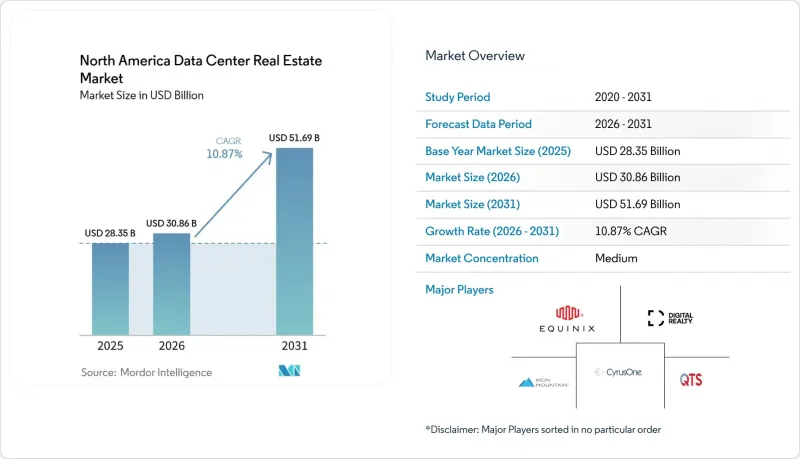
According to Mordor Intelligence, the North America data center real estate market size is expected to grow from USD 28.35 billion in 2025 to USD 30.86 billion in 2026 and is forecast to reach USD 51.69 billion by 2031 at 10.87% CAGR over 2026-2031.
This report is Segmented by Property Type (Colocation, Hyperscale, Edge, Modular, and Others), Ownership (Leased and Owner Occupied), Enterprise Size (Large Enterprises and Small and Medium Enterprises), End-Users (Information Technology and Telecom, and More), and Geography (United States, Canada, Mexico). The Market Forecasts are Provided in Terms of Value (USD).
North America Data Center Real Estate Market Trends and Insights
AI and Generative AI Demand Accelerates Colocation Expansion
AI training and inference workloads are changing the demand profile of the North America data center real estate market. These workloads run for longer periods and require denser power and cooling environments than many legacy enterprise applications. This makes specialized facilities more valuable because tenants need dependable capacity without long delays in internal build programs. The demand also extends beyond hyperscalers because neocloud providers, model-serving firms, and GPU-focused platforms now compete for the same real estate pipeline. That competition raises the strategic value of sites that can scale in stages without disrupting live operations. The North America data center real estate market, therefore, benefits from a broader AI customer base rather than from a single class of tenant.
Record-Low Vacancy Supports Strong Preleasing Activity
Tight vacancy conditions continue to shorten the leasing cycle across the North America data center real estate market. Tenants are increasingly willing to commit earlier because available high-quality capacity in major hubs remains limited. That behavior improves landlords' revenue visibility and gives lenders greater confidence in projects before delivery. It also supports larger development programs because owners can underwrite future cash flow with greater certainty. Early commitments from strong counterparties reduce lease-up risk and shift more attention toward execution risk. The North America data center real estate market is therefore attracting capital not only because demand is high, but also because contracted demand is visible earlier.
Utility Interconnection Delays Slow Data Center Development
Utility interconnection delays remain a structural constraint on the North America data center real estate market. Large projects need more than building permits because they depend on transmission readiness, substation work, and utility scheduling. These steps often stretch project timelines even when land and financing are already in place. Developers are responding by treating future power-delivery slots as a core part of site control rather than a later execution task. That change favors operators with established utility relationships and repeat development experience. The North America data center real estate market, therefore, remains capacity hungry, but not every announced project can move on the same timeline.
Other drivers and restraints analyzed in the detailed report include:
- Power Availability Drives Data Center Site Selection
- Frontier Markets Attract Data Center Development Investment
- Transformer and Substation Equipment Shortages Delay Project Delivery
For complete list of drivers and restraints, kindly check the Table Of Contents.
Segment Analysis
Colocation held 48.60% of the North America data center real estate market share in 2025, which confirms its role as the largest revenue pool in this market. The segment benefits from enterprise outsourcing, hyperscale overflow demand, and the need for fast access to ready capacity. In the North America data center real estate industry, colocation also offers a flexible path for tenants that want to scale without waiting for full self-build delivery. Hyperscale properties remain the second-largest category and continue to attract long lease structures with strong counterparties. Modular formats are gaining relevance where speed matters and permanent utility upgrades take longer than tenant deployment plans.
The edge segment is expected to grow at a 14.20% CAGR through 2031, making it the fastest-growing property type in the North America data center real estate market. Its growth reflects rising interest in low-latency inference, distributed content delivery, and localized processing closer to users. This property class is particularly relevant as AI serving moves from centralized model training into live enterprise and consumer applications. The Others category continues to lose relative weight because stand-alone enterprise ownership models are less efficient under current power, cooling, and compliance demands.
The leased segment accounted for 81.50% share of the North America data center real estate market size in 2025, which shows how strongly outsourced capacity still defines this market. The leased segment is projected to grow at a 11.4% CAGR through 2031, making it the fastest-growing ownership model. This outcome reflects the fact that build-to-suit leasing can deliver capacity faster than many self-build timelines. It also allows tenants to secure long-duration control without carrying the real estate asset on their own balance sheet. In the North America data center real estate industry, this model has become the clearest bridge between speed, flexibility, and scale.
Owner-occupied supply continues to matter because large technology companies still build and control major campuses directly. Even so, the line between leased and owner-directed capacity is becoming less rigid as long-term build-to-suit structures give tenants extensive operational control. That shift changes underwriting because some leased assets now behave more like infrastructure-backed net-lease properties. It also means a growing share of the North America data center real estate market is supported by customized lease structures rather than by standard multi-tenant formats.
Complete Report Scope:
- By Property Type
- Colocation
- Hyperscale
- Edge Data Center Properties
- Modular Data Center Properties
- Others (Wholesale, Retail and Enterprise)
- By Ownership
- Leased
- Owner Occupied
- By Enterprise Size
- Large Enterprises
- Small and Medium Enterprises
- By End-Users
- Information Technology and Telecom
- Banking, Financial Services, and Insurance
- Government and Public Sector
- Healthcare
- Other End Users
- By Country
- United States
- Canada
- Mexico
List of Companies Covered in this Report:
- Equinix, Inc.
- Digital Realty Trust, Inc.
- Iron Mountain Incorporated
- CyrusOne LLC
- QTS Realty Trust, LLC
- Vantage Data Centers LLC
- STACK Infrastructure
- NTT Global Data Centers
- CoreSite Realty Corporation
- Cologix, Inc.
- Flexential Corporation
- DataBank Holdings Ltd.
- EdgeConneX, Inc.
- Aligned Data Centers
- CloudHQ LLC
- Switch, Inc.
- Compass Datacenters
- Centersquare
- Prime Data Centers
- PowerHouse Data Centers
Additional Benefits:
- The market estimate (ME) sheet in Excel format
- 3 months of analyst support
TABLE OF CONTENTS
1 Introduction
- 1.1 Study Assumptions and Market Definition
- 1.2 Scope of the Study
2 Research Methodology
3 Executive Summary
4 Market Landscape
- 4.1 Market Overview
- 4.2 Market Drivers
- 4.2.1 AI and Generative AI Demand Accelerates Colocation Expansion
- 4.2.2 Record-Low Vacancy Supports Strong Preleasing Activity
- 4.2.3 Power Availability Drives Data Center Site Selection
- 4.2.4 Frontier Markets Attract Data Center Development Investment
- 4.2.5 On-Site Power Generation Enhances Energy Reliability
- 4.2.6 Subsea Cable and Interconnection Expansion Strengthens Connectivity
- 4.3 Market Restraints
- 4.3.1 Utility Interconnection Delays Slow Data Center Development
- 4.3.2 Transformer and Substation Equipment Shortages Delay Project Delivery
- 4.3.3 Water Availability and Cooling Constraints Limit New Developments
- 4.3.4 Rising Power Costs and Grid Curtailment Increase Operating Risks
- 4.4 Value / Supply-Chain Analysis
- 4.4.1 Overview of the Supply Chain and Ecosystem
- 4.4.2 List of Key Raw Materials, Resources & Suppliers
- 4.4.3 List of Major Distributors and Channel Partners
- 4.4.4 List of Major End Users
- 4.5 Regulatory Landscape
- 4.6 Technological Outlook
- 4.7 Porter's Five Forces Analysis
- 4.7.1 Bargaining Power of Suppliers
- 4.7.2 Bargaining Power of Consumers
- 4.7.3 Threat of New Entrants
- 4.7.4 Threat of Substitutes
- 4.7.5 Intensity of Competitive Rivalry
5 Market Size & Growth Forecasts (Value, USD)
- 5.1 By Property Type
- 5.1.1 Colocation
- 5.1.2 Hyperscale
- 5.1.3 Edge Data Center Properties
- 5.1.4 Modular Data Center Properties
- 5.1.5 Others (Wholesale, Retail and Enterprise)
- 5.2 By Ownership
- 5.2.1 Leased
- 5.2.2 Owner Occupied
- 5.3 By Enterprise Size
- 5.3.1 Large Enterprises
- 5.3.2 Small and Medium Enterprises
- 5.4 By End-Users
- 5.4.1 Information Technology and Telecom
- 5.4.2 Banking, Financial Services, and Insurance
- 5.4.3 Government and Public Sector
- 5.4.4 Healthcare
- 5.4.5 Other End Users
- 5.5 By Country
- 5.5.1 United States
- 5.5.2 Canada
- 5.5.3 Mexico
6 Competitive Landscape
- 6.1 Market Concentration
- 6.2 Strategic Moves
- 6.3 Market Share Analysis
- 6.4 Company Profiles (Includes Global Level Overview, Market Level Overview, Core Segments, Financials as Available, Strategic Information, Products and Services, Recent Developments)
- 6.4.1 Equinix, Inc.
- 6.4.2 Digital Realty Trust, Inc.
- 6.4.3 Iron Mountain Incorporated
- 6.4.4 CyrusOne LLC
- 6.4.5 QTS Realty Trust, LLC
- 6.4.6 Vantage Data Centers LLC
- 6.4.7 STACK Infrastructure
- 6.4.8 NTT Global Data Centers
- 6.4.9 CoreSite Realty Corporation
- 6.4.10 Cologix, Inc.
- 6.4.11 Flexential Corporation
- 6.4.12 DataBank Holdings Ltd.
- 6.4.13 EdgeConneX, Inc.
- 6.4.14 Aligned Data Centers
- 6.4.15 CloudHQ LLC
- 6.4.16 Switch, Inc.
- 6.4.17 Compass Datacenters
- 6.4.18 Centersquare
- 6.4.19 Prime Data Centers
- 6.4.20 PowerHouse Data Centers
7 Market Opportunities & Future Outlook
- 7.1 White-Space and Unmet-Need Assessment

