PUBLISHER: Mordor Intelligence | PRODUCT CODE: 2117586

PUBLISHER: Mordor Intelligence | PRODUCT CODE: 2117586
Marketing Data Governance Platform - Market Share Analysis, Industry Trends & Statistics, Growth Forecasts (2026 - 2031)
According to Mordor Intelligence, the marketing data governance platform market size is projected to expand from USD 1.04 billion in 2025 and USD 1.04 billion in 2026 to USD 2.45 billion by 2031, registering a CAGR of 16.85% between 2026 and 2031.
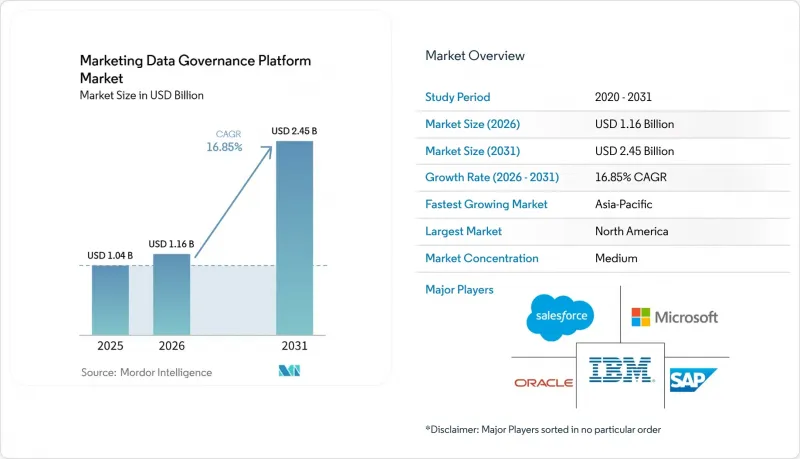
This report is Segmented by Deployment Mode (Cloud and On-Premises), Enterprise Size (Large Enterprises, and Small and Medium Enterprises), Application (Customer Data Governance, Consent and Preference Management, Campaign and Audience Governance, and Marketing Content and Asset Governance), and Geography (North America, and More). The Market Forecasts are Provided in Terms of Value (USD).
Global Marketing Data Governance Platform Market Trends and Insights
Surge in First-Party Data Activation Needs
The Marketing data governance platform market is supported by the move from third-party signals toward customer data collected directly by organizations. Marketing teams need trusted customer records before they can use personalization, audience development, or measurement tools effectively, which keeps the Marketing data governance platform market tied to everyday campaign performance. The Interactive Advertising Bureau reported that first-party dataset deployment rose from 41% to 71% over 2 years. This change raises the value of controls that define data ownership, quality rules, permitted uses, and lineage across channels. Customer data platforms can support activation, but they do not always provide the policy controls needed across connected systems. Governance tools, therefore, address a practical gap between campaign activation and accountable data use.
Privacy-by-Design Governance for Consent-Heavy Campaigns
Privacy enforcement is making consent design a core requirement for campaign teams rather than a legal review completed at launch. In September 2025, France's data protection authority fined Google EUR 325 million (USD 351 million) for advertisements in Gmail and for its consent choices for personalized advertising. The decision showed that a consent mechanism must allow users to freely opt out of personalized advertising. In December 2025, the same authority fined a loyalty-program operator EUR 3.5 million (USD 3.78 million) for transferring member data to a social network for advertising without a valid legal basis. These cases increase demand for record-level controls that apply the right consent rule in each jurisdiction, reinforcing demand across the Marketing data governance platform market. They also make manual checks less workable for organizations managing campaigns across several regions.
High Integration Complexity Across Fragmented Martech Stacks
Integration complexity can delay the value that buyers expect from the Marketing data governance platform market. Each marketing application can use a different schema, identity key, consent format, and data transfer process. Governance teams must map those differences before they can apply policy controls consistently. Composable technology environments can add flexibility, but they require controls to be checked whenever a component changes. Mid-sized organizations often face the largest burden because their technical teams must manage integration work alongside active campaign demands. Native metadata federation can reduce some effort, but it does not remove governance gaps across cloud environments and software-as-a-service applications.
Other drivers and restraints analyzed in the detailed report include:
- AI Content and Audience Data Auditability Requirements
- Martech Stack Convergence With Data Catalogs and Lineage Tools
- Limited Data Stewardship Skills in Marketing Teams
For complete list of drivers and restraints, kindly check the Table Of Contents.
Segment Analysis
Cloud deployment held 70.29% of the Marketing data governance platform market share in 2025. This position requires processing consent signals, policy changes, and access decisions across active marketing channels. Cloud environments support continuous lineage updates and policy checks without requiring each organization to build separate local infrastructure. They also work well with cloud warehouses and lakehouse environments that increasingly store customer and campaign data. A 2025 peer-reviewed study found that cloud-based governance frameworks can support security and compliance in marketing analytics through access controls, encryption, and residency measures.
On-premises deployment remains important where data sovereignty, internal security rules, or sector requirements limit cloud use. Financial services, regulated healthcare marketing, and public-sector-related operations often retain greater control over local processing environments. Many organizations instead use hybrid models that keep sensitive processing local while managing governance policies through cloud services. This structure gives teams a central policy layer without requiring every dataset to move immediately. Over the forecast period, hybrid adoption is expected to move more policy management toward cloud control planes.
Complete Report Scope:
- By Deployment Mode
- Cloud
- On-Premises
- By Enterprise Size
- Large Enterprises
- Small and Medium Enterprises
- By Application
- Customer Data Governance
- Consent and Preference Management
- Campaign and Audience Governance
- Marketing Content and Asset Governance
- By Geography
- North America
- United States
- Canada
- Mexico
- South America
- Brazil
- Argentina
- Rest of South America
- Europe
- Germany
- United Kingdom
- France
- Italy
- Spain
- Russia
- Rest of Europe
- Asia-Pacific
- China
- Japan
- India
- South Korea
- Australia and New Zealand
- Rest of Asia-Pacific
- Middle East
- Saudi Arabia
- United Arab Emirates
- Turkey
- Rest of Middle East
- Africa
- South Africa
- Nigeria
- Rest of Africa
- North America
Geography Analysis
North America accounted for 35.61% of the Marketing data governance platform market share in 2025. The United States combines substantial marketing technology budgets, a dense supplier base, and several state privacy requirements. California, Colorado, Connecticut, Virginia, and Texas have created a more complex compliance setting for organizations operating across state lines. This supports demand for platforms that apply different consent and data-rights rules within shared technology environments. Canada and Mexico add to regional activity as their data protection requirements encourage more formal governance practices.
Europe ranked second in 2025. GDPR compliance requirements and active enforcement of advertising consent rules support the Marketing data governance platform market in Europe. France's data protection authority imposed the EUR 325 million (USD 351 million) fine on Google in September 2025, reinforcing the need for a valid consent-based advertising model. The EU AI Act also makes transparency planning more urgent for organizations that use AI-generated marketing content. European buyers, therefore, need governance systems that connect consent, source data, approvals, content records, and internal accountability processes.
Asia-Pacific is projected to grow at a 17.56% CAGR through 2031, the fastest rate among the regions. China, India, Japan, Singapore, Thailand, and South Korea each have distinct data protection frameworks that affect the use of marketing data. Thailand released draft guidance on marketing and lawful bases in July 2026, including separate consent expectations for AI-driven marketing activity and profiling. China and India offer important opportunities because data localization, consent, and enforcement requirements require more than policy documents alone. South America, the Middle East, and Africa account for smaller shares, but Brazil, Saudi Arabia, the UAE, South Africa, and Nigeria are providing a growing regulatory base. These regions can create longer-term demand as digital marketing activity and enforcement capacity develop.
- Informatica LLC
- Collibra N.V.
- Alation, Inc.
- Microsoft Corporation
- IBM Corporation
- Oracle Corporation
- SAP SE
- Salesforce, Inc.
- OneTrust, LLC
- Ataccama Corporation
- Talend S.A.S.
- QlikTech International AB
- Precisely Holdings, LLC
- Varonis Systems, Inc.
- BigID, Inc.
- DataGalaxy SAS
- Atlan Pte. Ltd.
- Syniti, LLC
- Denodo Technologies, Inc.
- Reltio, Inc.
Additional Benefits:
- The market estimate (ME) sheet in Excel format
- 3 months of analyst support
TABLE OF CONTENTS
1 INTRODUCTION
- 1.1 Study Assumptions and Market Definition
- 1.2 Scope of the Study
2 RESEARCH METHODOLOGY
3 EXECUTIVE SUMMARY
4 MARKET LANDSCAPE
- 4.1 Market Overview
- 4.2 Market Drivers
- 4.2.1 Surge in First-Party Data Activation Needs
- 4.2.2 Privacy-By-Design Governance for Consent-Heavy Campaigns
- 4.2.3 AI Content and Audience Data Auditability Requirements
- 4.2.4 Martech Stack Convergence With Data Catalogs and Lineage Tools
- 4.2.5 Real-Time Governance for Omnichannel Decisioning
- 4.2.6 Clean Room and Secure Collaboration Adoption
- 4.3 Market Restraints
- 4.3.1 High Integration Complexity Across Fragmented Martech Stacks
- 4.3.2 Limited Data Stewardship Skills in Marketing Teams
- 4.3.3 Slow Governance Workflow Adoption in Revenue Organizations
- 4.3.4 Budget Pressure on Mid-Market Deployments
- 4.4 Industry Value Chain Analysis
- 4.5 Regulatory Landscape
- 4.6 Technological Outlook
- 4.7 Impact of Macroeconomic Factors on the Market
- 4.8 Porter's Five Forces Analysis
- 4.8.1 Threat of New Entrants
- 4.8.2 Bargaining Power of Suppliers
- 4.8.3 Bargaining Power of Buyers
- 4.8.4 Threat of Substitutes
- 4.8.5 Intensity of Competitive Rivalry
5 MARKET SIZE AND GROWTH FORECASTS (VALUE)
- 5.1 By Deployment Mode
- 5.1.1 Cloud
- 5.1.2 On-Premises
- 5.2 By Enterprise Size
- 5.2.1 Large Enterprises
- 5.2.2 Small and Medium Enterprises
- 5.3 By Application
- 5.3.1 Customer Data Governance
- 5.3.2 Consent and Preference Management
- 5.3.3 Campaign and Audience Governance
- 5.3.4 Marketing Content and Asset Governance
- 5.4 By Geography
- 5.4.1 North America
- 5.4.1.1 United States
- 5.4.1.2 Canada
- 5.4.1.3 Mexico
- 5.4.2 South America
- 5.4.2.1 Brazil
- 5.4.2.2 Argentina
- 5.4.2.3 Rest of South America
- 5.4.3 Europe
- 5.4.3.1 Germany
- 5.4.3.2 United Kingdom
- 5.4.3.3 France
- 5.4.3.4 Italy
- 5.4.3.5 Spain
- 5.4.3.6 Russia
- 5.4.3.7 Rest of Europe
- 5.4.4 Asia-Pacific
- 5.4.4.1 China
- 5.4.4.2 Japan
- 5.4.4.3 India
- 5.4.4.4 South Korea
- 5.4.4.5 Australia and New Zealand
- 5.4.4.6 Rest of Asia-Pacific
- 5.4.5 Middle East
- 5.4.5.1 Saudi Arabia
- 5.4.5.2 United Arab Emirates
- 5.4.5.3 Turkey
- 5.4.5.4 Rest of Middle East
- 5.4.6 Africa
- 5.4.6.1 South Africa
- 5.4.6.2 Nigeria
- 5.4.6.3 Rest of Africa
- 5.4.1 North America
6 COMPETITIVE LANDSCAPE
- 6.1 Market Concentration
- 6.2 Strategic Moves
- 6.3 Market Share Analysis
- 6.4 Company Profiles (includes Global Level Overview, Market Level Overview, Core Segments, Financials as available, Strategic Information, Market Rank/Share, Products and Services, Recent Developments)
- 6.4.1 Informatica LLC
- 6.4.2 Collibra N.V.
- 6.4.3 Alation, Inc.
- 6.4.4 Microsoft Corporation
- 6.4.5 IBM Corporation
- 6.4.6 Oracle Corporation
- 6.4.7 SAP SE
- 6.4.8 Salesforce, Inc.
- 6.4.9 OneTrust, LLC
- 6.4.10 Ataccama Corporation
- 6.4.11 Talend S.A.S.
- 6.4.12 QlikTech International AB
- 6.4.13 Precisely Holdings, LLC
- 6.4.14 Varonis Systems, Inc.
- 6.4.15 BigID, Inc.
- 6.4.16 DataGalaxy SAS
- 6.4.17 Atlan Pte. Ltd.
- 6.4.18 Syniti, LLC
- 6.4.19 Denodo Technologies, Inc.
- 6.4.20 Reltio, Inc.
7 MARKET OPPORTUNITIES AND FUTURE OUTLOOK
- 7.1 White-Space and Unmet-Need Assessment

