PUBLISHER: Mordor Intelligence | PRODUCT CODE: 2122657

PUBLISHER: Mordor Intelligence | PRODUCT CODE: 2122657
Data Governance - Market Share Analysis, Industry Trends & Statistics, Growth Forecasts (2026 - 2031)
According to Mordor Intelligence, the data governance market size stood at USD 4.60 billion in 2026 and is projected to reach USD 9.68 billion by 2031, translating into a robust 16.05% CAGR across the forecast window.
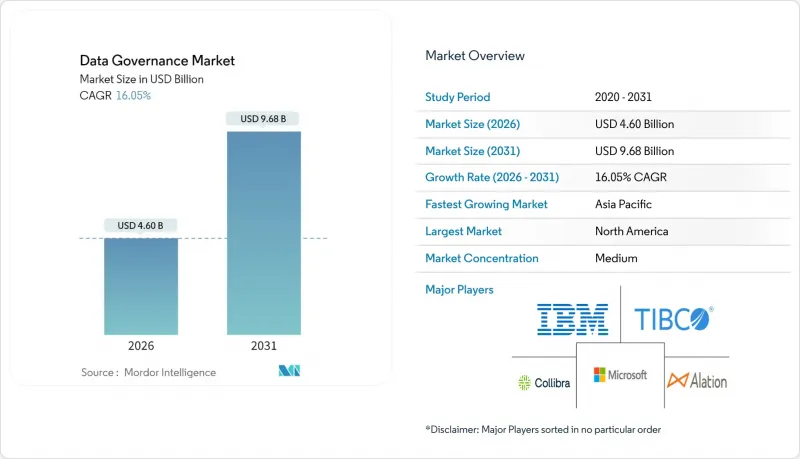
This report is Segmented by Component (Software, and Services), Deployment (Cloud, and On-Premise), Organization Size (Large Enterprises, and Small and Medium Enterprises), Business Function (IT and Operations, Finance and Risk, and More), Application (Audit Management, and More), End-User Industry (BFSI, IT and Telecom, and More), and Geography. The Market Forecasts are Provided in Terms of Value (USD).
Global Data Governance Market Trends and Insights
EU AI Act and Global AI-Regulation Requiring Explainable Data Lineage
The EU AI Act has been in force since August 2024 and classifies high-risk systems, compelling deployers to maintain end-to-end lineage that documents data provenance, bias-mitigation steps, and retraining triggers. Multinationals now standardize on automated lineage platforms that parse SQL, Python, and ETL workflows for cross-jurisdictional audit readiness, a trend already mirrored by Canada's Artificial Intelligence and Data Act. Financial institutions face heightened exposure because algorithmic models intertwine AI Act duties with stringent GDPR obligations. Penalties reaching 6% of global turnover elevate governance from an IT concern to a board-level risk, quickly unlocking budget approvals for catalog and lineage projects in the data governance market.
FedNow and Real-Time Payment Rails Forcing Sub-Millisecond Data Integrity in North American BFSI
FedNow, which attained critical mass in 2025, processes payments within 10 seconds, compressing reconciliation cycles and demanding real-time data-quality checks at the transaction edge. Banks have retired nightly profiling jobs in favor of streaming tools that validate Kafka topics or Flink state stores in milliseconds. Comparable dynamics in Brazil's PIX system and India's UPI underscore a global move toward instant payments, and a single data-quality lapse can cascade into millions of false declines or duplicate postings, far outweighing governance tool costs.
High Total Cost of Ownership for Enterprise-Scale Data Lineage Tooling in Tier-1 Banks
Full-stack governance programs can exceed USD 10 million during the first year when software licenses, professional services, and custom connectors are combined, with ongoing spend near USD 5 million annually. Budget approval therefore competes with revenue-generating priorities such as digital banking. Mid-tier banks struggle even more, lacking IT staff to configure complex lineage engines, which further inflates the effective cost per data asset and prolongs payback periods.
Other drivers and restraints analyzed in the detailed report include:
- Asia Pacific Sovereign-Cloud Mandates Accelerating In-Country Data Catalog Investments
- Generative AI Governance Use-Cases Elevating Automated Metadata Discovery Spend
- Talent Shortage of Certified Data Stewards and DCAM Practitioners
For complete list of drivers and restraints, kindly check the Table Of Contents.
Segment Analysis
Software generated 65.66% of 2025 revenue as enterprises preferred best-of-breed catalogs, lineage, and master-data platforms over monolithic suites. Data security and privacy governance sub-segments are forecast to grow at 19.62% CAGR, propelled by EU AI Act transparency requirements and sovereign-cloud mandates. Services captured 34.34%, with professional engagements expanding as on-premise estates migrate to cloud architectures. Vendors now overlap governance and observability, folding lineage alerts into DevOps dashboards, although pure-play providers still hold the deepest catalog capabilities.
Demand patterns illustrate how governance converges with cyber postures. Security-oriented platforms automate consent tracking and cross-border transfer logs, while quality and profiling tools extend into machine learning pipelines. The data governance market size attributable to privacy tools is poised to double by 2031. Growth also benefits from ISO 27001 certification trends, because BFSI and healthcare buyers request third-party attestations as procurement prerequisites in the data governance market.
Cloud deployment owned 72.44% share in 2025 and is on track for a 17.42% CAGR. Hyperscaler services such as AWS Glue Data Catalog, Microsoft Purview, and Google Dataplex integrate lineage at the pipeline level, sidestepping separate catalog rollouts. Digital-native retailers and media firms favor these managed services to minimize operational overhead. On-premise installations remain relevant for defense, government, and highly regulated banks where data must stay behind firewalls, keeping hybrid architectures in play.
Cost dynamics are nuanced. Scanning millions of cloud objects daily can push monthly catalog fees beyond USD 50,000. Consequently, some enterprises repatriate governance workloads to self-hosted Kubernetes clusters, especially when GDPR transfer-impact assessments complicate standard hyperscaler contracts. Over the forecast period, cloud footprints will still expand, but tooling flexibility to trace data across hybrid estates will dictate vendor selection.
Complete Report Scope:
- By Component
- Software
- Data Quality and Profiling Tools
- Metadata Management and Data Catalog
- Master Data Management
- Data Lineage and Impact Analysis
- Data Security and Privacy Governance
- Services
- Professional Services
- Managed Services
- Software
- By Deployment
- Cloud
- On-Premise
- By Organization Size
- Large Enterprises
- Small and Medium Enterprises (SMEs)
- By Business Function
- IT and Operations
- Legal and Compliance
- Finance and Risk
- Marketing and Sales
- Human Resources
- Other Business Functions
- By Application
- Compliance Management
- Risk Management
- Audit Management
- Incident Management
- Data Quality Management
- Other Applications
- By End-User Industry
- BFSI
- IT and Telecom
- Healthcare and Life Sciences
- Retail and E-Commerce
- Government and Defense
- Manufacturing
- Energy and Utilities
- Media and Entertainment
- Other End-User Industries
- By Geography
- North America
- United States
- Canada
- South America
- Brazil
- Argentina
- Chile
- Mexico
- Rest of South America
- Europe
- Germany
- United Kingdom
- France
- Italy
- Spain
- Sweden
- Norway
- Finland
- Denmark
- Russia
- Rest of Europe
- Asia Pacific
- China
- India
- Japan
- South Korea
- Southeast Asia
- Australia
- New Zealand
- Rest of Asia Pacific
- Middle East
- United Arab Emirates
- Saudi Arabia
- Qatar
- Turkey
- Israel
- Rest of Middle East
- Africa
- South Africa
- Nigeria
- Kenya
- Rest of Africa
- North America
Geography Analysis
North America held 42.64% share in 2025, underpinned by FedNow adoption, major cloud hyperscalers, and AI regulations converging with Canada's new federal act. Historical CAGR of roughly 13% has ticked upward as instant payments and generative AI elevate governance urgency. Mexico adds incremental upside as nearshoring extends U.S. supply-chain transparency frameworks.
Asia Pacific is the fastest-growing region at 18.22% CAGR. Sovereign-cloud mandates in India, Indonesia, and Vietnam oblige in-country catalogs, while China's Personal Information Protection Law drives domestic demand for lineage tools embedded in Alibaba and Tencent clouds. Japan and South Korea invest steadily to support digital manufacturing and open banking, whereas mature Australian markets expand more modestly.
Europe continues to invest due to GDPR and the EU AI Act. Nordic governments adopt cloud-first strategies that favor managed governance services, but Southern and Eastern Europe lag owing to constrained budgets. The Middle East and Africa and South America remain smaller markets, yet sovereign investment funds and privacy statutes in the UAE, Brazil, and South Africa are catalyzing compliance-driven rollouts.
- IBM Corporation
- Microsoft Corporation
- Oracle Corporation
- SAP SE
- Collibra NV
- Informatica Inc.
- Alation Inc.
- SAS Institute Inc.
- TIBCO Software Inc.
- Talend SA
- Varonis Systems Inc.
- Amazon Web Services
- Precisely LLC
- Ataccama Corp.
- Quest Software (erwin Data Intelligence)
- OneTrust LLC
- OpenText Corp. (incl. Micro Focus)
- ASG Technologies (Rocket Software)
- Snowflake Inc.
- Databricks Inc.
- Cloudera Inc.
- Alfresco Software Inc.
Additional Benefits:
- The market estimate (ME) sheet in Excel format
- 3 months of analyst support
TABLE OF CONTENTS
1 INTRODUCTION
- 1.1 Study Assumptions and Market Definition
- 1.2 Scope of the Study
2 RESEARCH METHODOLOGY
3 EXECUTIVE SUMMARY
4 MARKET LANDSCAPE
- 4.1 Market Overview
- 4.2 Market Drivers
- 4.2.1 EU AI Act and Global AI-Regulation Requiring Explainable Data Lineage
- 4.2.2 FedNow and Real-Time Payment Rails Forcing Sub-Millisecond Data Integrity in North-American BFSI
- 4.2.3 Asia Pacific Sovereign-Cloud Mandates (e.g., India DPDP Act) Accelerating In-Country Data Catalog Investments
- 4.2.4 Retail-Media Monetization Elevating Product-Master Data Quality Spend
- 4.2.5 Edge Analytics in Manufacturing 4.0 Demands Near-Edge Metadata Federation
- 4.2.6 Generative AI Governance Use-Cases Elevating Automated Metadata Discovery Spend
- 4.3 Market Restraints
- 4.3.1 High Total Cost of Ownership for Enterprise-Scale Data Lineage Tooling in Tier-1 Banks
- 4.3.2 Talent Shortage of Certified Data Stewards and DCAM Practitioners
- 4.3.3 Legacy Mainframe Interoperability Issues Limiting Real-Time Governance in Defense Agencies
- 4.3.4 Limited Inter-Catalog Interoperability Creating Metadata Silos in Multi-Cloud Environments
- 4.4 Industry Value Chain Analysis
- 4.5 Impact of Macroeconomic Factors on the Market
- 4.6 Regulatory Outlook
- 4.7 Technological Outlook
- 4.8 Porter's Five Forces Analysis
- 4.8.1 Bargaining Power of Suppliers
- 4.8.2 Bargaining Power of Buyers
- 4.8.3 Threat of New Entrants
- 4.8.4 Threat of Substitutes
- 4.8.5 Intensity of Competitive Rivalry
5 MARKET SIZE AND GROWTH FORECASTS (VALUE)
- 5.1 By Component
- 5.1.1 Software
- 5.1.1.1 Data Quality and Profiling Tools
- 5.1.1.2 Metadata Management and Data Catalog
- 5.1.1.3 Master Data Management
- 5.1.1.4 Data Lineage and Impact Analysis
- 5.1.1.5 Data Security and Privacy Governance
- 5.1.2 Services
- 5.1.2.1 Professional Services
- 5.1.2.2 Managed Services
- 5.1.1 Software
- 5.2 By Deployment
- 5.2.1 Cloud
- 5.2.2 On-Premise
- 5.3 By Organization Size
- 5.3.1 Large Enterprises
- 5.3.2 Small and Medium Enterprises (SMEs)
- 5.4 By Business Function
- 5.4.1 IT and Operations
- 5.4.2 Legal and Compliance
- 5.4.3 Finance and Risk
- 5.4.4 Marketing and Sales
- 5.4.5 Human Resources
- 5.4.6 Other Business Functions
- 5.5 By Application
- 5.5.1 Compliance Management
- 5.5.2 Risk Management
- 5.5.3 Audit Management
- 5.5.4 Incident Management
- 5.5.5 Data Quality Management
- 5.5.6 Other Applications
- 5.6 By End-User Industry
- 5.6.1 BFSI
- 5.6.2 IT and Telecom
- 5.6.3 Healthcare and Life Sciences
- 5.6.4 Retail and E-Commerce
- 5.6.5 Government and Defense
- 5.6.6 Manufacturing
- 5.6.7 Energy and Utilities
- 5.6.8 Media and Entertainment
- 5.6.9 Other End-User Industries
- 5.7 By Geography
- 5.7.1 North America
- 5.7.1.1 United States
- 5.7.1.2 Canada
- 5.7.2 South America
- 5.7.2.1 Brazil
- 5.7.2.2 Argentina
- 5.7.2.3 Chile
- 5.7.2.4 Mexico
- 5.7.2.5 Rest of South America
- 5.7.3 Europe
- 5.7.3.1 Germany
- 5.7.3.2 United Kingdom
- 5.7.3.3 France
- 5.7.3.4 Italy
- 5.7.3.5 Spain
- 5.7.3.6 Sweden
- 5.7.3.7 Norway
- 5.7.3.8 Finland
- 5.7.3.9 Denmark
- 5.7.3.10 Russia
- 5.7.3.11 Rest of Europe
- 5.7.4 Asia Pacific
- 5.7.4.1 China
- 5.7.4.2 India
- 5.7.4.3 Japan
- 5.7.4.4 South Korea
- 5.7.4.5 Southeast Asia
- 5.7.4.6 Australia
- 5.7.4.7 New Zealand
- 5.7.4.8 Rest of Asia Pacific
- 5.7.5 Middle East
- 5.7.5.1 United Arab Emirates
- 5.7.5.2 Saudi Arabia
- 5.7.5.3 Qatar
- 5.7.5.4 Turkey
- 5.7.5.5 Israel
- 5.7.5.6 Rest of Middle East
- 5.7.6 Africa
- 5.7.6.1 South Africa
- 5.7.6.2 Nigeria
- 5.7.6.3 Kenya
- 5.7.6.4 Rest of Africa
- 5.7.1 North America
6 COMPETITIVE LANDSCAPE
- 6.1 Market Concentration
- 6.2 Strategic Moves
- 6.3 Market Share Analysis
- 6.4 Company Profiles {(includes Global level Overview, Market level overview, Core Segments, Financials as available, Strategic Information, Market Rank/Share for key companies, Products and Services, and Recent Developments)}
- 6.4.1 IBM Corporation
- 6.4.2 Microsoft Corporation
- 6.4.3 Oracle Corporation
- 6.4.4 SAP SE
- 6.4.5 Collibra NV
- 6.4.6 Informatica Inc.
- 6.4.7 Alation Inc.
- 6.4.8 SAS Institute Inc.
- 6.4.9 TIBCO Software Inc.
- 6.4.10 Talend SA
- 6.4.11 Varonis Systems Inc.
- 6.4.12 Amazon Web Services
- 6.4.13 Precisely LLC
- 6.4.14 Ataccama Corp.
- 6.4.15 Quest Software (erwin Data Intelligence)
- 6.4.16 OneTrust LLC
- 6.4.17 OpenText Corp. (incl. Micro Focus)
- 6.4.18 ASG Technologies (Rocket Software)
- 6.4.19 Snowflake Inc.
- 6.4.20 Databricks Inc.
- 6.4.21 Cloudera Inc.
- 6.4.22 Alfresco Software Inc.
7 MARKET OPPORTUNITIES AND FUTURE OUTLOOK
- 7.1 White-Space and Unmet-Need Assessment

