PUBLISHER: Mordor Intelligence | PRODUCT CODE: 2117590

PUBLISHER: Mordor Intelligence | PRODUCT CODE: 2117590
User Generated Content Management Software - Market Share Analysis, Industry Trends & Statistics, Growth Forecasts (2026 - 2031)
According to Mordor Intelligence, the user generated content management software market size is projected to expand from USD 1.64 billion in 2025 and USD 1.86 billion in 2026 to USD 3.49 billion by 2031, registering a CAGR of 13.41% between 2026 to 2031.
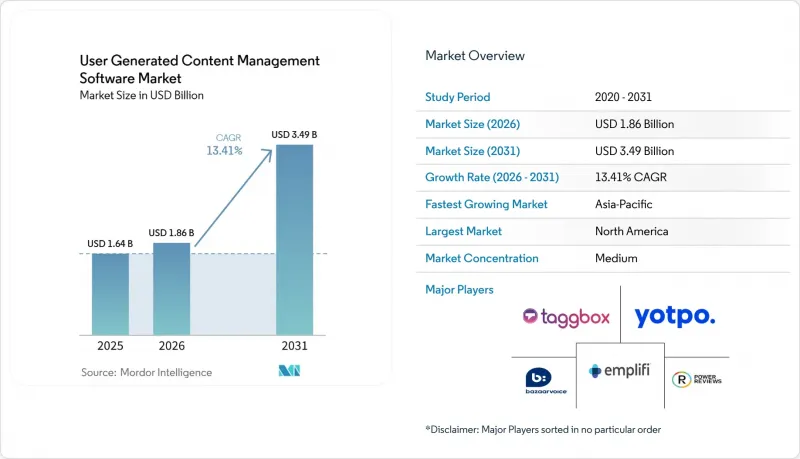
This report is Segmented by Deployment Mode (Cloud-Based, and On-Premises), Application (UGC Collection and Content Aggregation, Content Moderation, and More), Enterprise Size (Small and Medium Enterprises, and Large Enterprises), End-User Industry (Retail and E-Commerce, Media and Entertainment, and More), and Geography. The Market Forecasts are Provided in Terms of Value (USD).
Global User Generated Content Management Software Market Trends and Insights
Rising E-Commerce Review Volume and Social Proof Dependency
Customer review volumes are increasing faster than traditional teams can manually review, classify, and publish the content. This is increasing demand for the user generated content management software market, as brands need tools to manage content at scale. Research published in 2024 found that user-generated content reduces perceived purchase risk by providing direct peer validation during online shopping. As review libraries grow, freshness, relevance, and verification become more important than merely displaying a large number of reviews. Platforms with semantic filtering can help shoppers find product content that better matches their questions, use cases, and purchase intent. Bazaarvoice reported that product pages featuring both photo and text content recorded a median conversion improvement of 17% through its Shopify partner integration in 2026.
GenAI-Assisted Moderation and Metadata Enrichment Adoption
Generative AI is changing moderation economics by helping platforms classify, label, and route large content volumes faster. The user generated content management software market is therefore moving toward tools that support text, image, video, and audio review within one workflow. TikTok reported that its automated systems removed more than 86 million fake accounts during a single quarter, showing the scale of platform integrity work now supported by automated detection. Research presented at CVPR 2025 found that detectors trained on older benchmarks can struggle with newer forms of AI-generated video. This raises the value of moderation systems that can identify synthetic content across multiple formats and changing content patterns. Sprinklr strengthened its video and multimodal intelligence capabilities through the acquisition of ViralMoment in May 2026.
Content Authenticity, Consent, and Disclosure Compliance Burden
Consent, content ownership, and disclosure requirements can slow UGC program deployment for mid-sized brands. The user generated content management software market faces added complexity when brands reuse customer photos, testimonials, contest submissions, and creator posts in advertising. FTC guidance requires clear disclosure where a material relationship exists between an endorser and a brand. Each content format can have different approval, disclosure, and platform requirements. Manual rights clearance can create delays when campaigns involve many creators or multiple markets. Human reviewers also remain necessary for unusual cases that automated systems cannot interpret reliably.
Other drivers and restraints analyzed in the detailed report include:
- Creator and Influencer Commerce Workflow Expansion
- Rising Brand Safety Requirements Across Owned and Paid Channels
- High Moderation Cost for Video, Audio, and Multilingual Content
For complete list of drivers and restraints, kindly check the Table Of Contents.
Segment Analysis
Cloud-based deployment held 81.43% of revenue in 2025, making it the leading deployment approach in the user generated content management software market. Enterprise marketing and e-commerce teams favor cloud delivery because it supports rapid implementation and automatic product updates. Usage-based pricing also fits campaign cycles better than large infrastructure purchases. Cloud systems can scale resources during sudden spikes in reviews, social activity, or viral campaigns. This flexibility helps brands maintain consistent performance when large volumes of customer content arrive at the same time.
On-premises deployment is projected to grow at 13.98% CAGR through 2031. Demand is concentrated in regulated settings where data residency rules and internal security controls restrict the use of public-cloud environments. Financial services, government, and education organizations may require tighter control over customer content records. Hybrid options can allow sensitive metadata to remain within company systems while AI analysis runs through controlled cloud resources. Sprout Social reported 3,803 customers with at least USD 30,000 in annual recurring revenue in its fiscal 2025 annual report, demonstrating demand for premium cloud-delivered social and content management platforms.
UGC Analytics and Campaign Performance accounted for 28.76% of application revenue in 2025. This leading position reflects enterprise demand for systems that connect consumer content with conversion rates, return on advertising spend, and customer lifetime value. Analytics features help marketing teams demonstrate commercial outcomes during budget reviews. These functions also support contract renewals because they provide evidence of content performance. The user generated content management software market is increasingly shaped by buyers who expect measurable results rather than engagement metrics alone.
Content Moderation and Brand Safety is expected to grow at a 16.17% CAGR through 2031. Content collection and aggregation remain foundational capabilities, but they face pressure as large social platforms improve their native collection tools. Community management also remains important for maintaining customer participation and responding to questions. Rights management is becoming more valuable when brands use consumer content in paid channels and need proof of consent. Bazaarvoice introduced its Authentic Discovery API in April 2026 to make syndicated review content accessible to AI search and shopping tools. This development links rights-managed content, review syndication, and AI discovery within a more unified workflow.
Complete Report Scope:
- By Deployment Mode
- Cloud-Based
- On-Premises
- By Application
- UGC Collection and Content Aggregation
- Content Moderation and Brand Safety
- Community and Social Engagement Management
- UGC Rights Management and Compliance
- UGC Analytics and Campaign Performance
- Other Applications
- By Enterprise Size
- Small and Medium Enterprises
- Large Enterprises
- By End User Industry
- Retail and E-Commerce
- Media and Entertainment
- Banking, Financial Services, and insurance (BFSI)
- Travel and Hospitality
- Education and Research institutions
- Consumer Goods and Brands (CGP)
- Other End User Industries
- By Geography
- North America
- United States
- Canada
- Mexico
- South America
- Brazil
- Argentina
- Rest of South America
- Europe
- United Kingdom
- Germany
- France
- Italy
- Spain
- Russia
- Rest of Europe
- Asia-Pacific
- China
- India
- Japan
- South Korea
- Australia
- Rest of Asia-Pacific
- Middle East and Africa
- Middle East
- Turkey
- Saudi Arabia
- United Arab Emirates
- Rest of Middle East
- Africa
- South Africa
- Egypt
- Rest of Africa
- Middle East
- North America
Geography Analysis
North America held 36.29% of revenue in 2025, representing the largest regional user generated content management software market share. The region benefits from a high concentration of digital-native brands and established software purchasing practices. The United States remains the main source of regional demand because of its large retail, media, and consumer goods sectors. Canada contributes to demand through financial services and e-commerce adoption. Mexico is attracting more mid-market deployments as its creator economy and digital retail infrastructure develop.
Asia-Pacific is projected to expand to a 14.32% CAGR through 2031, making it the fastest-growing regional area. Mobile-first commerce, super-app use, and creator-led selling are supporting adoption across the region. China provides an advanced model where reviews, short-form videos, and community content support in-app purchasing. South Korea, India, Indonesia, and Southeast Asian countries are adapting similar models to local consumer behavior. South Korea also benefits from K-pop communities, content exports, and advanced 5G networks that support frequent video creation.
Europe is shaped by content moderation, transparency, and disclosure requirements under the Digital Services Act. The European Commission reported that 165 million moderation decisions had been appealed, with 30% reversed after Digital Services Act implementation. The United Kingdom, Germany, France, and Italy are investing in systems that support reporting and rights management. South America offers growth potential through Brazil's social commerce activity and Argentina's expanding creator base. The Middle East and Africa remain an emerging area, with early demand in Saudi Arabia, the UAE, and South Africa across travel, retail, and consumer goods.
- Bazaarvoice, Inc.
- Yotpo Ltd.
- Emplifi Inc.
- PowerReviews, Inc.
- Taggbox
- Pixlee TurnTo, Inc.
- Curalate, Inc.
- TINT
- CrowdRiff Inc.
- Stackla Pty Ltd
- Nosto Solutions Ltd.
- Hootsuite Inc.
- Sprout Social, Inc.
- Sprinklr, Inc.
- Khoros, LLC
- Adobe Inc.
- Meltwater N.V.
- Crowdangle, Inc.
- Later, Inc.
- Brandwatch, a Cision Ltd. company
- Foursixty, Inc.
- Photoslurp, S.L.
- Flowbox AB
Additional Benefits:
- The market estimate (ME) sheet in Excel format
- 3 months of analyst support
TABLE OF CONTENTS
1 INTRODUCTION
- 1.1 Study Assumptions and Market Definition
- 1.2 Scope of the Study
2 RESEARCH METHODOLOGY
3 EXECUTIVE SUMMARY
4 MARKET LANDSCAPE
- 4.1 Market Overview
- 4.2 Market Drivers
- 4.2.1 Rising E-Commerce Review Volume and Social Proof Dependency
- 4.2.2 GenAI-Assisted Moderation and Metadata Enrichment Adoption
- 4.2.3 Creator and Influencer Commerce Workflow Expansion
- 4.2.4 Rising Brand Safety Requirements Across Owned and Paid Channels
- 4.2.5 Zero-Party Data Capture Demand From Privacy-Constrained Personalization
- 4.2.6 Multi-Format UGC Demand From Short-Form Video and Live Commerce
- 4.3 Market Restraints
- 4.3.1 Content Authenticity, Consent, and Disclosure Compliance Burden
- 4.3.2 High Moderation Cost for Video, Audio, and Multilingual Content
- 4.3.3 Native UGC Features Embedded in Large Social and Commerce Platforms
- 4.3.4 Deepfake and Synthetic Media Detection Gaps
- 4.4 Industry Value-Chain Analysis
- 4.5 Impact of Macroeconomic Factors on the Market
- 4.6 Regulatory Landscape
- 4.7 Technological Outlook
- 4.8 Porter's Five Forces Analysis
- 4.8.1 Threat of New Entrants
- 4.8.2 Bargaining Power of Suppliers
- 4.8.3 Bargaining Power of Buyers
- 4.8.4 Threat of Substitutes
- 4.8.5 Intensity of Competitive Rivalry
5 MARKET SIZE AND GROWTH FORECASTS (VALUE)
- 5.1 By Deployment Mode
- 5.1.1 Cloud-Based
- 5.1.2 On-Premises
- 5.2 By Application
- 5.2.1 UGC Collection and Content Aggregation
- 5.2.2 Content Moderation and Brand Safety
- 5.2.3 Community and Social Engagement Management
- 5.2.4 UGC Rights Management and Compliance
- 5.2.5 UGC Analytics and Campaign Performance
- 5.2.6 Other Applications
- 5.3 By Enterprise Size
- 5.3.1 Small and Medium Enterprises
- 5.3.2 Large Enterprises
- 5.4 By End User Industry
- 5.4.1 Retail and E-Commerce
- 5.4.2 Media and Entertainment
- 5.4.3 Banking, Financial Services, and insurance (BFSI)
- 5.4.4 Travel and Hospitality
- 5.4.5 Education and Research institutions
- 5.4.6 Consumer Goods and Brands (CGP)
- 5.4.7 Other End User Industries
- 5.5 By Geography
- 5.5.1 North America
- 5.5.1.1 United States
- 5.5.1.2 Canada
- 5.5.1.3 Mexico
- 5.5.2 South America
- 5.5.2.1 Brazil
- 5.5.2.2 Argentina
- 5.5.2.3 Rest of South America
- 5.5.3 Europe
- 5.5.3.1 United Kingdom
- 5.5.3.2 Germany
- 5.5.3.3 France
- 5.5.3.4 Italy
- 5.5.3.5 Spain
- 5.5.3.6 Russia
- 5.5.3.7 Rest of Europe
- 5.5.4 Asia-Pacific
- 5.5.4.1 China
- 5.5.4.2 India
- 5.5.4.3 Japan
- 5.5.4.4 South Korea
- 5.5.4.5 Australia
- 5.5.4.6 Rest of Asia-Pacific
- 5.5.5 Middle East and Africa
- 5.5.5.1 Middle East
- 5.5.5.1.1 Turkey
- 5.5.5.1.2 Saudi Arabia
- 5.5.5.1.3 United Arab Emirates
- 5.5.5.1.4 Rest of Middle East
- 5.5.5.2 Africa
- 5.5.5.2.1 South Africa
- 5.5.5.2.2 Egypt
- 5.5.5.2.3 Rest of Africa
- 5.5.5.1 Middle East
- 5.5.1 North America
6 COMPETITIVE LANDSCAPE
- 6.1 Market Concentration
- 6.2 Strategic Moves
- 6.3 Market Share Analysis
- 6.4 Company Profiles (includes Global Level Overview, Market Level Overview, Core Segments, Financials as available, Strategic Information, Market Rank/Share, Products and Services, Recent Developments)
- 6.4.1 Bazaarvoice, Inc.
- 6.4.2 Yotpo Ltd.
- 6.4.3 Emplifi Inc.
- 6.4.4 PowerReviews, Inc.
- 6.4.5 Taggbox
- 6.4.6 Pixlee TurnTo, Inc.
- 6.4.7 Curalate, Inc.
- 6.4.8 TINT
- 6.4.9 CrowdRiff Inc.
- 6.4.10 Stackla Pty Ltd
- 6.4.11 Nosto Solutions Ltd.
- 6.4.12 Hootsuite Inc.
- 6.4.13 Sprout Social, Inc.
- 6.4.14 Sprinklr, Inc.
- 6.4.15 Khoros, LLC
- 6.4.16 Adobe Inc.
- 6.4.17 Meltwater N.V.
- 6.4.18 Crowdangle, Inc.
- 6.4.19 Later, Inc.
- 6.4.20 Brandwatch, a Cision Ltd. company
- 6.4.21 Foursixty, Inc.
- 6.4.22 Photoslurp, S.L.
- 6.4.23 Flowbox AB
7 MARKET OPPORTUNITIES AND FUTURE OUTLOOK
- 7.1 White-Space and Unmet-Need Assessment

