PUBLISHER: Mordor Intelligence | PRODUCT CODE: 2117626

PUBLISHER: Mordor Intelligence | PRODUCT CODE: 2117626
Magnesium Supplements - Market Share Analysis, Industry Trends & Statistics, Growth Forecasts (2026 - 2031)
Powder is projected to be the fastest-growing form in the magnesium supplements market, expanding at a CAGR of 8.61% from 2026 to 2031.
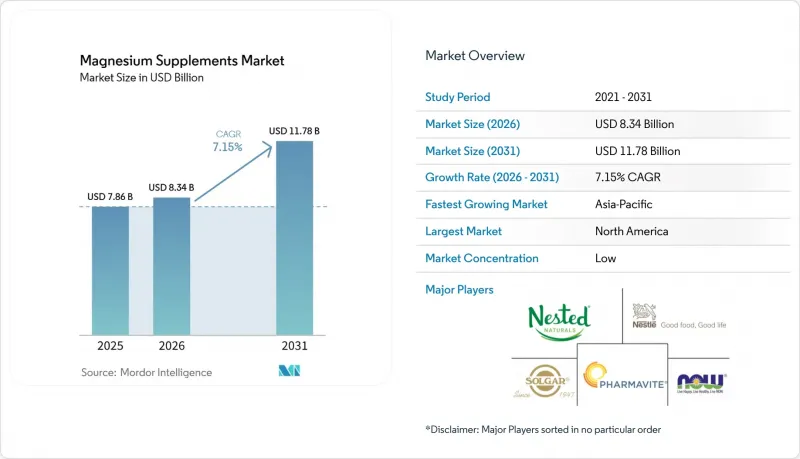
According to Mordor Intelligence, the magnesium supplements is expected to grow from USD 7.86 billion in 2025 to USD 8.34 billion in 2026 and is forecast to reach USD 11.78 billion by 2031 at 7.15% CAGR over 2026-2031. This report is Segmented by Product Type (Oxide, Citrate, Glycinate, and More), Form (Tablets, Capsules, Gummies, Powder, Liquid), Application (Bone and Muscle, Sleep Support, Cardiovascular, and More), End User (Gen Z, Millennials, Gen X, Boomers, Gen Alpha), Geography (North America, Europe, Asia-Pacific, South America, Middle East and Africa). The Market Forecasts are Provided in Terms of Value (USD).
Global Magnesium Supplements Market Trends and Insights
Rising Prevalence of Magnesium Deficiency
The rising prevalence of magnesium inadequacy is driving demand for magnesium supplements, as consumers seek to address insufficient dietary intake and support essential physiological functions. According to a 2025 review published in the National Library of Medicine, approximately 2.4 billion people, or around 31% of the global population, do not meet recommended magnesium intake levels . This widespread nutritional gap is raising awareness of magnesium's role in muscle and nerve function, energy metabolism, bone health, and electrolyte balance, particularly as consumers become more proactive about preventive health and wellness. As a result, consumers are increasingly using supplements to bridge dietary gaps and maintain adequate magnesium levels, thereby supporting the growth of the global magnesium supplements market.
Increasing Demand for Sleep and Stress-Management Solutions
Increasing demand for sleep and stress-management solutions is supporting the growth of the magnesium supplements market as consumers increasingly seek natural products to address sleep disturbances, stress, and relaxation-related concerns. Rising work-related pressures, changing lifestyles, and growing awareness of the importance of sleep are encouraging consumers to explore nutritional supplements that support relaxation and overall well-being. Magnesium is increasingly incorporated into sleep and stress-management products, particularly formulations featuring magnesium glycinate, magnesium citrate, and other forms positioned for relaxation support. The growing preference for preventive wellness and non-pharmaceutical solutions is therefore expanding consumer interest in magnesium supplements and supporting market growth.
Limited Consumer Awareness of Different Magnesium Forms
Limited consumer awareness of the differences between magnesium forms is restraining the growth of the magnesium supplements market by creating confusion during product selection. Magnesium supplements are available in various forms, including magnesium citrate, glycinate, oxide, malate, and chloride, which differ in absorption characteristics, applications, and consumer positioning. However, many consumers have limited knowledge of these differences and may select products based primarily on price, dosage, or brand recognition. This lack of understanding can discourage purchases, reduce confidence in premium formulations, and make it more difficult for manufacturers to communicate product differentiation, thereby limiting market growth.
Other drivers and restraints analyzed in the detailed report include:
- Rising Sports Nutrition and Fitness Participation
- Growing Aging Population Supporting Growth
- Side Effects Associated with Excessive Consumption
For complete list of drivers and restraints, kindly check the Table Of Contents.
Segment Analysis
Magnesium oxide held the largest share of the global magnesium supplements market, accounting for 25.62% in 2025. Its leading position is supported by its long-standing use in dietary supplements and broad consumer familiarity. Magnesium oxide is widely available across tablets and capsules, making it accessible through pharmacies, supermarkets, health stores, and online channels. Its relatively low production cost also supports its presence in mass-market and value-oriented supplement products. The ingredient is commonly positioned for general magnesium supplementation and bone and muscle health. Its established market presence and broad availability are expected to help it retain a significant share during the forecast period.
Magnesium glycinate is projected to be the fastest-growing product type, recording a CAGR of 8.56% from 2026 to 2031. Growth is being driven by increasing consumer interest in highly absorbable and well-tolerated magnesium formulations. The ingredient is particularly gaining traction among consumers seeking supplements for sleep support, relaxation, muscle recovery, and general wellness. Its premium positioning also aligns with the broader shift toward higher-quality and targeted nutritional supplements. Growing awareness of different magnesium forms is encouraging consumers to move beyond traditional magnesium oxide products.
Capsules accounted for the largest share of the magnesium supplements market, representing 34.62% of the market size in 2025. Their leading position is supported by convenience, portability, and ease of consumption. Capsules also enable manufacturers to offer precise dosages across various magnesium formulations, including glycinate, citrate, and oxide. The format is widely distributed through pharmacies, health stores, supermarkets, and e-commerce platforms. Growing consumer preference for convenient daily supplementation further supports demand for capsule-based products. As a result, capsules are expected to remain the dominant form throughout the forecast period.
Growth is being supported by increasing demand for flexible dosing and convenient supplementation formats. Magnesium powders can be easily mixed with water or other beverages, appealing to consumers seeking alternatives to tablets and capsules. The format is also gaining traction among sports nutrition and wellness consumers focused on hydration, recovery, and daily supplementation.
Complete Report Scope:
- By Product Type
- Magnesium Oxide
- Magnesium Citrate
- Magnesium Glycinate
- Magnesium L-Threonate
- Magnesium Taurate
- Other Product Types
- By Form
- Tablets
- Capsules
- Gummies
- Powder
- Liquid
- By Application
- Bone and Muscle
- Sleep Support
- Cardiovascular Health
- Brain and Cognitive Health
- Other Applications
- By End User
- Gen Alpha
- Gen Z
- Millennials
- Gen X
- Boomers
- By Geography
- North America
- United States
- Canada
- Mexico
- Rest of North America
- Europe
- Germany
- United Kingdom
- Italy
- Spain
- France
- Belgium
- Poland
- Rest of Europe
- Asia-Pacific
- China
- India
- Japan
- Australia
- South Korea
- Thailand
- Indonesia
- Vietnam
- Rest of Asia-Pacific
- South America
- Brazil
- Argentina
- Chile
- Peru
- Rest of South America
- Middle East and Africa
- South Africa
- Saudi Arabia
- United Arab Emirates
- Qatar
- Egypt
- Morocco
- Rest of Middle East and Africa
- North America
Geography Analysis
North America held the largest share of the global magnesium supplements market, accounting for 36.11% of market value in 2025. The region benefits from high consumer awareness of dietary supplements, preventive healthcare, and sports nutrition. Strong demand for products supporting muscle health, sleep, cardiovascular wellness, and cognitive health continues to support market growth. The presence of established supplement manufacturers, extensive retail networks, pharmacies, and e-commerce platforms further strengthens product accessibility. Consumers in the region also show strong interest in premium, specialized, and condition-focused magnesium formulations.
Asia-Pacific is projected to be the fastest-growing regional market, expanding at a CAGR of 9.23% from 2026 to 2031. Growth is supported by rising health awareness, increasing disposable incomes, and the expanding adoption of dietary supplements across major markets such as China, Japan, India, and Australia. Growing interest in sports nutrition, sleep support, active lifestyles, and preventive healthcare is increasing demand for magnesium-based products. The expansion of e-commerce and modern retail is also improving access to international and domestic supplement brands.
Europe represents a significant regional market, supported by strong health awareness, established supplement consumption, and demand for premium and clean-label products. South America is expected to benefit from rising wellness awareness and expanding retail and e-commerce distribution. The Middle East and Africa market is supported by growing interest in preventive health, fitness, and nutritional supplementation, although market penetration remains comparatively lower.
- Pharmavite LLC
- Nestle S.A.
- NOW Foods
- Nested Naturals, Inc.
- Solaray (Nutraceutical International Corporation)
- Doctor's Best, Inc.
- Solgar, Inc.
- Pure Encapsulations, LLC
- Life Extension Foundation
- Thorne HealthTech, Inc.
- Natural Vitality (The Clorox Company)
- Jigsaw Health, LLC
- BioEmblem, LLC
- Balchem Corporation (Albion Minerals)
- Jungbunzlauer Suisse AG
- Fortitech, Inc.
- Magceutics, Inc.
- Swanson Health Products, Inc.
- Jarrow Formulas, Inc.
- Sundown Naturals (The Bountiful Company)
Additional Benefits:
- The market estimate (ME) sheet in Excel format
- 3 months of analyst support
TABLE OF CONTENTS
1 INTRODUCTION
- 1.1 Study Assumptions and Market Definition
- 1.2 Scope of the Study
2 RESEARCH METHODOLOGY
3 EXECUTIVE SUMMARY
4 MARKET LANDSCAPE
- 4.1 Market Overview
- 4.2 Market Drivers
- 4.2.1 Rising Prevalence of Magnesium Deficiency
- 4.2.2 Growing Focus on Preventive Healthcare
- 4.2.3 Increasing Demand for Sleep and Stress-Management Solutions
- 4.2.4 Rising Sports Nutrition and Fitness Participation
- 4.2.5 Growing Aging Population Supporing Growth
- 4.2.6 Product Innovation and Formulation Diversification
- 4.3 Market Restraints
- 4.3.1 Limited Consumer Awareness of Different Magnesium Forms
- 4.3.2 Side Effects Associated with Excessive Consumption
- 4.3.3 Competition from Magnesium-Rich Foods
- 4.3.4 Regulatory Variations Across Countries
- 4.4 Supply Chain Analysis
- 4.5 Regulatory Outlook
- 4.6 Porter's Five Forces
- 4.6.1 Threat of New Entrants
- 4.6.2 Bargaining Power of Buyers/Consumers
- 4.6.3 Bargaining Power of Suppliers
- 4.6.4 Threat of Substitute Products
- 4.6.5 Intensity of Competitive Rivalry
5 MARKET SIZE and GROWTH FORECASTS (VALUE)
- 5.1 By Product Type
- 5.1.1 Magnesium Oxide
- 5.1.2 Magnesium Citrate
- 5.1.3 Magnesium Glycinate
- 5.1.4 Magnesium L-Threonate
- 5.1.5 Magnesium Taurate
- 5.1.6 Other Product Types
- 5.2 By Form
- 5.2.1 Tablets
- 5.2.2 Capsules
- 5.2.3 Gummies
- 5.2.4 Powder
- 5.2.5 Liquid
- 5.3 By Application
- 5.3.1 Bone and Muscle
- 5.3.2 Sleep Support
- 5.3.3 Cardiovascular Health
- 5.3.4 Brain and Cognitive Health
- 5.3.5 Other Applications
- 5.4 By End User
- 5.4.1 Gen Alpha
- 5.4.2 Gen Z
- 5.4.3 Millennials
- 5.4.4 Gen X
- 5.4.5 Boomers
- 5.5 By Geography
- 5.5.1 North America
- 5.5.1.1 United States
- 5.5.1.2 Canada
- 5.5.1.3 Mexico
- 5.5.1.4 Rest of North America
- 5.5.2 Europe
- 5.5.2.1 Germany
- 5.5.2.2 United Kingdom
- 5.5.2.3 Italy
- 5.5.2.4 Spain
- 5.5.2.5 France
- 5.5.2.6 Belgium
- 5.5.2.7 Poland
- 5.5.2.8 Rest of Europe
- 5.5.3 Asia-Pacific
- 5.5.3.1 China
- 5.5.3.2 India
- 5.5.3.3 Japan
- 5.5.3.4 Australia
- 5.5.3.5 South Korea
- 5.5.3.6 Thailand
- 5.5.3.7 Indonesia
- 5.5.3.8 Vietnam
- 5.5.3.9 Rest of Asia-Pacific
- 5.5.4 South America
- 5.5.4.1 Brazil
- 5.5.4.2 Argentina
- 5.5.4.3 Chile
- 5.5.4.4 Peru
- 5.5.4.5 Rest of South America
- 5.5.5 Middle East and Africa
- 5.5.5.1 South Africa
- 5.5.5.2 Saudi Arabia
- 5.5.5.3 United Arab Emirates
- 5.5.5.4 Qatar
- 5.5.5.5 Egypt
- 5.5.5.6 Morocco
- 5.5.5.7 Rest of Middle East and Africa
- 5.5.1 North America
6 COMPETITIVE LANDSCAPE
- 6.1 Market Concentration
- 6.2 Strategic Moves
- 6.3 Market Ranking Analysis
- 6.4 Company Profiles (includes Global-level Overview, Market-level Overview, Core Segments, Financials (if available), Strategic Information, Market Rank/Share, Products and Services, Recent Developments)
- 6.4.1 Pharmavite LLC
- 6.4.2 Nestle S.A.
- 6.4.3 NOW Foods
- 6.4.4 Nested Naturals, Inc.
- 6.4.5 Solaray (Nutraceutical International Corporation)
- 6.4.6 Doctor's Best, Inc.
- 6.4.7 Solgar, Inc.
- 6.4.8 Pure Encapsulations, LLC
- 6.4.9 Life Extension Foundation
- 6.4.10 Thorne HealthTech, Inc.
- 6.4.11 Natural Vitality (The Clorox Company)
- 6.4.12 Jigsaw Health, LLC
- 6.4.13 BioEmblem, LLC
- 6.4.14 Balchem Corporation (Albion Minerals)
- 6.4.15 Jungbunzlauer Suisse AG
- 6.4.16 Fortitech, Inc.
- 6.4.17 Magceutics, Inc.
- 6.4.18 Swanson Health Products, Inc.
- 6.4.19 Jarrow Formulas, Inc.
- 6.4.20 Sundown Naturals (The Bountiful Company)
7 MARKET OPPORTUNITIES AND FUTURE OUTLOOK

