PUBLISHER: Mordor Intelligence | PRODUCT CODE: 2117632

PUBLISHER: Mordor Intelligence | PRODUCT CODE: 2117632
Green Ammonia Fertilizer - Market Share Analysis, Industry Trends & Statistics, Growth Forecasts (2026 - 2031)
According to Mordor Intelligence, the green ammonia fertilizer market is anticipated to grow from USD 2.80 billion in 2025 to USD 2.97 billion in 2026, reaching USD 3.97 billion by 2031, at a CAGR of 6.0% during the forecast period 2026-2031.
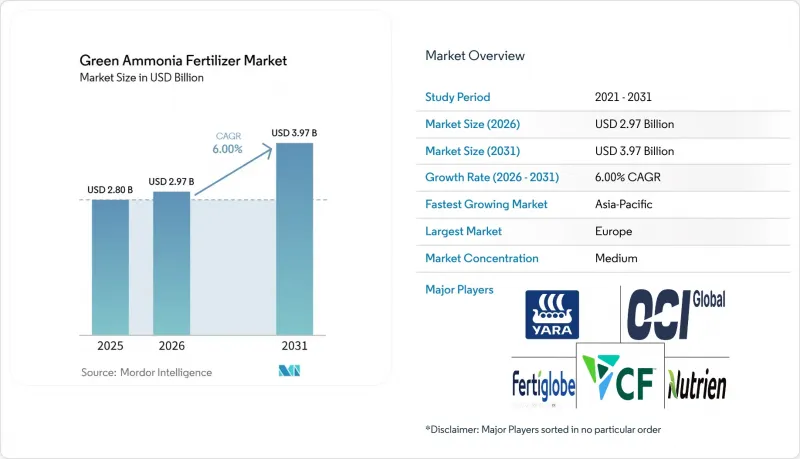
This report is Segmented by Fertilizer Type (Green Ammonia, Green Urea, and More), by Source Technology (Electrolytic Hydrogen Based, Biomass Gasification Based, and More), by Form (Solid and Liquid), by Crop Type (Field Crops, Horticultural Crops, and More), and by Geography (North America, South America, and More). The Market Forecasts are Provided in Terms of Value (USD) and Volume (Metric Tons).
Global Green Ammonia Fertilizer Market Trends and Insights
Carbon-Neutral Fertilizer Mandates
Binding emissions regulations are shifting the low-carbon nitrogen procurement from a voluntary option to a contractual requirement in several agricultural supply chains. The European Union's (EU) Effort Sharing Regulation (ESR) 2021-2030 requires member states to reduce greenhouse gas emissions in non-Emissions Trading System sectors, including agriculture, pushing fertilizer buyers toward certified lower-emission inputs. This policy shift is also increasing the value of traceability, as buyers increasingly require lifecycle verification rather than offset-based claims alone, which favors larger producers and more integrated supply chains. Japan's Hydrogen Society Promotion Act of 2024 is creating a similar demand pattern in East Asia by supporting imports through a policy structure that enables long-term contracting. As a result, compliance standards are now shaping upstream investment decisions across the green ammonia fertilizer market.
Renewable Power Cost Parity in Production Hubs
Falling renewable electricity and electrolyzer costs are narrowing the commercial gap between electrolytic ammonia and conventional ammonia production. The International Energy Agency (IEA) reported in its 2025 Global Hydrogen Review that electrolyzer installation costs outside China ranged from USD 2,000 to USD 2,600 per kilowatt in 2024. The cost advantage favors projects with reliable renewable grid access, as they can combine lower operating costs with stronger emissions performance. Flexible production modeling published in 2025 in MDPI also indicated materially lower future ammonia costs under optimized wind and solar-wind hybrid systems, supporting the view that cost competitiveness will improve as projects scale and system design matures. As this cost gap narrows, the green ammonia fertilizer market becomes less dependent on policy support and more capable of expanding on a commercial basis.
High Capital Intensity of Large-Scale Electrolyzers and Synthesis Trains
The high cost of building large green ammonia fertilizer plants remains the most significant barrier to faster supply expansion. The International Energy Agency reported in 2025 that only 4% of the global electrolyzer pipeline planned for 2030 had reached final investment decision or begun construction, despite a project pipeline of 520 gigawatts. This is significant because green ammonia fertilizer projects typically have build periods of 3 to 5 years, meaning any changes in carbon pricing or subsidy rules during construction can weaken returns before production begins. Financing is more difficult in emerging markets, where long-tenor project debt is limited and sovereign risk premiums increase the effective cost of capital. Progress therefore depends on long-term offtake contracts, policy stability, and construction-period risk support.
Other drivers and restraints analyzed in the detailed report include:
- Corporate Net-Zero Farming Procurement
- Green-Hydrogen Tax Credits and Production Incentives
- Grid Congestion Delaying Renewable Power Purchase Agreements
For complete list of drivers and restraints, kindly check the Table Of Contents.
Segment Analysis
Green ammonia fertilizer accounted for 46.0% of market revenue in 2025, making it the largest product segment in the green fertilizer market. Its dominant position is supported by compatibility with existing Haber-Bosch production facilities, ammonia terminals, and handling infrastructure used across the conventional nitrogen fertilizer industry. This established infrastructure lowers the transition costs for buyers by enabling the adoption of lower-emission ammonia without requiring major changes to existing production and logistics networks. Green ammonia also benefits from demand beyond agriculture, as its use as a marine fuel provides an additional offtake channel that helps improve asset utilization during periods of slower agricultural demand.
Green ammonia is projected to grow at a CAGR of 6.8% between 2026 and 2031, further strengthening its position as related green fertilizer categories continue to evolve. Government initiatives promoting low-carbon fertilizer production and the use of green ammonia in fertilizer manufacturing are improving the commercial outlook for green urea and other sustainable nitrogen products. At the same time, the fertilizer product mix is gradually expanding beyond conventional nitrogen substitution toward a broader portfolio of low-emission and circular nutrient solutions. Despite this diversification, green ammonia is anticipated to remain the commercial anchor of the market because it serves both agricultural and industrial end users.
Electrolytic hydrogen-based production held 54.0% of source technology revenue in 2025, accounting for the largest share of the green ammonia fertilizer market. Its position is supported by direct alignment with zero-carbon certification requirements and eligibility for major incentive programs in the United States, Europe, and Japan. This pathway also benefits from a more mature ecosystem of certifiers, insurers, engineering providers, and offtakers, which reduces transaction friction for large projects. Developers that choose electrolytic routes are often able to move faster because counterparties have a clearer understanding of the certification logic and financing structure. Biomass gasification-based production retains a presence in markets where crop residues create strong local feedstock advantages, particularly across South and Southeast Asia.
Waste-to-hydrogen based production is anticipated to expand at a 10.0% CAGR between 2026 and 2031, making it the fastest-growing source technology. This route attracts interest because it combines waste management and fertilizer decarbonization within a single business case, which can broaden the pool of capital available to projects. The strongest opportunity exists in locations where tipping-fee revenue or municipal waste obligations can directly support hydrogen production economics. Other pathways, such as plasma-assisted synthesis and electrochemical nitrogen reduction, remain at an earlier stage and are better viewed as longer-term technology options rather than near-term volume contributors in the green ammonia fertilizer market.
Complete Report Scope:
- By Fertilizer Type
- Green Ammonia
- Fully Green Ammonia
- Blended Green Ammonia Fertilizers
- Green Ammonia Based Bio Integrated Fertilizers
- Green Urea
- Other Fertilizer Types
- Green Ammonia
- By Source Technology
- Electrolytic Hydrogen Based
- Biomass Gasification Based
- Waste-to-Hydrogen Based
- Other Emerging Technologies
- By Form
- Solid
- Liquid
- By Crop Type
- Field Crops
- Horticultural Crops
- Turf and Ornamental
- By Geography
- North America
- United States
- Canada
- Mexico
- Rest of North America
- South America
- Brazil
- Argentina
- Rest of South America
- Europe
- Germany
- France
- United Kingdom
- Italy
- Spain
- Russia
- Rest of Europe
- Asia- Pacific
- China
- Japan
- India
- South Korea
- Australia and New Zealand
- Rest of Asia-Pacific
- Middle East
- Saudi Arabia
- United Arab Emirates
- Turkey
- Rest of Middle East
- Africa
- South Africa
- Egypt
- Rest of Africa
- North America
Geography Analysis
Europe held 32.0% of the green fertilizer market share in 2025, making it the largest region. Europe's position is supported by carbon pricing, stricter import accountability, and greater willingness among buyers to pay for certified lower-emission ammonia and downstream fertilizers. The Carbon Border Adjustment Mechanism (CBAM) moved into its definitive phase in January 2026, which improves the relative competitiveness of low-emission fertilizer supply, particularly for buyers with long-term exposure to imported conventional ammonia. Europe also remains a significant demand center as producers seek to reduce dependence on Russian-gas-linked feedstocks and reposition their supply chains around low-carbon sources.
Asia-Pacific is anticipated to expand at a 7.6% CAGR between 2026 and 2031, making it the fastest-growing region. Growth is being driven by governments in India, Japan, South Korea, China, and Australia combining demand creation with supply-side investment support. In June 2026, India signed 10-year agreements through the Solar Energy Corporation of India (SECI) covering 670,000 metric tons per year of green ammonia supply for 11 domestic fertilizer plants under the National Green Hydrogen Mission. Japan is supporting regional expansion through price-support frameworks that help cross-border green ammonia projects secure bankable export demand. Western Asia is also gaining importance, as Saudi Arabia, the United Arab Emirates, and Egypt combine low-cost renewable resources with export-oriented project strategies targeting European and East Asian buyers.
North America remains commercially significant, as the United States policy framework provides clean hydrogen and low-carbon ammonia projects with stronger financial support and clearer investment visibility. South America is building demand through export agriculture, particularly where growers and exporters require verifiable sustainable input use to maintain access to premium markets. Africa has a smaller but notable project pipeline, with Egypt and South Africa standing out as markets where resource quality and fertilizer demand support a viable long-term case for expansion. Russia remains a slower market, as low-cost natural gas, limited clean-energy policy momentum, and reduced access to Western technology partnerships continue to constrain the pace of change.
- Yara Clean Ammonia AS (Yara International ASA)
- CF Industries Holdings Inc.
- Nutrien Ltd.
- OCI Global (OCI N.V.)
- Fertiglobe PLC
- ACME Cleantech Solutions Private Limited (ACME Group)
- Air Products and Chemicals Inc.
- ENGIE SA
- Iberdrola S.A.
- thyssenkrupp Uhde GmbH (thyssenkrupp AG)
- Siemens Energy AG
- Nel ASA
- AmmPower Corp.
- Avina Clean Hydrogen Inc.
- Casale SA
- AM Green Ammonia India Private Limited (AM Green Group)
- Greenko Energy Holdings
- Fortescue Energy Pty Ltd
- Technip Energies N.V.
Additional Benefits:
- The market estimate (ME) sheet in Excel format
- 3 months of analyst support
TABLE OF CONTENTS
1 INTRODUCTION
- 1.1 Study Assumptions and Market Definition
- 1.2 Scope of the Study
2 RESEARCH METHODOLOGY
3 EXECUTIVE SUMMARY
4 MARKET LANDSCAPE
- 4.1 Market Overview
- 4.2 Market Drivers
- 4.2.1 Carbon-neutral fertilizer mandates
- 4.2.2 Renewable power cost parity in production hubs
- 4.2.3 Corporate net-zero farming procurement
- 4.2.4 Green-hydrogen tax credits and production incentives
- 4.2.5 Carbon border adjustment pressure on fertilizer trade
- 4.2.6 Ammonia bunkering demand pull-through from maritime decarbonization
- 4.3 Market Restraints
- 4.3.1 High capital intensity of large-scale electrolyzers and synthesis trains
- 4.3.2 Grid congestion delaying renewable power purchase agreements
- 4.3.3 Scarcity of certified green water resources in arid production zones
- 4.3.4 Slow agronomic validation of novel green fertilizer formulations
- 4.4 Value Chain and Supply Chain Analysis
- 4.5 Regulatory Landscape
- 4.6 Technological Outlook
- 4.7 Porter's Five Forces Analysis
- 4.7.1 Bargaining Power of Suppliers
- 4.7.2 Bargaining Power of Buyers
- 4.7.3 Threat of New Entrants
- 4.7.4 Threat of Substitutes
- 4.7.5 Competitive Rivalry
5 MARKET SIZE AND GROWTH FORECASTS (VALUE AND VOLUME)
- 5.1 By Fertilizer Type
- 5.1.1 Green Ammonia
- 5.1.1.1 Fully Green Ammonia
- 5.1.1.2 Blended Green Ammonia Fertilizers
- 5.1.1.3 Green Ammonia Based Bio Integrated Fertilizers
- 5.1.2 Green Urea
- 5.1.3 Other Fertilizer Types
- 5.1.1 Green Ammonia
- 5.2 By Source Technology
- 5.2.1 Electrolytic Hydrogen Based
- 5.2.2 Biomass Gasification Based
- 5.2.3 Waste-to-Hydrogen Based
- 5.2.4 Other Emerging Technologies
- 5.3 By Form
- 5.3.1 Solid
- 5.3.2 Liquid
- 5.4 By Crop Type
- 5.4.1 Field Crops
- 5.4.2 Horticultural Crops
- 5.4.3 Turf and Ornamental
- 5.5 By Geography
- 5.5.1 North America
- 5.5.1.1 United States
- 5.5.1.2 Canada
- 5.5.1.3 Mexico
- 5.5.1.4 Rest of North America
- 5.5.2 South America
- 5.5.2.1 Brazil
- 5.5.2.2 Argentina
- 5.5.2.3 Rest of South America
- 5.5.3 Europe
- 5.5.3.1 Germany
- 5.5.3.2 France
- 5.5.3.3 United Kingdom
- 5.5.3.4 Italy
- 5.5.3.5 Spain
- 5.5.3.6 Russia
- 5.5.3.7 Rest of Europe
- 5.5.4 Asia- Pacific
- 5.5.4.1 China
- 5.5.4.2 Japan
- 5.5.4.3 India
- 5.5.4.4 South Korea
- 5.5.4.5 Australia and New Zealand
- 5.5.4.6 Rest of Asia-Pacific
- 5.5.5 Middle East
- 5.5.5.1 Saudi Arabia
- 5.5.5.2 United Arab Emirates
- 5.5.5.3 Turkey
- 5.5.5.4 Rest of Middle East
- 5.5.6 Africa
- 5.5.6.1 South Africa
- 5.5.6.2 Egypt
- 5.5.6.3 Rest of Africa
- 5.5.1 North America
6 COMPETITIVE LANDSCAPE
- 6.1 Market Concentration
- 6.2 Strategic Moves
- 6.3 Market Share Analysis
- 6.4 Company Profiles (Includes Global Level Overview, Market Level Overview, Core Segments, Financials as Available, Strategic Information, Market Rank/Share for Key Companies, Products and Services, and Recent Developments)
- 6.4.1 Yara Clean Ammonia AS (Yara International ASA)
- 6.4.2 CF Industries Holdings Inc.
- 6.4.3 Nutrien Ltd.
- 6.4.4 OCI Global (OCI N.V.)
- 6.4.5 Fertiglobe PLC
- 6.4.6 ACME Cleantech Solutions Private Limited (ACME Group)
- 6.4.7 Air Products and Chemicals Inc.
- 6.4.8 ENGIE SA
- 6.4.9 Iberdrola S.A.
- 6.4.10 thyssenkrupp Uhde GmbH (thyssenkrupp AG)
- 6.4.11 Siemens Energy AG
- 6.4.12 Nel ASA
- 6.4.13 AmmPower Corp.
- 6.4.14 Avina Clean Hydrogen Inc.
- 6.4.15 Casale SA
- 6.4.16 AM Green Ammonia India Private Limited (AM Green Group)
- 6.4.17 Greenko Energy Holdings
- 6.4.18 Fortescue Energy Pty Ltd
- 6.4.19 Technip Energies N.V.
7 MARKET OPPORTUNITIES AND FUTURE OUTLOOK

