PUBLISHER: Mordor Intelligence | PRODUCT CODE: 2118078

PUBLISHER: Mordor Intelligence | PRODUCT CODE: 2118078
Software As A Medical Device (SaMD) For Diagnostic Applications - Market Share Analysis, Industry Trends & Statistics, Growth Forecasts (2026 - 2031)
According to Mordor Intelligence, the software as a medical device for diagnostic applications market size is expected to grow from USD 21.33 billion in 2025 to USD 24.98 billion in 2026 and is forecast to reach USD 49.98 billion by 2031 at 15.25% CAGR over 2026-2031.
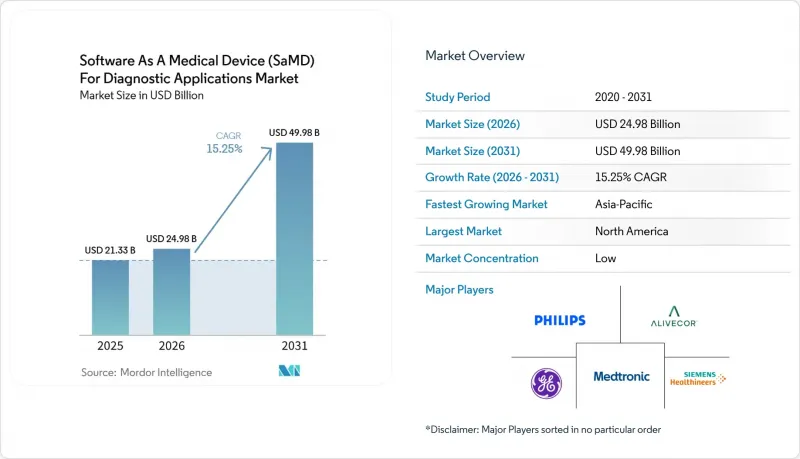
This report is Segmented by Diagnostic Application (Radiology & Imaging, Cardiology, Pathology, Ophthalmology, Neurology, Respiratory Diagnostics, Dermatology, Others), Deployment Mode (Cloud Based, On Premise), Risk Class (IMDRF Class I-IV), End User (Hospitals, Diagnostic Imaging Centers, Ambulatory Care Centers, Home Care Settings, Diagnostic Labs), and Geography. Forecasts are in Value (USD).
Global Software As A Medical Device (SaMD) For Diagnostic Applications Market Trends and Insights
Rising FDA and IMDRF Regulatory Clarity for Diagnostic SaMD
The Software as a Medical Device (SaMD) for Diagnostic Applications market is benefiting from clearer regulatory rules, especially after the FDA issued its January 2025 draft guidance on AI-enabled device software functions. The guidance recognized the iterative nature of machine learning and placed oversight within a total product life cycle framework. IMDRF N81 FINAL:2025 added a common risk characterization framework across the US, EU, Japan, South Korea, Canada, and Australia. Europe entered a stricter phase from August 2026, as higher-risk diagnostic AI software had to meet both EU MDR and EU AI Act requirements. Companies that align update plans, post-market evidence, and documentation across these regimes are reducing approval friction and strengthening buyer confidence.
Increased Clinical Demand for Faster Triage and Earlier Detection
The Software as a Medical Device (SaMD) for Diagnostic Applications market is advancing as hospitals face continued pressure to read scans and triage patients faster. Radiologist shortages, aging populations, and the rising chronic disease burden are driving AI-assisted diagnosis in time-sensitive workflows. Radiology, cardiovascular, and neurology panels together accounted for 90.6% of FDA AI- and ML-enabled device authorizations through December 2025, confirming strong demand in image-rich clinical pathways. In China, AI-enabled county imaging sharing centers expanded widely, and remote medical imaging diagnostic services exceeded 68 million person-times in 2025, showing that scale demand extends beyond Western healthcare systems.
Clinical Validation Burden and Site-Specific Generalizability Risk
The Software as a Medical Device (SaMD) for Diagnostic Applications market continues to face a significant validation challenge, as models must demonstrate reliability across diverse patient populations, scanner types, and clinical workflows. By December 2025, 502 of the 740 unique companies with FDA AI and ML authorizations held only one cleared indication, highlighting the high cost of scaling evidence across multiple use cases. Models trained in large academic centers may perform differently in community hospitals with different imaging protocols and patient mixes. This burden remains notable in underpenetrated specialties such as pathology and psychiatry, where authorization counts remain very low, while fragmented interoperability across hospital IT systems, PACS, and EHR systems slows multicenter deployment and real-world validation.
Other drivers and restraints analyzed in the detailed report include:
- Expansion of Cloud-Based AI Workflows in Radiology and Multimodal Diagnostics
- Hospital Pressure to Reduce Diagnostic Backlogs and Reporting Turnaround
- Reimbursement Uncertainty for Standalone Diagnostic Software
For complete list of drivers and restraints, kindly check the Table Of Contents.
Segment Analysis
Radiology and imaging held a 39.55% revenue share in 2025, giving it the broadest installed base within the Software as a Medical Device (SaMD) for Diagnostic Applications market. This leadership aligned with the FDA radiology panel, which accounted for 76.5% of all 1,430 FDA AI and ML authorizations through December 2025. Breast imaging remained commercially strong, supported by Hologic's Genius AI Detection, iCAD's ProFound AI, and iCAD's February 2025 partnership with Koios Medical to expand multi-modality breast cancer detection. Cardiology also remained a strong part of the market, supported by HeartFlow's September 2025 FDA 510(k) clearance for its next-generation plaque analysis platform and nationwide Aetna coverage by January 2026.
Neurology is the fastest-growing application, registering a 16.93% CAGR from 2026 to 2031, making it one of the most dynamic parts of the Software as a Medical Device (SaMD) for Diagnostic Applications market. The FDA granted De Novo classification to neuropacs in April 2026, creating a new regulatory category for AI-based diffusion MRI support in Parkinsonian syndrome differentiation. A June 2026 Nature Medicine study showed 92.6% balanced accuracy for a neuroimaging foundation model across diverse clinical datasets, strengthening the case for broader neurological use.
Cloud-based deployment held a 64.22% revenue share in 2025, making it the leading delivery model in the Software as a Medical Device (SaMD) for Diagnostic Applications market. The segment is projected to grow at a 17.67% CAGR through 2031, reflecting health system demand for centralized deployment across complex imaging networks. GE HealthCare's March 2026 acquisition of Intelerad showed that large vendors view cloud imaging as a core platform layer rather than an add-on capability. Cloud environments also support multimodal and foundation-model development through larger training datasets, simpler updates, and shared workflows across sites.
On-premise deployment still retains a role in the Software as a Medical Device (SaMD) for Diagnostic Applications market, particularly where institutions face strict data residency and privacy obligations. This mode remains relevant in jurisdictions with tighter limits on patient data storage, processing, and transfer. Many vendors are moving toward hybrid architectures that keep identifiable data in local environments while shifting heavier computing tasks into controlled cloud layers.
Complete Report Scope:
- By Diagnostic Application
- Radiology and Imaging
- Cardiology
- Pathology
- Ophthalmology
- Neurology
- Respiratory Diagnostics
- Dermatology
- Other Diagnostic Applications
- By Deployment Mode
- Cloud Based
- On Premise
- By Risk Class
- IMDRF Class I
- IMDRF Class II
- IMDRF Class III
- IMDRF Class IV
- By End User
- Hospitals
- Diagnostic Imaging Centers
- Ambulatory Care Centers
- Home Care Settings
- Diagnostic Laboratories
- By Geography
- North America
- United States
- Canada
- Mexico
- Europe
- Germany
- United Kingdom
- France
- Italy
- Spain
- Rest of Europe
- Asia-Pacific
- China
- India
- Japan
- Australia
- South Korea
- Rest of Asia-Pacific
- Middle East and Africa
- GCC
- South Africa
- Rest of Middle East and Africa
- South America
- Brazil
- Argentina
- Rest of South America
- North America
Geography Analysis
North America held 42.25% of the Software as a Medical Device (SaMD) for Diagnostic Applications market size in 2025, giving the region the largest revenue base. The US remained the core demand center, as FDA AI- and ML-enabled device authorizations reached 1,430 by December 2025 and continued to rise sharply during 2025. CMS proposed a new Software as a Medical Service payment category in July 2026, which could improve the commercial case for standalone diagnostic software if finalized. Europe remained the second-largest regional block, supported by a strong medtech base and active adoption across major health systems. From August 2026, the dual compliance burden under EU MDR and the EU AI Act makes regulatory readiness a decisive factor for launches in the region.
Asia-Pacific is projected to grow at a 15.95% CAGR through 2031, making it the fastest-growing regional block in the Software as a Medical Device (SaMD) for Diagnostic Applications market. China drove this growth through broader use of AI-enabled imaging networks and remote diagnostics, which exceeded 68 million person-times in 2025. South Korea also advanced quickly, with AI SaMD approvals rising to 157 in 2025 from 62 in 2023 and a fast-track access system launched in January 2026. The region's momentum reflects policy support, faster commercialization, and large provider networks that can adopt diagnostic AI at scale.
The Middle East and Africa and South America remain smaller in revenue terms but serve as important testing grounds for the next phase of the Software as a Medical Device (SaMD) for Diagnostic Applications market. Saudi Arabia expanded healthcare AI through Vision 2030 programs and Seha Virtual Hospital, where AI triage tools are being scaled for large consultation volumes. Brazil clarified SaMD regularization under RDC 657/2022 in January 2026 and is preparing further revisions for generative AI and deep learning models. Across both regions, adoption remains concentrated in larger urban and referral centers with stronger infrastructure, procurement capacity, and regulatory alignment.
- Aidoc Medical Ltd.
- AliveCor
- Butterfly Network, Inc.
- Canon
- Digital Diagnostics
- FUJIFILM
- GE HealthCare Technologies Inc.
- HeartFlow, Inc.
- Hologic
- iCAD, Inc.
- Iterative Scopes, Inc.
- Kheiron Medical Technologies Limited
- Koninklijke Philips
- Medtronic
- Paige AI, Inc.
- Qure.ai Technologies Private Limited
- Roche Diagnostics International Ltd
- Siemens Healthineers
- Tempus AI, Inc.
- Viz.ai, Inc.
Additional Benefits:
- The market estimate (ME) sheet in Excel format
- 3 months of analyst support
TABLE OF CONTENTS
1 INTRODUCTION
- 1.1 Study Assumptions and Market Definition
- 1.2 Scope of the Study
2 RESEARCH METHODOLOGY
3 EXECUTIVE SUMMARY
4 MARKET LANDSCAPE
- 4.1 Market Overview
- 4.2 Market Drivers
- 4.2.1 Rising FDA and IMDRF Regulatory Clarity for Diagnostic SaMD
- 4.2.2 Increased Clinical Demand for Faster Triage and Earlier Detection
- 4.2.3 Expansion of Cloud-Based AI Workflows in Radiology and Multimodal Diagnostics
- 4.2.4 Hospital Pressure to Reduce Diagnostic Backlogs and Reporting Turnaround Times
- 4.2.5 Growth in Multimodal Data Integration Across Imaging, EHR, and Laboratory Data
- 4.2.6 Rising Payer and Provider Interest in Measurable Diagnostic Workflow ROI
- 4.3 Market Restraints
- 4.3.1 Clinical Validation Burden and Site-Specific Generalizability Risk
- 4.3.2 Reimbursement Uncertainty for Standalone Diagnostic Software
- 4.3.3 Fragmented interoperability with hospital IT and EHR ecosystems
- 4.3.4 Data Governance, Privacy, and Cross-Border Transfer Constraints
- 4.4 Value/Supply Chain Analysis
- 4.5 Regulatory Landscape
- 4.6 Technological Outlook
- 4.7 Porter's Five Forces Analysis
- 4.7.1 Threat of New Entrants
- 4.7.2 Bargaining Power of Suppliers
- 4.7.3 Bargaining Power of Buyers
- 4.7.4 Threat of Substitutes
- 4.7.5 Industry Rivalry
5 MARKET SIZE AND GROWTH FORECASTS (VALUE, USD)
- 5.1 By Diagnostic Application
- 5.1.1 Radiology and Imaging
- 5.1.2 Cardiology
- 5.1.3 Pathology
- 5.1.4 Ophthalmology
- 5.1.5 Neurology
- 5.1.6 Respiratory Diagnostics
- 5.1.7 Dermatology
- 5.1.8 Other Diagnostic Applications
- 5.2 By Deployment Mode
- 5.2.1 Cloud Based
- 5.2.2 On Premise
- 5.3 By Risk Class
- 5.3.1 IMDRF Class I
- 5.3.2 IMDRF Class II
- 5.3.3 IMDRF Class III
- 5.3.4 IMDRF Class IV
- 5.4 By End User
- 5.4.1 Hospitals
- 5.4.2 Diagnostic Imaging Centers
- 5.4.3 Ambulatory Care Centers
- 5.4.4 Home Care Settings
- 5.4.5 Diagnostic Laboratories
- 5.5 By Geography
- 5.5.1 North America
- 5.5.1.1 United States
- 5.5.1.2 Canada
- 5.5.1.3 Mexico
- 5.5.2 Europe
- 5.5.2.1 Germany
- 5.5.2.2 United Kingdom
- 5.5.2.3 France
- 5.5.2.4 Italy
- 5.5.2.5 Spain
- 5.5.2.6 Rest of Europe
- 5.5.3 Asia-Pacific
- 5.5.3.1 China
- 5.5.3.2 India
- 5.5.3.3 Japan
- 5.5.3.4 Australia
- 5.5.3.5 South Korea
- 5.5.3.6 Rest of Asia-Pacific
- 5.5.4 Middle East and Africa
- 5.5.4.1 GCC
- 5.5.4.2 South Africa
- 5.5.4.3 Rest of Middle East and Africa
- 5.5.5 South America
- 5.5.5.1 Brazil
- 5.5.5.2 Argentina
- 5.5.5.3 Rest of South America
- 5.5.1 North America
6 COMPETITIVE LANDSCAPE
- 6.1 Market Concentration
- 6.2 Market Share Analysis
- 6.3 Company Profiles (includes Global Level Overview, Market Level Overview, Core Segments, Financials as available, Strategic Information, Market Rank/Share, Products and Services, Recent Developments)
- 6.3.1 Aidoc Medical Ltd.
- 6.3.2 AliveCor, Inc.
- 6.3.3 Butterfly Network, Inc.
- 6.3.4 Canon Medical Systems Corporation
- 6.3.5 Digital Diagnostics, Inc.
- 6.3.6 Fujifilm Holdings Corporation
- 6.3.7 GE HealthCare Technologies Inc.
- 6.3.8 HeartFlow, Inc.
- 6.3.9 Hologic, Inc.
- 6.3.10 iCAD, Inc.
- 6.3.11 Iterative Scopes, Inc.
- 6.3.12 Kheiron Medical Technologies Limited
- 6.3.13 Koninklijke Philips N.V.
- 6.3.14 Medtronic plc
- 6.3.15 Paige AI, Inc.
- 6.3.16 Qure.ai Technologies Private Limited
- 6.3.17 Roche Diagnostics International Ltd
- 6.3.18 Siemens Healthineers AG
- 6.3.19 Tempus AI, Inc.
- 6.3.20 Viz.ai, Inc.
7 MARKET OPPORTUNITIES AND FUTURE OUTLOOK
- 7.1 White-space and Unmet Need Assessment

