PUBLISHER: Mordor Intelligence | PRODUCT CODE: 2118081

PUBLISHER: Mordor Intelligence | PRODUCT CODE: 2118081
Hospital Software As A Medical Device (SaMD) - Market Share Analysis, Industry Trends & Statistics, Growth Forecasts (2026 - 2031)
According to Mordor Intelligence, the hospital software as a medical device market size is expected to increase from USD 10.55 billion in 2025 to USD 12.49 billion in 2026 and reach USD 29.06 billion by 2031, growing at a CAGR of 18.40% over 2026-2031.
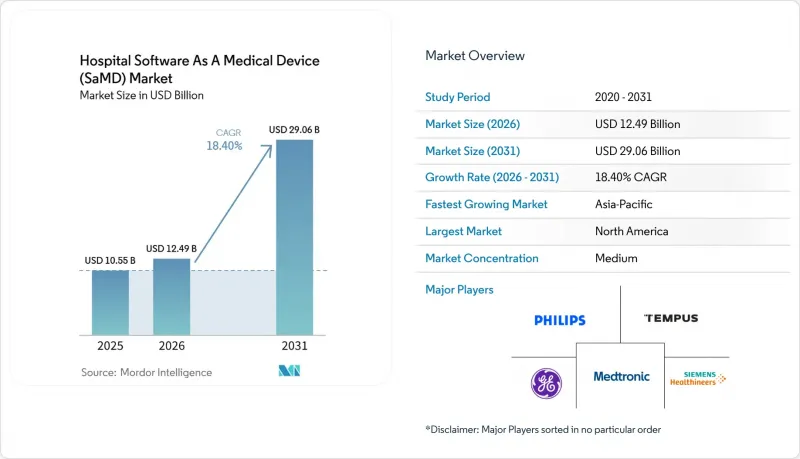
This report is Segmented by Delivery Mode (Cloud Based, On Premises), Software Type (Diagnostic, Monitoring and Alerting, and More), Application (Radiology, Cardiology, Neurology, Oncology, Critical Care, Pathology, Other), Technology (AI and ML, Rules Based, Hybrid Human AI), and Geography (North America, Europe, Asia-Pacific, MEA, South America). Forecasts in Value (USD).
Global Hospital Software As A Medical Device (SaMD) Market Trends and Insights
Rising Hospital Adoption of AI-Based Clinical Decision Making
The hospital software as a medical device (SaMD) market is benefiting from the rising adoption of AI tools that integrate directly into daily care pathways. Hospitals are prioritizing platforms that flag risk, support clinical prioritization, and fit into clinician workflows without adding extra steps. Procurement teams are also seeking evidence that software can influence treatment decisions, not just improve technical accuracy. Tempus AI reported that its ALERT trial across 35 hospitals and five US health systems improved treatment rates for significant valvular heart disease, with patients in the alert group 27% more likely to receive a multidisciplinary heart team evaluation and valve procedures increasing by 40% compared with usual care.
Expansion of Remote Monitoring and Virtual Ward Workflows
The hospital software as a medical device (SaMD) market is also gaining from the expansion of hospital-at-home and virtual ward models. These programs require software that can process remote patient data, detect deterioration early, and send timely alerts to care teams. A 2025 longitudinal analysis showed that NHS England had expanded virtual ward capacity to more than 12,600 beds by January 2025, with occupancy nearing 80%, indicating a larger installed need for monitoring software in formal care pathways. A multicenter UK cardiac study also found that remote monitoring for pre-surgical coronary artery bypass patients maintained clinical outcomes while reducing preoperative bed occupancy.
Complex and Fragmented Regulatory Classification Pathways
The hospital software as a medical device (SaMD) market continues to face complex and fragmented regulatory pathways across major regions. In Europe, vendors must manage medical device regulations and AI-specific obligations, increasing documentation requirements and extending approval timelines. Germany's Federal Commissioner for Data Protection and Freedom of Information and the Bundesnetzagentur issued a joint roadmap in July 2026 to help manufacturers navigate AI in medical devices, underscoring the compliance burden for vendors. Multi-country suppliers also face challenges as data handling, quality management, and clinical evidence expectations vary by market, slowing launches and favoring vendors with larger regulatory teams and stronger local partnerships.
Other drivers and restraints analyzed in the detailed report include:
- Hospital Pressure to Reduce Length of Stay and Readmissions
- PCCP-Enabled Iteration of AI Models After Market Clearance
- Hospital IT Interoperability and Cybersecurity Burden
For complete list of drivers and restraints, kindly check the Table Of Contents.
Segment Analysis
Cloud-based deployment accounted for 69.55% of the hospital software as a medical device (SaMD) market size in 2025, highlighting hospitals' strong shift toward vendor-managed delivery. Cloud platforms reduced local infrastructure needs, simplified software updates across care sites, and supported heavier computing workloads for imaging and model retraining. As a result, the hospital software as a medical device (SaMD) market continued to favor enterprise subscriptions over isolated departmental installations. The cloud-based deployment segment is projected to expand at a CAGR of 21.93% through 2031, reflecting platform consolidation across hospital networks.
Aidoc's April 2026 Series E funding round of USD 150 million brought its total funding above USD 500 million and supported wider deployment of its aiOS enterprise platform and further development of its CARE clinical foundation model. This move showed that suppliers were building for scale rather than single-use deployment within the hospital software as a medical device (SaMD) industry. However, on-premises deployment remained relevant for hospitals with stricter data residency rules or local control requirements for time-sensitive use cases.
Diagnostic SaMD held 44.22% of the hospital software as a medical device (SaMD) market share in 2025, maintaining its leading position across software categories. Imaging gave diagnostic tools a strong base, as hospitals already relied on software-assisted review, prioritization, and reporting in high-volume departments. These products also fit more naturally into existing clinical processes than newer categories that required new protocols or staffing adjustments. Monitoring and alerting SaMD is projected to be the fastest-growing software type, registering a CAGR of 22.67% through 2031, as hospitals expand remote observation and early warning use cases.
Reimbursement support also improved for selected use cases. CMS added HCPCS code G0680 in its April 2026 Hospital Outpatient Prospective Payment System update for software analysis of coronary artery calcium from chest CT scans, showing how payment pathways started aligning with validated clinical software. Clinical decision support software also advanced in cardiology and oncology, where hospitals sought more actionable guidance within record systems. This trend created a broader growth pathway for the hospital software as a medical device (SaMD) market beyond diagnostic interpretation alone.
Complete Report Scope:
- By Delivery Mode
- Cloud Based
- On Premises
- By Software Type
- Diagnostic SaMD
- Monitoring and Alerting SaMD
- Clinical Decision Support SaMD
- Therapeutic SaMD
- Administrative and Workflow SaMD
- By Application
- Radiology and Medical Imaging
- Cardiology
- Neurology
- Oncology
- Critical Care and Emergency Medicine
- Pathology and Laboratory Medicine
- Other Hospital Applications
- By Technology
- AI and Machine Learning
- Rules Based Software
- Hybrid Human AI Workflow Software
- By Geography
- North America
- United States
- Canada
- Mexico
- Europe
- Germany
- United Kingdom
- France
- Italy
- Spain
- Rest of Europe
- Asia-Pacific
- China
- India
- Japan
- Australia
- South Korea
- Rest of Asia-Pacific
- Middle East and Africa
- GCC
- South Africa
- Rest of Middle East and Africa
- South America
- Brazil
- Argentina
- Rest of South America
- North America
Geography Analysis
North America held 40.25% of the hospital software as a medical device (SaMD) market size in 2025, maintaining its leading regional position. The region benefited from a large base of cleared products, mature hospital IT systems, and strong commercial readiness for enterprise software deployment. Reimbursement was still evolving, but the outlook became more constructive for certain validated use cases. CMS added HCPCS code G0680 in April 2026 for software analysis of coronary artery calcium from chest CT scans, showing that payment frameworks started recognizing software as part of reimbursable clinical activity.
Europe remained a significant part of the hospital software as a medical device (SaMD) market, but a stricter compliance environment shaped its growth path. Hospitals and vendors had to address both device regulation and AI-related obligations, which increased market entry costs and slowed deployment in some cases. Germany's joint July 2026 roadmap from the BfDI and Bundesnetzagentur gave manufacturers clearer guidance on how AI in medical devices would be treated in practice. Large suppliers such as Philips remained well positioned in Europe by combining hardware relationships, clinical workflow tools, and certified software offerings across multiple hospital departments.
Asia-Pacific is the fastest-growing region in the hospital software as a medical device (SaMD) market, with a projected 21.95% CAGR through 2031. Digital health investment, large patient volumes, and rising interest in cloud-native hospital systems support growth. Japan's SaMD review pathway and India's expanding digital health infrastructure are helping software adoption move beyond early pilots in selected hospital networks. This regional trend is also expanding into the Middle East and Africa, where GCC healthcare modernization programs support procurement interest, while South America remains at an earlier stage, with Brazil and Argentina as the main entry points.
- Abbott Laboratories
- Aidoc Medical Ltd.
- Baxter
- BrightInsight, Inc.
- Butterfly Network, Inc.
- Canon
- Digital Diagnostics
- FUJIFILM
- GE HealthCare Technologies Inc.
- iCAD, Inc.
- Intuitive Surgical, Inc.
- Johnson & Johnson
- Koninklijke Philips
- Medtronic
- Qure.ai Technologies Private Limited
- RadNet, Inc.
- Siemens Healthineers
- Stryker
- Tempus AI, Inc.
- Viz.ai, Inc.
Additional Benefits:
- The market estimate (ME) sheet in Excel format
- 3 months of analyst support
TABLE OF CONTENTS
1 INTRODUCTION
- 1.1 Study Assumptions and Market Definition
- 1.2 Scope of the Study
2 RESEARCH METHODOLOGY
3 EXECUTIVE SUMMARY
4 MARKET LANDSCAPE
- 4.1 Market Overview
- 4.2 Market Drivers
- 4.2.1 Rising Hospital Adoption of AI-Based Clinical Decision Support
- 4.2.2 Expansion of Remote Monitoring and Virtual Ward Workflows
- 4.2.3 Hospital Pressure to Reduce Length of Stay and Readmissions
- 4.2.4 Increasing Integration of SaMD With PACS, RIS, LIS, and EHR Systems
- 4.2.5 Growth of Image-AI Triage for Time-Critical Specialties
- 4.2.6 PCCP-Enabled Iteration of AI Models After Market Clearance
- 4.3 Market Restraints
- 4.3.1 Complex and Fragmented Regulatory Classification Pathways
- 4.3.2 Hospital IT Interoperability and Cybersecurity Burden
- 4.3.3 Limited Clinical Evidence for Real-World Workflow Impact in Some Use Cases
- 4.3.4 Reimbursement Uncertainty for Standalone Software Benefits
- 4.4 Supply/Value Chain Analysis
- 4.5 Regulatory Landscape
- 4.6 Technological Outlook
- 4.7 Porter's Five Forces Analysis
- 4.7.1 Threat of New Entrants
- 4.7.2 Bargaining Power of Suppliers
- 4.7.3 Bargaining Power of Buyers
- 4.7.4 Threat of Substitutes
- 4.7.5 Competitive Rivalry
5 MARKET SIZE AND GROWTH FORECASTS (VALUE, USD)
- 5.1 By Delivery Mode
- 5.1.1 Cloud Based
- 5.1.2 On Premises
- 5.2 By Software Type
- 5.2.1 Diagnostic SaMD
- 5.2.2 Monitoring and Alerting SaMD
- 5.2.3 Clinical Decision Support SaMD
- 5.2.4 Therapeutic SaMD
- 5.2.5 Administrative and Workflow SaMD
- 5.3 By Application
- 5.3.1 Radiology and Medical Imaging
- 5.3.2 Cardiology
- 5.3.3 Neurology
- 5.3.4 Oncology
- 5.3.5 Critical Care and Emergency Medicine
- 5.3.6 Pathology and Laboratory Medicine
- 5.3.7 Other Hospital Applications
- 5.4 By Technology
- 5.4.1 AI and Machine Learning
- 5.4.2 Rules Based Software
- 5.4.3 Hybrid Human AI Workflow Software
- 5.5 By Geography
- 5.5.1 North America
- 5.5.1.1 United States
- 5.5.1.2 Canada
- 5.5.1.3 Mexico
- 5.5.2 Europe
- 5.5.2.1 Germany
- 5.5.2.2 United Kingdom
- 5.5.2.3 France
- 5.5.2.4 Italy
- 5.5.2.5 Spain
- 5.5.2.6 Rest of Europe
- 5.5.3 Asia-Pacific
- 5.5.3.1 China
- 5.5.3.2 India
- 5.5.3.3 Japan
- 5.5.3.4 Australia
- 5.5.3.5 South Korea
- 5.5.3.6 Rest of Asia-Pacific
- 5.5.4 Middle East and Africa
- 5.5.4.1 GCC
- 5.5.4.2 South Africa
- 5.5.4.3 Rest of Middle East and Africa
- 5.5.5 South America
- 5.5.5.1 Brazil
- 5.5.5.2 Argentina
- 5.5.5.3 Rest of South America
- 5.5.1 North America
6 COMPETITIVE LANDSCAPE
- 6.1 Market Concentration
- 6.2 Market Share Analysis
- 6.3 Company Profiles (includes Global Level Overview, Market Level Overview, Core Segments, Financials as available, Strategic Information, Market Rank/Share, Products and Services, Recent Developments)
- 6.3.1 Abbott Laboratories
- 6.3.2 Aidoc Medical Ltd.
- 6.3.3 Baxter International Inc.
- 6.3.4 BrightInsight, Inc.
- 6.3.5 Butterfly Network, Inc.
- 6.3.6 Canon Inc.
- 6.3.7 Digital Diagnostics Inc.
- 6.3.8 FUJIFILM Holdings Corporation
- 6.3.9 GE HealthCare Technologies Inc.
- 6.3.10 iCAD, Inc.
- 6.3.11 Intuitive Surgical, Inc.
- 6.3.12 Johnson & Johnson
- 6.3.13 Koninklijke Philips N.V.
- 6.3.14 Medtronic plc
- 6.3.15 Qure.ai Technologies Private Limited
- 6.3.16 RadNet, Inc.
- 6.3.17 Siemens Healthineers AG
- 6.3.18 Stryker Corporation
- 6.3.19 Tempus AI, Inc.
- 6.3.20 Viz.ai, Inc.
7 MARKET OPPORTUNITIES AND FUTURE OUTLOOK
- 7.1 White Space and Unmet Need Assessment

