PUBLISHER: Mordor Intelligence | PRODUCT CODE: 2118107

PUBLISHER: Mordor Intelligence | PRODUCT CODE: 2118107
Mobile DevOps Platform - Market Share Analysis, Industry Trends & Statistics, Growth Forecasts (2026 - 2031)
According to Mordor Intelligence, the mobile devOps platform market size was valued at USD 2.43 billion in 2025 and is estimated to grow from USD 2.68 billion in 2026 to reach USD 4.99 billion by 2031, at a CAGR of 13.24% during the forecast period (2026-2031).
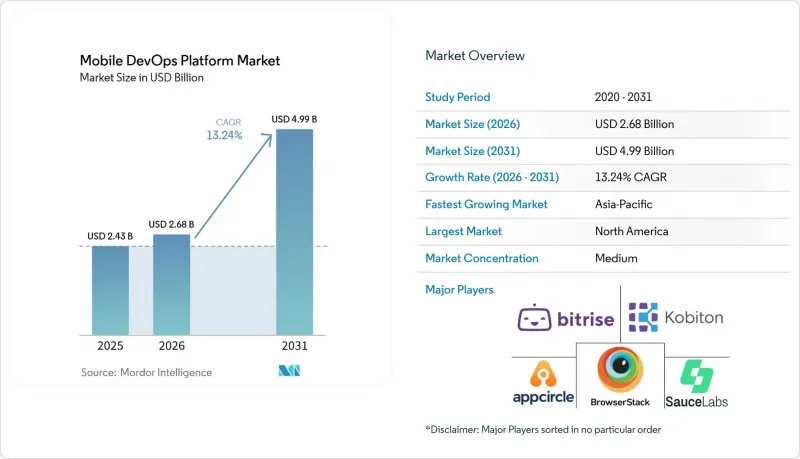
This report is Segmented by Component (Software, and Services), Deployment Model (Cloud, Hybrid, and On-Premises), Enterprise Size (Large Enterprises, and Small and Medium-Sized Enterprises), Development Framework (Native IOS Development, Native Android Development, and More), End User (IT and Telecommunication, BFSI, and More), and Geography. The Market Forecasts are Provided in Terms of Value (USD).
Global Mobile DevOps Platform Market Trends and Insights
Accelerating Demand for Continuous Delivery and Automated Mobile Release Pipelines
The Mobile DevOps Platform Market benefits as consumer-facing enterprises seek to release mobile updates in hours instead of weeks. A 2025 JetBrains survey of 805 software professionals found that 41% of organizations deployed via GitHub Actions, while Jenkins remained widely used in large enterprises due to its plugin ecosystem. Many enterprises still operate legacy build servers beside cloud-based CI/CD tools, which increases maintenance work and complicates release management. This creates demand for platforms that connect with current orchestrators rather than requiring a full migration. Mobile DevOps Platform providers that support the full delivery process through a single control layer can address this need. Expectations for quick app updates are placing additional pressure on procurement and engineering teams to modernize release workflows.
AI and ML Integration Enabling Autonomous Pipeline Management
AI-supported workflows are moving from code suggestions to automated testing, failure review, remediation, and deployment management. Harness introduced Autonomous Worker Agents in June 2026, with governance features that include Open Policy Agent controls and audit trails for pipeline actions. Bitrise reported that AI-assisted builds increased 164 times over 1 year, while the rate at which teams shipped to users fell by 20%. The gap shows that code generation can increase pressure on test and release processes if delivery systems do not scale with it. Platforms that work with AI coding tools and preserve review records are likely to have a stronger position with enterprise buyers. The Mobile DevOps Platform Market is therefore placing greater value on governance features rather than managed build capacity alone.
Legacy IT Infrastructure Integration Complexity and High Migration Overhead
Migration costs remain a major obstacle for enterprises that use Jenkins pipelines with large numbers of custom plugins. The 2025 JetBrains survey found that 32% of organizations used 2 CI/CD tools and 9% used 3 or more. These mixed environments can delay full platform consolidation for long periods. Mobile signing systems, including provisioning profiles, keystores, and App Store Connect credentials, are closely tied to current pipeline settings. Rebuilding those processes can require more work than moving the build steps themselves. ISO/IEC 27001 requirements can add further complexity, as organizations must maintain audit records throughout the transition. The Mobile DevOps Platform Market must therefore address both migration planning and product functionality.
Other drivers and restraints analyzed in the detailed report include:
- Rising Cloud-Native Adoption and Hybrid Deployment Architectures
- Mobile-First Digital Transformation Across Healthcare, BFSI, and Telecom Verticals
- Acute Shortage of Qualified Mobile DevOps Engineering Talent
For complete list of drivers and restraints, kindly check the Table Of Contents.
Segment Analysis
Software held 72.41% of the Mobile DevOps Platform Market share in 2025, reflecting enterprise use of subscription-based CI/CD platforms. Organizations moved from self-managed build servers to software platforms during the 2019-2025 period. The software category gives teams modular access to build, test, release, security review, and workflow approval functions from a common operating environment. It also supports license-based purchasing, which lets organizations align platform access with user counts, project needs, and recurring software budgets rather than project-specific service engagements. This structure remains attractive for enterprises that want common controls across several mobile teams.
Services are projected to grow at a 16.82% CAGR from 2026 to 2031, faster than software. Implementation consulting, pipeline migration, managed operations, and workflow design are becoming increasingly important after a platform is purchased, as production use requires practical changes to team processes. Many organizations need help adapting a platform to existing build, security, release, approval, and reporting processes without interrupting active application delivery. Vendors that combine services with platform licenses can develop more durable customer relationships. These services can also reduce the risk of disruption during a move from existing toolchains.
Cloud deployment accounted for 68.19% of the Mobile DevOps Platform Market size in 2025. Enterprises have used managed cloud runners to reduce the maintenance costs associated with legacy build infrastructure, including hardware administration, software updates, capacity planning, and runner availability. Cloud platforms also provide capacity when application release activity increases, which is useful when teams need parallel builds, automated tests, and distribution workflows across several applications. This model suits organizations that need to support several teams without maintaining their own build hardware. It has become the largest deployment option because it can simplify standard mobile delivery tasks.
Hybrid deployment is projected to grow at a 15.43% CAGR through 2031. Regulated sectors use this approach to keep selected controls, source repositories, credentials, and audit records on-premises while using cloud computing capacity when needed. Bitrise's USD 3 million investment in an EU-operated data center addressed the need to keep customer data within European jurisdictions. Defense, government, and highly regulated financial services users may continue to require isolated environments. ISO/IEC 27001 certifications and GDPR data processing requirements are becoming important factors in deployment decisions.
Complete Report Scope:
- By Component
- Software
- Services
- By Deployment Model
- Cloud
- Hybrid
- On-Premises
- By Enterprise Size
- Large Enterprises
- Small and Medium-Sized Enterprises
- By Development Framework
- Native iOS Development
- Native Android Development
- Cross-platform Development
- Progressive Web Applications
- By End User
- IT and Telecommunication
- BFSI
- Automotive and Transportation
- Healthcare and Life Sciences
- Retail and E-Commerce
- Industrial Manufacturing
- Education and Research Institutions
- Government and Administration
- Energy and Utilities
- Other End Users
- By Geography
- North America
- United States
- Canada
- Mexico
- South America
- Brazil
- Argentina
- Rest of South America
- Europe
- Germany
- United Kingdom
- France
- Russia
- Spain
- Rest of Europe
- Asia-Pacific
- China
- Japan
- India
- South Korea
- Southeast Asia
- Rest of Asia-Pacific
- Middle East and Africa
- Middle East
- Saudi Arabia
- United Arab Emirates
- Rest of Middle East
- Africa
- South Africa
- Nigeria
- Rest of Africa
- Middle East
- North America
Geography Analysis
North America held 36.71% of the Mobile DevOps Platform Market share in 2025. The region benefits from a high concentration of software-focused companies, mature cloud infrastructure, and strong spending on developer tools. Many enterprises are extending basic CI/CD practices to include release management, observability, and AI-assisted pipeline functions. Canadian financial institutions and government agencies also support hybrid demand through technology risk management expectations. Large buyers can retain pricing power because spending is concentrated among a smaller group of major platform companies.
Asia-Pacific is projected to grow at a 17.83% CAGR from 2026 to 2031, making it the fastest-growing regional area. India's growing developer base, China's large application platforms, and Japan's manufacturing digitization support demand for structured engineering and release tooling. South Korea's 5G-enabled application ecosystem contributes to demand from automotive technology and gaming users. Indonesia, Thailand, and Vietnam are developing as a regional demand cluster as digital financial services companies scale consumer applications.
Europe is the 3rd-largest regional area, led by Germany, the United Kingdom, and France. GDPR, DORA, and the Cyber Resilience Act are making compliance a more direct part of DevOps procurement in the region. GitLab released version 19.0 in May 2026 with on-premises support for the Duo Agent Platform in air-gapped regulated environments. South America has early adoption among fintech and e-commerce companies building new mobile platforms. The Middle East and Africa have demand from digital government and fintech investment in Saudi Arabia and the United Arab Emirates, while South Africa and Nigeria represent growing mobile-first markets.
- Bitrise AB
- Appcircle Inc.
- Nevercode Ltd.
- Kobiton, Inc.
- BrowserStack Limited
- Sauce Labs Inc.
- LambdaTest, Inc.
- HeadSpin, Inc.
- Perfecto Mobile, Inc.
- Applause App Quality, Inc.
- Kobiton Testing, Inc.
- Rainforest QA, Inc.
- Testlio, Inc.
- Global App Testing Limited
- Applause GmbH
- Buildkite Pty Ltd.
- Circle Internet Services, Inc.
- Harness, Inc.
- GitLab Inc.
- Atlassian Corporation Plc
- JFrog Ltd.
- CloudBees, Inc.
- Gradle Inc.
- JetBrains s.r.o.
- Embrace Mobile, Inc.
- Instabug, Inc.
- Zimperium, Inc.
- Appium
Additional Benefits:
- The market estimate (ME) sheet in Excel format
- 3 months of analyst support
TABLE OF CONTENTS
1 INTRODUCTION
- 1.1 Study Assumptions and Market Definition
- 1.2 Scope of the Study
2 RESEARCH METHODOLOGY
3 EXECUTIVE SUMMARY
4 MARKET LANDSCAPE
- 4.1 Market Overview
- 4.2 Market Drivers
- 4.2.1 Accelerating Mobile Release Cadence and Continuous Delivery Adoption
- 4.2.2 Device and Operating-System Fragmentation Increasing Automated Testing Demand
- 4.2.3 Rising Enterprise Use of Cross-Platform Mobile Frameworks
- 4.2.4 AI-Assisted Test Authoring and Failure Remediation
- 4.2.5 Mobile Application Security and Privacy Shifted Left Into Delivery Pipelines
- 4.2.6 Managed Apple Silicon Infrastructure Reducing iOS Build Bottlenecks
- 4.3 Market Restraints
- 4.3.1 Apple Platform Governance and Code-Signing Dependencies
- 4.3.2 Real-Device Coverage Costs and Capacity Constraints
- 4.3.3 Flaky Mobile Tests and Low Automation Reliability
- 4.3.4 Fragmented Toolchains and Skills Shortages in Mobile Release Engineering
- 4.4 Impact of Macroeconomic Factors on the Market
- 4.5 Industry Value-Chain Analysis
- 4.6 Technology Outlook
- 4.7 Regulatory Landscape
- 4.8 Porter's Five Forces Analysis
- 4.8.1 Threat of New Entrants
- 4.8.2 Bargaining Power of Suppliers
- 4.8.3 Bargaining Power of Buyers
- 4.8.4 Threat of Substitutes
- 4.8.5 Intensity of Competitive Rivalry
5 MARKET SIZE AND GROWTH FORECASTS (VALUE)
- 5.1 By Component
- 5.1.1 Software
- 5.1.2 Services
- 5.2 By Deployment Model
- 5.2.1 Cloud
- 5.2.2 Hybrid
- 5.2.3 On-Premises
- 5.3 By Enterprise Size
- 5.3.1 Large Enterprises
- 5.3.2 Small and Medium-Sized Enterprises
- 5.4 By Development Framework
- 5.4.1 Native iOS Development
- 5.4.2 Native Android Development
- 5.4.3 Cross-platform Development
- 5.4.4 Progressive Web Applications
- 5.5 By End User
- 5.5.1 IT and Telecommunication
- 5.5.2 BFSI
- 5.5.3 Automotive and Transportation
- 5.5.4 Healthcare and Life Sciences
- 5.5.5 Retail and E-Commerce
- 5.5.6 Industrial Manufacturing
- 5.5.7 Education and Research Institutions
- 5.5.8 Government and Administration
- 5.5.9 Energy and Utilities
- 5.5.10 Other End Users
- 5.6 By Geography
- 5.6.1 North America
- 5.6.1.1 United States
- 5.6.1.2 Canada
- 5.6.1.3 Mexico
- 5.6.2 South America
- 5.6.2.1 Brazil
- 5.6.2.2 Argentina
- 5.6.2.3 Rest of South America
- 5.6.3 Europe
- 5.6.3.1 Germany
- 5.6.3.2 United Kingdom
- 5.6.3.3 France
- 5.6.3.4 Russia
- 5.6.3.5 Spain
- 5.6.3.6 Rest of Europe
- 5.6.4 Asia-Pacific
- 5.6.4.1 China
- 5.6.4.2 Japan
- 5.6.4.3 India
- 5.6.4.4 South Korea
- 5.6.4.5 Southeast Asia
- 5.6.4.6 Rest of Asia-Pacific
- 5.6.5 Middle East and Africa
- 5.6.5.1 Middle East
- 5.6.5.1.1 Saudi Arabia
- 5.6.5.1.2 United Arab Emirates
- 5.6.5.1.3 Rest of Middle East
- 5.6.5.2 Africa
- 5.6.5.2.1 South Africa
- 5.6.5.2.2 Nigeria
- 5.6.5.2.3 Rest of Africa
- 5.6.5.1 Middle East
- 5.6.1 North America
6 COMPETITIVE LANDSCAPE
- 6.1 Market Concentration
- 6.2 Strategic Moves
- 6.3 Market Share Analysis
- 6.4 Company Profiles (includes Global Level Overview, Market Level Overview, Core Segments, Financials as available, Strategic Information, Market Rank/Share, Products and Services, Recent Developments)
- 6.4.1 Bitrise AB
- 6.4.2 Appcircle Inc.
- 6.4.3 Nevercode Ltd.
- 6.4.4 Kobiton, Inc.
- 6.4.5 BrowserStack Limited
- 6.4.6 Sauce Labs Inc.
- 6.4.7 LambdaTest, Inc.
- 6.4.8 HeadSpin, Inc.
- 6.4.9 Perfecto Mobile, Inc.
- 6.4.10 Applause App Quality, Inc.
- 6.4.11 Kobiton Testing, Inc.
- 6.4.12 Rainforest QA, Inc.
- 6.4.13 Testlio, Inc.
- 6.4.14 Global App Testing Limited
- 6.4.15 Applause GmbH
- 6.4.16 Buildkite Pty Ltd.
- 6.4.17 Circle Internet Services, Inc.
- 6.4.18 Harness, Inc.
- 6.4.19 GitLab Inc.
- 6.4.20 Atlassian Corporation Plc
- 6.4.21 JFrog Ltd.
- 6.4.22 CloudBees, Inc.
- 6.4.23 Gradle Inc.
- 6.4.24 JetBrains s.r.o.
- 6.4.25 Embrace Mobile, Inc.
- 6.4.26 Instabug, Inc.
- 6.4.27 Zimperium, Inc.
- 6.4.28 Appium
7 MARKET OPPORTUNITIES AND FUTURE OUTLOOK
- 7.1 White-Space and Unmet-Need Assessment

