PUBLISHER: Mordor Intelligence | PRODUCT CODE: 2118134

PUBLISHER: Mordor Intelligence | PRODUCT CODE: 2118134
Home Healthcare Software As A Medical Device (SaMD) - Market Share Analysis, Industry Trends & Statistics, Growth Forecasts (2026 - 2031)
According to Mordor Intelligence, the home healthcare software as a medical device market size was valued at USD 2.79 billion in 2025 and is estimated to grow from USD 3.16 billion in 2026 to reach USD 5.89 billion by 2031, at a CAGR of 13.25% during the forecast period (2026-2031).
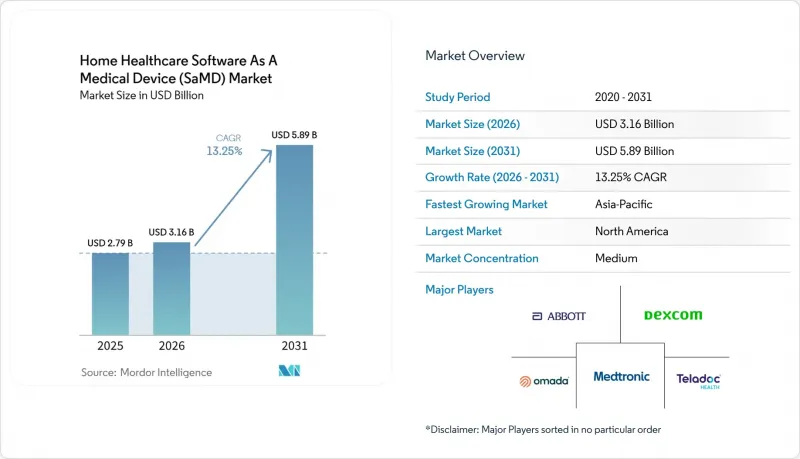
This report is Segmented by Product Type (Clinical Decision Support, Remote Patient Monitoring, and More), Risk Classification (Low, Moderate, High-Risk), Deployment (Cloud-Based, On-Premise, Hybrid), Application (Cardiovascular, Diabetes, Respiratory, and More), End User (Home Health Agencies, Hospitals, and More), and Geography (North America, Europe, Asia-Pacific, and More). Forecasts in Value (USD).
Global Home Healthcare Software As A Medical Device (SaMD) Market Trends and Insights
Expansion of Home-Based Chronic Disease Management
Cardiovascular disease, diabetes, and respiratory conditions continued to increase pressure on care teams beyond clinic-based care. The Home Healthcare SaMD Market supports remote measurement, clinical risk assessment, and care plan adjustments for patients at home. In June 2026, Dexcom reported that its CONNECT randomized controlled study showed a statistically significant HbA1c reduction among people with Type 2 diabetes who were not using insulin and used G7-based monitoring compared with routine care. This evidence gave payers a clearer basis for evaluating home-based monitoring in chronic disease programs.
Workforce Shortages Increasing Demand for Clinical Automation
Staffing pressure increased the value of scheduling, documentation, and care coordination tools in home care. In January 2026, Axxess reported that more than 60% of care-at-home organizations identified recruitment and retention as their main challenge entering 2026. The Home Healthcare SaMD Market is responding with tools that reduce repetitive administrative work and improve clinician schedule management. In March 2026, Homecare Homebase introduced Curate Scribe, which is designed to reduce start-of-care documentation by 35-45 minutes per admission.
Cybersecurity, Privacy, and Healthcare Data-Protection Requirements
Cybersecurity has become a key purchasing consideration for connected home care systems. In July 2026, AdaptHealth disclosed that a threat actor gained unauthorized access to certain cloud-based patient management systems, document storage platforms, and external electronic health record portals through a social-engineering incident. The incident involved protected health information and insurance billing credentials, highlighting the sensitivity of home care systems. The Home Healthcare SaMD Market faces longer vendor review cycles as agencies assess cloud controls, third-party access, native access controls, anomaly detection, independent security assurance, HIPAA Security Rule compliance, clinical liability, and data quality controls.
Other drivers and restraints analyzed in the detailed report include:
- Growth of Remote Patient Monitoring and Virtual Care
- Reimbursement and Value-Based Care Incentives
- Home-Environment Data Quality and Algorithm Generalizability Risk
For complete list of drivers and restraints, kindly check the Table Of Contents.
Segment Analysis
Clinical Decision Support Software held 34.35% of Home Healthcare SaMD Market share in 2025. It supported chronic disease programs by embedding risk assessment, protocol guidance, and alerts within the home health electronic record workflow, reducing the need for clinicians to switch between applications during care delivery. WellSky launched its Point of Care app in May 2026, combining AI-supported workflows, clinical intelligence, and patient records on a clinician's mobile device. The company stated that its Scribe feature could reduce charting time by up to 50% across more than 400 home health agencies.
Remote Patient Monitoring Software is forecast to expand at a 15.93% CAGR through 2031. Growth reflects the broader installed base of home monitoring hardware and the value of continuous patient data after hospital or clinic discharge. Digital therapeutics also contribute to the product mix, with Omada Health reporting more than 2 million members and more than 2,000 employer and health-plan clients in its 2025 results. Suppliers are linking documentation, communication, and patient monitoring within one workflow to reduce duplicate entry and support timely clinical action.
Moderate-Risk SaMD accounted for 55.45% of the Home Healthcare SaMD Market in 2025. This classification includes many clinically used cardiovascular and diabetes management tools that require 510(k) clearance but not the more demanding premarket approval route. These systems often combine diagnostic support with care coordination, and manufacturers must validate performance because malfunctions could affect patient safety. Device makers with established evidence and regulatory documentation can gain an advantage in this segment.
Low-Risk SaMD is forecast to grow at a 17.67% CAGR through 2031. Growth reflects opportunities in wellness coaching, sleep analysis, and lifestyle data applications with lower direct clinical risk. The FDA issued updated guidance for Clinical Decision Support Software in January 2026, clarifying criteria that help distinguish certain non-device clinical decision support functions. High-Risk SaMD remains smaller but strategically important for autonomous diagnostic tools and closed-loop insulin delivery, with Medtronic announcing FDA clearance of its MiniMed Flex system in 2025, including the SmartGuard algorithm and Meal Detection technology.
Complete Report Scope:
- By Product Type
- Clinical Decision Support Software
- Remote Patient Monitoring Software
- Digital Therapeutics Software
- Patient Engagement and Self-Management Software
- Clinical Documentation and Care-Planning Software
- Care Coordination and Referral Management Software
- Others
- By SaMD Risk Classification
- Low-Risk SaMD
- Moderate-Risk SaMD
- High-Risk SaMD
- By Deployment
- Cloud-Based SaMD
- On-Premise SaMD
- Hybrid Deployment
- By Application
- Cardiovascular Disease Management
- Diabetes Management
- Respiratory Disease Management
- Sleep Disorder Management
- Neurological Disorder Management
- Oncology Support and Remote Monitoring
- Medication Adherence and Safety
- Post-Acute Care Monitoring
- Others
- By End User
- Home Health Agencies
- Hospitals and Health Systems
- Hospices and Palliative Care Providers
- Skilled Nursing Facilities
- Senior Living and Life Plan Communities
- Physician Groups and Ambulatory Care Providers
- Others
- By Geography
- North America
- United States
- Canada
- Mexico
- Europe
- Germany
- United Kingdom
- France
- Italy
- Spain
- Rest of Europe
- Asia-Pacific
- China
- India
- Japan
- Australia
- South Korea
- Rest of Asia-Pacific
- Middle East and Africa
- GCC
- South Africa
- Rest of Middle East and Africa
- South America
- Brazil
- Argentina
- Rest of South America
- North America
Geography Analysis
North America held 39.66% of the Home Healthcare SaMD Market share in 2025. The region had a large base of home health agencies, established reimbursement structures, and mature clinical technology use. The United States remained the key demand center, as home-based care providers needed tools for monitoring, documentation, and care coordination. Canada and Mexico remained secondary markets as virtual care was incorporated into home and community care services.
Asia-Pacific is forecast to expand at a 15.56% CAGR through 2031. Rising chronic disease needs and national digital health programs are supporting demand for home monitoring and care-management systems. China, India, Japan, and South Korea each have different health financing and regulatory approaches. Suppliers entering the region need to account for national registration requirements as broader SaMD frameworks become more aligned.
Europe has a meaningful regional position, led by Germany, the United Kingdom, France, Italy, and Spain. Publicly funded systems create demand for tools that can expand service capacity without equivalent capital investment. The Middle East and Africa and South America remain smaller but developing areas of demand, supported by digital health infrastructure investments in Saudi Arabia and the United Arab Emirates and Brazil's telehealth reimbursement framework. Regional growth will not follow a uniform path, making local partnerships, adaptable workflows, and country-specific implementation plans critical for long-term adoption.
- Abbott Laboratories
- AlayaCare Inc.
- Axxess, Inc.
- Brightree LLC
- Cardiosense, Inc.
- Dexcom
- Garmin
- Hexoskin
- HHAeXchange Inc.
- Homecare Homebase, LLC
- MatrixCare, Inc.
- Medtronic
- Microsoft
- Netsmart Technologies, Inc.
- Omada Health
- PointClickCare Technologies Inc.
- Resmed
- Respiree Pte. Ltd.
- Teladoc Health
- WellSky Corporation
Additional Benefits:
- The market estimate (ME) sheet in Excel format
- 3 months of analyst support
TABLE OF CONTENTS
1 INTRODUCTION
- 1.1 Study Assumptions and Market Definition
- 1.2 Scope of the Study
2 RESEARCH METHODOLOGY
3 EXECUTIVE SUMMARY
4 MARKET LANDSCAPE
- 4.1 Market Overview
- 4.2 Market Drivers
- 4.2.1 Expansion of Home-Based Chronic Disease Management
- 4.2.2 Workforce Shortages Increasing Demand for Clinical Automation
- 4.2.3 Growth of Remote Patient Monitoring and Virtual Care
- 4.2.4 Reimbursement and Value-Based Care Incentives
- 4.2.5 FDA-Accepted Predetermined Change Control Plans for AI Software
- 4.2.6 Home-Based Real-World Evidence and Decentralized Clinical Trials
- 4.3 Market Restraints
- 4.3.1 Cybersecurity, Privacy, and Healthcare Data-Protection Requirements
- 4.3.2 Fragmented Reimbursement and Regulatory Pathways
- 4.3.3 Home-Environment Data Quality and Algorithm Generalizability Risk
- 4.3.4 Clinical Liability for Automated or Semi-Automated Patient Recommendations
- 4.4 Value and Supply-Chain Analysis
- 4.5 Regulatory Landscape
- 4.6 Technological Outlook
- 4.7 Porter's Five Forces Analysis
- 4.7.1 Threat of New Entrants
- 4.7.2 Bargaining Power of Software and Cloud Suppliers
- 4.7.3 Bargaining Power of Healthcare Providers and Payers
- 4.7.4 Threat of Substitutes
- 4.7.5 Competitive Rivalry
5 MARKET SIZE AND GROWTH FORECASTS (VALUE, USD)
- 5.1 By Product Type
- 5.1.1 Clinical Decision Support Software
- 5.1.2 Remote Patient Monitoring Software
- 5.1.3 Digital Therapeutics Software
- 5.1.4 Patient Engagement and Self-Management Software
- 5.1.5 Clinical Documentation and Care-Planning Software
- 5.1.6 Care Coordination and Referral Management Software
- 5.1.7 Others
- 5.2 By SaMD Risk Classification
- 5.2.1 Low-Risk SaMD
- 5.2.2 Moderate-Risk SaMD
- 5.2.3 High-Risk SaMD
- 5.3 By Deployment
- 5.3.1 Cloud-Based SaMD
- 5.3.2 On-Premise SaMD
- 5.3.3 Hybrid Deployment
- 5.4 By Application
- 5.4.1 Cardiovascular Disease Management
- 5.4.2 Diabetes Management
- 5.4.3 Respiratory Disease Management
- 5.4.4 Sleep Disorder Management
- 5.4.5 Neurological Disorder Management
- 5.4.6 Oncology Support and Remote Monitoring
- 5.4.7 Medication Adherence and Safety
- 5.4.8 Post-Acute Care Monitoring
- 5.4.9 Others
- 5.5 By End User
- 5.5.1 Home Health Agencies
- 5.5.2 Hospitals and Health Systems
- 5.5.3 Hospices and Palliative Care Providers
- 5.5.4 Skilled Nursing Facilities
- 5.5.5 Senior Living and Life Plan Communities
- 5.5.6 Physician Groups and Ambulatory Care Providers
- 5.5.7 Others
- 5.6 By Geography
- 5.6.1 North America
- 5.6.1.1 United States
- 5.6.1.2 Canada
- 5.6.1.3 Mexico
- 5.6.2 Europe
- 5.6.2.1 Germany
- 5.6.2.2 United Kingdom
- 5.6.2.3 France
- 5.6.2.4 Italy
- 5.6.2.5 Spain
- 5.6.2.6 Rest of Europe
- 5.6.3 Asia-Pacific
- 5.6.3.1 China
- 5.6.3.2 India
- 5.6.3.3 Japan
- 5.6.3.4 Australia
- 5.6.3.5 South Korea
- 5.6.3.6 Rest of Asia-Pacific
- 5.6.4 Middle East and Africa
- 5.6.4.1 GCC
- 5.6.4.2 South Africa
- 5.6.4.3 Rest of Middle East and Africa
- 5.6.5 South America
- 5.6.5.1 Brazil
- 5.6.5.2 Argentina
- 5.6.5.3 Rest of South America
- 5.6.1 North America
6 COMPETITIVE LANDSCAPE
- 6.1 Market Concentration
- 6.2 Market Share Analysis
- 6.3 Company Profiles (includes Global Level Overview, Market Level Overview, Core Segments, Financials as available, Strategic Information, Market Rank/Share, Products and Services, Recent Developments)
- 6.3.1 Abbott Laboratories
- 6.3.2 AlayaCare Inc.
- 6.3.3 Axxess, Inc.
- 6.3.4 Brightree LLC
- 6.3.5 Cardiosense, Inc.
- 6.3.6 Dexcom, Inc.
- 6.3.7 Garmin Ltd.
- 6.3.8 Hexoskin
- 6.3.9 HHAeXchange Inc.
- 6.3.10 Homecare Homebase, LLC
- 6.3.11 MatrixCare, Inc.
- 6.3.12 Medtronic plc
- 6.3.13 Microsoft Corporation
- 6.3.14 Netsmart Technologies, Inc.
- 6.3.15 Omada Health, Inc.
- 6.3.16 PointClickCare Technologies Inc.
- 6.3.17 ResMed Inc.
- 6.3.18 Respiree Pte. Ltd.
- 6.3.19 Teladoc Health, Inc.
- 6.3.20 WellSky Corporation
7 MARKET OPPORTUNITIES AND FUTURE OUTLOOK
- 7.1 White-Space and Unmet-Need Assessment

