PUBLISHER: Mordor Intelligence | PRODUCT CODE: 2118136

PUBLISHER: Mordor Intelligence | PRODUCT CODE: 2118136
Mobile Software As A Medical Device (SaMD) - Market Share Analysis, Industry Trends & Statistics, Growth Forecasts (2026 - 2031)
According to Mordor Intelligence, the mobile software as a Medical Device Market size was valued at USD 2.47 billion in 2025 and is estimated to grow from USD 2.93 billion in 2026 to reach USD 6.82 billion by 2031, at a CAGR of 18.45% during the forecast period (2026-2031).
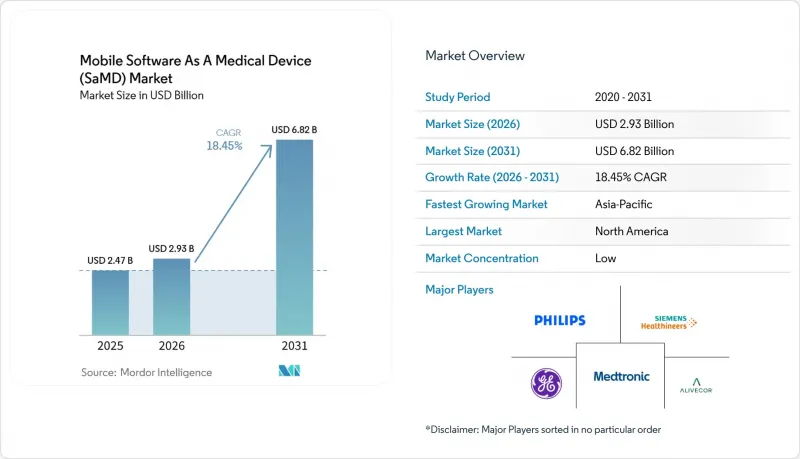
This report is Segmented by Product Type (CDS, RPM, Digital Therapeutics, Others), Device Type (Smartphones and Tablets, Wearables), Deployment (Cloud-Based, Hybrid Cloud, On-Premises), Application (Screening and Detection, Diagnostic Imaging), End User (Hospitals, Ambulatory Centers, Diagnostic Labs, Home Care) and Geography (North America, Europe, Asia-Pacific, MEA, South America). Forecasts in Value (USD).
Global Mobile Software As A Medical Device (SaMD) Market Trends and Insights
Clinical Adoption of AI-Assisted Diagnosis and Monitoring
Clinical AI software is moving from limited pilots into broader hospital operations. Aidoc raised USD 150 million in Series E funding in April 2026, taking its total funding above USD 500 million, and reported that its systems analyze more than 60 million patient cases annually across nearly 2,000 hospitals. This scale supports the shift toward enterprise platforms covering triage, diagnosis, and treatment decisions across specialties. Aidoc also received an FDA Breakthrough Device Designation for First Read in June 2026, its second designation in less than 1 year. Hospitals are replacing disconnected point tools with platforms that offer common governance and clearer accountability, favoring suppliers with broad clinical coverage, reliable oversight, and proven routine-care performance.
Expansion of Smartphone-Enabled Remote Patient Monitoring
Smartphone-enabled remote patient monitoring is moving beyond passive data capture into reimbursed clinical care. CMS reimbursement for AI-enhanced ECG analysis became effective in January 2025, and Viz.ai reported profitability in its healthcare business by the end of 2025. The 2024 merger of Biofourmis and CopilotIQ combined pre-surgical, acute, post-acute, and chronic-care capabilities on 1 platform. Biofourmis reported a 70% reduction in 30-day readmissions, a 21-hour earlier indication of clinical deterioration, and up to 38% lower cost of care. These results help payers and providers assess outcome improvement and cost control, while improving market access for vendors with comparable real-world evidence and workflow integration.
Clinical Validation and Evidence-Generation Requirements
Clinical evidence requirements are becoming more stringent for software that supports diagnosis or treatment. The FDA's January 2025 draft guidance described a total product life cycle approach for AI-enabled device software functions, covering performance monitoring, data quality, bias assessment, and clinician-AI interaction. Varying standards of care across providers and countries make study design complex. These requirements can favor companies with health-system partners, established quality systems, and clear post-market monitoring pathways.
Other drivers and restraints analyzed in the detailed report include:
- Rising Chronic Disease Management Requirements
- Cloud Interoperability and Virtual Care Integration
- Cybersecurity, Privacy, and Cross-Border Health-Data Restrictions
For complete list of drivers and restraints, kindly check the Table Of Contents.
Segment Analysis
Clinical Decision Support Software held 33.22% of the product category in 2025, making it the largest product category. Health systems use these products for triage, diagnosis, and treatment planning across radiology, cardiology, and emergency medicine. Enterprise buyers prefer platforms that support multiple use cases over separate products for each condition, as common platforms simplify governance, data management, and staff training.
Tempus AI received FDA 510(k) clearance for its updated Tempus Pixel cardiac imaging platform in September 2025. The clearance followed its acquisition of Arterys and showed how regulatory scope and acquired capabilities can strengthen an enterprise offering. Remote Patient Monitoring Software is forecast to grow at a CAGR of 20.93% from 2026 to 2031, the fastest rate among product types.
Wearable Devices accounted for 36.23% of the device category in 2025, the largest position among device types. Smartwatches, wearable ECG devices, blood-pressure monitors, and smart rings provide continuous or frequent physiological data. Their clinical role has expanded as more devices receive regulatory clearance for defined health functions.
Smartphones and Tablets are forecast to grow at a CAGR of 19.67% from 2026 to 2031, making them the fastest-growing device channel. They support prescription apps, remote communication, and camera-based measurement without requiring an additional device. This capability can extend care to rural and underserved settings where dedicated equipment is less available.
Complete Report Scope:
- By Product Type
- Clinical Decision Support Software
- Remote Patient Monitoring Software
- Digital Therapeutics Software
- Patient Engagement and Self-Management Software
- Clinical Documentation and Care-Planning Software
- Care Coordination and Referral Management Software
- Others
- By Device Type
- Smartphones and Tablets
- Wearable Devices
- Smartwatches
- Wearable ECG and Blood-Pressure Monitors
- Smart Rings
- Hearables and Earbuds
- Others
- By Deployment
- Cloud-Based
- Hybrid Cloud
- On-Premises
- By Application
- Screening and Early Detection
- Cardiovascular Screening
- Oncology Screening
- Neurological Screening
- Respiratory Screening
- Ophthalmic Screening
- Women's Health Screening
- Diagnostic Imaging and Interpretation
- Radiology
- Pathology
- By End User
- Hospitals and Clinics
- Ambulatory and Specialist Centers
- Diagnostic Laboratories
- Home-Care Settings
- Others
- By Geography
- North America
- United States
- Canada
- Mexico
- Europe
- Germany
- United Kingdom
- France
- Italy
- Spain
- Rest of Europe
- Asia-Pacific
- China
- India
- Japan
- Australia
- South Korea
- Rest of Asia-Pacific
- Middle East and Africa
- GCC
- South Africa
- Rest of Middle East and Africa
- South America
- Brazil
- Argentina
- Rest of South America
- North America
Geography Analysis
North America held 38.55% of global demand in 2025, supported by a mature FDA pathway for regulated software and expanding reimbursement for AI-enabled diagnostics and remote monitoring. Category III CPT codes for AI-enabled ECG analysis took effect in January 2025. Large integrated health systems deployed enterprise platforms across multiple facilities, generating real-world datasets for software monitoring and improvement. Canada began assessing AI-enabled software through its health technology assessment process, while Mexico developed frameworks for digital medical software.
Asia-Pacific is forecast to grow at a CAGR of 19.56% from 2026 to 2031, the fastest regional rate in the mobile software as a medical device market. Aging populations, chronic disease needs, expanding digital infrastructure, and developing regulatory pathways supported demand in the mobile software as a medical device market. Japan's PMDA approved 581 SaMD products as of March 2025 under its DASH for SaMD policy, while the PMDA approval of Apple's hypertension feature provided a recent example of home-use regulation. China and India formalized requirements for AI medical software through their national regulatory systems, while Qure.ai reported deployments in more than 100 countries and 39 million patient scans processed.
Europe represented a significant share in 2025, with Germany, the United Kingdom, and France supporting demand through established reimbursement and regulatory processes. Germany's DiGA framework offered a prescribed and reimbursed route for qualifying digital health applications, while the region's compliance requirements made evidence and data protection critical for market entry. The Middle East and Africa remained earlier-stage areas, but hardware-light software addressed gaps in specialist access.
- Abbott Laboratories
- Aidoc Medical Ltd.
- AliveCor
- Apple
- Arterys Inc.
- Biofourmis Inc.
- Brainomix Limited
- Butterfly Network, Inc.
- GE HealthCare Technologies Inc.
- iCAD, Inc.
- Intelerad Medical Systems
- Koninklijke Philips
- Medtronic
- Mindset Medical, Inc.
- Niramai Health Analytix Pvt. Ltd.
- Oxehealth Limited
- PanopticAI Limited
- Qure.ai Technologies Pvt. Ltd.
- Siemens Healthineers
- Tandem Diabetes Care
- Tempus AI, Inc.
- Viz.ai, Inc.
- ZBeats, Inc.
Additional Benefits:
- The market estimate (ME) sheet in Excel format
- 3 months of analyst support
TABLE OF CONTENTS
1 INTRODUCTION
- 1.1 Study Assumptions and Market Definition
- 1.2 Scope of the Study
2 RESEARCH METHODOLOGY
3 EXECUTIVE SUMMARY
4 MARKET LANDSCAPE
- 4.1 Market Overview
- 4.2 Market Drivers
- 4.2.1 Clinical Adoption of AI-Assisted Diagnosis and Monitoring
- 4.2.2 Expansion of Smartphone-Enabled Remote Patient Monitoring
- 4.2.3 Rising Chronic Disease Management Requirements
- 4.2.4 Cloud Interoperability and Virtual-Care Integration
- 4.2.5 Camera-Based Physiological Measurement Using Commodity Devices
- 4.3 Market Restraints
- 4.3.1 Clinical Validation and Evidence-Generation Requirements
- 4.3.2 Cybersecurity, Privacy, and Cross-Border Health-Data Restrictions
- 4.3.3 Fragmented Reimbursement and Procurement Pathways
- 4.4 Value/Supply-Chain Analysis
- 4.5 Regulatory Landscape
- 4.6 Technological Outlook
- 4.6.1 Porter's Five Forces Analysis
- 4.6.2 Threat of New Entrants
- 4.6.3 Bargaining Power of Suppliers
- 4.6.4 Bargaining Power of Buyers
- 4.6.5 Threat of Substitutes
- 4.6.6 Competitive Rivalry
5 MARKET SIZE AND GROWTH FORECASTS (VALUE, USD)
- 5.1 By Product Type
- 5.1.1 Clinical Decision Support Software
- 5.1.2 Remote Patient Monitoring Software
- 5.1.3 Digital Therapeutics Software
- 5.1.4 Patient Engagement and Self-Management Software
- 5.1.5 Clinical Documentation and Care-Planning Software
- 5.1.6 Care Coordination and Referral Management Software
- 5.1.7 Others
- 5.2 By Device Type
- 5.2.1 Smartphones and Tablets
- 5.2.2 Wearable Devices
- 5.2.3 Smartwatches
- 5.2.4 Wearable ECG and Blood-Pressure Monitors
- 5.2.5 Smart Rings
- 5.2.6 Hearables and Earbuds
- 5.2.7 Others
- 5.3 By Deployment
- 5.3.1 Cloud-Based
- 5.3.2 Hybrid Cloud
- 5.3.3 On-Premises
- 5.4 By Application
- 5.4.1 Screening and Early Detection
- 5.4.2 Cardiovascular Screening
- 5.4.3 Oncology Screening
- 5.4.4 Neurological Screening
- 5.4.5 Respiratory Screening
- 5.4.6 Ophthalmic Screening
- 5.4.7 Women's Health Screening
- 5.4.8 Diagnostic Imaging and Interpretation
- 5.4.9 Radiology
- 5.4.10 Pathology
- 5.5 By End User
- 5.5.1 Hospitals and Clinics
- 5.5.2 Ambulatory and Specialist Centers
- 5.5.3 Diagnostic Laboratories
- 5.5.4 Home-Care Settings
- 5.5.5 Others
- 5.6 By Geography
- 5.6.1 North America
- 5.6.1.1 United States
- 5.6.1.2 Canada
- 5.6.1.3 Mexico
- 5.6.2 Europe
- 5.6.2.1 Germany
- 5.6.2.2 United Kingdom
- 5.6.2.3 France
- 5.6.2.4 Italy
- 5.6.2.5 Spain
- 5.6.2.6 Rest of Europe
- 5.6.3 Asia-Pacific
- 5.6.3.1 China
- 5.6.3.2 India
- 5.6.3.3 Japan
- 5.6.3.4 Australia
- 5.6.3.5 South Korea
- 5.6.3.6 Rest of Asia-Pacific
- 5.6.4 Middle East and Africa
- 5.6.4.1 GCC
- 5.6.4.2 South Africa
- 5.6.4.3 Rest of Middle East and Africa
- 5.6.5 South America
- 5.6.5.1 Brazil
- 5.6.5.2 Argentina
- 5.6.5.3 Rest of South America
- 5.6.1 North America
6 COMPETITIVE LANDSCAPE
- 6.1 Market Concentration
- 6.2 Market Share Analysis
- 6.3 Company Profiles (includes Global Level Overview, Market Level Overview, Core Segments, Financials as available, Strategic Information, Market Rank/Share, Products and Services, Recent Developments)
- 6.3.1 Abbott Laboratories
- 6.3.2 Aidoc Medical Ltd.
- 6.3.3 AliveCor, Inc.
- 6.3.4 Apple Inc.
- 6.3.5 Arterys Inc.
- 6.3.6 Biofourmis Inc.
- 6.3.7 Brainomix Limited
- 6.3.8 Butterfly Network, Inc.
- 6.3.9 GE HealthCare Technologies Inc.
- 6.3.10 iCAD, Inc.
- 6.3.11 Intelerad Medical Systems Incorporated
- 6.3.12 Koninklijke Philips N.V.
- 6.3.13 Medtronic plc
- 6.3.14 Mindset Medical, Inc.
- 6.3.15 Niramai Health Analytix Pvt. Ltd.
- 6.3.16 Oxehealth Limited
- 6.3.17 PanopticAI Limited
- 6.3.18 Qure.ai Technologies Pvt. Ltd.
- 6.3.19 Siemens Healthineers AG
- 6.3.20 Tandem Diabetes Care, Inc.
- 6.3.21 Tempus AI, Inc.
- 6.3.22 Viz.ai, Inc.
- 6.3.23 ZBeats, Inc.
7 MARKET OPPORTUNITIES AND FUTURE OUTLOOK
- 7.1 White-Space and Unmet-Need Assessment

