PUBLISHER: Mordor Intelligence | PRODUCT CODE: 2118249

PUBLISHER: Mordor Intelligence | PRODUCT CODE: 2118249
Protein Reagents - Market Share Analysis, Industry Trends & Statistics, Growth Forecasts (2026 - 2031)
According to Mordor Intelligence, the protein reagents market size was valued at USD 10.42 billion in 2025 and is estimated to grow from USD 11.02 billion in 2026 to reach USD 14.28 billion by 2031, at a CAGR of 5.32% during the forecast period (2026-2031).
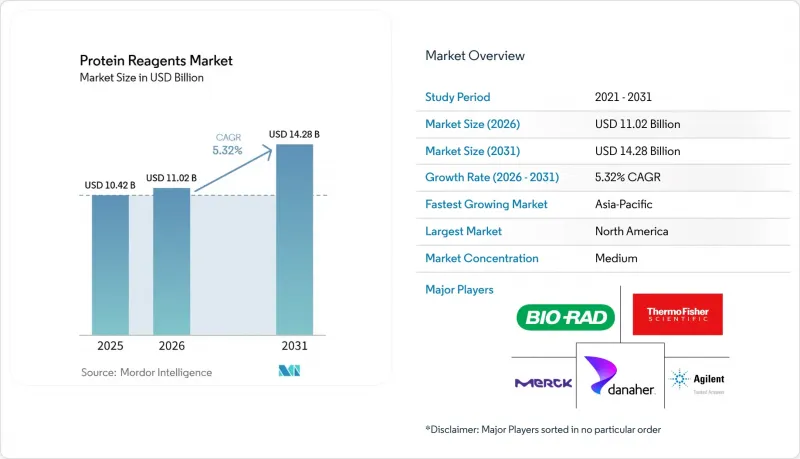
This report is Segmented by Product Type (Protein Labeling Reagents, Protein Purification Reagents, and More), Technology (Chromatography-Based Reagents, Electrophoresis Reagents, and More), Application (Proteomics Research, Drug Discovery and Development, and More), and Geography (Asia-Pacific, North America, Europe, and Rest of the World). The Market Forecasts are Provided in Terms of Value (USD).
Global Protein Reagents Market Trends and Insights
Rising Investments in Biopharmaceutical R&D
Steady research spending by large pharmaceutical and biotechnology companies continues to provide the protein reagents market with a dependable demand base across discovery, characterization, and process development activities. Reagent consumption does not stop at early screening; it continues through protein expression work, assay development, comparability studies, and analytical confirmation as programs advance. The protein reagents market also benefits when biologics pipelines become more complex, as those programs require repeated protein handling, deeper characterization, and stricter documentation across longer development cycles. This pattern extends reagent use per active program and helps reduce the effect of short-term funding changes on total demand. It also supports suppliers with validated catalogs, as research teams prefer continuity in assay conditions once a workflow is established. The protein reagents market draws strength not only from the number of programs in development but also from the rising technical intensity of each program.
Growing Biopharmaceutical Pipeline and Manufacturing Capacity
The shift from clinical research to commercial-scale biologics production continues to expand the operational role of the protein reagents market across purification, stabilization, formulation, and release-support workflows. FUJIFILM Wako Pure Chemical tripled Good Manufacturing Practice (GMP)-compliant raw material production capacity at its Osaka facility in May 2024, directly linking added capacity to growth in antibody and gene therapeutic production needs. The protein reagents market benefits from this kind of capacity expansion because commercial manufacturing requires recurring lots, validated performance, and stronger process reproducibility than early research settings typically demand. As more biologics plants move from pilot batches to sustained output, catalog-grade and manufacturing-grade reagents gain greater value over small custom runs with longer delivery schedules. This favors suppliers that can provide ready documentation, established lot history, and dependable distribution across multiple production sites. Over time, this makes the protein reagents market more closely tied to industrial biologics execution, rather than only to upstream research budgets.
High Cost of Specialty Protein Reagents
The protein reagents market is constrained by the high cost of specialty and manufacturing-grade materials, limiting adoption in smaller laboratories and price-sensitive geographies. A 2025 international workshop on biological testing reagents identified high costs, import complexity, and a limited pool of qualified suppliers as core barriers, particularly for lower-income settings that face logistical pressures and funding constraints. When laboratories operate within fixed grant budgets or venture-backed spending plans, higher reagent prices force tradeoffs between reagent quality, assay breadth, and total experiment volume. This does not remove demand from the protein reagents market, but it slows the adoption of premium formats in regions where infrastructure is still developing. The effect is most pronounced where buyers depend on imported products and have limited flexibility in stocking temperature-sensitive materials. Cost pressure may widen the gap between well-funded institutions that can standardize high-specification products and smaller buyers that remain selective in their usage.
Other drivers and restraints analyzed in the detailed report include:
- Increasing Demand for Proteomics-Driven Research Tools
- Expansion of Cell and Gene Therapy Clinical Programs
- Stringent Quality and Regulatory Compliance Requirements
For complete list of drivers and restraints, kindly check the Table Of Contents.
Segment Analysis
Protein Purification Reagents held the largest share at 27.44% in 2025, reflecting their central role in biologics production and protein isolation workflows. Their large installed base reflects routine use from early harvest steps through chromatographic processing and final preparation, making the category difficult to displace quickly. The market continues to favor purification products because many laboratories and manufacturing teams operate with established protocols that depend on consistent resin performance, buffer systems, and validated process chemistry. This creates switching friction, since even a modest process change can require repeat optimization across several downstream steps. Extraction, quantification, and modification products remain important supporting categories, yet they typically follow the broader installed workflow rather than defining it. As a result, the position of purification reagents remains linked to workflow centrality, repeat use, and the cost of protocol disruption.
Protein Labeling Reagents are forecast to grow at a 6.44% CAGR through 2031, making them the fastest-growing product group in the market as protein interaction studies, conjugation workflows, and multiplex discovery tools become more common. Demand is shifting toward site-specific and application-validated labeling formats, as buyers increasingly require tighter signal quality and lower background variation in advanced assays. This has practical importance for antibody-drug conjugate work, proximity-based assays, and live-cell studies where generic dye attachment methods often do not provide sufficient control. Protein Crosslinking Reagents are also gaining relevance in structural proteomics and interactome mapping, where researchers need stable methods to capture protein relationships before mass spectrometric analysis. Protein Quantification Reagents continue to see recurring use in automated screening environments, where consistent compatibility with plate-reader workflows and interference tolerance remain important. Protein Stabilization Reagents serve a growing niche in therapy formulation and cold-chain handling, representing another path toward higher-value, application-specific product demand.
Complete Report Scope:
- By Product Type
- Protein Labeling Reagents
- Protein Purification Reagents
- Protein Crosslinking Reagents
- Protein Stabilization Reagents
- Protein Extraction and Lysis Reagents
- Protein Quantification Reagents
- Protein Modification Reagents
- Other Protein Reagents
- By Technology
- Chromatography-Based Reagents
- Electrophoresis Reagents
- Immunoassay Reagents
- Mass Spectrometry Reagents
- Fluorescence-Based Reagents
- Other Technologies
- By Application
- Proteomics Research
- Drug Discovery and Development
- Biopharmaceutical Manufacturing
- Clinical Diagnostics
- Academic and Research
- Cell and Gene Therapy Research
- Other Applications
- By Geography
- Asia-Pacific
- China
- India
- Japan
- South Korea
- Rest of Asia-Pacific
- North America
- United States
- Canada
- Europe
- Germany
- United Kingdom
- France
- Italy
- Russia
- Rest of Europe
- Rest of the World
- South America
- Middle-East and Africa
- Asia-Pacific
Geography Analysis
North America held 44.73% of the protein reagents market in 2025, making it the largest region. The region has dense pharmaceutical research capacity and extensive academic and hospital proteomics infrastructure. The United States is the primary demand center, supported by multi-year federal awards that sustain reagent procurement across translational, cancer, aging, and exercise proteomics programs. The region also benefits from a broad base of commercial biologics and advanced therapy activity, which drives regular demand for Good Manufacturing Practice (GMP)-oriented and analytical protein products. Canada contributes to regional depth through biotechnology clusters that use distributed global catalogs for genomics and therapy-related work. North America is the most established geography in the protein reagents market, with strength derived from both discovery activity and industrial execution.
Asia-Pacific is the fastest-growing region in the protein reagents market and is projected to expand at a CAGR of 6.35% through 2031. Growth is driven by the institutionalization of domestic research systems, the development of contract development capacity, and therapy manufacturing programs across several countries. The Cell and Gene Therapy (CGT) program expansion further supports the market, as a larger clinical and manufacturing footprint increases demand for culture supplements, cytokines, purification inputs, and protein analytics. South Korea contributes to high-purity reagent demand, driven by its expanding biosimilar and antibody-drug conjugate manufacturing base. China and India contribute through broader biotechnology policy support and a larger installed research base, creating a more diversified set of end users compared to several years earlier. Validated availability and regional service depth remain uneven across countries, leaving room for further local supply development.
Europe is the third-largest regional segment in the protein reagents market, with Germany, the United Kingdom, and France as the primary demand centers. The region benefits from multi-omics and proteomics research programs, while regulated clinical and manufacturing environments support the use of validated and lot-controlled products. Stricter compliance requirements in diagnostics and biologics support premium positioning for suppliers that maintain quality documentation at scale. Rest of the World markets remain smaller due to import costs, cold-chain requirements, and a limited local supplier base, which restricts broader adoption, particularly for temperature-sensitive or regulated materials. International workshop findings have highlighted the importance of regional distribution and supply coordination for biological testing reagents in lower-access settings. Growth outside the major regions is expected to continue, but from a lower base than in North America, Asia-Pacific, or Europe.
- Abcam Limited
- Agilent Technologies, Inc.
- Bio-Rad Laboratories, Inc.
- Bio-Techne Corporation
- Danaher Corporation
- FUJIFILM Wako Pure Chemical Corporation
- LGC Biosearch Technologies
- Merck KGaA
- PerkinElmer
- Promega Corporation
- Proteintech Group
- Rockland Immunochemicals
- Takara Bio Inc.
- Thermo Fisher Scientific Inc.
- Vector Laboratories
Additional Benefits:
- The market estimate (ME) sheet in Excel format
- 3 months of analyst support
TABLE OF CONTENTS
1 Introduction
- 1.1 Study Assumptions and Market Definition
- 1.2 Scope of the Study
2 Research Methodology
3 Executive Summary
4 Market Landscape
- 4.1 Market Overview
- 4.2 Market Drivers
- 4.2.1 Rising Investments in Proteomics and Protein Research
- 4.2.2 Growing Biopharmaceutical and Biosimilar Development
- 4.2.3 Increasing Demand for Protein Characterization and Analysis
- 4.2.4 Expansion of Cell and Gene Therapy Research
- 4.2.5 Growing Use of Protein-Based Diagnostics and Biomarker Discovery
- 4.3 Market Restraints
- 4.3.1 High Cost of Specialty Protein Reagents
- 4.3.2 Stringent Quality and Regulatory Requirements
- 4.3.3 Limited Stability and Shelf Life of Certain Protein Reagents
- 4.4 Value Chain Analysis
- 4.5 Porter's Five Forces Analysis
- 4.5.1 Bargaining Power of Suppliers
- 4.5.2 Bargaining Power of Buyers
- 4.5.3 Threat of New Entrants
- 4.5.4 Threat of Substitutes
- 4.5.5 Competitive Rivalry
5 Market Size and Growth Forecasts (Value)
- 5.1 By Product Type
- 5.1.1 Protein Labeling Reagents
- 5.1.2 Protein Purification Reagents
- 5.1.3 Protein Crosslinking Reagents
- 5.1.4 Protein Stabilization Reagents
- 5.1.5 Protein Extraction and Lysis Reagents
- 5.1.6 Protein Quantification Reagents
- 5.1.7 Protein Modification Reagents
- 5.1.8 Other Protein Reagents
- 5.2 By Technology
- 5.2.1 Chromatography-Based Reagents
- 5.2.2 Electrophoresis Reagents
- 5.2.3 Immunoassay Reagents
- 5.2.4 Mass Spectrometry Reagents
- 5.2.5 Fluorescence-Based Reagents
- 5.2.6 Other Technologies
- 5.3 By Application
- 5.3.1 Proteomics Research
- 5.3.2 Drug Discovery and Development
- 5.3.3 Biopharmaceutical Manufacturing
- 5.3.4 Clinical Diagnostics
- 5.3.5 Academic and Research
- 5.3.6 Cell and Gene Therapy Research
- 5.3.7 Other Applications
- 5.4 By Geography
- 5.4.1 Asia-Pacific
- 5.4.1.1 China
- 5.4.1.2 India
- 5.4.1.3 Japan
- 5.4.1.4 South Korea
- 5.4.1.5 Rest of Asia-Pacific
- 5.4.2 North America
- 5.4.2.1 United States
- 5.4.2.2 Canada
- 5.4.3 Europe
- 5.4.3.1 Germany
- 5.4.3.2 United Kingdom
- 5.4.3.3 France
- 5.4.3.4 Italy
- 5.4.3.5 Russia
- 5.4.3.6 Rest of Europe
- 5.4.4 Rest of the World
- 5.4.4.1 South America
- 5.4.4.2 Middle-East and Africa
- 5.4.1 Asia-Pacific
6 Competitive Landscape
- 6.1 Market Concentration
- 6.2 Strategic Moves
- 6.3 Market Share (%)/Ranking Analysis
- 6.4 Company Profiles (includes Global Overview, Market Overview, Core Segments, Financials as available, Strategic Information, Products and Services, and Recent Developments)
- 6.4.1 Abcam Limited
- 6.4.2 Agilent Technologies, Inc.
- 6.4.3 Bio-Rad Laboratories, Inc.
- 6.4.4 Bio-Techne Corporation
- 6.4.5 Danaher Corporation
- 6.4.6 FUJIFILM Wako Pure Chemical Corporation
- 6.4.7 LGC Biosearch Technologies
- 6.4.8 Merck KGaA
- 6.4.9 PerkinElmer
- 6.4.10 Promega Corporation
- 6.4.11 Proteintech Group
- 6.4.12 Rockland Immunochemicals
- 6.4.13 Takara Bio Inc.
- 6.4.14 Thermo Fisher Scientific Inc.
- 6.4.15 Vector Laboratories
7 Market Opportunities and Future Outlook
- 7.1 White-Space and Unmet-Need Assessment

