PUBLISHER: Mordor Intelligence | PRODUCT CODE: 2118250

PUBLISHER: Mordor Intelligence | PRODUCT CODE: 2118250
Follicle Stimulating Hormone (FSH) - Market Share Analysis, Industry Trends & Statistics, Growth Forecasts (2026 - 2031)
According to Mordor Intelligence, the follicle stimulating hormone market size was valued at USD 2.35 billion in 2025 and is estimated to grow from USD 2.53 billion in 2026 to reach USD 3.67 billion by 2031, at a CAGR of 7.69% during the forecast period (2026-2031).
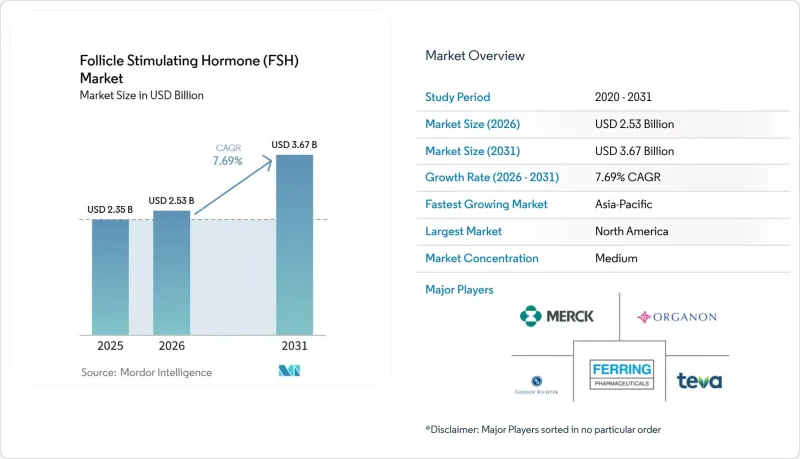
This report is Segmented by Product Type (Recombinant FSH, Urinary FSH, and More), by Form (Prefilled Pen Prefilled Syringe, and More), by Application (Infertility Treatment and More), by Route of Administration (Subcutaneous, Intramuscular), by Distribution Channel (Hospital Pharmacies and More), and Geography (North America, Europe, and More). The Market Forecasts are Provided in Terms of Value (USD).
Global Follicle Stimulating Hormone (FSH) Market Trends and Insights
Rising Infertility and Expanding ART Cycle Volumes
Infertility affects 17.5% of adults worldwide, which supports a sustained base of potential patients for fertility services. The follicle stimulating hormone market benefits when diagnosed patients progress from consultation to active treatment. More than 3 million assisted reproductive technology cycles occur each year worldwide. Cycle volumes in developed countries had increased by 5% to 10% annually before growth moderated in the most mature settings. China performs nearly 1 million ART cycles annually, creating frequent demand for gonadotropin treatment. Improved laboratory outcomes can encourage patients to pursue further retrieval cycles, which extends FSH use beyond a single treatment attempt.
Delayed Childbearing and Age-Related Ovarian Reserve Decline
Later family formation increases the proportion of patients who need individualized ovarian stimulation. The follicle stimulating hormone market, therefore, has greater exposure to protocols designed for variable ovarian reserve. Patients beginning treatment after age 35 often have lower antral follicle counts and anti-Mullerian hormone levels. These patients may require higher starting doses or more than 1 stimulation attempt. The 2025 ESHRE guidance recommends antral follicle count and anti-Mullerian hormone as biomarkers for predicting ovarian response. This approach shifts clinical decisions away from relying on basal FSH measurements and toward personalized protocol design.
High Per-Cycle Medication Cost and Incomplete Reimbursement
FSH medicines are among the largest medication expenses within an IVF cycle. The Follicle stimulating hormone market remains limited when patients cannot afford to start or continue treatment. Out-of-pocket medicine costs can exceed thousands of USD in markets without broad coverage. Uninsured patients in the United States, Southeast Asia, and Latin America may discontinue treatment because of medication expense. In October 2025, EMD Serono announced an 84% list-price discount for its IVF medicine portfolio for eligible patients. The measure addresses one barrier, but total IVF costs can still exceed USD 20,000 for an uninsured patient in the United States.
Other drivers and restraints analyzed in the detailed report include:
- Increasing Fertility Treatment Awareness and Reimbursement Support
- Recombinant FSH Production and Delivery Innovation
- Ovarian Hyperstimulation and Other Treatment-Related Safety Risks
For complete list of drivers and restraints, kindly check the Table Of Contents.
Segment Analysis
Recombinant FSH held 61.35% revenue share in 2025, making it the leading product group in the Follicle stimulating hormone market. Its position reflects consistent production quality, controlled dosing, and common use in high-volume fertility centers. Urinary FSH combined with other gonadotropins is the fastest-growing product group, with an 8.82% CAGR expected through 2031. These products combine FSH and LH activity in 1 administration. This can appeal to clinics that favor LH supplementation and need lower-cost treatment options. The product is particularly relevant in price-sensitive centers in Latin America and Southeast Asia. The 2025 ESHRE guideline stated that recombinant FSH with added LH activity is probably not superior to recombinant FSH alone for normal and low ovarian responders. The comparison means that price, local practice, and patient preference can influence product selection. Biosimilar competition may further reduce the gap between recombinant and urinary options.
Purified urinary FSH retains a position between lower-cost combination products and recombinant formulations. It offers greater purification than combination urinary products while remaining more affordable than many recombinant options. The Follicle stimulating hormone market includes this product choice because pricing does not move at the same pace across countries. Granata Bio and Georgetown Equity Partners formed GTE Bio in October 2025 to advance hypoglycosylated FSH into first-in-human studies. The program aims to reflect the glycoform profile seen in women of reproductive age. Ferring reported cumulative ongoing pregnancy rates of 64% in RITA-1 and 43.9% in RITA-2 for follitropin delta in 2025 presentations. These results support an approach based on individualized dosing evidence. Product selection will remain shaped by cost, formulation, and the clinical services attached to each brand.
Prefilled pens held 36.17% of form revenue in 2025. The follicle stimulating hormone market benefits from pens because patients can use dose-dialing devices during home stimulation. Ergonomic design and clearer dose selection can reduce handling concerns for patients. Outpatient-managed IVF cycles have made device design more important. Patients commonly self-administer FSH over a 10 to 14-day stimulation period. Pens suit this treatment pattern because they are designed for repeated home use. A 2025 Phase 3 comparison found Foligraf prefilled pen non-inferior to Gonal-f for efficacy. The study also reported comparable immunogenicity in a European regulatory submission. Equivalent device performance can reduce the protection that originators once received from pen design.
Lyophilized powder formulations remain relevant where cold-chain limitations or shelf-life requirements affect procurement. Multidose vials also remain cost-effective for busy reproductive centers. Clinics in China, India, and Brazil can use a vial for multiple patients on the same day. This approach can reduce medicine waste in clinic-administered models. Prefilled syringes are forecast to expand at a 9.15% CAGR through 2031. Specialty pharmacies and hospital programs value unit-dose packaging, inventory control, and sterility verification. Injection solutions remain useful across hospital-administered and self-administered settings. The follicle stimulating hormone market will continue to have several viable forms because care delivery varies by country. The choice between pens, syringes, vials, powders, and solutions will depend on price, storage, workflow, and patient support.
Complete Report Scope:
- By Product Type
- Recombinant FSH
- Urinary FSH
- Purified Urinary FSH
- Urinary FSH Combined With Other Gonadotropins
- By Form
- Injection Solution
- Lyophilized Powder
- Prefilled Pen
- Prefilled Syringe
- Multidose Vial
- By Application
- Infertility Treatment
- Controlled Ovarian Stimulation for IVF
- Intrauterine Insemination-Associated Stimulation
- Ovulation Induction
- Male Hypogonadotropic Hypogonadism and Spermatogenesis
- Other Therapeutic Applications
- By Route of Administration
- Subcutaneous
- Intramuscular
- By Distribution Channel
- Hospital Pharmacies
- Retail Pharmacies
- Online Pharmacies
- Specialty Pharmacies
- By Geography
- North America
- United States
- Canada
- Mexico
- Europe
- Germany
- United Kingdom
- France
- Italy
- Spain
- Rest of Europe
- Asia-Pacific
- China
- Japan
- India
- Australia
- South Korea
- Rest of Asia-Pacific
- Middle East and Africa
- GCC
- South Africa
- Rest of Middle East and Africa
- South America
- Brazil
- Argentina
- Rest of South America
- North America
Geography Analysis
North America held 43.17% of revenue in 2025. The follicle stimulating hormone market in the region is supported by the United States, which has a dense IVF clinic network and commercial insurance coverage. More than 435,000 ART cycles were performed in the United States in 2023. Gonal-f is a widely prescribed FSH product in the country. EMD Serono expanded a direct-to-patient access program in February 2026 to lower out-of-pocket medicine costs for eligible patients. Canada adds demand through provincial reimbursement programs. Mexico adds a cost-sensitive channel through fertility tourism for patients seeking lower-cost cycles. The region therefore includes both premium demand and demand that responds strongly to access programs.
Europe has a large and recurring FSH base. The region reported 923,318 ART cycles across 41 countries in 2020. Russia, France, Spain, Germany, and Italy are leading sources of treatment volume. The follicle stimulating hormone market in Europe also provides a model for biosimilar adoption. National medicines agencies and procurement systems in Germany and France support substitution practices in selected settings. Biosimilar follitropin alfa has gained meaningful clinic procurement share where institutional benefit-risk assessments support substitution. This environment increases price pressure on originators. It can also widen access when lower prices allow more cycles to be funded. Europe remains important for both reference biologics and companies seeking to establish biosimilar credibility.
Asia-Pacific is forecast to grow at a 9.21% CAGR through 2031. China anchors regional volume through nearly 1 million annual ART cycles. China's domestic FSH terminal sales reached RMB 2.541 billion in 2025, equivalent to USD 351 million, with recombinant products representing more than 56% of the total. Approvals of long-acting FSH products in August and September 2025 show that Chinese firms are competing through product development as well as price. Japan benefits from expanded national insurance coverage for ART. India, South Korea, and Australia add demand, while India's tier-2 city fertility centers widen access to affordable products.
- Anhui Anke Biotechnology Group Co., Ltd.
- Bharat Serums and Vaccines Limited
- Cipla
- Ferring Pharmaceuticals
- Gedeon Richter Plc
- GeneScience Pharmaceuticals Co., Ltd.
- IBSA Institut Biochimique SA
- Intas Pharmaceutical
- LG Chem Life Sciences
- Livzon Pharmaceutical Group Inc.
- Lupin
- Mankind Pharma Limited
- Meitheal Pharmaceuticals, Inc.
- Merck
- Organon
- Sanofi
- Shanghai Techwell Biopharmaceutical Co., Ltd.
- Sun Pharmaceuticals Industries
- Teva Pharmaceutical Industries
- Zydus Lifesciences Limited
Additional Benefits:
- The market estimate (ME) sheet in Excel format
- 3 months of analyst support
TABLE OF CONTENTS
1 INTRODUCTION
- 1.1 Study Assumptions and Market Definition
- 1.2 Scope of the Study
2 RESEARCH METHODOLOGY
3 EXECUTIVE SUMMARY
4 MARKET LANDSCAPE
- 4.1 Market Overview
- 4.2 Market Drivers
- 4.2.1 Rising Infertility and Expanding ART Cycle Volumes
- 4.2.2 Delayed Childbearing and Age-Related Ovarian Reserve Decline
- 4.2.3 Mainstream, Increasing Fertility Treatment Awareness and Reimbursement Support
- 4.2.4 Mainstream, Recombinant FSH Production and Delivery Innovation
- 4.2.5 Under-Reported, Long-Acting FSH and Reduced-Injection Protocols
- 4.2.6 Under-Reported, AI-Assisted Ovarian Stimulation and Dose Individualization
- 4.3 Market Restraints
- 4.3.1 Mainstream, High Per-Cycle Medication Cost and Incomplete Reimbursement
- 4.3.2 Mainstream, Ovarian Hyperstimulation and Other Treatment-Related Safety Risks
- 4.3.3 Under-Reported, Divergent Biosimilar Interchangeability and Substitution Rules
- 4.3.4 Under-Reported, Urinary-Derived Supply Traceability and Raw-Material Volatility
- 4.4 Supply Chain Analysis
- 4.5 Regulatory Landscape
- 4.6 Technological Outlook
- 4.7 Porter's Five Forces
- 4.7.1 Bargaining Power of Suppliers
- 4.7.2 Bargaining Power of Buyers
- 4.7.3 Threat of New Entrants
- 4.7.4 Threat of Substitutes
- 4.7.5 Competitive Rivalry
5 MARKET SIZE AND GROWTH FORECASTS
- 5.1 By Product Type
- 5.1.1 Recombinant FSH
- 5.1.2 Urinary FSH
- 5.1.3 Purified Urinary FSH
- 5.1.4 Urinary FSH Combined With Other Gonadotropins
- 5.2 By Form
- 5.2.1 Injection Solution
- 5.2.2 Lyophilized Powder
- 5.2.3 Prefilled Pen
- 5.2.4 Prefilled Syringe
- 5.2.5 Multidose Vial
- 5.3 By Application
- 5.3.1 Infertility Treatment
- 5.3.2 Controlled Ovarian Stimulation for IVF
- 5.3.3 Intrauterine Insemination-Associated Stimulation
- 5.3.4 Ovulation Induction
- 5.3.5 Male Hypogonadotropic Hypogonadism and Spermatogenesis
- 5.3.6 Other Therapeutic Applications
- 5.4 By Route of Administration
- 5.4.1 Subcutaneous
- 5.4.2 Intramuscular
- 5.5 By Distribution Channel
- 5.5.1 Hospital Pharmacies
- 5.5.2 Retail Pharmacies
- 5.5.3 Online Pharmacies
- 5.5.4 Specialty Pharmacies
- 5.6 By Geography
- 5.6.1 North America
- 5.6.1.1 United States
- 5.6.1.2 Canada
- 5.6.1.3 Mexico
- 5.6.2 Europe
- 5.6.2.1 Germany
- 5.6.2.2 United Kingdom
- 5.6.2.3 France
- 5.6.2.4 Italy
- 5.6.2.5 Spain
- 5.6.2.6 Rest of Europe
- 5.6.3 Asia-Pacific
- 5.6.3.1 China
- 5.6.3.2 Japan
- 5.6.3.3 India
- 5.6.3.4 Australia
- 5.6.3.5 South Korea
- 5.6.3.6 Rest of Asia-Pacific
- 5.6.4 Middle East and Africa
- 5.6.4.1 GCC
- 5.6.4.2 South Africa
- 5.6.4.3 Rest of Middle East and Africa
- 5.6.5 South America
- 5.6.5.1 Brazil
- 5.6.5.2 Argentina
- 5.6.5.3 Rest of South America
- 5.6.1 North America
6 COMPETITIVE LANDSCAPE
- 6.1 Market Concentration
- 6.2 Market Share Analysis
- 6.3 Company Profiles (includes Global Level Overview, Market Level Overview, Core Segments, Financials as available, Strategic Information, Market Rank/Share, Products and Services, Recent Developments)
- 6.3.1 Anhui Anke Biotechnology Group Co., Ltd.
- 6.3.2 Bharat Serums and Vaccines Limited
- 6.3.3 Cipla Ltd.
- 6.3.4 Ferring Pharmaceuticals
- 6.3.5 Gedeon Richter Plc
- 6.3.6 GeneScience Pharmaceuticals Co., Ltd.
- 6.3.7 IBSA Institut Biochimique SA
- 6.3.8 Intas Pharmaceuticals Ltd.
- 6.3.9 LG Chem Life Sciences
- 6.3.10 Livzon Pharmaceutical Group Inc.
- 6.3.11 Lupin Limited
- 6.3.12 Mankind Pharma Limited
- 6.3.13 Meitheal Pharmaceuticals, Inc.
- 6.3.14 Merck KGaA
- 6.3.15 Organon & Co.
- 6.3.16 Sanofi S.A.
- 6.3.17 Shanghai Techwell Biopharmaceutical Co., Ltd.
- 6.3.18 Sun Pharmaceutical Industries Ltd.
- 6.3.19 Teva Pharmaceutical Industries Ltd.
- 6.3.20 Zydus Lifesciences Limited
7 MARKET OPPORTUNITIES AND FUTURE OUTLOOK
- 7.1 White-Space and Unmet-Need Assessment

