PUBLISHER: Mordor Intelligence | PRODUCT CODE: 2154923

PUBLISHER: Mordor Intelligence | PRODUCT CODE: 2154923
Melanin - Market Share Analysis, Industry Trends & Statistics, Growth Forecasts (2026 - 2031)
According to Mordor Intelligence, the melanin market size was valued at USD 165.12 million in 2025 and is estimated to grow from USD 176.32 million in 2026 to reach USD 244.76 million by 2031, at a CAGR of 6.78% during the forecast period (2026-2031).
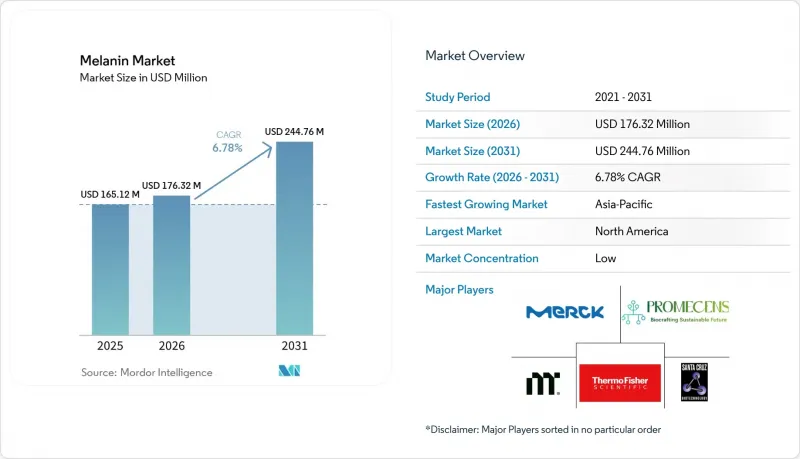
Global Melanin Market Trends and Insights
Rising Demand for Natural UV-Protective Ingredients
Melanin absorbs wavelengths from ultraviolet-C through visible light and dissipates absorbed energy without producing a large thermal burden. This property gives the melanin market a role in products designed to address broader light exposure. Research on melanin and related nanocosmetic materials describes its use in photoprotection and hair coloration, while also noting the need for evidence on safety and performance. Visible light and long-wave ultraviolet exposure can worsen hyperpigmentation in darker skin types, which adds pressure to improve conventional sunscreen formulations. A European patent publication described water-soluble melanin produced through laccase-mediated oxidation for use as a Sun Protection Factor (SPF)-boosting additive in sunscreen compositions. These developments support the use of melanin as a complementary ingredient rather than a replacement for approved ultraviolet filters.
Expansion of Inclusive Skincare and Photoprotection
The melanin market is supported by skincare demand that recognizes different responses to visible light across Fitzpatrick skin types III to VI. Dermatology research reports that tinted sunscreen products show a wide range of near-visible ultraviolet A and visible-light transmittance, which can affect their protection performance. Melanin has a native photoprotective role in skin, making it a relevant candidate for shade-inclusive product development. EltaMD introduced its Deep Tint line for darker skin tones in 2025, illustrating greater commercial attention to this consumer group. Avisa Myko launched a bio-based melanin sunscreen in India in January 2026, based on fungal fermentation. Tighter ingredient safety requirements in Europe also favor suppliers that can provide clear composition and safety documentation.
Complex Safety and Regulatory Qualification Requirements
Regulatory qualification limits the near-term addressable applications of the melanin market. Melanin nanoparticles have shown photoprotective potential, but they are not approved as ultraviolet filters under the relevant United States, European Union, and ASEAN cosmetic rules. Formulators must therefore use them in non-SPF pathways unless the required safety and efficacy dossiers are accepted. In Europe, nanoparticle formats must meet requirements under the Registration, Evaluation, Authorisation and Restriction of Chemicals (REACH) framework and undergo relevant safety assessment before notification. Commission Regulation (EU) 2026/78 strengthened restrictions on carcinogenic, mutagenic, or reprotoxic cosmetic substances in January 2026. The rules encourage investment in documentation but add cost and time before commercial launch.
Other drivers and restraints analyzed in the detailed report include:
- Advances in Synthetic Biology and Microbial Fermentation
- Growth of Melanin-Based Biomedical Research
- High Extraction, Purification, and Formulation Costs
For complete list of drivers and restraints, kindly check the Table Of Contents.
Segment Analysis
Synthetic melanin accounted for 64.67% of the global melanin market size in 2025 and is projected to grow at a 7.23% CAGR from 2026 to 2031. Its position reflects reproducibility advantages in regulated pharmaceutical and cosmetics applications. Polydopamine-based production and chemical DOPA polymerization can provide defined molecular-weight distributions. These methods can also provide more predictable ultraviolet attenuation profiles than natural extraction. Formulators value that control when they need consistent performance across production batches.
The segment also has a lead in advanced materials research. Molecularly engineered selenomelanin nanoparticles achieved a persistent radical concentration of 1.76 X 10¹⁸ spins g-1 in a 2025 study. The study reported 100% 30-day murine survival following 6 Gy total-body gamma-ray irradiation at 7.5 mg kg-1 body weight. Natural melanin remains relevant for applications that prioritize biocompatibility. Fungal eumelanin from Thermothelomyces hinnuleus SP1 demonstrated SPF values of 10.67 and human adult low Calcium high Temperature (HaCaT) cell viability from 94.9% to 98.83% in 2026 testing. Water-solubilization methods may improve the functional role of natural forms in high-value formulations.
Complete Report Scope:
- By Type
- Synthetic Melanin
- Natural Melanin
- By Application
- Pharmaceuticals
- Beauty and Personal Care
- Research and Advanced Materials
- Food, Nutraceuticals, and Functional Ingredients
- Other Applications
- By Geography
- Asia-Pacific
- China
- India
- Japan
- South Korea
- ASEAN Countries
- Rest of Asia-Pacific
- North America
- United States
- Canada
- Mexico
- Europe
- Germany
- United Kingdom
- France
- Italy
- NORDIC Countries
- Rest of Europe
- South America
- Brazil
- Argentina
- Rest of South America
- Middle East and Africa
- Saudi Arabia
- South Africa
- Rest of Middle East and Africa
- Asia-Pacific
Geography Analysis
North America held 38.23% of the melanin market share in 2025. High pharmaceutical research spending and established personal care manufacturing support regional demand. The United States has a demand for dermatological pharmaceuticals and photoprotection cosmetics. Regulatory expectations are also raising the importance of supplier quality systems and safety records. This favors producers that can offer consistent research-grade and pharmaceutical-grade materials.
Asia-Pacific is projected to grow at a 7.12% CAGR from 2026 to 2031. The region supports the melanin market through pharmaceutical manufacturing in China and India, cosmetics development in South Korea and Japan, and expanding biotechnology capacity across ASEAN economies. South Korea and Japan use their cosmetics formulation ecosystems to develop pigmentation-management and ultraviolet-defense products. India's Avisa Myko launched a fungal-fermentation melanin sunscreen in January 2026. China's National Institutes for Food and Drug Control invited proposals for 2026 cosmetic standards focused on raw-material safety and restricted ingredients in December 2025. The proposal process can shape procurement requirements for bio-derived inputs across regional supply chains.
Europe has a significant position through Germany, the United Kingdom, and France. The region combines pharmaceutical innovation with demand for sustainable cosmetic ingredients. The melanin market is influenced by compliance with Regulation (EC) No. 1223/2009 and later amendments. Nordic countries show interest in circular bio-based supply chains, and Melatech ApS participates in this regional innovation group. South America and Middle East and Africa remain smaller contributors. Their demand is supported by high solar exposure and products addressing pigmentation concerns among sun-exposed populations.
- Avisa Myko
- Biosynth
- Cayman Chemical
- Cephalosource
- Insectta
- MedChemExpress
- Melatech ApS
- Melsa Biotech Inc.
- Merck KGaA
- Oxyco
- Photoprotective Technologies, Inc.
- Promecens
- Santa Cruz Biotechnology, Inc.
- SimSon Pharma Limited
- Thermo Fisher Scientific Inc.
Additional Benefits:
- The market estimate (ME) sheet in Excel format
- 3 months of analyst support
TABLE OF CONTENTS
1 Introduction
- 1.1 Study Assumptions and Market Definition
- 1.2 Scope of the Study
2 Research Methodology
3 Executive Summary
4 Market Landscape
- 4.1 Market Overview
- 4.2 Market Drivers
- 4.2.1 Rising Demand for Natural UV-Protective Ingredients
- 4.2.2 Expansion of Inclusive Skincare and Photoprotection
- 4.2.3 Advances in Synthetic Biology and Microbial Fermentation
- 4.2.4 Growth of Melanin-Based Biomedical Research
- 4.2.5 Commercialization of Melanin Bioelectronics and Radiation-Shielding Materials
- 4.3 Market Restraints
- 4.3.1 Complex Safety and Regulatory Qualification Requirements
- 4.3.2 High Extraction, Purification, and Formulation Costs
- 4.3.3 Batch-to-Batch Variability in Bio-Derived Melanin
- 4.4 Value Chain Analysis
- 4.5 Porter's Five Forces Analysis
- 4.5.1 Threat of New Entrants
- 4.5.2 Bargaining Power of Suppliers
- 4.5.3 Bargaining Power of Buyers
- 4.5.4 Threat of Substitutes
- 4.5.5 Competitive Rivalry
5 Market Size and Growth Forecasts (Value)
- 5.1 By Type
- 5.1.1 Synthetic Melanin
- 5.1.2 Natural Melanin
- 5.2 By Application
- 5.2.1 Pharmaceuticals
- 5.2.2 Beauty and Personal Care
- 5.2.3 Research and Advanced Materials
- 5.2.4 Food, Nutraceuticals, and Functional Ingredients
- 5.2.5 Other Applications
- 5.3 By Geography
- 5.3.1 Asia-Pacific
- 5.3.1.1 China
- 5.3.1.2 India
- 5.3.1.3 Japan
- 5.3.1.4 South Korea
- 5.3.1.5 ASEAN Countries
- 5.3.1.6 Rest of Asia-Pacific
- 5.3.2 North America
- 5.3.2.1 United States
- 5.3.2.2 Canada
- 5.3.2.3 Mexico
- 5.3.3 Europe
- 5.3.3.1 Germany
- 5.3.3.2 United Kingdom
- 5.3.3.3 France
- 5.3.3.4 Italy
- 5.3.3.5 NORDIC Countries
- 5.3.3.6 Rest of Europe
- 5.3.4 South America
- 5.3.4.1 Brazil
- 5.3.4.2 Argentina
- 5.3.4.3 Rest of South America
- 5.3.5 Middle East and Africa
- 5.3.5.1 Saudi Arabia
- 5.3.5.2 South Africa
- 5.3.5.3 Rest of Middle East and Africa
- 5.3.1 Asia-Pacific
6 Competitive Landscape
- 6.1 Market Concentration
- 6.2 Strategic Moves
- 6.3 Market Share (%)/Ranking Analysis
- 6.4 Company Profiles (includes Global Overview, Market Overview, Core Segments, Financials as available, Strategic Information, Products and Services, and Recent Developments)
- 6.4.1 Avisa Myko
- 6.4.2 Biosynth
- 6.4.3 Cayman Chemical
- 6.4.4 Cephalosource
- 6.4.5 Insectta
- 6.4.6 MedChemExpress
- 6.4.7 Melatech ApS
- 6.4.8 Melsa Biotech Inc.
- 6.4.9 Merck KGaA
- 6.4.10 Oxyco
- 6.4.11 Photoprotective Technologies, Inc.
- 6.4.12 Promecens
- 6.4.13 Santa Cruz Biotechnology, Inc.
- 6.4.14 SimSon Pharma Limited
- 6.4.15 Thermo Fisher Scientific Inc.
7 Market Opportunities and Future Outlook
- 7.1 White-Space and Unmet-Need Assessment

