PUBLISHER: Mordor Intelligence | PRODUCT CODE: 2118269

PUBLISHER: Mordor Intelligence | PRODUCT CODE: 2118269
Germany Nutritional Supplements - Market Share Analysis, Industry Trends & Statistics, Growth Forecasts (2026 - 2031)
According to Mordor Intelligence, the Germany nutritional supplements market size is expected to grow from USD 4.72 billion in 2025 to USD 5.01 billion in 2026 and is forecast to reach USD 7.11 billion by 2031 at 7.25% CAGR over 2026-2031.
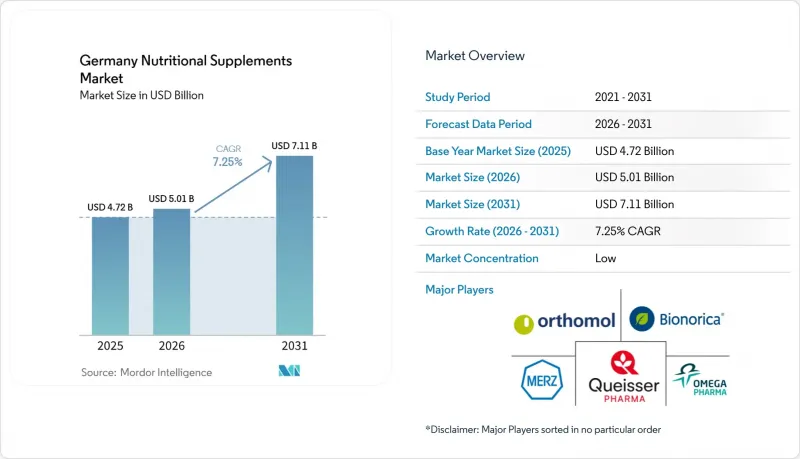
This report is Segmented by Product Type (Vitamins and Minerals, Herbal and Botanical, Collagen, Omega Fatty Acid, Other Types), Form (Capsules and Softgels, Tablets, Powders, Gummies, Liquid, Others), and Distribution Channel (Supermarkets/Hypermarkets, Specialty Stores, Online Retail, Direct Selling, Other Channels). The Market Forecasts are Provided in Terms of Value (USD).
Germany Nutritional Supplements Market Trends and Insights
Growing health and wellness awareness
Increasing focus on preventive healthcare, immunity support, and overall well-being is significantly driving the growth of the Germany nutritional supplements market. Consumers are becoming more aware of the role of essential vitamins, minerals, and functional nutrients in maintaining health and addressing nutritional deficiencies. The aging population is further contributing to demand for supplements supporting bone health, joint care, cognitive function, and healthy aging. Additionally, rising participation in fitness activities and active lifestyles is encouraging the consumption of sports nutrition and performance-enhancing supplements. Growing interest in personalized nutrition, natural ingredients, and clean-label formulations is also influencing consumer preferences.
Rising demand for preventive healthcare products
Growing emphasis on preventive healthcare and proactive disease management is driving the demand for nutritional supplements in Germany, as consumers increasingly seek products that support long-term health and reduce the risk of nutrient deficiencies. Rising awareness regarding the importance of adequate vitamin and mineral intake has encouraged the adoption of supplements across different age groups. The Federal Institute for Risk Assessment (BfR) highlights the importance of targeted supplementation, stating that folic acid supplementation is advisable for women planning pregnancy, while vitamin D supplements may be appropriate when sunlight exposure is insufficient. Such recommendations are increasing consumer confidence in supplements for specific health needs.
Strict EU supplement regulations
Germany enforces a structured regulatory framework for nutritional supplements. The German Nutritional Supplements Ordinance requires manufacturers and importers to notify the Federal Office of Consumer Protection and Food Safety before marketing a product. EU regulations also restrict vitamin and mineral sources to the lists established under Directive 2002/46/EC. The Federal Institute for Risk Assessment has issued recommendations on maximum levels for vitamins and essential minerals, which inform ongoing European discussions on harmonized limits. Companies operating across several EU countries must manage varying national tolerance levels until regulators harmonize the rules. As a result, the Germany nutritional supplements market favors companies that integrate regulatory review, substantiation records, and compliant communications into product development.
Other drivers and restraints analyzed in the detailed report include:
- Increasing vitamin D deficiency concerns
- Aging population boosting supplement demand
- Limited awareness of supplement benefits
For complete list of drivers and restraints, kindly check the Table Of Contents.
Segment Analysis
Vitamins and minerals accounted for the largest share of 45.18% in the Germany nutritional supplements market in 2025. The segment dominates due to strong consumer awareness regarding the importance of essential micronutrients in maintaining overall health and preventing nutritional deficiencies. Daily supplementation with vitamins such as Vitamin D, Vitamin C, and B-complex, along with minerals including magnesium, calcium, and zinc, has become increasingly common across different age groups. Germany's aging population and rising focus on preventive healthcare continue to support demand for these products. In addition, healthcare professionals frequently recommend vitamin and mineral supplements to address nutrient gaps, further strengthening consumer confidence.
Collagen supplements are projected to register the fastest CAGR of 8.61% during the forecast period through 2031. The rapid growth of this segment is driven by increasing consumer interest in healthy aging, skin health, joint mobility, and bone strength. Younger consumers are also adopting collagen supplements as part of beauty-from-within and wellness routines, expanding the target consumer base beyond older populations. Manufacturers are introducing innovative formulations such as marine collagen, bovine collagen peptides, flavored powders, gummies, and ready-to-drink products to improve convenience and appeal.
Complete Report Scope:
- By Product Type
- Vitamins and Minerals
- Herbal and Botanical Supplements
- Collagen Supplements
- Omega Fatty Acid Supplements
- Other Product Types
- By Form
- Capsules and Softgels
- Tablets
- Powders
- Gummies
- Liquid Supplements
- Others
- By Distribution Channel
- Supermarkets/Hypermarkets
- Specialty Stores
- Online Retail Channels
- Direct Selling
- Other Distribution Channels
List of Companies Covered in this Report:
- Orthomol Holding GmbH
- Queisser Pharma GmbH & Co. KG
- Omega Pharma Deutschland GmbH
- Merz Consumer Care GmbH
- Bionorica SE
- Sunday Natural Products GmbH
- nu3 GmbH
- Vitafy GmbH
- Pure Encapsulations Germany GmbH
- NORSAN GmbH
- Krauterhaus Sanct Bernhard KG
- Synformulas GmbH
- MCM Klosterfrau Vertriebsgesellschaft mbH
- Quality Group GmbH
- Foodspring GmbH
- Body Attack Sports Nutrition GmbH & Co. KG
- Alpha Foods GmbH
- Raab Vitalfood GmbH
- Dr. Wolz Zell GmbH
- Amapharm GmbH
Additional Benefits:
- The market estimate (ME) sheet in Excel format
- 3 months of analyst support
TABLE OF CONTENTS
1 INTRODUCTION
- 1.1 Study Assumptions and Market Definition
- 1.2 Scope of the Study
2 RESEARCH METHODOLOGY
3 EXECUTIVE SUMMARY
4 MARKET LANDSCAPE
- 4.1 Market Overview
- 4.2 Market Drivers
- 4.2.1 Growing health and wellness awareness
- 4.2.2 Rising demand for preventive healthcare products
- 4.2.3 Increasing vitamin D deficiency concerns
- 4.2.4 Aging population boosting supplement demand
- 4.2.5 Increasing consumer spending on premium and branded nutritional supplements
- 4.2.6 Rising demand for immunity-support supplements
- 4.3 Market Restraints
- 4.3.1 Strict EU supplement regulations
- 4.3.2 Limited awareness of supplement benefits
- 4.3.3 Competition from functional foods and pharmaceuticals
- 4.3.4 Concerns over excessive supplement usage
- 4.4 Consumer Behavior Analysis
- 4.5 Regulatory Landscape
- 4.6 Technological Outlook
- 4.7 Porter's Five Forces
- 4.7.1 Bargaining Power of Suppliers
- 4.7.2 Bargaining Power of Buyers
- 4.7.3 Threat of New Entrants
- 4.7.4 Threat of Substitutes
- 4.7.5 Competitive Rivalry
5 MARKET SIZE AND GROWTH FORECASTS (VALUE)
- 5.1 By Product Type
- 5.1.1 Vitamins and Minerals
- 5.1.2 Herbal and Botanical Supplements
- 5.1.3 Collagen Supplements
- 5.1.4 Omega Fatty Acid Supplements
- 5.1.5 Other Product Types
- 5.2 By Form
- 5.2.1 Capsules and Softgels
- 5.2.2 Tablets
- 5.2.3 Powders
- 5.2.4 Gummies
- 5.2.5 Liquid Supplements
- 5.2.6 Others
- 5.3 By Distribution Channel
- 5.3.1 Supermarkets/Hypermarkets
- 5.3.2 Specialty Stores
- 5.3.3 Online Retail Channels
- 5.3.4 Direct Selling
- 5.3.5 Other Distribution Channels
6 COMPETITIVE LANDSCAPE
- 6.1 Market Concentration
- 6.2 Strategic Moves
- 6.3 Market Share Analysis
- 6.4 Company Profiles (includes Global level Overview, Market level overview, Core Segments, Financials (if available), Strategic Information, Market Rank/Share, Products, Recent Developments)
- 6.4.1 Orthomol Holding GmbH
- 6.4.2 Queisser Pharma GmbH & Co. KG
- 6.4.3 Omega Pharma Deutschland GmbH
- 6.4.4 Merz Consumer Care GmbH
- 6.4.5 Bionorica SE
- 6.4.6 Sunday Natural Products GmbH
- 6.4.7 nu3 GmbH
- 6.4.8 Vitafy GmbH
- 6.4.9 Pure Encapsulations Germany GmbH
- 6.4.10 NORSAN GmbH
- 6.4.11 Krauterhaus Sanct Bernhard KG
- 6.4.12 Synformulas GmbH
- 6.4.13 MCM Klosterfrau Vertriebsgesellschaft mbH
- 6.4.14 Quality Group GmbH
- 6.4.15 Foodspring GmbH
- 6.4.16 Body Attack Sports Nutrition GmbH & Co. KG
- 6.4.17 Alpha Foods GmbH
- 6.4.18 Raab Vitalfood GmbH
- 6.4.19 Dr. Wolz Zell GmbH
- 6.4.20 Amapharm GmbH
7 MARKET OPPORTUNITIES AND FUTURE OUTLOOK

