PUBLISHER: Mordor Intelligence | PRODUCT CODE: 2119271

PUBLISHER: Mordor Intelligence | PRODUCT CODE: 2119271
Nutritional Supplements - Market Share Analysis, Industry Trends & Statistics, Growth Forecasts (2026 - 2031)
According to Mordor Intelligence, the nutritional supplements market was valued at USD 178.00 billion in 2025 and is estimated to grow from USD 189.75 billion in 2026 to USD 261.19 billion by 2031, at a CAGR of 6.60% during the forecast period 2026-2031.
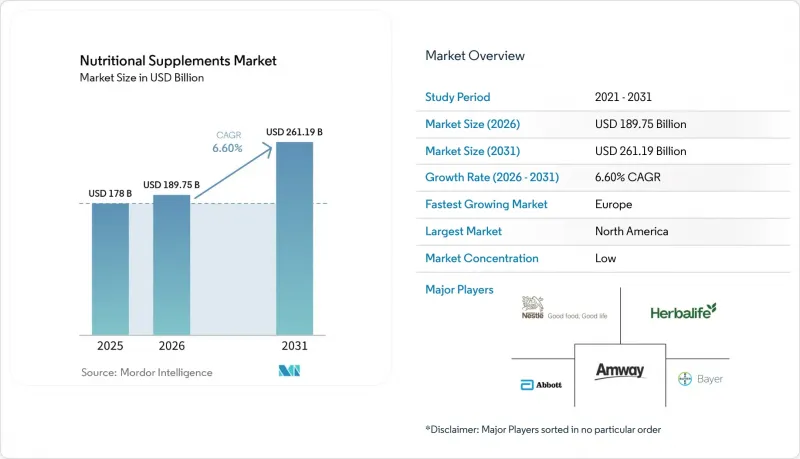
This report is Segmented by Product Type (Sports Nutrition and Dietary Supplements), by Consumer Group (Men, Women, Unisex, and Kids/Children), by Distribution Channel (Supermarkets and Hypermarkets, Online Retail Stores, and More), and by Geography (North America, Europe, and More). The Market Forecasts are Provided in Terms of Value (USD).
Global Nutritional Supplements Market Trends and Insights
Growing consumer focus on preventive health and wellness
Growing consumer focus on preventive health and wellness: Rising attention toward preventive healthcare and overall wellness is encouraging consumers to adopt a more proactive approach to nutrition, disease-risk management, and healthy aging, supporting demand for nutritional supplements. This trend is reinforced by the scale of healthcare spending in developed markets, with UK total healthcare expenditure reaching approximately GBP 345 billion in 2025 in both nominal and real terms, according to the Office for National Statistics . As consumers and healthcare systems place greater emphasis on maintaining health and addressing nutritional needs before serious health issues arise, demand is expanding for vitamins, minerals, probiotics, omega-3 products, and other supplements positioned around immunity, energy, bone health, cognitive wellness, and healthy aging.
Clean-label, plant-based and sustainable formulations
Growing consumer preference for clean-label, plant-based, and sustainably sourced nutritional supplements is encouraging manufacturers to reformulate products around natural ingredients, transparent labeling, vegan alternatives, and environmentally responsible sourcing. This trend is particularly strong among younger consumers, as Gen Z and Millennials are willing to pay around 20-30% more for products carrying claims such as organic, natural, high protein, and no artificial ingredients . This willingness to pay a premium is encouraging supplement brands to develop plant-based proteins, botanical formulations, non-GMO products, and sustainably sourced ingredients, while emphasizing ingredient transparency and traceability. As consumers increasingly associate clean formulations with health, quality, and responsible consumption, these attributes are becoming key differentiators and supporting premiumization across the nutritional supplements market.
Misleading or exaggerated health claims
The use of misleading, exaggerated, or insufficiently substantiated health claims can restrain the nutritional supplements market by reducing consumer confidence and increasing regulatory scrutiny. Claims related to immunity, weight management, anti-aging, cognitive performance, or disease prevention may create unrealistic expectations when not adequately supported by scientific evidence. This can prompt regulators to impose stricter requirements on product labeling, advertising, and marketing communications, increasing compliance costs for manufacturers. Additionally, repeated exposure to overstated claims can make consumers more skeptical of supplement efficacy, particularly for emerging ingredients and products, potentially limiting adoption and weakening trust in the broader nutritional supplements category.
Other drivers and restraints analyzed in the detailed report include:
- Expansion of sports and active nutrition
- Expansion of functional and condition-specific supplements
- Raw-material volatility and sustainable-input constraints
For complete list of drivers and restraints, kindly check the Table Of Contents.
Segment Analysis
Sports nutrition accounted for 48.81% of the overall market in 2025, making it the largest revenue-generating segment. Within this segment, sports protein powder, protein RTDs, and protein bars represent the highest-volume sub-categories. Protein bars are gaining traction as an on-the-go format that spans both sports nutrition and functional food. Sports non-protein products, including pre-workouts, creatine, electrolytes, and BCAAs, are recording notable growth, driven by creatine's increasing adoption as a mainstream wellness ingredient beyond elite athletes.
The dietary supplements segment, while currently smaller, is forecast to grow at a CAGR of 8.53% through 2031, outpacing sports nutrition. Vitamins and minerals, probiotics and prebiotics, and collagen formulations are attracting a broader consumer base across demographics. Herbal supplements and fatty acids (omega-3s) contribute meaningfully to overall volume, while the collagen sub-category is benefiting from growing interest in beauty-from-within products and clinical evidence supporting joint health, particularly among the 35-55 age cohort.
Complete Report Scope:
- Product Type
- Sports Nutrition
- Sports Protein Powder
- Protein RTD
- Protein Bars
- Sports Non-Protein Products
- Dietary Supplements
- Vitamins and Minerals
- Collagen
- Fatty Acids
- Herbal Supplements
- Enzymes
- Prebiotics and Probiotics
- Other Product Type
- Sports Nutrition
- By Consumer Group
- Men
- Women
- Unisex
- Kids/Children
- By Distribution Channel
- Supermarkets and Hypermarkets
- Pharmacies and Drugstores
- Online Retail Stores
- Specialty and Health Food Stores
- Geography
- North America
- United States
- Canada
- Mexico
- Rest of North America
- Europe
- United Kingdom
- Germany
- France
- Italy
- Spain
- Russia
- Sweden
- Belgium
- Poland
- Netherlands
- Rest of Europe
- Asia-Pacific
- China
- Japan
- India
- Thailand
- Singapore
- Indonesia
- South Korea
- Australia
- New Zealand
- Rest of Asia-Pacific
- South America
- Brazil
- Argentina
- Colombia
- Chile
- Rest of South America
- Middle East and Africa
- United Arab Emirates
- South Africa
- Saudi Arabia
- Nigeria
- Egypt
- Morocco
- Turkey
- Rest of Middle East and Africa
- North America
Geography Analysis
North America remains the largest geography in the market, holding a 28.68% share in 2025, supported by well-established supplement consumption habits, high disposable income, and a mature retail infrastructure. The United States is driven by innovation in protein formats, social commerce discovery, and the mainstream adoption of creatine, collagen, and magnesium. Canada and Mexico contribute meaningful volume in North America, with Mexico showing particular momentum in sports nutrition as gym culture expands in urban centers. The 2026 FDA regulatory modernization agenda, including finalized New Dietary Ingredient guidance, GRAS reform, and Good Manufacturing Practice (GMP) updates, introduces both compliance costs and a more defined competitive environment that benefits well-capitalized manufacturers.
Europe is the fastest-growing geography, forecast at a CAGR of 8.08% through 2031. This growth reflects the region's ongoing shift from reactive healthcare to preventive nutrition, as well as the scale of innovation in sports and active nutrition formats. The United Kingdom ranked as the leading European country for sports nutrition product launches over the past two years, with Germany, Spain, the Netherlands, and Italy following closely, according to Innova Market Insights data from June 2026. European sports nutrition brands face a distinct challenge: performance nutrition launches with natural claims declined from 29% in 2023 to 19% in 2025 in Germany, indicating that "natural" positioning without clinical substantiation is losing commercial traction, even as consumer demand for genuine clean-label products intensifies.
Asia-Pacific presents the most structurally diverse demand landscape, with China, Japan, India, South Korea, and Indonesia each operating under distinct regulatory, cultural, and retail conditions. South Africa anchors supplement demand in Africa, which remains an earlier-stage but fast-expanding market, benefiting from urbanization, rising health awareness, and the growth of international supplement brands through e-commerce. However, infrastructure constraints and import duties continue to limit market penetration in lower-income markets across Nigeria, Morocco, and Egypt.
- Amway Corporation
- Herbalife Ltd.
- Nestle S.A.
- Abbott Laboratories
- Haleon plc
- Bayer AG
- Glanbia PLC
- Otsuka Holdings Co. Ltd.
- Suntory Holdings Ltd.
- Church and Dwight Co. Inc.
- Reckitt Benckiser Group PLC
- NOW Health Group Inc.
- Vitabiotics Ltd.
- H&H Group
- Jamieson Wellness Inc.
- GNC Holdings, LLC
- Nature's Sunshine Products, Inc.
- Nestle Health Science
- Nutrabolt
- Fonterra Co-operative Group Limited
Additional Benefits:
- The market estimate (ME) sheet in Excel format
- 3 months of analyst support
TABLE OF CONTENTS
1 INTRODUCTION
- 1.1 Study Assumptions and Market Definition
- 1.2 Scope of the Study
2 RESEARCH METHODOLOGY
3 EXECUTIVE SUMMARY
4 MARKET LANDSCAPE
- 4.1 Market Overview
- 4.2 Market Drivers
- 4.2.1 Growing consumer focus on preventive health and wellness
- 4.2.2 Rising demand for vitamins and minerals
- 4.2.3 Clean-label, plant-based and sustainable formulations
- 4.2.4 Expansion of sports and active nutrition
- 4.2.5 Expansion of functional and condition-specific supplements
- 4.2.6 Rapid growth of convenient supplement formats
- 4.3 Market Restraints
- 4.3.1 Misleading or exaggerated health claims
- 4.3.2 Raw-material volatility and sustainable-input constraints
- 4.3.3 High product costs and price sensitivity
- 4.3.4 Stringent and fragmented regulatory frameworks
- 4.4 Consumer Buying Behavior
- 4.5 Regulatory Landscape
- 4.6 Technological Outlook
- 4.7 Porter's Five Forces
- 4.7.1 Threat of New Entrants
- 4.7.2 Bargaining Power of Buyers
- 4.7.3 Bargaining Power of Suppliers
- 4.7.4 Threat of Substitutes
- 4.7.5 Competitive Rivalry
5 MARKET SIZE AND GROWTH FORECASTS (VALUE)
- 5.1 Product Type
- 5.1.1 Sports Nutrition
- 5.1.1.1 Sports Protein Powder
- 5.1.1.2 Protein RTD
- 5.1.1.3 Protein Bars
- 5.1.1.4 Sports Non-Protein Products
- 5.1.2 Dietary Supplements
- 5.1.2.1 Vitamins and Minerals
- 5.1.2.2 Collagen
- 5.1.2.3 Fatty Acids
- 5.1.2.4 Herbal Supplements
- 5.1.2.5 Enzymes
- 5.1.2.6 Prebiotics and Probiotics
- 5.1.2.7 Other Product Type
- 5.1.1 Sports Nutrition
- 5.2 By Consumer Group
- 5.2.1 Men
- 5.2.2 Women
- 5.2.3 Unisex
- 5.2.4 Kids/Children
- 5.3 By Distribution Channel
- 5.3.1 Supermarkets and Hypermarkets
- 5.3.2 Pharmacies and Drugstores
- 5.3.3 Online Retail Stores
- 5.3.4 Specialty and Health Food Stores
- 5.4 Geography
- 5.4.1 North America
- 5.4.1.1 United States
- 5.4.1.2 Canada
- 5.4.1.3 Mexico
- 5.4.1.4 Rest of North America
- 5.4.2 Europe
- 5.4.2.1 United Kingdom
- 5.4.2.2 Germany
- 5.4.2.3 France
- 5.4.2.4 Italy
- 5.4.2.5 Spain
- 5.4.2.6 Russia
- 5.4.2.7 Sweden
- 5.4.2.8 Belgium
- 5.4.2.9 Poland
- 5.4.2.10 Netherlands
- 5.4.2.11 Rest of Europe
- 5.4.3 Asia-Pacific
- 5.4.3.1 China
- 5.4.3.2 Japan
- 5.4.3.3 India
- 5.4.3.4 Thailand
- 5.4.3.5 Singapore
- 5.4.3.6 Indonesia
- 5.4.3.7 South Korea
- 5.4.3.8 Australia
- 5.4.3.9 New Zealand
- 5.4.3.10 Rest of Asia-Pacific
- 5.4.4 South America
- 5.4.4.1 Brazil
- 5.4.4.2 Argentina
- 5.4.4.3 Colombia
- 5.4.4.4 Chile
- 5.4.4.5 Rest of South America
- 5.4.5 Middle East and Africa
- 5.4.5.1 United Arab Emirates
- 5.4.5.2 South Africa
- 5.4.5.3 Saudi Arabia
- 5.4.5.4 Nigeria
- 5.4.5.5 Egypt
- 5.4.5.6 Morocco
- 5.4.5.7 Turkey
- 5.4.5.8 Rest of Middle East and Africa
- 5.4.1 North America
6 COMPETITIVE LANDSCAPE
- 6.1 Market Concentration
- 6.2 Strategic Moves
- 6.3 Market Share Analysis
- 6.4 Company Profiles (includes Global level Overview, Market level overview, Core Segments, Financials as available, Strategic Information, Market Rank/Share for key companies, Products and Services, and Recent Developments)
- 6.4.1 Amway Corporation
- 6.4.2 Herbalife Ltd.
- 6.4.3 Nestle S.A.
- 6.4.4 Abbott Laboratories
- 6.4.5 Haleon plc
- 6.4.6 Bayer AG
- 6.4.7 Glanbia PLC
- 6.4.8 Otsuka Holdings Co. Ltd.
- 6.4.9 Suntory Holdings Ltd.
- 6.4.10 Church and Dwight Co. Inc.
- 6.4.11 Reckitt Benckiser Group PLC
- 6.4.12 NOW Health Group Inc.
- 6.4.13 Vitabiotics Ltd.
- 6.4.14 H&H Group
- 6.4.15 Jamieson Wellness Inc.
- 6.4.16 GNC Holdings, LLC
- 6.4.17 Nature's Sunshine Products, Inc.
- 6.4.18 Nestle Health Science
- 6.4.19 Nutrabolt
- 6.4.20 Fonterra Co-operative Group Limited
7 MARKET OPPORTUNITIES AND FUTURE OUTLOOK

