PUBLISHER: Mordor Intelligence | PRODUCT CODE: 2118868

PUBLISHER: Mordor Intelligence | PRODUCT CODE: 2118868
Vascular Ulcers Treatment - Market Share Analysis, Industry Trends & Statistics, Growth Forecasts (2026 - 2031)
According to Mordor Intelligence, the vascular ulcers treatment market size is expected to increase from USD 3.75 billion in 2025 to USD 3.96 billion in 2026 and reach USD 5.19 billion by 2031, growing at a CAGR of 5.55% over 2026-2031.
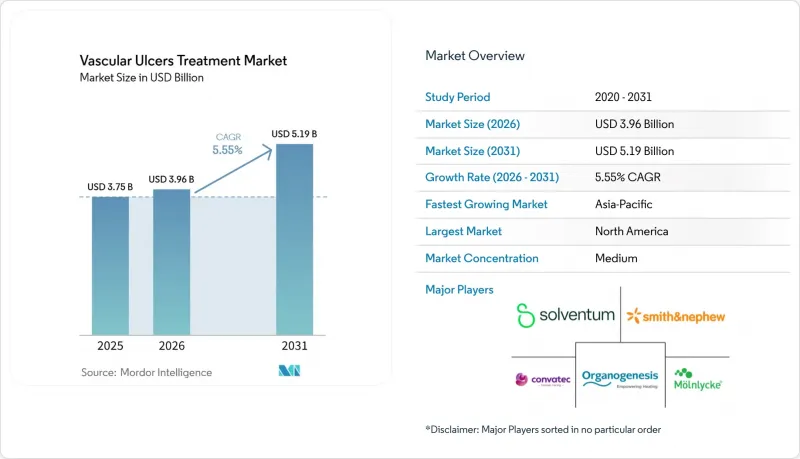
This report is Segmented by Ulcer Type (Venous Ulcers, Diabetic Ulcers, Arterial Ulcers, and More), Product Type (Compression Bandages/Stockings/Pumps, Advanced Dressings, and More), Wound Stage, End User (Hospitals, Clinics, Ascs, Homecare), Distribution Channel (Hospital, Retail, Online), and Geography (North America, Europe, Asia-Pacific, and More). Forecasts are Provided in Value (USD).
Global Vascular Ulcers Treatment Market Trends and Insights
Rising Prevalence of Diabetes, Chronic Venous Insufficiency and Peripheral Arterial Disease
The vascular ulcers treatment market draws demand from a large and growing diabetes population. In 2024, 589 million adults aged 20 to 79 lived with diabetes worldwide, or 11.11% of this adult population. The number is projected to reach 853 million by 2050, which expands the pool of patients who may require prevention, early assessment, and long-duration wound care. More than 59% of adults aged 30 and older with diabetes did not receive medication in 2022, leaving unmanaged disease concentrated in many low- and middle-income countries where access to early care is less consistent. Chronic venous insufficiency and peripheral arterial disease further complicate healing because they can coexist with diabetes and increase the need for repeated treatment decisions, specialist review, and product use. A 2025 U.S. analysis reported lower-extremity peripheral arterial disease healthcare costs above USD 21 billion annually, largely from hospital care and long-term ischemic wound management, which shows the scale of care associated with severe vascular disease.
Expansion of Advanced Wound Care and Bioengineered Tissue Products
Advanced wound care products are becoming more important when conventional treatment does not close a wound. A 2025 meta-analysis covering 29 randomized controlled trials and 2,255 patients found that cellular and acellular tissue-based products combined with standard care had a pooled odds ratio of 2.9 for complete healing versus standard care alone. This benefit remained across patient age and initial wound-size groups, which makes the evidence relevant to a broad range of difficult-to-heal wounds. The vascular ulcers treatment market therefore has greater scope for biological products in persistent wounds that have not responded to standard compression and dressings. ConvaTec received EU and UK approval for ConvaMatrix, a porcine placenta-derived skin substitute, in September 2025. Wider clinical evidence can move these products from occasional use toward earlier consideration in hospital and outpatient formularies, although suppliers still need to show that higher product costs are matched by appropriate clinical and economic value.
High Cost of Advanced Dressings, Biologics and Therapy Devices
The cost of advanced care can restrict use even when clinical evidence is favorable. Skin substitutes can cost more than USD 1,000 per application, while coverage for repeated use differs widely by payer and by the documentation required for a non-healing wound. Paul Hartmann AG reported EUR 623.6 million (USD 710.35 million) in wound-care revenue in 2025 and organic growth of 2.6%. Germany and France experienced direct revenue pressure from coverage reductions, demonstrating how reimbursement changes can affect even established suppliers. These conditions show that price and health-economic evidence must accompany clinical development and product launches. The vascular ulcers treatment market may face slower adoption in systems that are tightening reimbursement for premium wound products, particularly when less costly compression and dressing options remain available for earlier-stage care. The vascular ulcers treatment market consequently rewards suppliers that can support coverage decisions with clear evidence.
Other drivers and restraints analyzed in the detailed report include:
- Shift Toward Outpatient, Homecare and Community-Based Wound Management
- Growth of Multidisciplinary Limb-Salvage and Vascular-Wound Care Pathways
- Compression Nonadherence Caused by Pain, Heat, Dexterity Limitations and Poor Fit
For complete list of drivers and restraints, kindly check the Table Of Contents.
Segment Analysis
Venous ulcers held 45.31% of revenue in 2025, supported by chronic venous insufficiency and long treatment cycles. Their prevalence in older Western populations provides a steady demand base for dressings, compression, and follow-up care. Active venous leg ulcer prevalence was 0.1% in the general population, but it rose to 4% to 5% among adults older than 80. This age pattern makes population aging important to the vascular ulcers treatment market. Arterial, neurotrophic, and mixed vascular ulcers require different clinical decisions and can lengthen treatment. Mixed ulcers require confirmation of arterial sufficiency before compression is used safely.
Diabetic ulcers are projected to grow at a 7.58% CAGR through 2031. Diabetic foot ulcers affect 12% to 25% of adults with diabetes and account for 80% to 90% of lower-extremity amputations in the United States. The 2024 global diabetes population of 589 million creates a growing pathway toward established vascular ulcers. Diabetic ulcers may exceed venous ulcers in growth momentum before 2031. Suppliers need portfolios that address ischemia, infection risk, and prolonged healing without becoming too narrowly focused.
Advanced wound dressings held 38.24% of product revenue in 2025. They remain central to wound-bed preparation and daily exudate management across hospitals, clinics, and homes. Their broad use means they remain a core volume category even as biological products expand. Compression bandages, wraps, stockings, garments, pumps, and devices remain integral to venous ulcer treatment. NICE found that four-layer bandages and two-layer hosiery remained the most cost-effective compression configurations in the United Kingdom. That finding can constrain premium pricing for wraps and self-managed devices.
Skin substitutes and biological matrices are projected to expand at an 8.22% CAGR through 2031. A 2025 meta-analysis of 29 randomized controlled trials and 2,255 patients found an odds ratio of 2.9 for complete healing when tissue-based products were combined with standard care. The result remained consistent across age and wound-size groups. ConvaMatrix received EU and UK approval in September 2025, adding a porcine placenta-derived option for advanced wound management. The vascular ulcers treatment market needs adequate wound-bed preparation before high-cost biological products can deliver their intended value. Debridement and wound-cleansing products therefore remain stable contributors across the product mix.
Complete Report Scope:
- By Ulcer Type
- Venous Ulcers
- Diabetic Ulcers
- Arterial Ulcers
- Neurotrophic Ulcers
- Mixed Vascular Ulcers
- By Product Type
- Compression Bandages and Wraps
- Compression Stockings and Garments
- Compression Pumps and Devices
- Advanced Wound Dressings
- Skin Substitutes and Biological Matrices
- Debridement and Wound-Cleansing Products
- Other Product Types
- By Wound Stage
- Superficial or Mild Ulcers
- Moderate Ulcers
- Deep or Severe Ulcers
- Infected or Complicated Ulcers
- Ischemic or Neuro-Ischemic Ulcers
- By End User
- Hospitals
- Specialty Wound Care Clinics
- Ambulatory Surgical Centers
- Homecare Settings
- Other End Users
- By Distribution Channel
- Hospital Pharmacies
- Retail Pharmacies
- Online Pharmacies and E-Commerce
- Other Distribution Channels
- By Geography
- North America
- United States
- Canada
- Mexico
- Europe
- Germany
- United Kingdom
- France
- Italy
- Spain
- Rest of Europe
- Asia-Pacific
- China
- Japan
- India
- Australia
- South Korea
- Rest of Asia-Pacific
- Middle East and Africa
- GCC
- South Africa
- Rest of Middle East and Africa
- South America
- Brazil
- Argentina
- Rest of South America
- North America
Geography Analysis
North America held 40.61% of revenue in 2025. Its specialist infrastructure and reimbursement pathways support adoption of advanced products in the vascular ulcers treatment market. The region combines specialist wound centers, hospital procurement systems, and outpatient payment structures that support the use of advanced products. The Centers for Medicare & Medicaid Services revised the Wound and Ulcer Care LCD L38902 effective September 2025. It maintained coverage for medically necessary outpatient debridement, advanced dressings, and device therapies. Smith+Nephew launched ALLEVYN COMPLETE CARE Foam Dressing in the United States in March 2026. MiMedx launched CHORIOFIX in the United States in March 2026 through national distribution. These launches illustrate why the vascular ulcers treatment market remains an important launch setting for suppliers of premium wound products.
Europe is the second-largest regional area, supported by chronic venous disease across Germany, the United Kingdom, France, Italy, and Spain. The vascular ulcers treatment market depends on established care infrastructure in these countries, but patient access and reimbursement rules differ widely. A German claims analysis of 16,615 insured patients with venous leg ulcers found that 25% did not receive compression therapy during a 5-year observation period. This gap remains despite compression being the first-line guideline approach. Paul Hartmann reported direct coverage-related pressure in Germany and France during 2025. EU Medical Device Regulation requirements raise the clinical evidence threshold for biologics and advanced dressings. These requirements favor companies with established European regulatory programs and can narrow access for new suppliers.
Asia-Pacific is projected to grow at an 8.25% CAGR through 2031. Japan's population aged 65 and older accounted for 29% of the national total, adding to venous leg ulcer and pressure injury caseloads. China's venous leg ulcer prevalence was 1.5%, while its absolute peripheral arterial disease case count continued to increase despite a plateau in standardized prevalence rates. These demographic and disease patterns give the vascular ulcers treatment market a broader base for long-term growth in the region. India is the fastest-growing country in the region, supported by rising diabetes incidence and broader health coverage in tier-2 and tier-3 cities. Molnlycke formed a joint venture with Zhende Medical in China in May 2026, showing the importance of local distribution partnerships. GCC private hospital networks support advanced product adoption, while parts of Africa, Brazil, Argentina, and other South American countries face uneven access, economic volatility, or both.
- Axio Biosolutions Pvt. Ltd.
- B. Braun
- Bauerfeind
- BioTissue Holdings, Inc.
- Cardinal Health
- Coloplast
- Convatec
- Essity
- Integra LifeSciences
- Medline Industries
- MIMEDX Group, Inc.
- Molnlycke Health Care
- Organogenesis
- Hartmann Group
- PolyNovo Limited
- SIGVARIS GROUP
- Smith+Nephew plc
- Solventum Corporation
- Urgo Medical
Additional Benefits:
- The market estimate (ME) sheet in Excel format
- 3 months of analyst support
TABLE OF CONTENTS
1 Introduction
- 1.1 Study Assumptions and Market Definition
- 1.2 Scope of the Study
2 Research Methodology
3 Executive Summary
4 Market Landscape
- 4.1 Market Overview
- 4.2 Market Drivers
- 4.2.1 Rising Prevalence of Diabetes, Chronic Venous Insufficiency and Peripheral Arterial Disease
- 4.2.2 Expansion of Advanced Wound Care and Bioengineered Tissue Products
- 4.2.3 Shift Toward Outpatient, Homecare and Community-Based Wound Management
- 4.2.4 Growth of Multidisciplinary Limb-Salvage and Vascular-Wound Care Pathways
- 4.2.5 Remote Wound Monitoring and AI-Assisted Wound Assessment
- 4.2.6 Increasing Adoption of Adjustable and Self-Managed Compression Systems
- 4.3 Market Restraints
- 4.3.1 High Cost of Advanced Dressings, Biologics and Therapy Devices
- 4.3.2 Limited Specialist Access and Uneven Reimbursement Coverage
- 4.3.3 Compression Nonadherence Caused by Pain, Heat, Dexterity Limitations and Poor Fit
- 4.3.4 Inconsistent Vascular Assessment and Delayed Etiology Classification
- 4.4 Supply-Chain Analysis
- 4.5 Regulatory Landscape
- 4.6 Technological Outlook
- 4.7 Porter's Five Forces Analysis
- 4.7.1 Bargaining Power of Suppliers
- 4.7.2 Bargaining Power of Buyers
- 4.7.3 Threat of New Entrants
- 4.7.4 Threat of Substitutes
- 4.7.5 Competitive Rivalry
5 Market Size & Growth Forecasts (Value, USD)
- 5.1 By Ulcer Type
- 5.1.1 Venous Ulcers
- 5.1.2 Diabetic Ulcers
- 5.1.3 Arterial Ulcers
- 5.1.4 Neurotrophic Ulcers
- 5.1.5 Mixed Vascular Ulcers
- 5.2 By Product Type
- 5.2.1 Compression Bandages and Wraps
- 5.2.2 Compression Stockings and Garments
- 5.2.3 Compression Pumps and Devices
- 5.2.4 Advanced Wound Dressings
- 5.2.5 Skin Substitutes and Biological Matrices
- 5.2.6 Debridement and Wound-Cleansing Products
- 5.2.7 Other Product Types
- 5.3 By Wound Stage
- 5.3.1 Superficial or Mild Ulcers
- 5.3.2 Moderate Ulcers
- 5.3.3 Deep or Severe Ulcers
- 5.3.4 Infected or Complicated Ulcers
- 5.3.5 Ischemic or Neuro-Ischemic Ulcers
- 5.4 By End User
- 5.4.1 Hospitals
- 5.4.2 Specialty Wound Care Clinics
- 5.4.3 Ambulatory Surgical Centers
- 5.4.4 Homecare Settings
- 5.4.5 Other End Users
- 5.5 By Distribution Channel
- 5.5.1 Hospital Pharmacies
- 5.5.2 Retail Pharmacies
- 5.5.3 Online Pharmacies and E-Commerce
- 5.5.4 Other Distribution Channels
- 5.6 By Geography
- 5.6.1 North America
- 5.6.1.1 United States
- 5.6.1.2 Canada
- 5.6.1.3 Mexico
- 5.6.2 Europe
- 5.6.2.1 Germany
- 5.6.2.2 United Kingdom
- 5.6.2.3 France
- 5.6.2.4 Italy
- 5.6.2.5 Spain
- 5.6.2.6 Rest of Europe
- 5.6.3 Asia-Pacific
- 5.6.3.1 China
- 5.6.3.2 Japan
- 5.6.3.3 India
- 5.6.3.4 Australia
- 5.6.3.5 South Korea
- 5.6.3.6 Rest of Asia-Pacific
- 5.6.4 Middle East and Africa
- 5.6.4.1 GCC
- 5.6.4.2 South Africa
- 5.6.4.3 Rest of Middle East and Africa
- 5.6.5 South America
- 5.6.5.1 Brazil
- 5.6.5.2 Argentina
- 5.6.5.3 Rest of South America
- 5.6.1 North America
6 Competitive Landscape
- 6.1 Market Concentration
- 6.2 Market Share Analysis
- 6.3 Company Profiles (includes Global Level Overview, Market Level Overview, Core Segments, Financials as available, Strategic Information, Market Rank/Share, Products and Services, Recent Developments)
- 6.3.1 Axio Biosolutions Pvt. Ltd.
- 6.3.2 B. Braun Melsungen AG
- 6.3.3 Bauerfeind AG
- 6.3.4 BioTissue Holdings, Inc.
- 6.3.5 Cardinal Health, Inc.
- 6.3.6 Coloplast A/S
- 6.3.7 ConvaTec Group PLC
- 6.3.8 Essity AB
- 6.3.9 Integra LifeSciences Holdings Corporation
- 6.3.10 Medline Industries, LP
- 6.3.11 MIMEDX Group, Inc.
- 6.3.12 Molnlycke Health Care AB
- 6.3.13 Organogenesis Holdings Inc.
- 6.3.14 Paul Hartmann AG
- 6.3.15 PolyNovo Limited
- 6.3.16 SIGVARIS GROUP
- 6.3.17 Smith+Nephew plc
- 6.3.18 Solventum Corporation
- 6.3.19 Urgo Medical
7 Market Opportunities and Future Outlook
- 7.1 White-Space and Unmet-Need Assessment

