PUBLISHER: Mordor Intelligence | PRODUCT CODE: 2118876

PUBLISHER: Mordor Intelligence | PRODUCT CODE: 2118876
Asia-Pacific 5G Device - Market Share Analysis, Industry Trends & Statistics, Growth Forecasts (2026 - 2031)
According to Mordor Intelligence, the Asia-Pacific 5G device market size in terms of shipment volume is expected to grow from 3.41 billion units in 2025 to 4.10 billion units in 2026 and is forecast to reach 8.17 billion units by 2031 at 14.79% CAGR over 2026-2031.
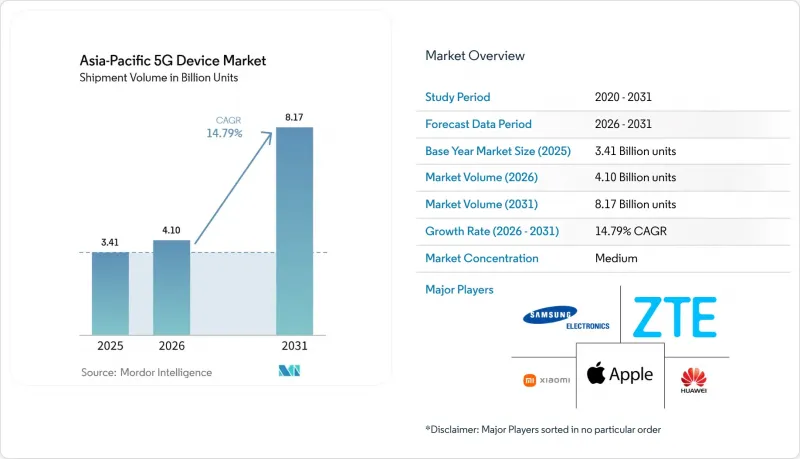
This report is Segmented by Form Factor (Smartphones, Customer-Premises Equipment (Indoor/Outdoor), and More), Spectrum Support (Sub-6 GHz, Mmwave, and Hybrid (Sub-6 GHz and MmWave)), End User Industry (Consumer Electronics, Industrial and Manufacturing, and More), Application (Enhanced Mobile Broadband (eMBB), and More), and Country. The Market Forecasts are Provided in Terms of Volume (Units).
Asia-Pacific 5G Device Market Trends and Insights
5G Network Rollout and Device Upgrade Cycles
China's network scale remains a major source of demand for the Asia-Pacific 5G device market. China had 4.838 million 5G base stations at the end of 2025 and 4.958 million at the end of March 2026. 5G-Advanced service had reached 330 Chinese cities in early 2026, creating demand for devices that can support more advanced network functions. Across the region, 69 operators in 26 countries had launched commercial 5G by mid-2025, with 13 operators deploying networks and 17 planning services. Regional telecom operators have committed USD 254 billion to network infrastructure through 2030, with 5G as the main focus. The retirement of older networks in Singapore, India, and New Zealand has also led to delayed replacement decisions being converted into device purchases.
Mid-Range 5G Smartphone Penetration in Asia-Pacific
India illustrates how lower device prices are expanding the Asia-Pacific 5G device market. More than 90% of smartphones shipped in India in 2025 were 5G-enabled, while monthly 5G data traffic rose 70% year over year to 12.9 exabytes. Nearly 47% of India's mobile broadband traffic was carried on 5G during that year. Shipments of 5G handsets priced below USD 100 increased more than tenfold, indicating that radio hardware has reached the entry-level. Qualcomm introduced Snapdragon 6 Gen 5 and Snapdragon 4 Gen 5 platforms in India in May 2026, placing the country at the center of development for mid-range and entry devices. This price range is likely to shape regional shipment volumes, as it serves both first-time 5G buyers and replacement customers.
High Bill of Materials for 5G Devices and RF Components
The cost of RF components limits how quickly 5G hardware can move into lower-priced devices. A flagship 5G handset requires USD 15 to USD 25 of FR1 RF components and USD 20 to USD 80 for each mmWave antenna-in-package module. The total RF front-end cost can therefore range from USD 35 to USD 105 per device, or 5% to 15% of the handset bill of materials. Memory and storage account for more than 30% of the bill of materials in smartphones priced below USD 200. More than 60% of devices shipped in Southeast Asia fall into this price band, so component inflation can affect affordability and manufacturer margins. RF front-end lead times of 16 to 26 weeks in 2026 add procurement pressure as AI infrastructure competes for advanced packaging and wafer capacity.
Other drivers and restraints analyzed in the detailed report include:
- Industrial 5G and Private Network Device Adoption
- Fixed Wireless Access Substitution for Last-Mile Broadband
- mmWave Cost and Integration Complexity
For complete list of drivers and restraints, kindly check the Table Of Contents.
Segment Analysis
Smartphones held 65.40% of regional device volume in 2025, supported by the region's mobile-first customer base and handset manufacturing capacity. China Mobile's 5G subscriber base exceeded 1.2 billion mobile users at the end of September 2025. This installed base supports shipments of 5G devices across the Asia-Pacific market, including low-cost, mid-range, and premium tiers. Customer-premises equipment is the second-largest form-factor contributor by deployment velocity because fixed wireless services require routers and outdoor units. Industrial routers, gateways, modules, and hotspots have smaller volumes but higher unit values than mainstream consumer devices.
Wearables and XR devices are projected to grow at a 16.25% CAGR from 2026 to 2031. Singapore, South Korea, Japan, and major Chinese cities already have 5G standalone coverage that can support lower-latency spatial computing. SoftBank Corp., Ericsson Japan, and Qualcomm Technologies completed a commercial 5G standalone XR streaming field trial in Tokyo during December 2025. South Korea's enterprise and AR/VR uses are also encouraging device makers to pursue mmWave-capable and enhanced sub-6 GHz platforms. India's production-linked incentive program has attracted investment in electronics assembly and supports lower unit costs for consumer devices.
Sub-6 GHz devices accounted for 59.66% of the Asia-Pacific 5G device market size in 2025. The band provides broad coverage, lower integration cost, and accessible regulatory conditions across diverse regional markets. Its position is particularly durable where 5G coverage is centered on n77 and n78 spectrum. Consumer price sensitivity also limits the near-term addressable base for mmWave hardware. Hybrid devices that support both sub-6 GHz and mmWave remain concentrated in premium and enterprise use cases in Japan and South Korea.
mmWave devices are projected to expand at a 16.05% CAGR through 2031 from a smaller 2025 base. Demand in the Asia-Pacific 5G device market is driven by private networks, semiconductor plants, and high-density venues that require high throughput and low latency. ASE Technology has announced plans for a 5G mmWave NR-DC standalone smart factory targeting a 600 Mbps uplink over 2.6 GHz and 28 GHz links. Japan and South Korea apply strict type-approval rules for the N257 and N258 bands. Established certification records can favor Samsung Electronics, Qualcomm, and Sony Group in this premium tier.
Complete Report Scope:
- By Form Factor
- Smartphones
- Customer-Premises Equipment (Indoor/Outdoor)
- Industrial Grade Routers/Gateways
- Modules
- Laptops/Tablets
- Hotspots
- Wearables and XR Devices
- By Spectrum Support
- Sub-6 GHz
- mmWave
- Hybrid (Sub-6 GHz and mmWave)
- By End-User Industry
- Consumer Electronics
- Industrial and Manufacturing
- Automotive and Transportation
- Healthcare
- Energy and Utilities
- Enterprise/Commercial
- By Application
- Enhanced Mobile Broadband (eMBB)
- Ultra-Reliable Low-Latency Comms (URLLC)
- Massive Machine-Type Comms (mMTC)
- Fixed Wireless Access
- Vehicle-to-Everything (V2X)
- By Country
- China
- Japan
- India
- South Korea
- ASEAN
- Rest of Asia-Pacific
List of Companies Covered in this Report:
- Apple Inc.
- Samsung Electronics Co., Ltd.
- Xiaomi Corporation
- Huawei Technologies Co., Ltd.
- ZTE Corporation
- Sony Group Corporation
- D-Link Corporation
- Nokia Corporation
- Fibocom Wireless Inc.
- Inseego Corp.
- HTC Corporation
- Askey Computer Corp.
- Lenovo Group Limited
- Qualcomm Incorporated
- MediaTek Inc.
- Quectel Wireless Solutions Co., Ltd.
- MeiG Smart Technology Co., Ltd.
- SIMCom Wireless Solutions Co., Ltd.
- OPPO (OPPO Mobile Telecommunications Corp. Ltd.)
- Vivo Mobile Communication Co., Ltd.
Additional Benefits:
- The market estimate (ME) sheet in Excel format
- 3 months of analyst support
TABLE OF CONTENTS
1 INTRODUCTION
- 1.1 Study Assumptions and Market Definition
- 1.2 Scope of the Study
2 RESEARCH METHODOLOGY
3 EXECUTIVE SUMMARY
4 MARKET LANDSCAPE
- 4.1 Market Overview
- 4.2 Market Drivers
- 4.2.1 5G Network Rollout and Device Upgrade Cycles
- 4.2.2 Mid-Range 5G Smartphone Penetration in Asia-Pacific
- 4.2.3 Industrial 5G and Private Network Device Adoption
- 4.2.4 Fixed Wireless Access Substitution for Last-Mile Broadband
- 4.2.5 5G RedCap and Low-Power Device Enablement
- 4.2.6 AI-Ready Handsets and Premium Device Refresh Demand
- 4.3 Market Restraints
- 4.3.1 High Bill of Materials for 5G Devices and RF Components
- 4.3.2 mmWave Cost and Integration Complexity
- 4.3.3 Supply Chain Dependence on Advanced Semiconductors
- 4.3.4 Industrial Integration Complexity Across Legacy Systems
- 4.4 Industry Value Chain Analysis
- 4.5 Regulatory Landscape
- 4.6 Technological Outlook
- 4.7 Porter's Five Forces Analysis
- 4.7.1 Bargaining Power of Suppliers
- 4.7.2 Bargaining Power of Buyers
- 4.7.3 Threat of New Entrants
- 4.7.4 Threat of Substitutes
- 4.7.5 Intensity of Competitive Rivalry
5 MARKET SIZE AND GROWTH FORECASTS (VOLUME)
- 5.1 By Form Factor
- 5.1.1 Smartphones
- 5.1.2 Customer-Premises Equipment (Indoor/Outdoor)
- 5.1.3 Industrial Grade Routers/Gateways
- 5.1.4 Modules
- 5.1.5 Laptops/Tablets
- 5.1.6 Hotspots
- 5.1.7 Wearables and XR Devices
- 5.2 By Spectrum Support
- 5.2.1 Sub-6 GHz
- 5.2.2 mmWave
- 5.2.3 Hybrid (Sub-6 GHz and mmWave)
- 5.3 By End-User Industry
- 5.3.1 Consumer Electronics
- 5.3.2 Industrial and Manufacturing
- 5.3.3 Automotive and Transportation
- 5.3.4 Healthcare
- 5.3.5 Energy and Utilities
- 5.3.6 Enterprise/Commercial
- 5.4 By Application
- 5.4.1 Enhanced Mobile Broadband (eMBB)
- 5.4.2 Ultra-Reliable Low-Latency Comms (URLLC)
- 5.4.3 Massive Machine-Type Comms (mMTC)
- 5.4.4 Fixed Wireless Access
- 5.4.5 Vehicle-to-Everything (V2X)
- 5.5 By Country
- 5.5.1 China
- 5.5.2 Japan
- 5.5.3 India
- 5.5.4 South Korea
- 5.5.5 ASEAN
- 5.5.6 Rest of Asia-Pacific
6 COMPETITIVE LANDSCAPE
- 6.1 Market Concentration
- 6.2 Strategic Moves
- 6.3 Market Share Analysis
- 6.4 Company Profiles (includes Global Level Overview, Market Level Overview, Core Segments, Financials as available, Strategic Information, Market Rank/Share, Products and Services, Recent Developments)
- 6.4.1 Apple Inc.
- 6.4.2 Samsung Electronics Co., Ltd.
- 6.4.3 Xiaomi Corporation
- 6.4.4 Huawei Technologies Co., Ltd.
- 6.4.5 ZTE Corporation
- 6.4.6 Sony Group Corporation
- 6.4.7 D-Link Corporation
- 6.4.8 Nokia Corporation
- 6.4.9 Fibocom Wireless Inc.
- 6.4.10 Inseego Corp.
- 6.4.11 HTC Corporation
- 6.4.12 Askey Computer Corp.
- 6.4.13 Lenovo Group Limited
- 6.4.14 Qualcomm Incorporated
- 6.4.15 MediaTek Inc.
- 6.4.16 Quectel Wireless Solutions Co., Ltd.
- 6.4.17 MeiG Smart Technology Co., Ltd.
- 6.4.18 SIMCom Wireless Solutions Co., Ltd.
- 6.4.19 OPPO (OPPO Mobile Telecommunications Corp. Ltd.)
- 6.4.20 Vivo Mobile Communication Co., Ltd.
7 MARKET OPPORTUNITIES AND FUTURE OUTLOOK
- 7.1 White-Space and Unmet-Need Assessment

