PUBLISHER: Mordor Intelligence | PRODUCT CODE: 2124473

PUBLISHER: Mordor Intelligence | PRODUCT CODE: 2124473
5G Devices - Market Share Analysis, Industry Trends & Statistics, Growth Forecasts (2026 - 2031)
According to Mordor Intelligence, the 5G devices market size in terms of shipment volume is expected to grow from 6.11 billion units in 2025 to 7.42 billion units in 2026 and is forecast to reach 14.56 billion units by 2031 at 14.43% CAGR over 2026-2031.
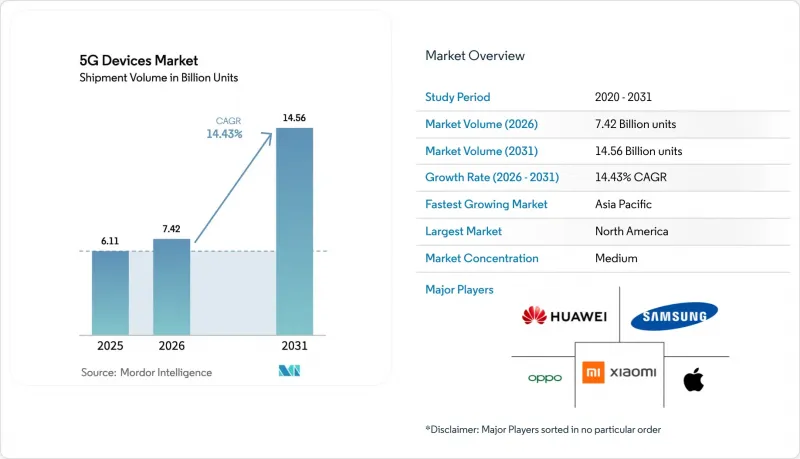
This report is Segmented by Form Factor (Smartphones, CPE, Industrial Routers, Modules, Laptops and Tablets, Hotspots, and Wearables and XR), Spectrum Support (Sub-6 GHz, Mmwave, and Hybrid), End-User (Consumer, Industrial, Automotive, Healthcare, Energy, and Enterprise), Application (eMBB, URLLC, MMTC, FWA, and V2X), and Geography. The Market Forecasts are Provided in Terms of Volume (Units).
Global 5G Devices Market Trends and Insights
Explosive Mobile-Data Demand in Emerging Economies
Monthly data consumption per user in India surpassed 20 gigabytes in 2025, driven by cloud gaming, augmented-reality filters, and real-time translation tools that require latency under 100 milliseconds. Although global 5G coverage reached 55%, penetration in low-income nations was only 4%, so affordability rather than infrastructure dictated adoption. Carriers responded with financing schemes that lowered upfront handset costs, prompting brands to release sub-USD 150 smartphones trimmed of high-end features. This dynamic expanded the 5G device market beyond early adopters, even as margins tightened. The result is a broadening unit base that underpins double-digit shipment growth.
Declining ASP of 5G Chipsets and RF Front-Ends
Qualcomm's Snapdragon 4-series average selling price dropped 22% year over year in fiscal 2024, mainly because MediaTek discounted Dimensity 6000 processors. GaAs power amplifiers for sub-6 gigahertz bands fell below USD 2 per unit in 2025, down from USD 3.50 in 2022. As a result, the bill-of-materials premium for 5G over 4G fell below USD 15, dismantling the largest barrier to mass-market adoption. MmWave front-end modules still cost USD 12-18, confining that band to premium devices. Even so, falling core silicon prices widen the 5G devices market by making entry-level models affordable in emerging economies.
Supply-Chain Volatility for RF Semiconductors
Gallium-nitride wafer shortages pushed RF front-end lead times to 30 weeks in 2024, compared with 14 weeks for baseband silicon. Only three fabs worldwide can mass-produce gallium-nitride-on-silicon-carbide substrates, so premium mmWave gear often reaches stores late. Original equipment manufacturers mitigate risk by shipping dual stock-keeping units: volume sub-6 gigahertz models and limited mmWave variants. The bifurcation blunts the overall 5G devices market CAGR until new fab capacity comes online.
Other drivers and restraints analyzed in the detailed report include:
- Aggressive Carrier Device-Subsidy Programs
- Enterprise Private-Network Rollouts
- Patchy mmWave Coverage Outside Dense Urban Zones
For complete list of drivers and restraints, kindly check the Table Of Contents.
Segment Analysis
Smartphones accounted for 64.96% of shipments in 2025, underscoring their central role as primary access devices for more than 4.5 billion users worldwide. Yet replacement intervals lengthened to 31 months in 2025, signaling maturation. Wearables and extended-reality hardware are on a 15.52% CAGR path to 2031, lifted by insurer wellness incentives and workplace safety mandates. Apple reported that cellular-enabled watches formed 38% of its wearable mix in 2024, up from 22% in 2022. Customer-premises equipment for fixed wireless has risen with rural broadband initiatives, while industrial routers priced at USD 500-1,200 thrive in harsh-environment deployments. Modules, critical for machine-to-machine automotive and metering links, scale in parallel with the Internet of Things.
Growth leadership shows why pocket-centric demand is plateauing while body-worn and ambient endpoints surge. Augmented-reality glasses lower maintenance errors in factories by overlaying instructions in workers' fields of view. However, battery anxiety persists because users expect multi-day endurance on wrist and eyewear devices. Continuous silicon advances that push power draw below 300 milliwatts therefore remain decisive for form-factor migration. As these advances materialize, the 5G devices market will rely less on handsets for its next 7 billion-unit expansion.
Sub-6 gigahertz radios captured 58.22% share in 2025 since they deliver 300-600 megabits per second across kilometer-scale cells at front-end costs below USD 6. MmWave shipments grow at 14.86% but start from a lower base because modules cost USD 12-18 and require network densification that is still underway. Hybrid devices that combine both bands represented 18% of 2025 smartphones, catering to early adopters keen on peak speeds. Carriers must install 10-15 times more mmWave small cells than sub-6 gigahertz sites to match signal reach, a heavy capital burden that delays ubiquitous coverage.
Momentum favors sub-6 gigahertz for nationwide availability, with mmWave reserved for stadiums, airports, and high-density downtown corridors. Consequently, sub-6 gigahertz hardware will stay the volume backbone of the 5G devices market while mmWave targets premium tiers. Once densities rise and front-end prices fall, the share of mmWave could approach 30% by 2031, but its upside hinges on solving both infrastructure and component supply bottlenecks.
Complete Report Scope:
- By Form Factor
- Smartphones
- Customer-Premises Equipment (Indoor / Outdoor)
- Industrial Grade Routers / Gateways
- Modules
- Laptops/Tablets
- Hotspots
- Wearables and XR Devices
- By Spectrum Support
- Sub-6 GHz
- mmWave
- Hybrid (Sub-6 GHz + mmWave)
- By End-User Industry
- Consumer Electronics
- Industrial and Manufacturing
- Automotive and Transportation
- Healthcare
- Energy and Utilities
- Enterprise/Commercial
- By Application
- Enhanced Mobile Broadband (eMBB)
- Ultra-Reliable Low-Latency Comms (URLLC)
- Massive Machine-Type Comms (mMTC)
- Fixed Wireless Access
- Vehicle-to-Everything (V2X)
- By Geography
- North America
- United States
- Canada
- Mexico
- South America
- Brazil
- Argentina
- Rest of South America
- Europe
- Germany
- United Kingdom
- France
- Italy
- Spain
- Rest of Europe
- Asia-Pacific
- China
- Japan
- India
- South Korea
- ASEAN
- Rest of Asia-Pacific
- Middle East
- Saudi Arabia
- United Arab Emirates
- Rest of Middle East
- Africa
- South Africa
- Nigeria
- Rest of Africa
- North America
Geography Analysis
Asia-Pacific shipped 55.73% of global units in 2025, buoyed by China's 420 million-device output and India's production-linked incentive program that drew USD 15 billion in assembly investments. Japan and South Korea punch above their volume-based rank by owning 40% of the premium tier above USD 1,000. Southeast Asian markets expand rapidly on sub-USD 300 handsets, whereas Australia and New Zealand see 36-month cycles that temper growth. Localized component ecosystems give Asia-Pacific up to 30% cost advantages versus Europe and North America, locking in its leadership of the 5G devices market.
The Middle East is one of the fastest risers, with a 16.01% CAGR to 2031. Saudi Arabia allocated USD 20 billion to 5G smart-city projects under Vision 2030, and the United Arab Emirates achieved 95% population coverage in 2024. Device uptake lags network rollout because average selling prices remain high; continued chipset cost erosion will unlock the next leg of adoption.
North America and Europe face countervailing forces: mature 5G footprints coexist with regulatory pressures that slow handset churn. The European Union tightened e-waste rules in 2023, adding end-of-life fees of USD 2-5 per phone. U.S. right-to-repair debates encourage longer use, holding region-wide CAGR to low double digits. South America and Africa together account for 12% of shipments, though fixed wireless presents a mid-term leapfrog path in underserved rural areas.
- Apple Inc.
- Samsung Electronics Co., Ltd.
- Huawei Technologies Co., Ltd.
- Xiaomi Corp.
- Guangdong OPPO Mobile Telecommunications Corp., Ltd.
- Vivo Mobile Communication Co., Ltd.
- Lenovo Group Ltd. (Motorola Mobility LLC)
- Nokia Corp.
- ZTE Corp.
- Cisco Systems, Inc.
- Ericsson AB
- Qualcomm Inc.
- MediaTek Inc.
- Quectel Wireless Solutions Co., Ltd.
- Fibocom Wireless Inc.
- Sierra Wireless, Inc. (Semtech)
- Telit Cinterion Ltd.
- Keysight Technologies, Inc.
- TCL Technology Group Corp.
- Honor Device Co., Ltd.
- Realme Mobile Telecommunications (Shenzhen) Co., Ltd.
- HMD Global Oy
- OnePlus Technology (Shenzhen) Co., Ltd.
- AsusTek Computer Inc.
Additional Benefits:
- The market estimate (ME) sheet in Excel format
- 3 months of analyst support
TABLE OF CONTENTS
1 INTRODUCTION
- 1.1 Study Assumptions and Market Definition
- 1.2 Scope of the Study
2 RESEARCH METHODOLOGY
3 EXECUTIVE SUMMARY
4 MARKET LANDSCAPE
- 4.1 Market Overview
- 4.2 Market Drivers
- 4.2.1 Explosive Mobile-Data Demand In Emerging Economies
- 4.2.2 Declining ASP of 5G Chipsets and RF Front-Ends
- 4.2.3 Aggressive Carrier Device-Subsidy Programs
- 4.2.4 Enterprise Private-Network Roll-Outs
- 4.2.5 Regulatory Spectrum-Sharing Models (CBRS, UK LSA) Catalysing Industrial Devices
- 4.2.6 Multi-Access Edge AI Chips Enabling Ultra-Low-Power 5G Wearables
- 4.3 Market Restraints
- 4.3.1 Supply-Chain Volatility For RF Semiconductors
- 4.3.2 Patchy Mmwave Coverage Outside Dense Urban Zones
- 4.3.3 E-Waste Regulations Restricting Rapid Handset Refresh
- 4.3.4 Cross-Border Security Certifications Delaying Industrial Routers
- 4.4 Industry Value Chain Analysis
- 4.5 Regulatory Landscape
- 4.6 Technological Outlook
- 4.7 Porter's Five Forces Analysis
- 4.7.1 Bargaining Power of Suppliers
- 4.7.2 Bargaining Power of Buyers
- 4.7.3 Threat of New Entrants
- 4.7.4 Threat of Substitutes
- 4.7.5 Intensity of Competitive Rivalry
5 MARKET SIZE AND GROWTH FORECASTS (VOLUME)
- 5.1 By Form Factor
- 5.1.1 Smartphones
- 5.1.2 Customer-Premises Equipment (Indoor / Outdoor)
- 5.1.3 Industrial Grade Routers / Gateways
- 5.1.4 Modules
- 5.1.5 Laptops/Tablets
- 5.1.6 Hotspots
- 5.1.7 Wearables and XR Devices
- 5.2 By Spectrum Support
- 5.2.1 Sub-6 GHz
- 5.2.2 mmWave
- 5.2.3 Hybrid (Sub-6 GHz + mmWave)
- 5.3 By End-User Industry
- 5.3.1 Consumer Electronics
- 5.3.2 Industrial and Manufacturing
- 5.3.3 Automotive and Transportation
- 5.3.4 Healthcare
- 5.3.5 Energy and Utilities
- 5.3.6 Enterprise/Commercial
- 5.4 By Application
- 5.4.1 Enhanced Mobile Broadband (eMBB)
- 5.4.2 Ultra-Reliable Low-Latency Comms (URLLC)
- 5.4.3 Massive Machine-Type Comms (mMTC)
- 5.4.4 Fixed Wireless Access
- 5.4.5 Vehicle-to-Everything (V2X)
- 5.5 By Geography
- 5.5.1 North America
- 5.5.1.1 United States
- 5.5.1.2 Canada
- 5.5.1.3 Mexico
- 5.5.2 South America
- 5.5.2.1 Brazil
- 5.5.2.2 Argentina
- 5.5.2.3 Rest of South America
- 5.5.3 Europe
- 5.5.3.1 Germany
- 5.5.3.2 United Kingdom
- 5.5.3.3 France
- 5.5.3.4 Italy
- 5.5.3.5 Spain
- 5.5.3.6 Rest of Europe
- 5.5.4 Asia-Pacific
- 5.5.4.1 China
- 5.5.4.2 Japan
- 5.5.4.3 India
- 5.5.4.4 South Korea
- 5.5.4.5 ASEAN
- 5.5.4.6 Rest of Asia-Pacific
- 5.5.5 Middle East
- 5.5.5.1 Saudi Arabia
- 5.5.5.2 United Arab Emirates
- 5.5.5.3 Rest of Middle East
- 5.5.6 Africa
- 5.5.6.1 South Africa
- 5.5.6.2 Nigeria
- 5.5.6.3 Rest of Africa
- 5.5.1 North America
6 COMPETITIVE LANDSCAPE
- 6.1 Market Concentration
- 6.2 Strategic Moves
- 6.3 Market Share Analysis
- 6.4 Company Profiles (includes Global level Overview, Market Level Overview, Core Segments, Financials as Available, Strategic Information, Market Rank/Share for Key Companies, Products and Services, and Recent Developments)
- 6.4.1 Apple Inc.
- 6.4.2 Samsung Electronics Co., Ltd.
- 6.4.3 Huawei Technologies Co., Ltd.
- 6.4.4 Xiaomi Corp.
- 6.4.5 Guangdong OPPO Mobile Telecommunications Corp., Ltd.
- 6.4.6 Vivo Mobile Communication Co., Ltd.
- 6.4.7 Lenovo Group Ltd. (Motorola Mobility LLC)
- 6.4.8 Nokia Corp.
- 6.4.9 ZTE Corp.
- 6.4.10 Cisco Systems, Inc.
- 6.4.11 Ericsson AB
- 6.4.12 Qualcomm Inc.
- 6.4.13 MediaTek Inc.
- 6.4.14 Quectel Wireless Solutions Co., Ltd.
- 6.4.15 Fibocom Wireless Inc.
- 6.4.16 Sierra Wireless, Inc. (Semtech)
- 6.4.17 Telit Cinterion Ltd.
- 6.4.18 Keysight Technologies, Inc.
- 6.4.19 TCL Technology Group Corp.
- 6.4.20 Honor Device Co., Ltd.
- 6.4.21 Realme Mobile Telecommunications (Shenzhen) Co., Ltd.
- 6.4.22 HMD Global Oy
- 6.4.23 OnePlus Technology (Shenzhen) Co., Ltd.
- 6.4.24 AsusTek Computer Inc.
7 MARKET OPPORTUNITIES AND FUTURE OUTLOOK
- 7.1 White-space and Unmet-Need Assessment

