PUBLISHER: Mordor Intelligence | PRODUCT CODE: 2118898

PUBLISHER: Mordor Intelligence | PRODUCT CODE: 2118898
Streaming Platform Technology - Market Share Analysis, Industry Trends & Statistics, Growth Forecasts (2026 - 2031)
According to Mordor Intelligence, the streaming platform technology market size was valued at USD 5.56 billion in 2025 and estimated to grow from USD 6.25 billion in 2026 to reach USD 10.03 billion by 2031, at a CAGR of 9.92% during the forecast period (2026-2031).
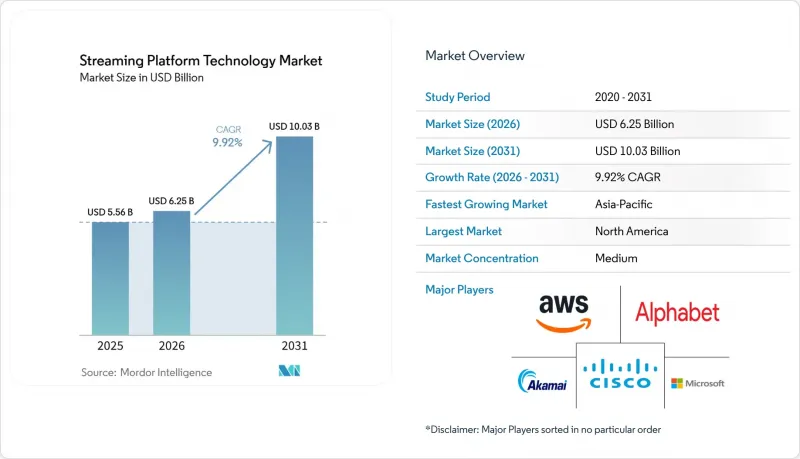
This report is Segmented by Component (Solutions, and Services), Streaming Type (Live Streaming and Video-On-Demand Streaming), Industry Vertical (Media, Entertainment and Broadcasting, Sports and Live Events, Telecommunications and Pay-TV, Enterprise and Corporate Communications, Education and E-Learning, and More), and Geography. The Market Forecasts are Provided in Terms of Value (USD).
Global Streaming Platform Technology Market Trends and Insights
Rising Demand for Low-Latency Live Experiences
The streaming platform technology market benefits as sub-second video delivery becomes a commercial requirement for live formats where viewers react, bid, or place bets in real time. Traditional HLS designs can introduce delays of 10-30 seconds, which limits their usefulness for synchronized sports, interactive commerce, polling, and second-screen programs. LL-HLS, CMAF-CTE, and Media over QUIC are reducing acceptable delay windows and increasing demand for specialized delivery networks, player software, and real-time analytics. Cloudflare introduced a globally distributed Media over QUIC relay network across more than 330 cities in 2025, with development involving Meta, Google, Cisco, and the IETF community. Internet Initiative Japan, Fujitsu, and Nomura Research Institute demonstrated Local 5G and physical AI streaming at the KYOJO CUP racing series in July 2026, using AI-selected camera angles with low delay at an event scale.
AI-Powered Video Automation and Localization
The streaming platform technology market is changing video operations, moving beyond ingest and metadata tagging to include localization, accessibility, and advertising workflows. These capabilities reduce the manual work required to prepare the same content for several languages, devices, and regional audiences. Brightcove announced an expanded AI Suite in February 2026 that included captions in more than 90 languages, AI-supported audio descriptions, and contextual advertising based on content analysis. Kaltura expanded its platform after acquiring eSelf.ai and PathFactory, and it introduced Agentic Avatars that generate personalized media in more than 30 languages in real time. Akamai introduced cloud instances powered by NETINT video processing units in 2025, enabling lower-cost video processing for media workloads.
Escalating Bandwidth and Transcoding Costs
The streaming platform technology market faces high bandwidth and transcoding costs, as spending rises with concurrent audience size and higher video quality requirements. This cost structure favors operators that can secure committed-volume pricing or operate infrastructure at a large scale. Smaller providers often have fewer resources to manage multi-CDN routing, internal encoding ladders, and quality controls. Akamai's video processing unit cloud instances provide one route to lower compute costs for media workloads and demonstrate how cost efficiency has become a competitive requirement. Energy-efficiency obligations under European data center rules add another factor to provider selection and encourage some operators to consolidate workloads with providers that can document their operating performance.
Other drivers and restraints analyzed in the detailed report include:
- Cloud-Native Video Workflows Lowering Time to Market
- Expansion of Connected TV and Multi-Device Delivery
- Privacy, Rights, and Data Residency Constraints
For complete list of drivers and restraints, kindly check the Table Of Contents.
Segment Analysis
Solutions accounted for 76.82% of the streaming platform technology market in 2025, as they cover the software functions required to operate a complete streaming service. Video processing, encoding, and packaging form the computational core, while delivery, playback, workflow, monetization, and security tools support the rest of the service. These layers are closely connected because problems in one part of the workflow can affect playback quality, advertising accuracy, or content protection. Video monetization and security functions are receiving greater attention as ad-supported services need accurate insertion and operators address data residency requirements. Analytics, observability, and quality-of-experience monitoring are also becoming increasingly important in vendor selection, as customers need evidence that service targets can be met. Akamai added MediaMelon's SmartSight video intelligence platform to its Qualified Compute Partner Program in 2025, linking streaming analytics with infrastructure deployment. Within the streaming platform technology market, these requirements keep solutions central to spending. Operators also prefer integrated systems when they need to coordinate content preparation, delivery, advertising, and security across multiple markets.
Services are projected to expand at a CAGR of 10.63% through 2031, making it the fastest-growing component category. Managed and professional services appeal to operators that need to deploy multi-CDN, adaptive bitrate, security, and cloud workflows without building large internal engineering teams. The model also supports contracts based on service quality and delivery outcomes, rather than solely on the sale of software licenses. Demand is particularly relevant for smaller operators in South America, Africa, and parts of the Asia-Pacific that may not have specialized video operations teams. Standards compliance is becoming part of larger public-sector and enterprise procurement processes, which supports providers with established cloud-native implementations. The component mix shows that the streaming platform technology industry is shifting toward technical support that helps customers operate complex environments after implementation. This change can shorten deployment time, but it also makes service quality and workforce capacity more important for suppliers. It allows vendors to deepen customer relationships once the platforms are deployed to production.
Complete Report Scope:
- By Component
- Solutions
- Video Processing, Encoding and Packaging
- Video Content Management and Workflow
- Video Delivery, Playback and Experience
- Video Monetization Solutions
- Video Security and Access Management
- Other Solutions
- Services
- Solutions
- By Streaming Type
- Live Streaming
- Video-on-Demand Streaming
- By Industry Vertical
- Media, Entertainment and Broadcasting
- Sports and Live Events
- Telecommunications and Pay-TV
- Enterprise and Corporate Communications
- Education and E-Learning
- Healthcare
- Banking, Financial Services and Insurance
- Government and Public Sector
- Retail and E-Commerce
- Other Industry Verticals
- By Geography
- North America
- United States
- Canada
- Mexico
- South America
- Brazil
- Argentina
- Rest of South America
- Europe
- United Kingdom
- Germany
- France
- Italy
- Spain
- Russia
- Rest of Europe
- Asia-Pacific
- China
- India
- Japan
- South Korea
- Australia
- Rest of Asia-Pacific
- Middle East
- Saudi Arabia
- United Arab Emirates
- Turkey
- Rest of Middle East
- Africa
- South Africa
- Nigeria
- Egypt
- Rest of Africa
- North America
Geography Analysis
North America held 37.41% of the streaming platform technology market share in 2025, supported by the region's concentration of cloud infrastructure, media companies, and enterprise customers. The region has a mature connected television ecosystem and a strong need for ad insertion, audience measurement, playback, and security tools. Canada creates bilingual localization needs, while Mexico adds early-stage demand as broadband access and streaming activity expand. These conditions support continued spending in the streaming platform technology market on systems that can operate across regions without compromising service quality.
Asia-Pacific is projected to grow at a CAGR of 10.38% through 2031, making it the fastest-growing regional segment. The region's scale, content spending, mobile use, and connected television expansion make it a priority growth area for the streaming platform technology market. Its large number of languages and wide range of network conditions increase the need for adaptable workflows, playback tools, and delivery methods.
Europe maintained a significant position in 2025 because broadcasters in the United Kingdom, Germany, France, and the Netherlands operate cloud-based live and VoD services at scale. ITV partnered with Akamai to launch Freely, leveraging content delivery, web application protection, and bot management for free streaming television. The EU Data Act, NIS2 Directive, and DORA requirements are encouraging upgrades that support security and sovereignty requirements. South America is growing through broadband development and domestic content investment, with local language and regulatory needs favoring regional delivery capabilities. Middle Eastern investment in domestic content and sovereign cloud infrastructure is creating public-sector-led demand, while Africa requires mobile-first, bandwidth-efficient services for constrained networks. Together, these markets give the streaming platform technology market a broader regional base, although infrastructure quality, local compliance rules, and purchasing capacity differ widely.
- Amazon.com, Inc.
- Alphabet Inc.
- Microsoft Corporation
- Akamai Technologies, Inc.
- Cisco Systems, Inc.
- Brightcove Inc.
- Kaltura, Inc.
- Vimeo, Inc.
- Wowza Media Systems, LLC
- Muvi LLC
- Bitmovin Inc.
- Haivision Systems Inc.
- Telestream, LLC
- Cloudinary Ltd.
- Mux, Inc.
- Panopto, Inc.
- JW Player, Inc.
- Dacast, Inc.
- Verimatrix, Inc.
- Synamedia Limited
- Amagi Media Labs Private Limited
- Dalet S.A.
- Conviva, Inc.
Additional Benefits:
- The market estimate (ME) sheet in Excel format
- 3 months of analyst support
TABLE OF CONTENTS
1 INTRODUCTION
- 1.1 Study Assumptions and Market Definition
- 1.2 Scope of the Study
2 RESEARCH METHODOLOGY
3 EXECUTIVE SUMMARY
4 MARKET LANDSCAPE
- 4.1 Market Overview
- 4.2 Market Drivers
- 4.2.1 Rising Demand for Low-Latency Live Experiences
- 4.2.2 Cloud-Native Video Workflows Lowering Time to Market
- 4.2.3 AI-Powered Video Automation and Localization
- 4.2.4 Expansion of Connected TV and Multi-Device Delivery
- 4.2.5 Growth of Ad-Supported and Hybrid Monetization
- 4.2.6 5G and Edge Infrastructure Enabling Interactive Streaming
- 4.3 Market Restraints
- 4.3.1 Escalating Bandwidth and Transcoding Costs
- 4.3.2 Device, Codec, and Player Fragmentation
- 4.3.3 Privacy, Rights, and Data Residency Constraints
- 4.3.4 Peak-Time Quality Instability in Emerging Networks
- 4.4 Industry Value Chain Analysis
- 4.5 Impact of Macroeconomic Factors on the Market
- 4.6 Regulatory Landscape
- 4.7 Technological Outlook
- 4.8 Porter's Five Forces Analysis
- 4.8.1 Bargaining Power of Suppliers
- 4.8.2 Bargaining Power of Buyers
- 4.8.3 Threat of New Entrants
- 4.8.4 Threat of Substitutes
- 4.8.5 Intensity of Competitive Rivalry
5 MARKET SIZE AND GROWTH FORECASTS (VALUE)
- 5.1 By Component
- 5.1.1 Solutions
- 5.1.1.1 Video Processing, Encoding and Packaging
- 5.1.1.2 Video Content Management and Workflow
- 5.1.1.3 Video Delivery, Playback and Experience
- 5.1.1.4 Video Monetization Solutions
- 5.1.1.5 Video Security and Access Management
- 5.1.1.6 Other Solutions
- 5.1.2 Services
- 5.1.1 Solutions
- 5.2 By Streaming Type
- 5.2.1 Live Streaming
- 5.2.2 Video-on-Demand Streaming
- 5.3 By Industry Vertical
- 5.3.1 Media, Entertainment and Broadcasting
- 5.3.2 Sports and Live Events
- 5.3.3 Telecommunications and Pay-TV
- 5.3.4 Enterprise and Corporate Communications
- 5.3.5 Education and E-Learning
- 5.3.6 Healthcare
- 5.3.7 Banking, Financial Services and Insurance
- 5.3.8 Government and Public Sector
- 5.3.9 Retail and E-Commerce
- 5.3.10 Other Industry Verticals
- 5.4 By Geography
- 5.4.1 North America
- 5.4.1.1 United States
- 5.4.1.2 Canada
- 5.4.1.3 Mexico
- 5.4.2 South America
- 5.4.2.1 Brazil
- 5.4.2.2 Argentina
- 5.4.2.3 Rest of South America
- 5.4.3 Europe
- 5.4.3.1 United Kingdom
- 5.4.3.2 Germany
- 5.4.3.3 France
- 5.4.3.4 Italy
- 5.4.3.5 Spain
- 5.4.3.6 Russia
- 5.4.3.7 Rest of Europe
- 5.4.4 Asia-Pacific
- 5.4.4.1 China
- 5.4.4.2 India
- 5.4.4.3 Japan
- 5.4.4.4 South Korea
- 5.4.4.5 Australia
- 5.4.4.6 Rest of Asia-Pacific
- 5.4.5 Middle East
- 5.4.5.1 Saudi Arabia
- 5.4.5.2 United Arab Emirates
- 5.4.5.3 Turkey
- 5.4.5.4 Rest of Middle East
- 5.4.6 Africa
- 5.4.6.1 South Africa
- 5.4.6.2 Nigeria
- 5.4.6.3 Egypt
- 5.4.6.4 Rest of Africa
- 5.4.1 North America
6 COMPETITIVE LANDSCAPE
- 6.1 Market Concentration
- 6.2 Strategic Moves
- 6.3 Market Positioning Analysis
- 6.4 Company Profiles (includes Global Level Overview, Market Level Overview, Core Segments, Financials as available, Strategic Information, Market Rank/Share, Products and Services, Recent Developments)
- 6.4.1 Amazon.com, Inc.
- 6.4.2 Alphabet Inc.
- 6.4.3 Microsoft Corporation
- 6.4.4 Akamai Technologies, Inc.
- 6.4.5 Cisco Systems, Inc.
- 6.4.6 Brightcove Inc.
- 6.4.7 Kaltura, Inc.
- 6.4.8 Vimeo, Inc.
- 6.4.9 Wowza Media Systems, LLC
- 6.4.10 Muvi LLC
- 6.4.11 Bitmovin Inc.
- 6.4.12 Haivision Systems Inc.
- 6.4.13 Telestream, LLC
- 6.4.14 Cloudinary Ltd.
- 6.4.15 Mux, Inc.
- 6.4.16 Panopto, Inc.
- 6.4.17 JW Player, Inc.
- 6.4.18 Dacast, Inc.
- 6.4.19 Verimatrix, Inc.
- 6.4.20 Synamedia Limited
- 6.4.21 Amagi Media Labs Private Limited
- 6.4.22 Dalet S.A.
- 6.4.23 Conviva, Inc.
7 MARKET OPPORTUNITIES AND FUTURE OUTLOOK
- 7.1 White-Space and Unmet-Need Assessment

