PUBLISHER: Mordor Intelligence | PRODUCT CODE: 2118935

PUBLISHER: Mordor Intelligence | PRODUCT CODE: 2118935
United States Fiber Optic Cable - Market Share Analysis, Industry Trends & Statistics, Growth Forecasts (2026 - 2031)
According to Mordor Intelligence, the United States fiber optic cable market size is projected to expand from USD 5.84 billion in 2025 and USD 6.24 billion in 2026 to USD 8.69 billion by 2031, registering a CAGR of 6.75% between 2026 and 2031.
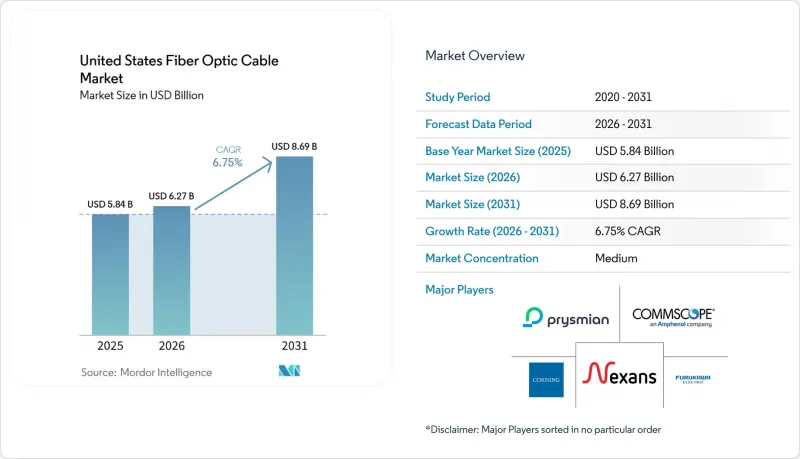
This report is Segmented by Cable Type (Loose-Tube, Tight-Buffered, and More), Mode (Single-Mode, and Multi-Mode), Deployment Type (Underground, Aerial, and Submarine), End-User Industry (Telecommunications, Power Utilities, Defense and Military, Industrial and Manufacturing, Data Centers and Cloud Service Providers, and More). The Market Forecasts are Provided in Terms of Value (USD).
United States Fiber Optic Cable Market Trends and Insights
AI Data Center Interconnect and 800G/1.6T Deployment Fuels Structural Cable Demand
The United States fiber optic cable market is benefiting from the shift from isolated data centers to distributed AI GPU clusters. These clusters need ultra-low-loss, high-fiber-count cable routes that can connect facilities across tens or hundreds of miles. These requirements increase the physical infrastructure needed to operate geographically distributed systems as a unified computing environment. Inside facilities, 800G interfaces support wider use of MPO-24 ribbon connections in new construction. The shift toward 1.6T optical interconnects in 2026 requires more fibers and tighter production tolerances. This favors manufacturers that can sustain product development and deliver consistent high-density products.
Accelerating Fiber-to-the-Home and 5G X-Haul Rollouts Underpin Volume Demand
Fiber broadband infrastructure reached more than 60% of US households by the end of 2025, adding 11.8 million homes during the year. Fiber-to-the-home construction remains the main volume driver for the United States fiber optic cable market, even as AI-related demand rises. Mid-band 5G densification uses more fiber strands per route mile because cell sites need connections for several sectors and regional aggregation. Carriers are deploying fronthaul, midhaul, and broadband fiber in shared outside-plant systems, which is driving demand for higher-fiber-count cable. Tight-buffered cable is useful in last-mile and cell-site settings because technicians can terminate it without the need for intermediate breakout hardware. Suppliers that can serve both broadband and mobile applications from the same product range can improve their product mix during the deployment cycle.
Civil Works, Permitting, and Right-of-Way Cost Inflation Compresses Project Economics
Civil works and permits are now more important to project economics than cable pricing in many projects. Median underground deployment costs reached USD 18.00 per foot in 2025, while aerial costs reached USD 8.00 per foot. The same survey found that 88% of respondents expected higher costs in 2026 because of labor, materials, permitting, and make-ready work. Permits can account for 10% of a project budget and reach 30% in difficult jurisdictions. Rail crossings, transportation department approvals, environmental reviews, historic districts, and municipal moratoria can extend schedules by weeks or months. Microtrenching can reduce costs, but inconsistent restoration rules limit its use across many jurisdictions.
Other drivers and restraints analyzed in the detailed report include:
- Federal and State Broadband Funding, Including BEAD and RDOF, Provides Demand Support
- Fiberization of Utility, Grid, and Critical Infrastructure Networks Opens a New Demand Vertical
- Shortage of Qualified Splicing, Testing, and Outside-Plant Technicians Lengthens Build Schedules
For complete list of drivers and restraints, kindly check the Table Of Contents.
Segment Analysis
Loose-tube cables accounted for 32.65% of the United States fiber optic cable market in 2025. Their moisture resistance and thermal performance make them suitable for outside-plant, aerial, and long-haul routes used by fiber-to-the-home, 5G backhaul, and utility grid projects. Ribbon cable is used in high-density outside-plant builds because mass fusion splicing reduces time per splice, while armored cable is used for direct-burial utility and industrial routes exposed to crushing forces. Corning launched its Contour Flow micro cable at OFC 2026 with 1,728 fibers in nearly half the diameter of legacy ribbon cable and a low-friction jacket for air-jet installation. These designs show that installation method and fiber density are becoming important within established outdoor cable categories.
Tight-buffered cable is projected to grow at a 7.80% CAGR through 2031, the fastest rate among cable types in the United States fiber optic cable industry. Its direct-termination capability suits 800G data center links and enterprise last-mile installations, while pre-terminated trunks place tight-buffered fibers and MPO connectors within a common jacket before delivery. These assemblies can reduce field-termination time by more than half compared with field-polished connections, and ANSI/TIA-568 standards support their use for indoor runs. The move toward 1.6T interconnects is expected to increase fiber counts in these assemblies. Manufacturers with connector and assembly capability can capture cable and connectivity revenue, while cable-only suppliers may face margin pressure.
Single-mode fiber accounted for 61.92% of the United States fiber-optic cable market in 2025. It remains necessary for metro, long-haul, and fiber-to-the-home networks because no practical substitute serves these distances at the same scale. Its installed base supports demand across public broadband programs and commercial routes. Multimode fiber is projected to grow at a 7.30% CAGR from 2026 to 2031 as AI GPU clusters increase demand for OM4 and OM5 cable in 800G intra-facility networks. IEEE 802.3ck has reinforced the use of multimode in hyperscale procurement specifications for short-reach connections.
Multimode demand is extending beyond lower-cost enterprise local area networks. In AI facilities, 800GBASE-SR8 over OM4 can support intra- and inter-rack links up to 100 meters, with lower transceiver costs than comparable single-mode configurations. OM5 supports wavelength-division multiplexing over short distances and can help manage ribbon density inside server racks. The choice between single-mode and multimode depends heavily on transceiver pricing, which producers must include in demand planning. Prysmian and Corning are positioning OM4 and OM5 as AI data center products, supporting a higher-value mix in the United States fiber optic cable market and favoring suppliers that can provide cable and connectivity components.
Complete Report Scope:
- By Cable Type
- Loose-Tube
- Tight-Buffered
- Ribbon
- Armored
- By Mode
- Single-Mode
- Multi-Mode
- By Deployment Type
- Underground
- Aerial
- Submarine
- By End-User Industry
- Telecommunications
- Power Utilities
- Defense and Military
- Industrial and Manufacturing
- Data Centers and Cloud Service Providers
- Healthcare and Medical
- Other End-User Industries
List of Companies Covered in this Report:
- Prysmian Group
- Corning Inc.
- Nexans SA
- CommScope Holding Company Inc.
- Furukawa Electric Co., Ltd.
- Sumitomo Electric Industries Ltd.
- Sterlite Technologies Limited
- Fujikura Ltd.
- Leoni AG
- Belden Inc.
- LS Cable and System
- HUBER+SUHNER AG
- Hexatronic Group AB
- AFL (Fujikura)
- Optical Cable Corp.
- Coherent Corp. (Finisar Corporation)
- ZTT Group
- Molex LLC
- Clearfield, Inc.
- viaPhoton, Inc.
Additional Benefits:
- The market estimate (ME) sheet in Excel format
- 3 months of analyst support
TABLE OF CONTENTS
1 INTRODUCTION
- 1.1 Study Assumptions and Market Definition
- 1.2 Scope of the Study
2 RESEARCH METHODOLOGY
3 EXECUTIVE SUMMARY
4 MARKET LANDSCAPE
- 4.1 Market Overview
- 4.2 Market Drivers
- 4.2.1 AI Data-Center Interconnect and 800G/1.6T Deployment
- 4.2.2 Accelerating Fiber-to-the-Home and 5G X-Haul Rollouts
- 4.2.3 Federal and State Broadband Funding, Including BEAD and RDOF
- 4.2.4 Fiberization of Utility, Grid, and Critical-Infrastructure Networks
- 4.2.5 Domestic Manufacturing and Build America, Buy America Procurement
- 4.2.6 High-Fiber-Count and Pre-Terminated Cable Adoption to Offset Installation Labor Constraints
- 4.3 Market Restraints
- 4.3.1 Civil-Works, Permitting, and Right-of-Way Cost Inflation
- 4.3.2 Fixed-Wireless and Low-Earth-Orbit Satellite Substitution in Sparse Areas
- 4.3.3 Shortage of Qualified Splicing, Testing, and Outside-Plant Technicians
- 4.3.4 Preform, Fiber, and Specialized Component Supply Volatility
- 4.4 Value-Chain Analysis
- 4.5 Regulatory Landscape
- 4.6 Technological Outlook
- 4.7 State of Fiber Optics in Key Industries
- 4.8 Porter's Five Forces Analysis
- 4.8.1 Threat of New Entrants
- 4.8.2 Bargaining Power of Suppliers
- 4.8.3 Bargaining Power of Buyers
- 4.8.4 Threat of Substitutes
- 4.8.5 Competitive Rivalry
- 4.9 Impact of Macroeconomic Factors on the Market
5 MARKET SIZE AND GROWTH FORECASTS (VALUE)
- 5.1 By Cable Type
- 5.1.1 Loose-Tube
- 5.1.2 Tight-Buffered
- 5.1.3 Ribbon
- 5.1.4 Armored
- 5.2 By Mode
- 5.2.1 Single-Mode
- 5.2.2 Multi-Mode
- 5.3 By Deployment Type
- 5.3.1 Underground
- 5.3.2 Aerial
- 5.3.3 Submarine
- 5.4 By End-User Industry
- 5.4.1 Telecommunications
- 5.4.2 Power Utilities
- 5.4.3 Defense and Military
- 5.4.4 Industrial and Manufacturing
- 5.4.5 Data Centers and Cloud Service Providers
- 5.4.6 Healthcare and Medical
- 5.4.7 Other End-User Industries
6 COMPETITIVE LANDSCAPE
- 6.1 Market Concentration
- 6.2 Strategic Moves
- 6.3 Market Share Analysis
- 6.4 Company Profiles (includes Global Level Overview, Market Level Overview, Core Segments, Financials as available, Strategic Information, Market Rank/Share, Products and Services, Recent Developments)
- 6.4.1 Prysmian Group
- 6.4.2 Corning Inc.
- 6.4.3 Nexans SA
- 6.4.4 CommScope Holding Company Inc.
- 6.4.5 Furukawa Electric Co., Ltd.
- 6.4.6 Sumitomo Electric Industries Ltd.
- 6.4.7 Sterlite Technologies Limited
- 6.4.8 Fujikura Ltd.
- 6.4.9 Leoni AG
- 6.4.10 Belden Inc.
- 6.4.11 LS Cable and System
- 6.4.12 HUBER+SUHNER AG
- 6.4.13 Hexatronic Group AB
- 6.4.14 AFL (Fujikura)
- 6.4.15 Optical Cable Corp.
- 6.4.16 Coherent Corp. (Finisar Corporation)
- 6.4.17 ZTT Group
- 6.4.18 Molex LLC
- 6.4.19 Clearfield, Inc.
- 6.4.20 viaPhoton, Inc.
7 MARKET OPPORTUNITIES AND FUTURE OUTLOOK
- 7.1 White-Space and Unmet-Need Assessment
- 7.1.1 Rural Middle-Mile and Tribal Broadband Deployment Gaps
- 7.1.2 Domestic High-Density Cable and Connector Capacity
- 7.1.3 Fiber for AI Factory and Edge-Data-Center Expansion
- 7.1.4 Utility-Fiber Leasing and Shared-Infrastructure Models
- 7.1.5 Labor-Saving Pre-Terminated and Modular Deployment Systems

