PUBLISHER: Mordor Intelligence | PRODUCT CODE: 2125613

PUBLISHER: Mordor Intelligence | PRODUCT CODE: 2125613
United States And European Fiber Optic Cable - Market Share Analysis, Industry Trends & Statistics, Growth Forecasts (2026 - 2031)
According to Mordor Intelligence, the United States and European Fiber Optic Cable Market size in 2026 is estimated at USD 4.56 billion, growing from 2025 value of USD 4.18 billion with 2031 projections showing USD 7.03 billion, growing at 9.05% CAGR over 2026-2031.
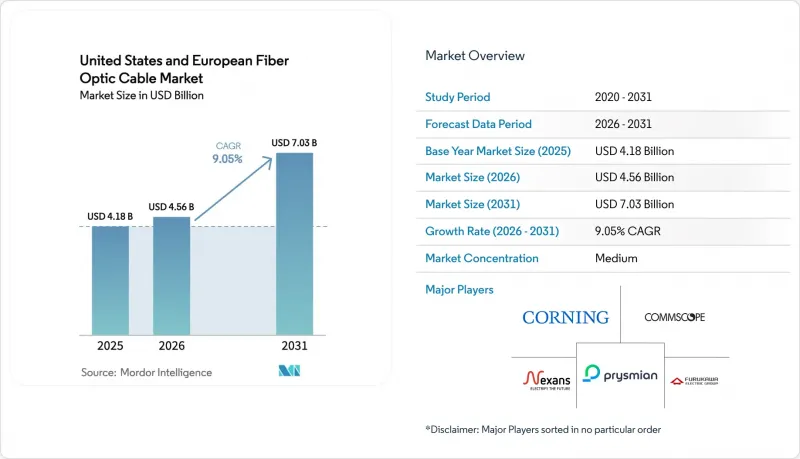
This report is Segmented by Cable Type (Loose-Tube, Tight-Buffered, and More), Mode (Single-Mode, Multi-Mode), Deployment Type (Underground, Aerial, Submarine), End-User Industry (Telecommunications, Power Utilities, and More), and Geography. The Market Forecasts are Provided in Terms of Value (USD).
United States And European Fiber Optic Cable Market Trends and Insights
Surging Data Traffic and Cloud Workloads
Hyperscale data centers dedicated to AI training clusters are consuming high-density ribbon assemblies at an unprecedented pace, reflecting east-west traffic patterns that copper links cannot support. Meta's Project Waterworth and Amazon's Ireland-US cable exemplify multibillion-dollar commitments to private backbone infrastructure that prioritize 400 G and 800 G optical lanes. Connector lead times exceed 16 weeks for MPO/MTP formats, illustrating a tightening supply environment that strengthens the hand of vertically integrated suppliers . Ultra-low-loss G.654.E fibers are gaining traction because they reduce regeneration sites across ocean spans, thereby decreasing the total cost of ownership for cloud operators. As a result, manufacturers capable of delivering specialty tight-buffered and ribbon designs optimized for AI workloads secure premium pricing while broadening recurring services revenue from on-premise moves, adds, and changes.
Accelerated FTTH and 5G Rollout Investments
EU39 fiber coverage rose to 74.6% by September 2024, with Germany adding 3.8 million premises and the United Kingdom passing 4.2 million during that period. Competitive overbuilds by Delta Fibre, Open Dutch Fibre, and KPN's Glaspoort drove the Netherlands to an 88% household coverage milestone. In parallel, millimeter-wave 5G densification depends on dark-fiber backhaul to small-cell clusters, prompting mobile network operators to co-deploy FTTH and 5G assets to amortize trenching costs. Infrastructure sharing and neutral-host tower models lower barriers for alternative operators, while multitenant data centers leverage the same conduit systems to integrate meet-me rooms. This convergence accelerates order pipelines for cable makers that maintain modular product portfolios adaptable to both aerial and underground pathways.
High Civil-Works and Right-of-Way Costs
Underground construction reached USD 18.25 per foot in 2024, a 12% leap attributed to labor inflation and lengthy permitting cycles in dense metros . Civil works represent up to 80% of project budgets, compelling operators to pursue micro-trenches and conduit reuse strategies. Aerial placement, priced at USD 6.55 per foot, remains attractive but faces European mandates for burial to preserve streetscapes. These dynamics tilt the playing field toward incumbents holding legacy pole-attachment rights and pre-existing ducts, deterring greenfield overbuilds and moderating competitive intensity in mature ZIP codes.
Other drivers and restraints analyzed in the detailed report include:
- Government Broadband Stimulus Programs
- Adoption of Ultra-Low-Loss Single-Mode Fibers
- Competition from Fixed-Wireless and Satellite Broadband
For complete list of drivers and restraints, kindly check the Table Of Contents.
Segment Analysis
Loose-tube designs maintained a 33.68% revenue lead within the fiber optic cable market in 2025, owing to moisture-blocked constructions ideal for outdoor ducts and aerial spans. This segment capitalizes on government-funded rural builds, where extended temperature swings demand gel-filled or dry-core loose-tube formats for long-term reliability. Demand ties closely to statewide broadband grants that prioritize buried networks over wireless substitutes, enabling predictable furnace loading at domestic facilities owned by incumbents.
Hyperscale and colocation operators, however, are accelerating procurement of tight-buffered assemblies that demonstrate a 9.54% CAGR to 2031, reflecting growing intra-data-hall deployments where bend-insensitive jacketing and 900-µm coatings reduce installation time. Port counts per rack have tripled in AI clusters, and ribbonized tight buffers ease mass-fusion splicing to pre-terminated MPO trunks, attracting price premiums amid ongoing connector shortages. As GPU expansion favors multi-tenant buildings located near renewable energy, the cable mix skews toward flame-retardant plenum ratings, prompting vendors to retool jacketing lines for lower-toxicity compounds.
Single-mode solutions controlled 60.92% of 2025 revenue, given their long-haul reach and future-proof bandwidth for FTTH, metro, and subsea backbones. Government subsidies cement single-mode dominance for access loops where 1 Gbps services are baseline. Operators deploy standard G.652.D or bend-tolerant G.657.A2 cores to extend the life cycles of new plant investments.
Multi-mode fiber volumes are set for a 9.41% CAGR through 2031 as OM4/OM5 variants support 400G SR8 and 800G SR4 lanes inside hyperscale leaf-spine fabrics. Parallel-optic architectures limit reach to 150 m but slash transceiver costs, reclaiming share in data halls. Vendors respond with graded-index profiles optimized for 850 nm VCSEL sources that improve modal dispersion, tightening spec tolerances. The trend lifts overall volume for short-reach jumpers, enhancing factory utilization rates between long-haul campaign runs and helping buffer revenue cyclicality inherent in carrier capex cycles.
Complete Report Scope:
- By Cable Type
- Loose-tube
- Tight-buffered
- Ribbon
- Armoured
- By Mode
- Single-mode
- Multi-mode
- By Deployment Type
- Underground
- Aerial
- Submarine
- By End-user Industry
- Telecommunications
- Power Utilities
- Defense and Military
- Industrial and Manufacturing
- Medical
- By Country
- United States
- Germany
- United Kingdom
- France
- Italy
- Spain
- Netherlands
- Austria
- Switzerland
- Rest of Europe
List of Companies Covered in this Report:
- Prysmian Group
- Corning Inc.
- Nexans SA
- CommScope Holding Company Inc.
- Furukawa Electric Co., Ltd.
- Sumitomo Electric Industries Ltd.
- Sterlite Technologies Limited
- Fujikura Ltd.
- Leoni AG
- Belden Inc.
- LS Cable and System
- HUBER+SUHNER AG
- Hexatronic Group AB
- AFL (Fujikura)
- Optical Cable Corp.
- Coherent Corp. (Finisar Corporation)
- ZTT Group
- Molex LLC
Additional Benefits:
- The market estimate (ME) sheet in Excel format
- 3 months of analyst support
TABLE OF CONTENTS
1 INTRODUCTION
- 1.1 Study Assumptions and Market Definition
- 1.2 Scope of the Study
2 RESEARCH METHODOLOGY
3 EXECUTIVE SUMMARY
4 MARKET LANDSCAPE
- 4.1 Market Overview
- 4.2 Market Drivers
- 4.2.1 Surging data traffic and cloud workloads
- 4.2.2 Accelerated FTTH and 5G rollout investments
- 4.2.3 Government broadband stimulus (US BEAD/EU Digital Decade)
- 4.2.4 Adoption of ultra-low-loss single-mode fibers
- 4.2.5 Open-RAN neutral-host densification needs dark fiber
- 4.2.6 Utility-owned fiber commercialization for grid modernization
- 4.3 Market Restraints
- 4.3.1 High civil-works and right-of-way costs
- 4.3.2 Competition from fixed-wireless and satellite broadband
- 4.3.3 Skilled labour shortage for fiber splicing
- 4.3.4 Volatility in glass-preform supply chain
- 4.4 Value Chain Analysis
- 4.5 Regulatory Landscape
- 4.6 Technological Outlook
- 4.7 State of Fiber Optics in Key Industries
- 4.8 Porter's Five Forces Analysis
- 4.8.1 Threat of New Entrants
- 4.8.2 Bargaining Power of Suppliers
- 4.8.3 Bargaining Power of Buyers
- 4.8.4 Threat of Substitutes
- 4.8.5 Competitive Rivalry
- 4.9 Impact of Macroeconomic Factors on the Market
5 UNITED STATES MARKET SIZE AND GROWTH FORECASTS (VALUE)
- 5.1 By Cable Type
- 5.1.1 Loose-tube
- 5.1.2 Tight-buffered
- 5.1.3 Ribbon
- 5.1.4 Armoured
- 5.2 By Mode
- 5.2.1 Single-mode
- 5.2.2 Multi-mode
- 5.3 By Deployment Type
- 5.3.1 Underground
- 5.3.2 Aerial
- 5.3.3 Submarine
- 5.4 By End-user Industry
- 5.4.1 Telecommunications
- 5.4.2 Power Utilities
- 5.4.3 Defense and Military
- 5.4.4 Industrial and Manufacturing
- 5.4.5 Medical
- 5.5 By Country
- 5.5.1 United States
- 5.5.2 Germany
- 5.5.3 United Kingdom
- 5.5.4 France
- 5.5.5 Italy
- 5.5.6 Spain
- 5.5.7 Netherlands
- 5.5.8 Austria
- 5.5.9 Switzerland
- 5.5.10 Rest of Europe
6 COMPETITIVE LANDSCAPE
- 6.1 Market Concentration
- 6.2 Strategic Moves
- 6.3 Market Share Analysis
- 6.4 Company Profiles (includes Global level Overview, Market level overview, Core Segments, Financials as available, Strategic Information, Market Rank/Share for key companies, Products and Services, and Recent Developments)
- 6.4.1 Prysmian Group
- 6.4.2 Corning Inc.
- 6.4.3 Nexans SA
- 6.4.4 CommScope Holding Company Inc.
- 6.4.5 Furukawa Electric Co., Ltd.
- 6.4.6 Sumitomo Electric Industries Ltd.
- 6.4.7 Sterlite Technologies Limited
- 6.4.8 Fujikura Ltd.
- 6.4.9 Leoni AG
- 6.4.10 Belden Inc.
- 6.4.11 LS Cable and System
- 6.4.12 HUBER+SUHNER AG
- 6.4.13 Hexatronic Group AB
- 6.4.14 AFL (Fujikura)
- 6.4.15 Optical Cable Corp.
- 6.4.16 Coherent Corp. (Finisar Corporation)
- 6.4.17 ZTT Group
- 6.4.18 Molex LLC
7 MARKET OPPORTUNITIES AND FUTURE OUTLOOK
- 7.1 White-space and Unmet-need Assessment

