PUBLISHER: Mordor Intelligence | PRODUCT CODE: 2118965

PUBLISHER: Mordor Intelligence | PRODUCT CODE: 2118965
OTT Audience Analytics - Market Share Analysis, Industry Trends & Statistics, Growth Forecasts (2026 - 2031)
According to Mordor Intelligence, the OTT audience analytics market size is projected to grow from USD 1.25 billion in 2025 to USD 2.99 billion by 2031, at a CAGR of 15.42% from 2026 to 2031.
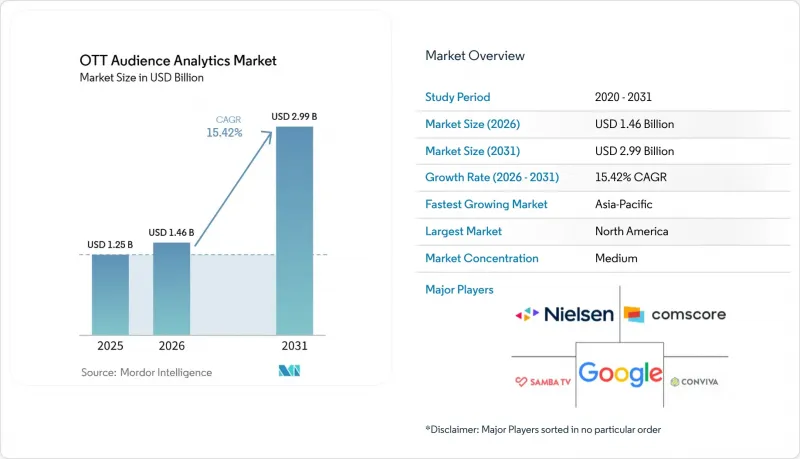
This report is Segmented by Analytics Capability (Audience Measurement, Reach, and Forecasting, Audience Segmentation and Behavioral Analytics, Content Performance and Programming Analytics, and More), End User (OTT and Streaming Service Providers, Telecom and Pay-TV Operators, Content Owner, Studios, and Rights Holder, and More), and Geography. The Market Forecasts are Provided in Terms of Value (USD).
Global OTT Audience Analytics Market Trends and Insights
Migration of Advertising Budgets Toward Measurable Connected TV Inventory
The OTT audience analytics market is gaining from a shift of linear television budgets into connected TV inventory. Among advertisers that plan to increase connected TV and OTT spending in 2026, 54% identified linear TV reallocation as the funding source, while 40% cited print and radio and 25% cited new budget growth. Those transferred budgets bring established expectations around audience delivery, brand safety, and campaign accountability. Analytics providers need to make verification and attribution part of the operating workflow rather than separate reporting products. This raises the value of tools that can document viewability, outcomes, and audience delivery during a campaign. The IAB's Open Measurement Software Development Kit and SupplyChain framework are relevant standards for buyers that want more consistent controls across the digital video supply chain.
Streaming Fragmentation Increasing Demand for Unified Audience Intelligence
The OTT audience analytics market is responding to viewing that is spread across many streaming services and devices. A single platform can measure activity within its own service, but advertisers and agencies still need deduplicated views of audiences across services. The IAB's Project Eidos seeks to replace channel-level measurement with more interoperable approaches that use shared taxonomies and privacy-resilient measurement inputs. This need puts greater emphasis on products that can connect viewing data without treating each service as an isolated environment. Providers with panel-calibrated cross-device linkage and direct access to viewership data can offer a more usable basis for cross-platform reporting. Providers relying mainly on probabilistic matching face pressure when differences in linkage quality can be tested through industry certification processes.
Privacy Regulation and Consent-Governance Complexity
Privacy and consent requirements affecting the OTT audience analytics market limit the data that streaming analytics providers can collect and use, particularly in Europe and emerging markets. This can reduce the volume of usable signals for audience models and make deployment more complex for OTT operators. Smaller providers can face greater compliance burdens because they must adapt products and governance processes for different jurisdictions. The effect is especially important where vendors want to use device-level or IP-derived data for audience segmentation. India's Digital Personal Data Protection Act also creates data-localization considerations for providers serving local and regional streaming operators. The OTT audience analytics market must therefore support more localized data practices while preserving the utility of audience measurement.
Other drivers and restraints analyzed in the detailed report include:
- AI-Enabled Personalization and Predictive Churn Management
- Real-Time Quality-of-Experience Signals Becoming Commercial KPIs
- Fragmented Identity, Measurement, and Interoperability Standards
For complete list of drivers and restraints, kindly check the Table Of Contents.
Segment Analysis
Audience Measurement, Reach and Forecasting held 25.30% of the OTT audience analytics market size in 2025. The segment remains the primary measurement foundation for linear television and connected TV negotiations. Agencies and broadcasters have long used reach-based measures in planning and trading workflows. This established use continues even as customers adopt more outcome-based measurement approaches. Advertising Audience and Campaign Analytics is projected to expand at a 15.85% CAGR through 2031. The segment benefits from the maturation of programmatic connected TV buying and the demand for targeting, verification, and campaign reporting.
Programmatic buying accounted for 50% of connected TV and OTT advertising in 2026, placing greater value on analytics that can operate within media buying workflows. Content Performance and Programming Analytics supports decisions on renewal, windowing, and distribution through completion and episode-level engagement data. Subscriber Lifecycle and Retention Analytics helps platforms use behavior patterns to identify customers who may need timely retention offers. Audience Segmentation and Behavioral Analytics helps advertisers address defined cohorts and helps content teams construct personalization models. Product Experience and Audience QoE Analytics is gaining attention as live and FAST services connect delivery quality with advertising value. Buyers also see potential uses for agentic AI in media planning, buying recommendations, and inventory discovery, all of which require structured audience data.
Complete Report Scope:
- By Analytics Capability
- Audience Measurement, Reach, and Forecasting
- Audience Segmentation and Behavioural Analytics
- Content Performance and Programming Analytics
- Advertising Audience and Campaign Analytics
- Subscriber Lifecycle and Retention Analytics
- Product Experience and Audience QoE Analytics
- By End User
- OTT and Streaming Service Providers
- Broadcasters, Networks, and FAST Operators
- Advertisers and Media Agencies
- Content Owners, Studios, and Rights Holders
- Telecom and Pay-TV Operators
- By Geography
- North America
- United States
- Canada
- Mexico
- South America
- Brazil
- Argentina
- Rest of South America
- Europe
- United Kingdom
- Germany
- France
- Italy
- Spain
- Russia
- Rest of Europe
- Asia-Pacific
- China
- Japan
- India
- South Korea
- Australia and New Zealand
- Rest of Asia-Pacific
- Middle East
- Turkey
- Saudi Arabia
- United Arab Emirates
- Rest of Middle East
- Africa
- South Africa
- Nigeria
- Egypt
- Rest of Africa
- North America
Geography Analysis
North America accounted for 45.50% of the OTT audience analytics market share in 2025. The OTT audience analytics market in the region has extensive connected TV advertising infrastructure and frequent purchasing of measurement, attribution, and audience verification tools. The Joint Industry Committee certified Comscore, iSpot, and VideoAmp as alternative currencies for the 2025-2026 broadcast season, expanding the range of measurement options used by buyers. Canada and Mexico add demand as streaming platforms increase their local operations and need local audience measurement.
Europe was the second-largest regional contributor to the OTT audience analytics market in 2025. Its demand is supported by mature streaming use, although privacy requirements can raise the cost and complexity of data collection. Germany requires prior consent for certain client-side analytics tracking under Section 25 of the Telecommunications Digital Services Data Protection Act. Analytics providers in Europe must balance measurement coverage with the governance requirements of individual national markets.
Asia-Pacific is projected to expand at a 15.89% CAGR through 2031, making it the fastest-growing region in the OTT audience analytics market. Its scale comes from a large streaming viewer base and continuing growth in online video revenue. India's privacy framework requires vendors to consider localized data processing, which can favor providers with local operating capabilities. China uses a distinct data environment that combines video, messaging, and payment activity. South America offers growing demand as streaming revenue rises and pay television loses relative importance. The Middle East and Africa remain earlier-stage opportunities, where government-linked media entities, telecom bundles, and uneven infrastructure shape the pace of analytics adoption.
- The Nielsen Company
- Comscore, Inc.
- Kantar Media Audiences Limited
- Samba TV, Inc.
- iSpot.tv, Inc.
- TVision Insights, Inc.
- Google LLC
- Adobe Inc.
- Oracle Corporation
- Conviva Inc.
- NicePeopleAtWork S.L.
- Amagi Corporation
- Parrot Analytics Limited
- RealityMine Limited
- MediaMelon, Inc.
- Innovid Corp.
- Roku, Inc.
- Xperi Inc.
- Akamai Technologies, Inc.
- Brightcove Inc.
Additional Benefits:
- The market estimate (ME) sheet in Excel format
- 3 months of analyst support
TABLE OF CONTENTS
1 INTRODUCTION
- 1.1 Study Assumptions and Market Definition
- 1.2 Scope of the Study
2 RESEARCH METHODOLOGY
3 EXECUTIVE SUMMARY
4 MARKET LANDSCAPE
- 4.1 Market Overview
- 4.2 Impact of Macroeconomic Factors on the Market
- 4.3 Market Drivers
- 4.3.1 Migration of Advertising Budgets Toward Measurable Connected-TV Inventory
- 4.3.2 Streaming Content Fragmentation Increasing Demand for Unified Audience Intelligence
- 4.3.3 AI-Enabled Personalization and Predictive Churn Management
- 4.3.4 Real-Time Quality-of-Experience Signals Becoming Commercial KPIs
- 4.3.5 Cross-Market Content Planning Using Anonymized Viewing Logs
- 4.3.6 Attention-Based and Outcome-Based Measurement Currencies
- 4.4 Market Restraints
- 4.4.1 Privacy Regulation and Consent-Governance Complexity
- 4.4.2 Fragmented Identity, Measurement, and Interoperability Standards
- 4.4.3 High-Cardinality Data and Edge-Processing Cost
- 4.4.4 Limited Access to Walled-Garden and Platform-Native Signals
- 4.5 Industry Value Chain Analysis
- 4.6 Regulatory Landscape
- 4.7 Technological Outlook
- 4.8 Porter's Five Forces Analysis
- 4.8.1 Threat of New Entrants
- 4.8.2 Bargaining Power of Suppliers
- 4.8.3 Bargaining Power of Buyers
- 4.8.4 Threat of Substitutes
- 4.8.5 Rivalry Among Existing Competitors
- 4.9 Pricing Analysis
5 MARKET SIZE AND GROWTH FORECASTS (VALUE)
- 5.1 By Analytics Capability
- 5.1.1 Audience Measurement, Reach, and Forecasting
- 5.1.2 Audience Segmentation and Behavioural Analytics
- 5.1.3 Content Performance and Programming Analytics
- 5.1.4 Advertising Audience and Campaign Analytics
- 5.1.5 Subscriber Lifecycle and Retention Analytics
- 5.1.6 Product Experience and Audience QoE Analytics
- 5.2 By End User
- 5.2.1 OTT and Streaming Service Providers
- 5.2.2 Broadcasters, Networks, and FAST Operators
- 5.2.3 Advertisers and Media Agencies
- 5.2.4 Content Owners, Studios, and Rights Holders
- 5.2.5 Telecom and Pay-TV Operators
- 5.3 By Geography
- 5.3.1 North America
- 5.3.1.1 United States
- 5.3.1.2 Canada
- 5.3.1.3 Mexico
- 5.3.2 South America
- 5.3.2.1 Brazil
- 5.3.2.2 Argentina
- 5.3.2.3 Rest of South America
- 5.3.3 Europe
- 5.3.3.1 United Kingdom
- 5.3.3.2 Germany
- 5.3.3.3 France
- 5.3.3.4 Italy
- 5.3.3.5 Spain
- 5.3.3.6 Russia
- 5.3.3.7 Rest of Europe
- 5.3.4 Asia-Pacific
- 5.3.4.1 China
- 5.3.4.2 Japan
- 5.3.4.3 India
- 5.3.4.4 South Korea
- 5.3.4.5 Australia and New Zealand
- 5.3.4.6 Rest of Asia-Pacific
- 5.3.5 Middle East
- 5.3.5.1 Turkey
- 5.3.5.2 Saudi Arabia
- 5.3.5.3 United Arab Emirates
- 5.3.5.4 Rest of Middle East
- 5.3.6 Africa
- 5.3.6.1 South Africa
- 5.3.6.2 Nigeria
- 5.3.6.3 Egypt
- 5.3.6.4 Rest of Africa
- 5.3.1 North America
6 COMPETITIVE LANDSCAPE
- 6.1 Market Concentration
- 6.2 Strategic Moves
- 6.3 Market Positioning Analysis
- 6.4 Company Profiles (includes Global Level Overview, Market Level Overview, Core Segments, Financials as available, Strategic Information, Market Rank/Share, Products and Services, Recent Developments)
- 6.4.1 The Nielsen Company
- 6.4.2 Comscore, Inc.
- 6.4.3 Kantar Media Audiences Limited
- 6.4.4 Samba TV, Inc.
- 6.4.5 iSpot.tv, Inc.
- 6.4.6 TVision Insights, Inc.
- 6.4.7 Google LLC
- 6.4.8 Adobe Inc.
- 6.4.9 Oracle Corporation
- 6.4.10 Conviva Inc.
- 6.4.11 NicePeopleAtWork S.L.
- 6.4.12 Amagi Corporation
- 6.4.13 Parrot Analytics Limited
- 6.4.14 RealityMine Limited
- 6.4.15 MediaMelon, Inc.
- 6.4.16 Innovid Corp.
- 6.4.17 Roku, Inc.
- 6.4.18 Xperi Inc.
- 6.4.19 Akamai Technologies, Inc.
- 6.4.20 Brightcove Inc.
7 MARKET OPPORTUNITIES AND FUTURE OUTLOOK
- 7.1 White-Space and Unmet-Need Assessment

