PUBLISHER: Mordor Intelligence | PRODUCT CODE: 2123138

PUBLISHER: Mordor Intelligence | PRODUCT CODE: 2123138
Audience Analytics - Market Share Analysis, Industry Trends & Statistics, Growth Forecasts (2026 - 2031)
According to Mordor Intelligence, the audience analytics market size was valued at USD 5.14 billion in 2025 and estimated to grow from USD 5.71 billion in 2026 to reach USD 9.71 billion by 2031, at a CAGR of 11.18% during the forecast period (2026-2031).
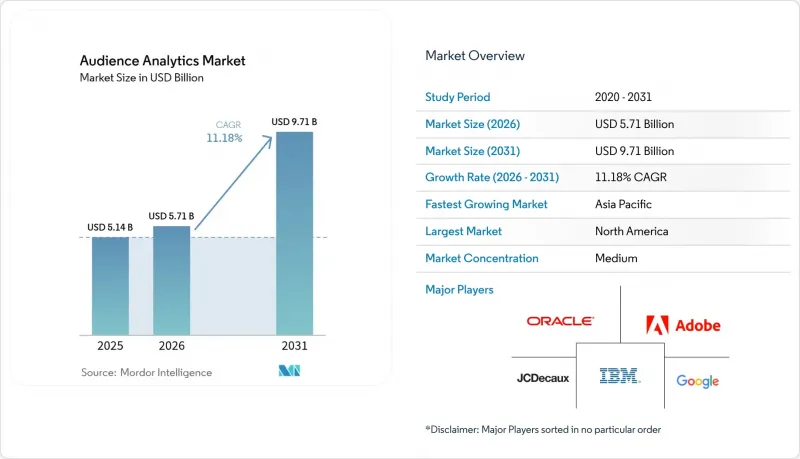
This report is Segmented by Component (Solutions and Services), Deployment Mode (On-Premises and Cloud), Organization Size (Large Enterprises and Small and Medium Enterprises (SMEs)), Application (Sales and Marketing Optimisation, Customer Experience Management, and More), End-User Industry (Media and Entertainment, Retail and ECommerce, and More), and Geography.
Global Audience Analytics Market Trends and Insights
Rapid Growth in Omnichannel First-Party Data Collection
Brands are rebuilding data architectures around owned interaction points, integrating in-store behaviour, mobile engagement, and connected-device signals. Retailers now operate sophisticated media networks that align physical and digital journeys, opening USD-level revenue channels once dominated by third-party data brokers. The ability to merge offline and online insights improves lifetime value modelling and elevates segmentation precision.
Surging Adoption of AI/ML-Powered Predictive Analytics
Machine-learning algorithms now underpin behavioural modelling, conversion prediction, and automated cohort creation across mainstream platforms. Google Analytics 4 and Adobe Experience Cloud showcase AI engines that slash insight latency from weeks to minutes while improving forecast accuracy by more than 30%. Cloud delivery makes these functions accessible to mid-market firms previously constrained by infrastructure costs and talent shortages.
Increasing Privacy-First Regulation
GDPR, CPRA, and the Digital Markets Act compel firms to re-engineer data flows, often diverting 15-20% of analytics budgets to compliance efforts. Privacy-preserving solutions, such as cookieless web analytics, reduce dependence on personal identifiers while sustaining behavioural insight quality. Vendors tout contextual targeting and edge processing to balance regulatory demands with commercial goals.
Other drivers and restraints analyzed in the detailed report include:
- Media and Entertainment Shift to Real-Time Audience Monetisation
- Cookieless Marketing Pushes Demand for Consent-Based Identity Graphs
- Data-Engineering Skill Shortages Among SME Users
For complete list of drivers and restraints, kindly check the Table Of Contents.
Segment Analysis
Solutions generated 67.20% of 2025 revenue and remain the backbone of the audience analytics market. They comprise data-integration hubs, customer data platforms, and AI inference engines that enable cross-channel insight generation. Organisations invest heavily at the outset in scalable infrastructures, creating high switching costs and entrenched vendor relationships. Services, however, achieve a 12.45% CAGR as firms outsource expertise in identity resolution, model governance, and compliance auditing. Managed offerings deliver continuous optimisation and bridge the data-engineering talent gap, elevating overall project success rates.
The rise of analytics-as-a-service signals a strategic shift from perpetual licences to consumption-based engagements. Consultancies and system integrators package technology stacks with advisory support, ensuring business objectives drive implementation choices. As privacy regulation tightens, specialised services in consent management and edge deployment command premium pricing, accelerating the revenue mix transition toward recurring professional support.
On-premises systems held 65.10% of the audience analytics market share in 2025, reflecting enduring concerns over data sovereignty and latency for high-volume streaming analyses. Sectors such as banking and government rely on self-hosted platforms to retain sensitive personally identifiable information. Nevertheless, cloud instances grow at a 12.84% CAGR as vendors implement region-specific encryption, sovereign-cloud options, and advanced compliance certifications. Adobe's joint offering with AWS exemplifies tailored cloud solutions for real-time customer profiling.
Hybrid architectures surface as the prevailing model, retaining golden customer profiles on-premises while bursting compute-intensive workloads to the cloud. This arrangement curbs infrastructure capital expenditure and unlocks elastic processing for seasonal campaigns and sudden surges in data ingestion. The audience analytics market size represented by cloud deployments is forecast to overtake on-premises revenue in the post-2030 horizon as confidence in public-cloud security matures.
Complete Report Scope:
- By Component
- Solutions
- Services
- By Deployment Mode
- On-premises
- Cloud
- By Organisation Size
- Large Enterprises
- Small and Medium Enterprises (SMEs)
- By Application
- Sales and Marketing Optimisation
- Customer Experience Management
- Competitive/Media Intelligence
- Product and Content Development
- Fraud and Risk Analytics
- By End-user Industry
- Media and Entertainment
- Retail and eCommerce
- BFSI
- Telecom and IT
- Healthcare and Life Sciences
- Government and Public Sector
- Others
- By Geography
- North America
- United States
- Canada
- Mexico
- Europe
- Germany
- United Kingdom
- France
- Italy
- Spain
- Russia
- Rest of Europe
- Asia-Pacific
- China
- Japan
- India
- South Korea
- Australia and New Zealand
- Rest of Asia-Pacific
- South America
- Brazil
- Argentina
- Rest of South America
- Middle East and Africa
- Middle East
- Saudi Arabia
- United Arab Emirates
- Turkey
- Rest of Middle East
- Africa
- South Africa
- Nigeria
- Rest of Africa
- Middle East
- North America
Geography Analysis
North America held 39.90% revenue in 2025, anchored by a sophisticated advertising ecosystem, heavy technology investment, and early adoption of privacy-first tools. United States retailers such as Walmart and Target lead in retail media revenue generation, while Canada benefits from progressive privacy laws that nudge firms toward compliant analytics architectures. Mexico's accelerating e-commerce adoption widens the regional user base for scalable, cloud-delivered insight engines.
Europe sits in a steady growth phase shaped by GDPR and the Digital Markets Act, which elevate demand for consent-based solutions that minimise personal data dependence. Germany and the United Kingdom endorse edge-processing pilots that keep data resident, reducing cross-border transfer complexity. France and Italy explore contextual targeting to maintain advertising efficiency. Independent vendors that can interoperate across multiple identity frameworks attract mid-market adopters seeking flexible compliance.
Asia-Pacific is the fastest-growing region at a 11.96% CAGR, supported by a USD 880 billion mobile economy and 1.8 billion mobile subscribers. China pioneers social commerce analytics that blend video, messaging, and payments, creating granular, real-time insight streams. India's fintech boom expands transactional datasets, while Japan and South Korea integrate audience analytics into gaming ecosystems to optimise retention. Australia and New Zealand embrace enterprise analytics to support omnichannel retail and public-service modernisation. Rising smartphone penetration and government digital initiatives propel additional demand across Southeast Asia, reinforcing long-term momentum for the audience analytics market.
- Adobe Inc.
- Oracle Corporation
- Google LLC
- International Business Machines Corp.
- comScore, Inc.
- SAS Institute Inc.
- Microsoft Corp.
- Amazon Web Services, Inc.
- Salesforce, Inc.
- Nielsen Holdings Plc
- JCDecaux Group
- Akamai Technologies, Inc.
- Cxense ASA
- Meltwater
- Audiense Ltd.
- Upwave
- Mixpanel, Inc.
- Amplitude, Inc.
- Chartbeat, Inc.
- Piwik PRO
Additional Benefits:
- The market estimate (ME) sheet in Excel format
- 3 months of analyst support
TABLE OF CONTENTS
1 INTRODUCTION
- 1.1 Study Assumptions and Market Definition
- 1.2 Scope of the Study
2 RESEARCH METHODOLOGY
3 EXECUTIVE SUMMARY
4 MARKET LANDSCAPE
- 4.1 Market Overview
- 4.2 Market Drivers
- 4.2.1 Rapid growth in omnichannel first-party data collection
- 4.2.2 Surging adoption of AI/ML-powered predictive analytics
- 4.2.3 Media and entertainment shift to real-time audience monetisation
- 4.2.4 Cookieless marketing pushes demand for consent-based identity graphs
- 4.2.5 Retail media networks scaling first-party shopper insights
- 4.2.6 Edge analytics on devices enabling privacy-preserving insights
- 4.3 Market Restraints
- 4.3.1 Increasing privacy-first regulation (GDPR, CPRA, DMA)
- 4.3.2 Data-engineering skill shortages among SME users
- 4.3.3 Rising cloud-compute costs for petabyte-scale analytics workloads
- 4.3.4 Fragmentation of identity solutions hinders interoperability
- 4.4 Value Chain Analysis
- 4.5 Technological Outlook
- 4.6 Regulatory Landscape
- 4.7 Porter's Five Forces Analysis
- 4.7.1 Threat of New Entrants
- 4.7.2 Bargaining Power of Buyers
- 4.7.3 Bargaining Power of Suppliers
- 4.7.4 Threat of Substitutes
- 4.7.5 Intensity of Competitive Rivalry
- 4.8 Assessment of the Impact of Macroeconomic Trends on the Market
5 MARKET SIZE AND GROWTH FORECASTS (VALUE)
- 5.1 By Component
- 5.1.1 Solutions
- 5.1.2 Services
- 5.2 By Deployment Mode
- 5.2.1 On-premises
- 5.2.2 Cloud
- 5.3 By Organisation Size
- 5.3.1 Large Enterprises
- 5.3.2 Small and Medium Enterprises (SMEs)
- 5.4 By Application
- 5.4.1 Sales and Marketing Optimisation
- 5.4.2 Customer Experience Management
- 5.4.3 Competitive/Media Intelligence
- 5.4.4 Product and Content Development
- 5.4.5 Fraud and Risk Analytics
- 5.5 By End-user Industry
- 5.5.1 Media and Entertainment
- 5.5.2 Retail and eCommerce
- 5.5.3 BFSI
- 5.5.4 Telecom and IT
- 5.5.5 Healthcare and Life Sciences
- 5.5.6 Government and Public Sector
- 5.5.7 Others
- 5.6 By Geography
- 5.6.1 North America
- 5.6.1.1 United States
- 5.6.1.2 Canada
- 5.6.1.3 Mexico
- 5.6.2 Europe
- 5.6.2.1 Germany
- 5.6.2.2 United Kingdom
- 5.6.2.3 France
- 5.6.2.4 Italy
- 5.6.2.5 Spain
- 5.6.2.6 Russia
- 5.6.2.7 Rest of Europe
- 5.6.3 Asia-Pacific
- 5.6.3.1 China
- 5.6.3.2 Japan
- 5.6.3.3 India
- 5.6.3.4 South Korea
- 5.6.3.5 Australia and New Zealand
- 5.6.3.6 Rest of Asia-Pacific
- 5.6.4 South America
- 5.6.4.1 Brazil
- 5.6.4.2 Argentina
- 5.6.4.3 Rest of South America
- 5.6.5 Middle East and Africa
- 5.6.5.1 Middle East
- 5.6.5.1.1 Saudi Arabia
- 5.6.5.1.2 United Arab Emirates
- 5.6.5.1.3 Turkey
- 5.6.5.1.4 Rest of Middle East
- 5.6.5.2 Africa
- 5.6.5.2.1 South Africa
- 5.6.5.2.2 Nigeria
- 5.6.5.2.3 Rest of Africa
- 5.6.5.1 Middle East
- 5.6.1 North America
6 COMPETITIVE LANDSCAPE
- 6.1 Market Concentration
- 6.2 Strategic Moves
- 6.3 Market Share Analysis
- 6.4 Company Profiles (includes Global level Overview, Market level overview, Core Segments, Financials as available, Strategic Information, Market Rank/Share, Products and Services, Recent Developments)
- 6.4.1 Adobe Inc.
- 6.4.2 Oracle Corporation
- 6.4.3 Google LLC
- 6.4.4 International Business Machines Corp.
- 6.4.5 comScore, Inc.
- 6.4.6 SAS Institute Inc.
- 6.4.7 Microsoft Corp.
- 6.4.8 Amazon Web Services, Inc.
- 6.4.9 Salesforce, Inc.
- 6.4.10 Nielsen Holdings Plc
- 6.4.11 JCDecaux Group
- 6.4.12 Akamai Technologies, Inc.
- 6.4.13 Cxense ASA
- 6.4.14 Meltwater
- 6.4.15 Audiense Ltd.
- 6.4.16 Upwave
- 6.4.17 Mixpanel, Inc.
- 6.4.18 Amplitude, Inc.
- 6.4.19 Chartbeat, Inc.
- 6.4.20 Piwik PRO
7 MARKET OPPORTUNITIES AND FUTURE OUTLOOK
- 7.1 White-space and Unmet-need Assessment

