PUBLISHER: Mordor Intelligence | PRODUCT CODE: 2118972

PUBLISHER: Mordor Intelligence | PRODUCT CODE: 2118972
Phosphate - Market Share Analysis, Industry Trends & Statistics, Growth Forecasts (2026 - 2031)
According to Mordor Intelligence, the phosphate market size was estimated at USD 181.13 billion in 2025 and is projected to grow from USD 191.27 billion in 2026 to USD 251.48 billion by 2031, at a CAGR of 5.63% over the forecast period (2026-2031).
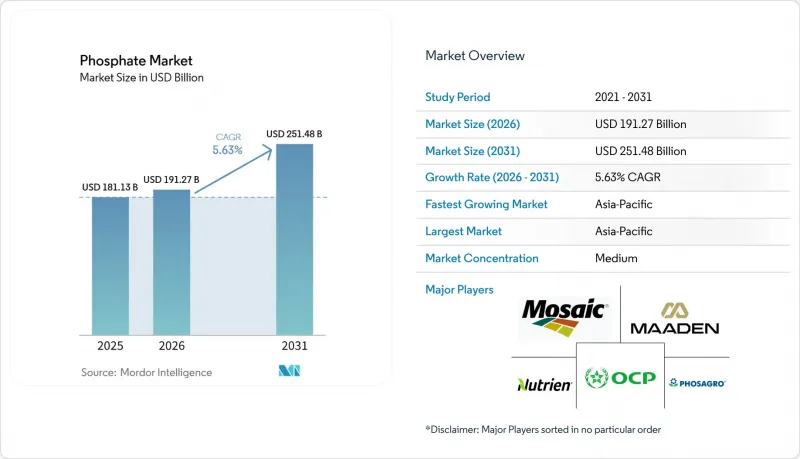
This report is Segmented by Product Type (Ammonium Phosphate, Calcium Phosphate, and More), Grade (Food and Feed Grade, Pharmaceutical Grade, and More), End-User Industry (Agrochemicals, Food and Beverages, and More), and Geography (Asia-Pacific, North America, Europe, South America, and Middle-East and Africa). The Market Forecasts are Provided in Terms of Value (USD).
Global Phosphate Market Trends and Insights
Increasing Use of Phosphate Chemicals in Water Treatment and Wastewater Management
Phosphate corrosion inhibitors and scale-control compounds remain important in municipal and industrial water systems. Governments are expanding treatment capacity as discharge requirements become more stringent. Water regulations in the United States and Europe, along with chemical compliance requirements, encourage utilities to use treatment chemicals and recovery reagents. Wastewater plants are also shifting from phosphate consumption toward struvite recovery, which can be sold as a slow-release fertilizer. A 2026 study found that struvite and struvite-K crystallization can recover phosphorus from laundry effluent, broadening the range of industrial wastewater streams that can support recovery. Expanding treatment infrastructure in Southeast Asia and sub-Saharan Africa is increasing demand for phosphate in both water-treatment chemicals and recovery inputs.
Rising Demand for Feed-Grade Phosphates Driven by Growth in Animal Nutrition
Feed-grade phosphate demand supports the phosphate market through the scale of global livestock production and the nutritional requirements of poultry and swine. Broiler diets generally require phosphorus for bone development and shell formation, while swine requirements increase during peak growth stages. Purity standards are becoming more important in feed supply chains, favoring producers with controlled processing and documentation. PhosAgro reported that its phosphate-based fertilizer and feed-phosphate production rose 5.5% year over year to 7.02 million tons in the first nine months of 2025. Its Balakovo monocalcium phosphate modernization program was advancing as part of the company's long-term development plan. Certified synthetic phosphate salts are also being used by aquafeed mills seeking improved digestibility and traceability for export markets.
Limited Availability and Geographic Concentration of Phosphate Rock Resources
Phosphorus cannot be produced from the atmosphere and depends on finite mined deposits, making the global phosphate market sensitive to reserve concentration, export decisions, and logistics disruptions. OCP and China account for a large share of global phosphate rock output, while the European Union has limited domestic reserves. Import-dependent fertilizer producers therefore rely on long-term supply arrangements and have few rapid alternatives. The United States invoked the Defense Production Act in 2026 to secure supplies of elemental phosphorus, highlighting the growing strategic importance of supply reliability. China's export restrictions and high sulfur costs can further affect availability, pricing, and production planning for buyers outside major producing regions.
Other drivers and restraints analyzed in the detailed report include:
- Expanding Adoption of Phosphorus Recovery and Recycling Technologies
- Increasing Demand for Sustainable and Low-Carbon Fertilizer Solutions
- Stringent Environmental Regulations Related to Phosphate Emissions and Water Pollution
For complete list of drivers and restraints, kindly check the Table Of Contents.
Segment Analysis
Ammonium phosphate held 46.22% of product-category revenue in 2025, making it the largest product category. This position reflects sustained demand for diammonium phosphate (DAP) and monoammonium phosphate (MAP) across grain-producing regions in Asia, North America, and South America. Potassium phosphate is the fastest-growing product type, with a projected CAGR of 6.47% through 2031. Demand is concentrated in specialty crop nutrition, high-pressure drip-irrigation horticulture, and food ingredients that require controlled phosphorus-to-potassium ratios. These uses include coffee-creamer buffering and non-dairy protein stabilization. Brazil's fertilizer deliveries reached 49.11 million tons in 2025, with phosphate products accounting for a material share of import demand, underscoring the importance of large agricultural markets to ammonium phosphate consumption.
Phosphoric acid is developing into distinct fertilizer and industrial application streams. Battery-grade phosphoric acid for lithium iron phosphate cathodes represented an estimated 15% of China's industrial phosphoric acid demand in 2024, with demand growing at more than 20% annually from its current base. Calcium phosphate is used as a pharmaceutical excipient and in nutraceutical products, where quality specifications are important. Sodium phosphate retains established roles in food processing, detergent formulations, and boiler-water treatment. Other phosphates, including polyphosphates and electronic-grade reagents, serve semiconductor production and specialty industrial cleaning. These smaller applications give specialty producers areas where formulation quality and customer approvals matter more than volume.
Complete Report Scope:
- By Product Type
- Ammonium Phosphate
- Calcium Phosphate
- Phosphoric Acid
- Potassium Phosphate
- Sodium Phosphate
- Other Phosphates
- By Grade
- Food and Feed Grade
- Pharmaceutical Grade
- Industrial Grade
- By End-User Industry
- Agrochemicals
- Food and Beverages
- Animal Feed
- Cleansers and Detergents
- Pharmaceutical and Personal Care
- Water Treatment
- By Geography
- Asia-Pacific
- China
- India
- Japan
- South Korea
- Rest of Asia-Pacific
- North America
- United States
- Canada
- Mexico
- Europe
- Germany
- United Kingdom
- France
- Italy
- Russia
- Rest of Europe
- South America
- Brazil
- Argentina
- Rest of South America
- Middle-East and Africa
- Saudi Arabia
- South Africa
- Rest of Middle-East and Africa
- Asia-Pacific
Geography Analysis
Asia-Pacific accounted for 44.81% of the phosphate market in 2025 and is forecast to grow at a 6.14% CAGR through 2031. Agricultural intensification, food processing, and demand for battery materials support phosphate consumption in the region. China produces an estimated 41% of global phosphate output from 5% of known reserves, raising concerns about resource depletion and conservation. India remains a major DAP importer, and its subsidy system supports large fertilizer demand. CRISIL Ratings stated in February 2026 that India's complex fertilizer capacity is expected to increase by 25% over the next three fiscal years. Japan and South Korea support specialty and pharmaceutical-grade demand, while Vietnam and Indonesia represent growing feed and aquaculture markets.
North America and Europe are both significant net-importing regions in the phosphate market, though their approaches differ. In North America, Mosaic and Nutrien account for more than 90% of regional phosphate production capacity. Nutrien is evaluating options for its phosphate division, while Mosaic adjusted output at its Louisiana and Bartow facilities amid high sulfur costs in 2026. U.S. policy actions since 2025 have focused on domestic supply resilience. Europe is using carbon and compliance requirements to influence the sourcing of imported fertilizers. Downstream processors in Germany, France, and Italy are reviewing supply chains that have long relied on Moroccan phosphate flows.
South America, the Middle-East, and Africa each have distinct roles in the phosphate market. Brazil is a major import destination. Argentina remains a price-sensitive MAP buyer and imported cargoes from Saudi Arabia during tighter global supply conditions in 2025. Morocco's OCP is investing in fertilizer capacity, green ammonia, desalination, and renewable energy infrastructure, aiming to add 9 million tons of fertilizer production capacity by 2028. Saudi Arabia's Maaden is growing as an integrated producer, while South African demand is tied to food security. Angola is also adding regional supply capacity through the Cabinda Phosphate Fertilizer Plant Project.
- Chemische Fabrik Budenheim KG
- EuroChem Group
- Fosfitalia Group
- Guizhou Phosphate Chemical Group
- Hubei Xingfa Chemicals Group Co., Ltd.
- ICL Group Ltd.
- Innophos Holdings, Inc.
- Jordan Phosphate Mines Company (JPMC)
- Maaden
- Mosaic
- Nutrien
- OCP S.A.
- PhosAgro Group
- Prayon SA
- Reciphos SAS
- WENGFU GROUP CO. LTD.
- Yara International ASA
- Yunnan Yuntianhua Co., Ltd.
Additional Benefits:
- The market estimate (ME) sheet in Excel format
- 3 months of analyst support
TABLE OF CONTENTS
1 Introduction
- 1.1 Study Assumptions and Market Definition
- 1.2 Scope of the Study
2 Research Methodology
3 Executive Summary
4 Market Landscape
- 4.1 Market Overview
- 4.2 Market Drivers
- 4.2.1 Increasing Use of Phosphate Chemicals in Water Treatment and Wastewater Management
- 4.2.2 Rising Demand for Feed-Grade Phosphates Driven by Growth in Animal Nutrition
- 4.2.3 Expanding Adoption of Phosphorus Recovery and Recycling Technologies
- 4.2.4 Growing Investments in Integrated Phosphate Mining and Processing Operations
- 4.2.5 Increasing Demand for Sustainable and Low-Carbon Fertilizer Solutions
- 4.3 Market Restraints
- 4.3.1 Limited Availability and Geographic Concentration of Phosphate Rock Resources
- 4.3.2 Stringent Environmental Regulations Related to Phosphate Emissions and Water Pollution
- 4.3.3 Stringent Regulatory and Quality Compliance Requirements for Food, Feed, and Pharmaceutical Grades
- 4.4 Value Chain Analysis
- 4.5 Porter's Five Forces Analysis
- 4.5.1 Threat of New Entrants
- 4.5.2 Bargaining Power of Suppliers
- 4.5.3 Bargaining Power of Buyers
- 4.5.4 Threat of Substitutes
- 4.5.5 Competitive Rivalry
5 Market Size and Growth Forecasts (Value)
- 5.1 By Product Type
- 5.1.1 Ammonium Phosphate
- 5.1.2 Calcium Phosphate
- 5.1.3 Phosphoric Acid
- 5.1.4 Potassium Phosphate
- 5.1.5 Sodium Phosphate
- 5.1.6 Other Phosphates
- 5.2 By Grade
- 5.2.1 Food and Feed Grade
- 5.2.2 Pharmaceutical Grade
- 5.2.3 Industrial Grade
- 5.3 By End-User Industry
- 5.3.1 Agrochemicals
- 5.3.2 Food and Beverages
- 5.3.3 Animal Feed
- 5.3.4 Cleansers and Detergents
- 5.3.5 Pharmaceutical and Personal Care
- 5.3.6 Water Treatment
- 5.4 By Geography
- 5.4.1 Asia-Pacific
- 5.4.1.1 China
- 5.4.1.2 India
- 5.4.1.3 Japan
- 5.4.1.4 South Korea
- 5.4.1.5 Rest of Asia-Pacific
- 5.4.2 North America
- 5.4.2.1 United States
- 5.4.2.2 Canada
- 5.4.2.3 Mexico
- 5.4.3 Europe
- 5.4.3.1 Germany
- 5.4.3.2 United Kingdom
- 5.4.3.3 France
- 5.4.3.4 Italy
- 5.4.3.5 Russia
- 5.4.3.6 Rest of Europe
- 5.4.4 South America
- 5.4.4.1 Brazil
- 5.4.4.2 Argentina
- 5.4.4.3 Rest of South America
- 5.4.5 Middle-East and Africa
- 5.4.5.1 Saudi Arabia
- 5.4.5.2 South Africa
- 5.4.5.3 Rest of Middle-East and Africa
- 5.4.1 Asia-Pacific
6 Competitive Landscape
- 6.1 Market Concentration
- 6.2 Strategic Moves
- 6.3 Market Share (%)/Ranking Analysis
- 6.4 Company Profiles (includes Global Overview, Market Overview, Core Segments, Financials as available, Strategic Information, Products and Services, and Recent Developments)
- 6.4.1 Chemische Fabrik Budenheim KG
- 6.4.2 EuroChem Group
- 6.4.3 Fosfitalia Group
- 6.4.4 Guizhou Phosphate Chemical Group
- 6.4.5 Hubei Xingfa Chemicals Group Co., Ltd.
- 6.4.6 ICL Group Ltd.
- 6.4.7 Innophos Holdings, Inc.
- 6.4.8 Jordan Phosphate Mines Company (JPMC)
- 6.4.9 Maaden
- 6.4.10 Mosaic
- 6.4.11 Nutrien
- 6.4.12 OCP S.A.
- 6.4.13 PhosAgro Group
- 6.4.14 Prayon SA
- 6.4.15 Reciphos SAS
- 6.4.16 WENGFU GROUP CO. LTD.
- 6.4.17 Yara International ASA
- 6.4.18 Yunnan Yuntianhua Co., Ltd.
7 Market Opportunities and Future Outlook
- 7.1 White-Space and Unmet-Need Assessment

