PUBLISHER: Mordor Intelligence | PRODUCT CODE: 2118974

PUBLISHER: Mordor Intelligence | PRODUCT CODE: 2118974
Nitrocellulose - Market Share Analysis, Industry Trends & Statistics, Growth Forecasts (2026 - 2031)
According to Mordor Intelligence, the nitrocellulose market was valued at USD 0.97 billion in 2025 and is estimated to grow from USD 1.02 billion in 2026 to reach USD 1.31 billion by 2031, at a CAGR of 5.13% during the forecast period (2026-2031).
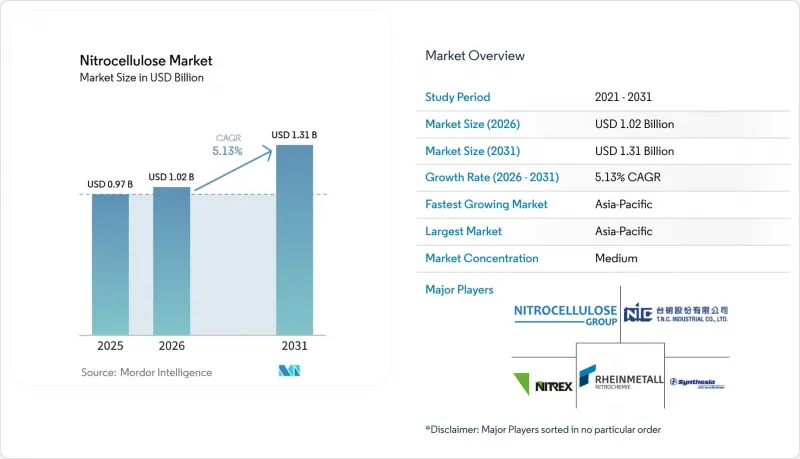
This report is Segmented by Grade (Industrial Grade, Pharmaceutical Grade, and Specialty Grade), Application (Printing Inks, Automotive Paints, and More), End-Use Industry (Paints and Coatings, Printing and Packaging, Pharmaceuticals and Healthcare, and More), and Geography (Asia-Pacific, North America, Europe, South America, and Middle-East and Africa). The Market Forecasts are Provided in Terms of Value (USD).
Global Nitrocellulose Market Trends and Insights
Growing Demand for High-Gloss and Fast-Drying Coatings Across Industrial Applications
Nitrocellulose provides fast solvent release, self-leveling film formation, and a high-gloss finish in industrial lacquer systems. Auto-refinish shops, furniture plants, and metal finishers use these properties to reduce the time between application, handling, and the next manufacturing step. Shorter drying cycles allow lines to complete more work within an existing shift without adding curing equipment or expanding floor space. Automotive refinish activity in India provides a demand base for industrial-grade material through 2031, particularly where repair work must be completed quickly. U.S. surface-coating requirements influence product specifications and have encouraged formulators to use compliant solvent blends. The nitrocellulose market benefits when waterborne systems cannot deliver comparable throughput, finish quality, and practical drying speed in the same operation.
Increasing Use of Nitrocellulose in Flexographic and Gravure Printing Inks
Nitrocellulose is widely used as a film-forming binder in solvent-based gravure and flexographic inks because it supports adhesion, gloss, and rapid solvent evaporation. These characteristics are particularly useful on Biaxially Oriented Polypropylene (BOPP), Polyethylene Terephthalate (PET), and polyamide films, which are non-absorbent materials used in flexible food and consumer-goods packaging. High-speed print lines need stable film formation, and a change in binder can affect both print performance and production settings. China, India, and Southeast Asia have large packaging-film production bases, which gives regional ink demand a substantial revenue base. The nitrocellulose market also faces a different requirement in Europe, where water-based and Ultraviolet (UV)-cured alternatives are gaining use. Germany's Printing Ink Ordinance took effect in 2026 and restricts certain nitrocellulose-derived binders in food-contact inks, making separate regional formulations more necessary.
Stringent Safety Requirements for the Handling, Storage, and Transportation of Nitrocellulose
The European Agreement concerning the International Carriage of Dangerous Goods by Road (ADR) 2025 classifies nitrocellulose solution under UN 2059 as a Class 3 flammable liquid with strict transport conditions. Dry solid nitrocellulose falls under UN 0340 or UN 0341 and is classified as a Class 1 explosive, requiring more demanding controls. Licensed transport, advance notification, route restrictions, and secure handling can increase delivered costs and limit viable transport distances. Large integrated producers can spread the cost of safety infrastructure across higher volumes, while smaller producers face higher compliance costs per ton. A 2024 incident at a nitrocellulose workshop in Laohekou, Hubei Province, highlighted continuing process-safety risks. The nitrocellulose market may see tighter industrial-grade availability when greater oversight adds operating requirements.
Other drivers and restraints analyzed in the detailed report include:
- Rising Demand for Premium Wood Coatings and Furniture Finishes
- Growing Preference for Fast-Curing Coating Systems to Improve Manufacturing Efficiency
- Increasing Competition from Alternative Resins such as Acrylics and Polyurethanes
For complete list of drivers and restraints, kindly check the Table Of Contents.
Segment Analysis
Industrial grade held 54.38% of revenue in 2025, supported by solvent-based coatings, printing inks, automotive refinish paints, and leather finishes. Industrial grade buyers in the nitrocellulose market seek delivered-price discipline, reliable viscosity, and consistent supply for established coating and ink lines. The nitrocellulose industry serves this demand through large-volume products that match existing production processes. Its wide application base keeps industrial grade central to revenue, but also links suppliers to changes in packaging, coating, and finishing output. Producers, therefore, need dependable industrial supply while managing shifts in regional demand and product specifications.
Specialty grade is forecast to grow at a 5.83% CAGR through 2031, led by pharmaceutical excipients and high-purity cosmetic applications. Buyers in these uses require purity certification, stable lot-to-lot viscosity, and controlled manufacturing practices. Nitrocellulose membranes support diagnostic lateral-flow assays, while selected controlled-release tablet coatings and nail lacquers require specialized grades. Pharmaceutical grade earns higher margins because sterility, purity, and regulatory requirements are demanding. Limited qualified supply can increase supply-concentration risk and encourage longer-term purchasing agreements.
Complete Report Scope:
- By Grade
- Industrial Grade
- Pharmaceutical Grade
- Specialty Grade
- By Application
- Printing Inks
- Automotive Paints
- Wood Coatings
- Leather Finishes
- Nail Varnishes
- Other Applications
- By End-Use Industry
- Paints and Coatings
- Printing and Packaging
- Pharmaceuticals and Healthcare
- Personal Care and Cosmetics
- Leather and Textile
- Other End-use Industries
- By Geography
- Asia-Pacific
- China
- India
- Japan
- South Korea
- Rest of Asia-Pacific
- North America
- United States
- Canada
- Mexico
- Europe
- Germany
- United Kingdom
- France
- Italy
- Russia
- Rest of Europe
- South America
- Brazil
- Argentina
- Rest of South America
- Middle-East and Africa
- Saudi Arabia
- South Africa
- Rest of Middle-East and Africa
- Asia-Pacific
Geography Analysis
Asia-Pacific held 43.81% of revenue in 2025 and is forecast to grow at a 5.84% CAGR through 2031. China has a production base in Shandong, Jiangsu, and Zhejiang. This supply base serves domestic coatings and ink manufacturers and export customers across Southeast Asia and Latin America, reinforcing Asia-Pacific's position in the nitrocellulose market. India is an important demand center for packaging, printing, wood coatings, and leather processing, while Japan supports demand for precision coatings and high-quality furniture finishes. India has imposed anti-dumping duties on Chinese nitrocellulose imports, and Nitrex Chemicals India is expanding capacity at Jhagadia for domestic and export demand.
North American demand is based on auto-refinish paints, cabinetry and flooring finishes, and flexible-packaging printing inks, while its residential renovation base supports cabinet-finishing lacquer demand. Europe faces tighter food-contact ink requirements while some production capacity shifts toward energetic-grade material. EU REACH requirements and Germany's Printing Ink Ordinance create reformulation and compliance work for suppliers and formulators.
South America, and Middle-East, and Africa remain smaller but growing demand centers. The nitrocellulose market in these regions relies heavily on imports and the development of local coatings and ink manufacturing. Brazil and Mexico support South American demand through packaging, furniture production, and industrial coatings, with wood coatings providing the fastest application growth path in Latin America. Saudi Arabia and South Africa are the main Middle-East and Africa demand centers, where decorative coatings, printing inks, and leather finishes support imports. Limited local production and infrastructure constraints keep consumption per person below global averages.
- ARDIN CHEMICAL COMPANY
- Eurenco
- GRN Cellulose Pvt. Ltd.
- Hubei Xuefei Chemical Co., Ltd
- IVM Chemicals srl
- MSM Walsrode GmbH and Co. KG
- Nitrex Chemicals India Ltd
- Nitrocellulose Group
- Nitrochemie
- Synthesia Nitrocellulose, a.s.
- T.N.C. Industrial Co., Ltd.
- TNC Chemicals Philippines Inc.
- Unix Cellulose
Additional Benefits:
- The market estimate (ME) sheet in Excel format
- 3 months of analyst support
TABLE OF CONTENTS
1 Introduction
- 1.1 Study Assumptions and Market Definition
- 1.2 Scope of the Study
2 Research Methodology
3 Executive Summary
4 Market Landscape
- 4.1 Market Overview
- 4.2 Market Drivers
- 4.2.1 Growing Demand for High-Gloss and Fast-Drying Coatings Across Industrial Applications
- 4.2.2 Increasing Use of Nitrocellulose in Flexographic and Gravure Printing Inks
- 4.2.3 Rising Demand for Premium Wood Coatings and Furniture Finishes
- 4.2.4 Growing Preference for Fast-Curing Coating Systems to Improve Manufacturing Efficiency
- 4.2.5 Increasing Product Innovation Toward Low-VOC and Environmentally Compliant Formulations
- 4.3 Market Restraints
- 4.3.1 Stringent Safety Requirements for the Handling, Storage, and Transportation of Nitrocellulose
- 4.3.2 Increasing Competition from Alternative Resins such as Acrylics and Polyurethanes
- 4.3.3 High Compliance Costs Associated with Storage, Safety, and Regulatory Requirements
- 4.4 Value Chain Analysis
- 4.5 Porter's Five Forces Analysis
- 4.5.1 Threat of New Entrants
- 4.5.2 Bargaining Power of Suppliers
- 4.5.3 Bargaining Power of Buyers
- 4.5.4 Threat of Substitutes
- 4.5.5 Competitive Rivalry
5 Market Size and Growth Forecasts (Value)
- 5.1 By Grade
- 5.1.1 Industrial Grade
- 5.1.2 Pharmaceutical Grade
- 5.1.3 Specialty Grade
- 5.2 By Application
- 5.2.1 Printing Inks
- 5.2.2 Automotive Paints
- 5.2.3 Wood Coatings
- 5.2.4 Leather Finishes
- 5.2.5 Nail Varnishes
- 5.2.6 Other Applications
- 5.3 By End-Use Industry
- 5.3.1 Paints and Coatings
- 5.3.2 Printing and Packaging
- 5.3.3 Pharmaceuticals and Healthcare
- 5.3.4 Personal Care and Cosmetics
- 5.3.5 Leather and Textile
- 5.3.6 Other End-use Industries
- 5.4 By Geography
- 5.4.1 Asia-Pacific
- 5.4.1.1 China
- 5.4.1.2 India
- 5.4.1.3 Japan
- 5.4.1.4 South Korea
- 5.4.1.5 Rest of Asia-Pacific
- 5.4.2 North America
- 5.4.2.1 United States
- 5.4.2.2 Canada
- 5.4.2.3 Mexico
- 5.4.3 Europe
- 5.4.3.1 Germany
- 5.4.3.2 United Kingdom
- 5.4.3.3 France
- 5.4.3.4 Italy
- 5.4.3.5 Russia
- 5.4.3.6 Rest of Europe
- 5.4.4 South America
- 5.4.4.1 Brazil
- 5.4.4.2 Argentina
- 5.4.4.3 Rest of South America
- 5.4.5 Middle-East and Africa
- 5.4.5.1 Saudi Arabia
- 5.4.5.2 South Africa
- 5.4.5.3 Rest of Middle-East and Africa
- 5.4.1 Asia-Pacific
6 Competitive Landscape
- 6.1 Market Concentration
- 6.2 Strategic Moves
- 6.3 Market Share (%)/Ranking Analysis
- 6.4 Company Profiles (includes Global Overview, Market Overview, Core Segments, Financials as available, Strategic Information, Products and Services, and Recent Developments)
- 6.4.1 ARDIN CHEMICAL COMPANY
- 6.4.2 Eurenco
- 6.4.3 GRN Cellulose Pvt. Ltd.
- 6.4.4 Hubei Xuefei Chemical Co., Ltd
- 6.4.5 IVM Chemicals srl
- 6.4.6 MSM Walsrode GmbH and Co. KG
- 6.4.7 Nitrex Chemicals India Ltd
- 6.4.8 Nitrocellulose Group
- 6.4.9 Nitrochemie
- 6.4.10 Synthesia Nitrocellulose, a.s.
- 6.4.11 T.N.C. Industrial Co., Ltd.
- 6.4.12 TNC Chemicals Philippines Inc.
- 6.4.13 Unix Cellulose
7 Market Opportunities and Future Outlook
- 7.1 White-Space and Unmet-Need Assessment

