PUBLISHER: Mordor Intelligence | PRODUCT CODE: 2118995

PUBLISHER: Mordor Intelligence | PRODUCT CODE: 2118995
United States Olive Oil - Market Share Analysis, Industry Trends & Statistics, Growth Forecasts (2026 - 2031)
According to Mordor Intelligence, the United States olive oil market size is expected to grow from USD 3.52 billion in 2025 to USD 3.93 billion in 2026 and is forecast to reach USD 4.86 billion by 2031 at a 4.33% CAGR over 2026-2031.
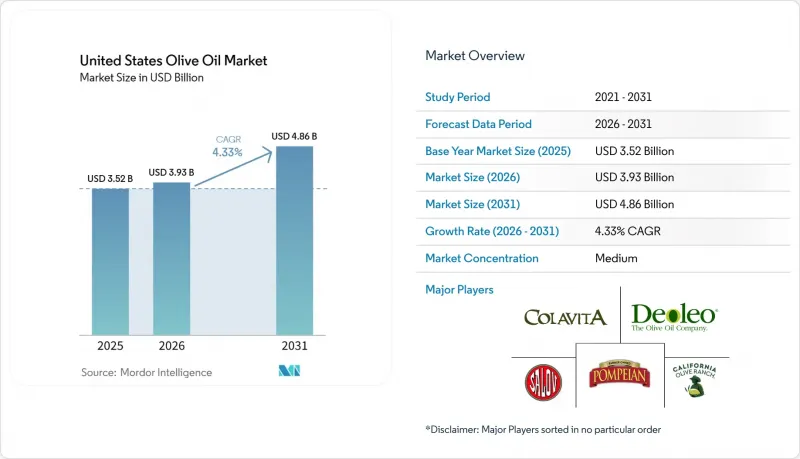
This report is Segmented by Product Type (Extra Virgin Olive Oil, Virgin Olive Oil, Refined Olive Oil, and Other Product Types), Nature (Conventional Olive Oil and Organic Olive Oil), Packaging (Bottles, Cans, Pouches, and Others), and Distribution Channel (Retail, Food Processing, and Foodservice). The Market Forecasts are Provided in Terms of Value (USD) and Volume (Liters).
United States Olive Oil Market Trends and Insights
Growing preference for heart-healthy cooking oils
Growing consumer awareness of the cardiovascular benefits of unsaturated fats is driving greater adoption of olive oil as a preferred cooking oil in the United States. According to the North American Olive Oil Association (NAOOA) 2026 State of the Industry report, olive oil household penetration reached 50.9% of United States households, reflecting its increasing acceptance as a staple in health-conscious kitchens. In addition, the NAOOA reported that its "NAOOA Certified" seal now appears on 49% of branded olive oil sold in the United States, highlighting the industry's growing emphasis on product authenticity and quality as consumers increasingly seek trusted, heart-healthy cooking oils.
Rising adoption of Mediterranean dietary patterns
Growing consumer interest in balanced eating and preventive nutrition is driving the incorporation of Mediterranean-style ingredients, particularly olive oil, into everyday meals. According to the International Food Information Council (IFIC) 2025 Spotlight Survey, 56% of Americans reported that olive oil is among the oils they use most often when cooking or consuming food, ahead of vegetable oil (41%) and butter (38%). The survey also found that 56% of respondents identified olive oil as one of the three healthiest types of fat or oil, reinforcing its association with Mediterranean dietary habits and supporting continued demand in the United States olive oil market.
Olive oil adulteration and authenticity concerns
Concerns over olive oil adulteration and misleading product labeling continue to undermine consumer confidence in the market. Instances of blending olive oil with lower-cost vegetable oils, or making inaccurate claims about grade and origin, have increased scrutiny of product authenticity. As a result, consumers are placing greater emphasis on certifications, traceability, and trusted brands when making purchasing decisions. These concerns can discourage repeat purchases, particularly in the premium segment, while increasing compliance and quality assurance costs for manufacturers and importers.
Other drivers and restraints analyzed in the detailed report include:
- Expanding consumer awareness of clean-label and natural foods
- Product innovation in flavored and infused olive oils
- Climate-related variability in olive production
For complete list of drivers and restraints, kindly check the Table Of Contents.
Segment Analysis
Virgin olive oil accounted for the largest share of the United States olive oil market, capturing 73.56% of revenue in 2025. Its dominant position is supported by widespread availability, balanced pricing, and broad use across both household and foodservice applications. The segment benefits from strong retail penetration and consumer familiarity, making it a preferred choice for everyday cooking and routine consumption across the country.
Extra virgin olive oil is projected to be the fastest-growing product type, registering a CAGR of 5.35% during 2026-2031. Growth is driven by increasing consumer preference for minimally processed, premium-quality edible oils, along with rising awareness of their nutritional benefits. Growing demand for clean-label products, increasing interest in premium and origin-certified olive oils, and continued product innovation in flavored and specialty offerings are further supporting the segment's growth.
Conventional olive oil held the largest share of the United States olive oil market, accounting for 82.23% of revenue in 2025. Its dominant position is driven by broad availability, competitive pricing, and strong consumer acceptance across mainstream retail channels. The segment benefits from established brand presence and widespread use in everyday cooking, making it the preferred choice for most households and foodservice operators. Its versatility across a wide range of cooking applications, including sauteing, baking, frying, and salad preparation, continues to support steady demand among both residential and commercial users.
Organic olive oil is projected to be the fastest-growing segment by nature, registering a CAGR of 6.46% during 2026-2031. Growth is supported by increasing consumer preference for organic and minimally processed food products, along with rising demand for clean-label ingredients and sustainably produced edible oils. Expanding retail availability of certified organic olive oils and growing interest in premium, health-oriented products are expected to further support demand throughout the forecast period.
Complete Report Scope:
- By Product Type
- Extra Virgin Olive Oil
- Virgin Olive Oil
- Refined Olive Oil
- Other Product Types
- By Nature
- Conventional Olive Oil
- Organic Olive Oil
- By Packaging
- Bottles
- Cans
- Pouches
- Others
- By Distribution Channel
- Retail
- Supermarkets/Hypermarkets
- Convenience Stores
- Online Retail
- Other Distribution Channel
- Food Processing
- Foodservice
- Retail
List of Companies Covered in this Report:
- Pompeian, Inc.
- Deoleo, S.A.
- California Olive Ranch, Inc.
- Salov S.p.A.
- Colavita USA, LLC
- Gallo Worldwide
- Cargill, Incorporated
- Sovena Group
- Borges International Group
- Goya Foods, Inc.
- STAR Fine Foods
- Monini
- Ybarra
- Filippo Berio USA, Ltd.
- Catania Oils
- Corto Olive Co.
- World Finer Foods, Inc.
- McEvoy Ranch
- Cobram Estate
- Queen Creek Olive Mill
Additional Benefits:
- The market estimate (ME) sheet in Excel format
- 3 months of analyst support
TABLE OF CONTENTS
1 INTRODUCTION
- 1.1 Study Assumptions and Market Definition
- 1.2 Scope of the Study
2 RESEARCH METHODOLOGY
3 EXECUTIVE SUMMARY
4 MARKET LANDSCAPE
- 4.1 Market Overview
- 4.2 Market Drivers
- 4.2.1 Growing preference for heart-healthy cooking oils
- 4.2.2 Rising adoption of Mediterranean dietary patterns
- 4.2.3 Expanding consumer awareness of clean-label and natural foods
- 4.2.4 Product innovation in flavored and infused olive oils
- 4.2.5 Expansion of gourmet home cooking and culinary exploration
- 4.2.6 Foodservice and multicultural culinary expansion
- 4.3 Market Restraints
- 4.3.1 Olive oil adulteration and authenticity concerns
- 4.3.2 Climate-related variability in olive production
- 4.3.3 Competition from alternative plant-based cooking oils
- 4.3.4 Rising olive oil prices limiting household consumption
- 4.4 Consumer Behavior Analysis
- 4.5 Regulatory Landscape
- 4.6 Porter's Five Forces Analysis
- 4.6.1 Threat of New Entrants
- 4.6.2 Bargaining Power of Suppliers
- 4.6.3 Bargaining Power of Buyers
- 4.6.4 Threat of Substitutes
- 4.6.5 Industry Rivalry
5 MARKET SIZE AND GROWTH FORECASTS (VALUE AND VOLUME)
- 5.1 By Product Type
- 5.1.1 Extra Virgin Olive Oil
- 5.1.2 Virgin Olive Oil
- 5.1.3 Refined Olive Oil
- 5.1.4 Other Product Types
- 5.2 By Nature
- 5.2.1 Conventional Olive Oil
- 5.2.2 Organic Olive Oil
- 5.3 By Packaging
- 5.3.1 Bottles
- 5.3.2 Cans
- 5.3.3 Pouches
- 5.3.4 Others
- 5.4 By Distribution Channel
- 5.4.1 Retail
- 5.4.1.1 Supermarkets/Hypermarkets
- 5.4.1.2 Convenience Stores
- 5.4.1.3 Online Retail
- 5.4.1.4 Other Distribution Channel
- 5.4.2 Food Processing
- 5.4.3 Foodservice
- 5.4.1 Retail
6 COMPETITIVE LANDSCAPE
- 6.1 Market Concentration
- 6.2 Strategic Moves
- 6.3 Market Share Analysis
- 6.4 Company Profiles (includes Company Highlights, Core Segments, Financials (if available), Strategic Information, Market Share Analysis for Key Companies, Products, and Recent Developments)
- 6.4.1 Pompeian, Inc.
- 6.4.2 Deoleo, S.A.
- 6.4.3 California Olive Ranch, Inc.
- 6.4.4 Salov S.p.A.
- 6.4.5 Colavita USA, LLC
- 6.4.6 Gallo Worldwide
- 6.4.7 Cargill, Incorporated
- 6.4.8 Sovena Group
- 6.4.9 Borges International Group
- 6.4.10 Goya Foods, Inc.
- 6.4.11 STAR Fine Foods
- 6.4.12 Monini
- 6.4.13 Ybarra
- 6.4.14 Filippo Berio USA, Ltd.
- 6.4.15 Catania Oils
- 6.4.16 Corto Olive Co.
- 6.4.17 World Finer Foods, Inc.
- 6.4.18 McEvoy Ranch
- 6.4.19 Cobram Estate
- 6.4.20 Queen Creek Olive Mill
7 MARKET OPPORTUNITIES AND FUTURE OUTLOOK

