PUBLISHER: Mordor Intelligence | PRODUCT CODE: 2119013

PUBLISHER: Mordor Intelligence | PRODUCT CODE: 2119013
Aerospace Forging - Market Share Analysis, Industry Trends & Statistics, Growth Forecasts (2026 - 2031)
According to Mordor Intelligence, the aerospace forging market size was estimated at USD 28.10 billion in 2025 and is estimated to grow from USD 29.65 billion in 2026 to USD 38.41 billion by 2031, at a CAGR of 5.31% during the forecast period (2026-2031).
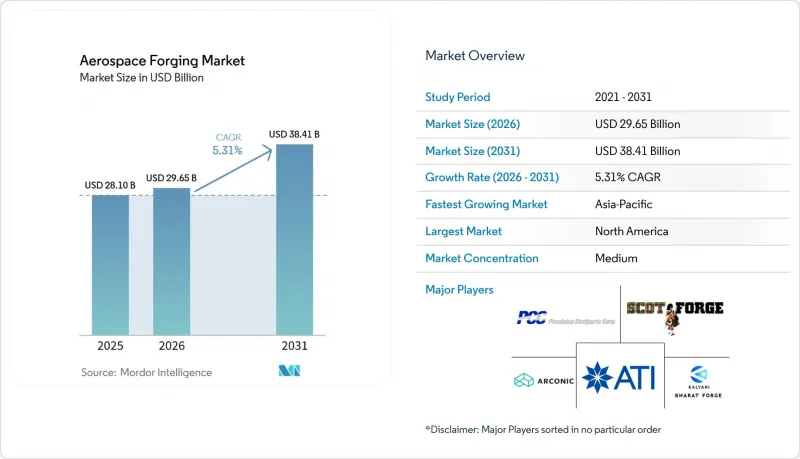
This report is Segmented by Material Type (Aluminum Alloys, Titanium Alloys, and More), Aircraft Outlook (Commercial Aerospace, Military Aerospace, and More), Application (Engine Components, Airframe Components, and More), and Geography (Asia-Pacific, North America, Europe, South America, and Middle-East and Africa). The Market Forecasts are Provided in Terms of Value (USD).
Global Aerospace Forging Market Trends and Insights
Commercial Aircraft Production Backlogs Create Structural Forging Demand
Commercial aircraft order books and limited delivery rates are shifting forging procurement toward longer supply commitments. Airbus reported an order backlog of 9,216 commercial aircraft in its mid-2026 report, providing suppliers with visibility across a broad range of narrowbody and widebody programs. Both Airbus and Boeing programs require forgings for engine rotating parts, landing gear, pylons, and wing structures. The Aerospace Forging Market benefits when OEMs favor qualified suppliers that can maintain stable throughput across multiple production cycles. Long-term agreements provide the demand certainty needed to justify investments in high-ton presses and related heat-treatment equipment, while also reducing reliance on short-notice purchasing for parts with long production and certification cycles.
Fleet Modernization and Engine Maintenance, Repair, and Overhaul (MRO) Squeeze Isothermal Forging Capacity
Delayed new aircraft deliveries have kept older aircraft in service and increased demand for maintenance, repair, and overhaul (MRO) work. This places aftermarket engine orders and new-build orders in competition for similar isothermal forging capacity. Engine turbine discs, compressor stages, and other hot-section components require materials and processes capable of withstanding repeated thermal and mechanical loads. Higher operating temperatures in newer turbofan engines can shorten overhaul intervals for some parts, increasing replacement requirements over the engine's life cycle. The Aerospace Forging Market receives demand from both original equipment production and the installed fleet. Labor availability remains a relevant factor, as specialized forge operations require trained workers and onboarding new employees can take several months.
Capital Intensity of High-Tonnage Press Infrastructure Limits Capacity Response
Aerospace forging requires large investments in presses, dies, tooling, heat treatment, and quality systems. In April 2026, Safran Aircraft Engines announced a EUR 150 million (USD 175 million) investment in a 30,000-metric-ton hydraulic press at its Gennevilliers site, with commissioning planned for 2029. This investment illustrates that large forging capacity cannot be added quickly in response to rising demand. A major press installation can require 3 to 5 years from commitment to commercial production, and component qualification adds a further 12 to 18 months for many flight-critical parts. The aerospace forging market is therefore constrained by the time required to build and certify capacity, even when customer demand is visible well in advance.
Other drivers and restraints analyzed in the detailed report include:
- Titanium and High-Strength Alloy Adoption Reshapes the Material Mix
- Military Procurement and Space Expansion Broaden the Forging Demand Base
- Specialty Alloy Billet Shortages Create Persistent Delivery Exposure
For complete list of drivers and restraints, kindly check the Table Of Contents.
Segment Analysis
Titanium alloys held 38.41% of the aerospace forging market share in 2025, making them the largest material category. Their position reflects their use in landing gear systems, engine pylons, fuselage frames, and structural fittings. These applications require high strength, corrosion resistance, and a favorable weight profile. Ti-6Al-4V is the most widely qualified titanium alloy across major commercial and military programs. It is used where aluminum lacks sufficient strength or thermal tolerance. Steel alloys continue to serve undercarriage housings, high-strength joints, and other areas where toughness and load performance are required. Aluminum alloys remain relevant to structural applications such as wing ribs and spars. Other materials include emerging options such as titanium-aluminum intermetallics for selected high-temperature engine uses.
Nickel-based superalloys are the fastest-growing material segment, with an expected CAGR of 5.66% from 2026 to 2031. These materials are used in turbofan hot sections because they retain structural integrity under high cyclic stress and temperatures above 1,100°C. The aerospace forging market size for nickel-based superalloys is supported by demand for turbine discs, compressor hardware, and other high-temperature engine parts. A 2026 CIRP Annals study found that in-process micro-forging during additive manufacturing of Inconel 718 refined the grain structure compared with as-built additive material. The finding supports continued interest in combining additive processes with forging for specialized nickel components. Such approaches may improve material performance while retaining the mechanical advantages associated with forging. EN 9100 quality management certification and Nadcap special-process accreditation remain important barriers to entry across aerospace material categories. These requirements favor suppliers that can demonstrate consistent control of materials, heat treatment, inspection, and documentation.
Complete Report Scope:
- By Material Type
- Aluminum Alloys
- Titanium Alloys
- Steel Alloys
- Nickel-Based Superalloys
- Other Materials
- By Aircraft Outlook
- Commercial Aerospace
- Military Aerospace
- Space Exploration
- By Application
- Engine Components
- Airframe Components
- Landing Gear Components
- Other Components
- By Geography
- Asia-Pacific
- China
- India
- Japan
- South Korea
- Rest of Asia-Pacific
- North America
- United States
- Canada
- Mexico
- Europe
- Germany
- United Kingdom
- France
- Italy
- Russia
- Rest of Europe
- South America
- Brazil
- Argentina
- Rest of South America
- Middle-East and Africa
- Saudi Arabia
- South Africa
- Rest of Middle-East and Africa
- Asia-Pacific
Geography Analysis
North America held 41.31% of the global aerospace forging market share in 2025. The region benefits from commercial aircraft manufacturing, defense procurement, engine production, and an established network of material and forging suppliers. Boeing programs and US defense aircraft generate demand across facilities in the Pacific Northwest, Southern California, Ohio, and Texas. Precision Castparts Corp. planned to invest USD 380 million in its Wyman-Gordon forging sites, including two new isothermal presses focused on nickel superalloy forgings for commercial and military engine programs. Arconic commissioned a USD 57.5 million expansion at its Davenport Works plant in 2025, which doubled domestic US high-purity aluminum production for defense and aerospace applications. These investments reflect the importance of domestic materials and process capacity to North American supply chain security.
Asia-Pacific is forecast to grow at a 6.23% CAGR from 2026 to 2031, the highest regional rate in the aerospace forging market. China's civil aviation expansion, India's defense manufacturing efforts, and Japan's precision forging capabilities support regional demand. Aerolloy Technologies, a PTC Industries subsidiary, completed installation and commissioning of a 4,500/5,100-ton intelligent open-die forging system at its Strategic Materials Technology Complex in March 2026. The facility supplies aerospace-grade titanium and superalloy forgings for domestic and international programs. India's supplier base is also expanding through work on aircraft engines and landing gear. Japan and South Korea have capabilities in high-integrity superalloy forging, which supports supply chain diversification.
Europe plays a significant role in the aerospace forging market through the Airbus supply chain, regional engine programs, and military aircraft production. Safran's Gennevilliers press investment is expected to support CFM LEAP, Rafale, Mirage, A400M, and GE90 engine programs when it enters service in 2029. Groupement des Industries Francaises Aeronautiques et Spatiales (GIFAS) reported USD 92.4 billion in revenue for the French aerospace and space sector in 2025. European material traceability and certification standards raise qualification requirements for suppliers serving flight-critical programs. South America remains a smaller market, centered on Embraer's commercial and defense activities.
- Arconic
- ATI
- Bharat Forge
- Doncasters Group Ltd.
- ELLWOOD Group Inc.
- Farinia Group
- Forged Solutions Group
- Howmet Aerospace
- Jiangyin Hengrun Heavy Industries Co., Ltd.
- LARSEN & TOUBRO LIMITED
- Mettis Aerospace Ltd.
- PACIFIC FORGE, INC.
- Precision Castparts Corp.
- Safran
- Scot Forge Company
- VSMPO-AVISMA Corporation
- Weber Metals
Additional Benefits:
- The market estimate (ME) sheet in Excel format
- 3 months of analyst support
TABLE OF CONTENTS
1 Introduction
- 1.1 Study Assumptions and Market Definition
- 1.2 Scope of the Study
2 Research Methodology
3 Executive Summary
4 Market Landscape
- 4.1 Market Overview
- 4.2 Market Drivers
- 4.2.1 Growing Production Backlogs for Commercial Narrowbody and Widebody Aircraft
- 4.2.2 Increasing Fleet Modernization and Aircraft Engine Replacement Programs
- 4.2.3 Rising Adoption of Titanium and High-Strength Alloy Forgings in Aerospace Applications
- 4.2.4 Growing Procurement of Military Aircraft, Defense Platforms, and Spacecraft
- 4.2.5 Integration of Hybrid Manufacturing Technologies Combining Additive Manufacturing and Forging
- 4.3 Market Restraints
- 4.3.1 High Capital Investment Required for Forging Equipment, Tooling, and Heat Treatment Facilities
- 4.3.2 Supply Constraints for Aerospace-Grade Billets and Specialty Alloy Raw Materials
- 4.3.3 High Material Scrap Rates and Rework Costs for Complex Forged Components
- 4.4 Value Chain Analysis
- 4.5 Porter's Five Forces Analysis
- 4.5.1 Threat of New Entrants
- 4.5.2 Bargaining Power of Suppliers
- 4.5.3 Bargaining Power of Buyers
- 4.5.4 Threat of Substitutes
- 4.5.5 Competitive Rivalry
5 Market Size and Growth Forecasts (Value)
- 5.1 By Material Type
- 5.1.1 Aluminum Alloys
- 5.1.2 Titanium Alloys
- 5.1.3 Steel Alloys
- 5.1.4 Nickel-Based Superalloys
- 5.1.5 Other Materials
- 5.2 By Aircraft Outlook
- 5.2.1 Commercial Aerospace
- 5.2.2 Military Aerospace
- 5.2.3 Space Exploration
- 5.3 By Application
- 5.3.1 Engine Components
- 5.3.2 Airframe Components
- 5.3.3 Landing Gear Components
- 5.3.4 Other Components
- 5.4 By Geography
- 5.4.1 Asia-Pacific
- 5.4.1.1 China
- 5.4.1.2 India
- 5.4.1.3 Japan
- 5.4.1.4 South Korea
- 5.4.1.5 Rest of Asia-Pacific
- 5.4.2 North America
- 5.4.2.1 United States
- 5.4.2.2 Canada
- 5.4.2.3 Mexico
- 5.4.3 Europe
- 5.4.3.1 Germany
- 5.4.3.2 United Kingdom
- 5.4.3.3 France
- 5.4.3.4 Italy
- 5.4.3.5 Russia
- 5.4.3.6 Rest of Europe
- 5.4.4 South America
- 5.4.4.1 Brazil
- 5.4.4.2 Argentina
- 5.4.4.3 Rest of South America
- 5.4.5 Middle-East and Africa
- 5.4.5.1 Saudi Arabia
- 5.4.5.2 South Africa
- 5.4.5.3 Rest of Middle-East and Africa
- 5.4.1 Asia-Pacific
6 Competitive Landscape
- 6.1 Market Concentration
- 6.2 Strategic Moves
- 6.3 Market Share (%)/Ranking Analysis
- 6.4 Company Profiles (includes Global Overview, Market Overview, Core Segments, Financials as available, Strategic Information, Products and Services, and Recent Developments)
- 6.4.1 Arconic
- 6.4.2 ATI
- 6.4.3 Bharat Forge
- 6.4.4 Doncasters Group Ltd.
- 6.4.5 ELLWOOD Group Inc.
- 6.4.6 Farinia Group
- 6.4.7 Forged Solutions Group
- 6.4.8 Howmet Aerospace
- 6.4.9 Jiangyin Hengrun Heavy Industries Co., Ltd.
- 6.4.10 LARSEN & TOUBRO LIMITED
- 6.4.11 Mettis Aerospace Ltd.
- 6.4.12 PACIFIC FORGE, INC.
- 6.4.13 Precision Castparts Corp.
- 6.4.14 Safran
- 6.4.15 Scot Forge Company
- 6.4.16 VSMPO-AVISMA Corporation
- 6.4.17 Weber Metals
7 Market Opportunities and Future Outlook
- 7.1 White-Space and Unmet-Need Assessment

