PUBLISHER: Mordor Intelligence | PRODUCT CODE: 2119021

PUBLISHER: Mordor Intelligence | PRODUCT CODE: 2119021
China Seed Processing Machinery - Market Share Analysis, Industry Trends & Statistics, Growth Forecasts (2026 - 2031)
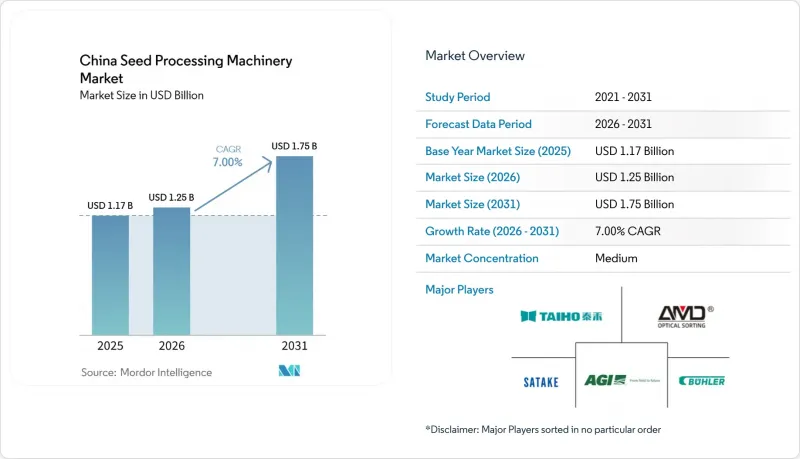
According to Mordor Intelligence, the China seed processing machinery market was valued at USD 1.17 billion in 2025 and is estimated to grow from USD 1.25 billion in 2026 to reach USD 1.75 billion by 2031, at a CAGR of 7% during the forecast period (2026-2031).
This report is Segmented by Machinery Type (Pre-Cleaners, Cleaners, Dryers, Graders, Polishers, Optical Sorters, Seed Packagers, and More), by Operation Mode (Automatic and Semi-Automatic), and by End-User (Commercial Seed Processing Plants, Seed Producers, On-Farm Facilities, and More). The Market Forecasts are Provided in Terms of Value (USD).
China Seed Processing Machinery Market Trends and Insights
Expansion of Certified Seed Production
China's first certified seeds reached commercial markets in early 2025, following the accreditation of 2 certification bodies and the registration of the first certification inspectors in 2024. The new system imposes stricter requirements for physical purity and germination than the previous approach. As a result, processors require graders, destoners, coaters, and cleaners within the same production line, making a basic cleaner insufficient for certified production needs. MARA's 2025 action on crop variety homogenization further supports the use of traceable, high-purity varieties. This is directing more capital spending toward post-harvest seed handling. The impact is most pronounced in Northeast China, where soybean and corn seed certification is expanding. The China seed processing machinery market stands to benefit as certification converts quality control from a voluntary process into a production requirement.
Government Subsidies for Seed Processing Equipment
The central government's 2025 subsidy list includes seed initial-processing equipment within agricultural machinery purchase support. This support is in accordance with the 2024-2026 national machinery purchase and application subsidy guidelines. Provincial programs can supplement central support and improve the economics of larger projects. Gansu seed production counties have provided facility and equipment subsidies covering up to 40% of installation costs. The national framework prioritizes high-performance and intelligent equipment, including optical sorters and automated grading systems. This makes replacing older mechanical lines more feasible for processors. The policy also increases the appeal of complete, multi-stage systems over stand-alone machines. Demand in China's seed processing machinery market is supported across major growing provinces, as the eligible equipment category is clearly defined.
High Upfront Cost of Optical Sorting Systems
Domestic optical sorters cost USD 105,000 per channel, while imported systems cost USD 235,000 per channel. Both prices are significantly above the USD 11,500 entry price of a small domestic air-screen cleaner. Most of China's estimated 25,000 installed processing lines handle less than 500 tonnes of seed per season. These operators often cannot justify the cost of optical sorting equipment within a payback period of less than 5 years. Retrofitting an optical sorter into an older mechanical line can add a 22.5% integration cost premium, raising the financial hurdle even when buyers do not replace the entire line. Equipment leasing and service-based models could reduce the initial financial burden, but subsidy eligibility still favors equipment purchases. Until financing options expand or equipment prices decline, cost will remain a limiting factor for adoption in smaller processing operations.
Other drivers and restraints analyzed in the detailed report include:
- Automation of Seed Quality Inspection
- Rising Demand for Export-Grade Seed Purity
- Fragmented Demand among Small and Medium Processors
For complete list of drivers and restraints, kindly check the Table Of Contents.
Segment Analysis
Cleaners accounted for 27.5% of revenue in 2025, making it the largest machinery category. Optical sorters is forecast to grow at the fastest rate, with a 11.5% CAGR through 2031, the highest among machinery types. Optical sorters generated 7-9 times the revenue per unit of standard cleaners, reflecting their domestic price of USD 105,000 per channel. Commercial plants increasingly specify multi-channel installations, so sorting revenue can rise faster than machine volumes.
China's AI-powered seed sorting represents a structural shift rather than an incremental upgrade. Research published by the Chinese Academy of Sciences (CAS) has validated a nondestructive laser-spectroscopy seed vitality detection system, achieving near-100% post-sorting germination rates. This indicates that future generations of optical sorters in China will be capable of detecting internal seed defects, an area where current equipment is limited to surface-level assessment. This capability gap between current and next-generation sorting is driving a replacement cycle for optical equipment, which domestic suppliers, including Hefei Taihe and Anhui Zhongke, are positioning to capture before international competitors can reprice their products.
Complete Report Scope:
- By Machinery Type
- Pre-Cleaners
- Cleaners
- Dryers
- Graders
- Coaters and Treaters
- Separators and Destoners
- Polishers
- Optical Sorters
- Seed Packagers
- Other Specialized Equipment
- By Operation Mode
- Automatic
- Semi-Automatic
- By End User
- Commercial Seed Processing Plants
- Seed Producers
- Research Institutions
- On-Farm Facilities
- Grain Handling Facilities
List of Companies Covered in this Report:
- Buhler AG
- Satake Corporation
- AGI
- Cimbria A/S
- Hefei Taihe Optoelectronic Technology Co., Ltd.
- Anhui Zhongke Optic-electronic Color Sorter Machinery Co., Ltd.
- Shijiazhuang Synmec International Trading, Ltd.
- Hebei Ruixue Grain Selecting Machinery Co., Ltd.
- Shijiazhuang Sanli Grain Sorting Machinery Co., Ltd.
- Shijiazhuang Dingliang Machinery Equipment Co., Ltd.
- Kaifeng Lecheng Machinery Co., Ltd.
- Hebei Beibu Machinery Technology Co., Ltd.
- Shijiazhuang Xinlu Technology Co., Ltd.
- Henan Zhongyuan Grain Machinery Co., Ltd.
- Shandong Sishui Sanyi Machinery Co., Ltd.
- Zhengzhou Aix Machinery Equipment Co., Ltd.
- Shijiazhuang Hongdefa Machinery Co., Ltd.
- Hefei Meyer Optoelectronic Technology Inc.
Additional Benefits:
- The market estimate (ME) sheet in Excel format
- 3 months of analyst support
TABLE OF CONTENTS
1 Introduction
- 1.1 Study Assumptions and Market Definition
- 1.2 Scope of the Study
2 Research Methodology
3 Executive Summary
4 Market Landscape
- 4.1 Market Overview
- 4.2 Market Drivers
- 4.2.1 Expansion of certified seed production
- 4.2.2 Government subsidies for seed processing equipment
- 4.2.3 Automation of seed quality inspection
- 4.2.4 Rising demand for export-grade seed purity
- 4.2.5 Growth of contract seed processing
- 4.2.6 Digital traceability requirements in seed processing
- 4.3 Market Restraints
- 4.3.1 High upfront cost of optical sorting systems
- 4.3.2 Fragmented demand among small and medium processors
- 4.3.3 Shortage of skilled commissioning and maintenance technicians
- 4.3.4 Inconsistent data and compliance requirements across provinces
- 4.4 Regulatory Landscape
- 4.5 Technological Outlook
- 4.6 Porter's Five Forces Analysis
- 4.6.1 Bargaining Power of Suppliers
- 4.6.2 Bargaining Power of Buyers
- 4.6.3 Threat of New Entrants
- 4.6.4 Threat of Substitutes
- 4.6.5 Intensity of Competitive Rivalry
5 Market Size And Growth Forecasts (Value)
- 5.1 By Machinery Type
- 5.1.1 Pre-Cleaners
- 5.1.2 Cleaners
- 5.1.3 Dryers
- 5.1.4 Graders
- 5.1.5 Coaters and Treaters
- 5.1.6 Separators and Destoners
- 5.1.7 Polishers
- 5.1.8 Optical Sorters
- 5.1.9 Seed Packagers
- 5.1.10 Other Specialized Equipment
- 5.2 By Operation Mode
- 5.2.1 Automatic
- 5.2.2 Semi-Automatic
- 5.3 By End User
- 5.3.1 Commercial Seed Processing Plants
- 5.3.2 Seed Producers
- 5.3.3 Research Institutions
- 5.3.4 On-Farm Facilities
- 5.3.5 Grain Handling Facilities
6 Competitive Landscape
- 6.1 Market Concentration
- 6.2 Strategic Moves
- 6.3 Market Share Analysis
- 6.4 Company Profiles (includes Global Level Overview, Market Level Overview, Core Segments, Financials as available, Strategic Information, Market Rank/Share, Products and Services, Recent Developments)
- 6.4.1 Buhler AG
- 6.4.2 Satake Corporation
- 6.4.3 AGI
- 6.4.4 Cimbria A/S
- 6.4.5 Hefei Taihe Optoelectronic Technology Co., Ltd.
- 6.4.6 Anhui Zhongke Optic-electronic Color Sorter Machinery Co., Ltd.
- 6.4.7 Shijiazhuang Synmec International Trading, Ltd.
- 6.4.8 Hebei Ruixue Grain Selecting Machinery Co., Ltd.
- 6.4.9 Shijiazhuang Sanli Grain Sorting Machinery Co., Ltd.
- 6.4.10 Shijiazhuang Dingliang Machinery Equipment Co., Ltd.
- 6.4.11 Kaifeng Lecheng Machinery Co., Ltd.
- 6.4.12 Hebei Beibu Machinery Technology Co., Ltd.
- 6.4.13 Shijiazhuang Xinlu Technology Co., Ltd.
- 6.4.14 Henan Zhongyuan Grain Machinery Co., Ltd.
- 6.4.15 Shandong Sishui Sanyi Machinery Co., Ltd.
- 6.4.16 Zhengzhou Aix Machinery Equipment Co., Ltd.
- 6.4.17 Shijiazhuang Hongdefa Machinery Co., Ltd.
- 6.4.18 Hefei Meyer Optoelectronic Technology Inc.
7 Market Opportunities And Future Outlook

