PUBLISHER: Mordor Intelligence | PRODUCT CODE: 2119045

PUBLISHER: Mordor Intelligence | PRODUCT CODE: 2119045
Liquid Alternate Fuel and Raw Materials (AFR) Firing Systems - Market Share Analysis, Industry Trends & Statistics, Growth Forecasts (2026 - 2031)
According to Mordor Intelligence, the liquid alternate fuel and Raw Materials Firing Systems Market size was valued at USD 172.34 million in 2025 and is estimated to grow from USD 185.61 million in 2026 to reach USD 258.11 million by 2031, at a CAGR of 6.82% during the forecast period (2026-2031).
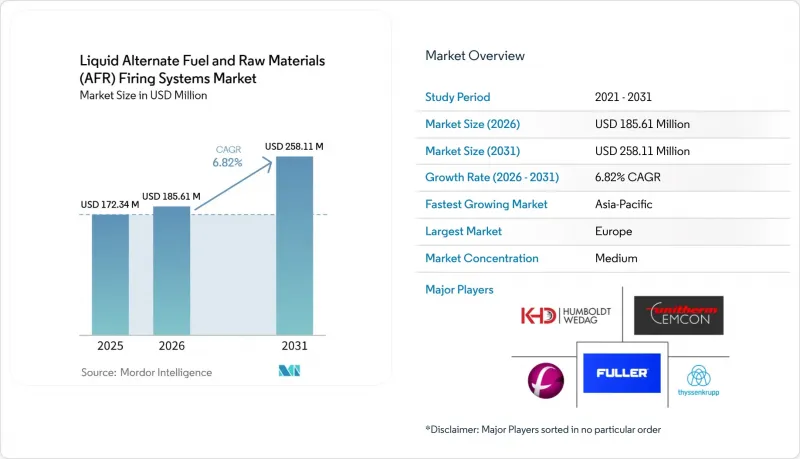
This report is Segmented by Burner and System Type (Rotary Kiln Main Burner, Calciner, Multi-Point, Others), Fuel Type (Waste Oils, Used Solvents, Liquid Biomass/Bio-Oils, Others), End-User Industry (Cement, Lime, Waste-To-Energy, Pulp & Paper, Others), and Geography (North America, Europe, Asia-Pacific, South America, and Middle East and Africa). The Market Forecasts are Provided in Terms of Value (USD).
Global Liquid Alternate Fuel and Raw Materials (AFR) Firing Systems Market Trends and Insights
Decarbonization Mandates and Emissions Cost Avoidance
Carbon pricing changes the cost of operating a kiln and makes lower-carbon fuel inputs more attractive. The EU Emissions Trading System gives cement producers a financial reason to replace fossil fuels with liquid alternative fuels that have lower or partly biogenic carbon content. Holcim's Eclepens plant increased its thermal substitution rate from 70% to nearly 95% within 6 months by expanding waste oil and animal fat use. The change reduced net CO2 emissions by 40,000 tonnes annually. China included cement producers in its national carbon emissions trading scheme and issued enterprise-level guidance for alternative-fuel accounting in June 2025. These rules increase demand in the Liquid AFR firing systems market for control systems that can measure and document fuel use and emissions.
Fossil Fuel Price Volatility and Energy Security
Energy represented 40% of cement production costs, leaving producers exposed to coal and petcoke price movements. Flexible systems that use waste oils and solvents can reduce that exposure when conventional fuel prices increase. A 2026 study found that replacing 40% of fuel with oily sludge reduced conventional production costs from CNY 392.89 to CNY 358.45 per tonne and reduced CO2 emissions by 13.17%. The result shows why imported-fuel markets in MEA and South Asia are considering liquid alternative fuels for supply security as well as for carbon management. Fuller Technologies evaluated its FUELFLEX Pyrolyzer in 2025 to produce pyrolysis oil from waste and RDF at cement plants. On-site production can reduce the Liquid AFR firing systems market's dependence on external liquid fuel supply chains.
High Retrofit Capital Expenditure and Integration Complexity
A legacy kiln needs more than a burner replacement to co-fire liquid alternative fuels safely. The required equipment can include dual-fluid atomization nozzles, preheating circuits, feed monitoring, emergency isolation, and control-system integration. These requirements make a full retrofit expensive before operating savings are realized. Research published in 2025 identified capital cost and technical integration as continuing barriers, particularly in lower-income markets without carbon-pricing incentives. Cement Australia's AUD 77.5 million kiln upgrade required a 45-day shutdown in 2026, illustrating why some operators delay extensive conversions. This constraint favors gradual co-firing in the Liquid AFR firing systems market, especially in South America and parts of Southeast Asia.
Other drivers and restraints analyzed in the detailed report include:
- Circular Economy and Landfill Diversion Requirements
- Cement Plant Modernization and Thermal Substitution Targets
- Variable Fuel Quality and Process Instability Risk
For complete list of drivers and restraints, kindly check the Table Of Contents.
Segment Analysis
Rotary Kiln Main Burner Liquid AFR Systems held 47.3% of the Liquid AFR firing systems market size in 2025. Their position reflects the main burner's role as the primary heat source in cement pyroprocessing. Most kiln modernization projects begin with this location because it has a large installed base and a clear operating role. Main burners can co-fire liquid, solid, and gaseous fuels in established plant layouts. Their use provides a practical first step for plants that are moving away from conventional fossil fuels. However, main burner substitution normally reaches 50-60% unless the plant adds satellite or multi-point capability. This limitation creates a reason for operators to consider more extensive injection configurations.
Multi-Point Liquid AFR Firing Systems are expected to grow at a 7.7% CAGR from 2026 to 2031. They distribute liquid fuel across the calciner, main burner, and satellite injection locations. This arrangement lets the operator adjust combustion to fuel quality and kiln load. A 2026 study found that specific mixed liquid-waste ratios can reduce CO emissions by as much as 93.29% against single-fuel baseline cases. European emissions-monitoring requirements also favor systems that offer precise and traceable injection control. Calciner systems remain another major category because they can achieve 80-100% thermal substitution in the precalciner zone. KHD's Pyrorotor installations demonstrate how calciner equipment can process lower-quality fuel streams. Other systems include satellite burners that provide a lower-capital route to incremental substitution gains.
Complete Report Scope:
- By Burner and System Type
- Rotary Kiln Main Burner Liquid AFR Systems
- Calciner Liquid AFR Firing Systems
- Multi-Point Liquid AFR Firing Systems
- Others
- By Fuel Type
- Waste Oils
- Used Solvents and Liquid Chemical Residues
- Liquid Biomass and Bio-Oils
- Sewage Sludge and Pumpable Slurries
- Others
- By End-User Industry
- Cement Industry
- Lime Industry
- Waste-to-Energy Plants
- Pulp & Paper Industry
- Other Industrial Kilns and Furnaces
- By Geography
- North America
- United States
- Canada
- Mexico
- Europe
- Germany
- France
- Italy
- Spain
- United Kingdom
- Poland
- Russia
- Rest of Europe
- Asia-Pacific
- China
- India
- Japan
- South Korea
- Australia
- Indonesia
- Vietnam
- Thailand
- Rest of Asia-Pacific
- South America
- Brazil
- Argentina
- Chile
- Rest of South America
- Middle East and Africa
- Saudi Arabia
- United Arab Emirates
- Egypt
- South Africa
- Morocco
- Rest of Middle East and Africa
- North America
Geography Analysis
Europe held 41.3% of the Liquid AFR firing systems market share in 2025. EU carbon costs, landfill-diversion requirements, and long-established waste infrastructure support a consistent liquid fuel supply. France, Germany, Italy, Poland, and Spain are the region's main high-volume markets. Austria and Switzerland have demonstrated high thermal substitution performance. Holcim's Eclepens plant reached nearly 95% substitution within 6 months and reduced net CO2 output by 40,000 tonnes a year. Europe's upcoming Industrial Emissions Directive requirements are likely to increase spending on monitoring and control equipment through the late 2020s.
Asia-Pacific is projected to expand at an 8.7% CAGR from 2026 to 2031, the fastest rate among the geographic segments. China's inclusion of cement in its national carbon market gives alternative-fuel investments a clearer financial basis. KHD commissioned its second Pyrorotor system for Conch Group's Baoshan plant in December 2025. Conch then stated that it would assess further installations across its network. Indonesia's Semen Baturaja increased liquid-inclusive AFR use by 41% in 2024 and raised thermal substitution to 3.18%. India's plants averaged 3-5% thermal substitution, leaving material capacity for additional system adoption.
North America, South America, and MEA have different demand conditions. North America's average thermal substitution rate was 16% in 2024, compared with 52% in Europe, and fuel security remains a stronger motivation than carbon pricing. South America is building momentum through circular-economy initiatives and combustion-system investment. The Middle East and Africa have direct fuel-conversion opportunities, but projects are shaped by local policy and capital availability. Sinoma signed a USD 12 million EPC contract with Qassim Cement in August 2025 to convert Buraydah plant lines from crude oil firing to natural gas. The project had a 15-month schedule.
- A TEC Production & Services GmbH
- Dynamis Ltd.
- FCT Combustion Pty Ltd
- Fives Group
- Fuller Technologies, Inc.
- GRECO Combustion Systems Europe GmbH
- KHD Humboldt Wedag International AG
- SATAREM S.A.
- Sinoma International Engineering Co., Ltd.
- thyssenkrupp Polysius GmbH
- Unitherm Cemcon Feuerungsanlagen GmbH
Additional Benefits:
- The market estimate (ME) sheet in Excel format
- 3 months of analyst support
TABLE OF CONTENTS
1 INTRODUCTION
- 1.1 Study Assumptions and Market Definition
- 1.2 Scope of the Study
2 RESEARCH METHODOLOGY
3 EXECUTIVE SUMMARY
4 MARKET LANDSCAPE
- 4.1 Market Overview
- 4.2 Market Drivers
- 4.2.1 Decarbonization Mandates and Emissions-Cost Avoidance
- 4.2.2 Fossil-Fuel Price Volatility and Energy-Security Priorities
- 4.2.3 Circular-Economy and Landfill-Diversion Requirements
- 4.2.4 Cement-Plant Modernization and Thermal Substitution Targets
- 4.2.5 Liquid AFR Specification Variability Driving Adaptive Atomization Demand
- 4.2.6 Localized Waste Logistics and Seasonal Feedstock Availability
- 4.3 Market Restraints
- 4.3.1 High Retrofit Capex and Integration Complexity
- 4.3.2 Variable Fuel Quality and Process-Instability Risk
- 4.3.3 Hazardous-Liquid Handling Permitting and Liability Exposure
- 4.3.4 Contaminant-Driven Corrosion and Burner-Tip Wear
- 4.4 Value Chain Analysis
- 4.5 Technology Outlook
- 4.6 Regulatory Landscape
- 4.7 Porter's Five Forces Analysis
- 4.7.1 Bargaining Power of Suppliers
- 4.7.2 Bargaining Power of Buyers
- 4.7.3 Threat of New Entrants
- 4.7.4 Threat of Substitutes
- 4.7.5 Competitive Rivalry
5 MARKET SIZE AND GROWTH FORECASTS
- 5.1 By Burner and System Type
- 5.1.1 Rotary Kiln Main Burner Liquid AFR Systems
- 5.1.2 Calciner Liquid AFR Firing Systems
- 5.1.3 Multi-Point Liquid AFR Firing Systems
- 5.1.4 Others
- 5.2 By Fuel Type
- 5.2.1 Waste Oils
- 5.2.2 Used Solvents and Liquid Chemical Residues
- 5.2.3 Liquid Biomass and Bio-Oils
- 5.2.4 Sewage Sludge and Pumpable Slurries
- 5.2.5 Others
- 5.3 By End-User Industry
- 5.3.1 Cement Industry
- 5.3.2 Lime Industry
- 5.3.3 Waste-to-Energy Plants
- 5.3.4 Pulp & Paper Industry
- 5.3.5 Other Industrial Kilns and Furnaces
- 5.4 By Geography
- 5.4.1 North America
- 5.4.1.1 United States
- 5.4.1.2 Canada
- 5.4.1.3 Mexico
- 5.4.2 Europe
- 5.4.2.1 Germany
- 5.4.2.2 France
- 5.4.2.3 Italy
- 5.4.2.4 Spain
- 5.4.2.5 United Kingdom
- 5.4.2.6 Poland
- 5.4.2.7 Russia
- 5.4.2.8 Rest of Europe
- 5.4.3 Asia-Pacific
- 5.4.3.1 China
- 5.4.3.2 India
- 5.4.3.3 Japan
- 5.4.3.4 South Korea
- 5.4.3.5 Australia
- 5.4.3.6 Indonesia
- 5.4.3.7 Vietnam
- 5.4.3.8 Thailand
- 5.4.3.9 Rest of Asia-Pacific
- 5.4.4 South America
- 5.4.4.1 Brazil
- 5.4.4.2 Argentina
- 5.4.4.3 Chile
- 5.4.4.4 Rest of South America
- 5.4.5 Middle East and Africa
- 5.4.5.1 Saudi Arabia
- 5.4.5.2 United Arab Emirates
- 5.4.5.3 Egypt
- 5.4.5.4 South Africa
- 5.4.5.5 Morocco
- 5.4.5.6 Rest of Middle East and Africa
- 5.4.1 North America
6 COMPETITIVE LANDSCAPE
- 6.1 Market Concentration
- 6.2 Strategic Moves
- 6.3 Market Share Analysis
- 6.4 Company Profiles (includes Global Level Overview, Market Level Overview, Core Segments, Financials as available, Strategic Information, Market Rank/Share, Products and Services, Recent Developments)
- 6.4.1 A TEC Production & Services GmbH
- 6.4.2 Dynamis Ltd.
- 6.4.3 FCT Combustion Pty Ltd
- 6.4.4 Fives Group
- 6.4.5 Fuller Technologies, Inc.
- 6.4.6 GRECO Combustion Systems Europe GmbH
- 6.4.7 KHD Humboldt Wedag International AG
- 6.4.8 SATAREM S.A.
- 6.4.9 Sinoma International Engineering Co., Ltd.
- 6.4.10 thyssenkrupp Polysius GmbH
- 6.4.11 Unitherm Cemcon Feuerungsanlagen GmbH
7 MARKET OPPORTUNITIES AND FUTURE OUTLOOK
- 7.1 White-Space and Unmet-Need Assessment

