PUBLISHER: Mordor Intelligence | PRODUCT CODE: 2119096

PUBLISHER: Mordor Intelligence | PRODUCT CODE: 2119096
Pharma Digital Engagement Services - Market Share Analysis, Industry Trends & Statistics, Growth Forecasts (2026 - 2031)
According to Mordor Intelligence, the pharma digital engagement services market size is projected to expand from USD 8.42 billion in 2025 to USD 9.16 billion in 2026, and to USD 14.61 billion by 2031, registering a CAGR of 9.79% between 2026 and 2031.
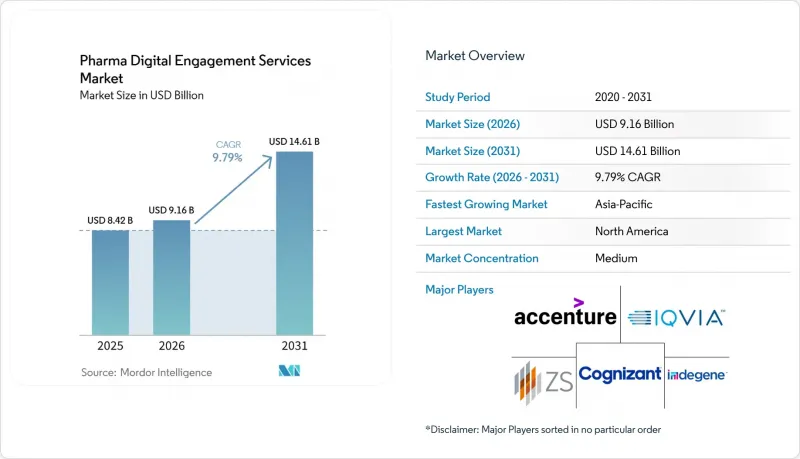
This report is Segmented by Service Type (Omnichannel Strategy and Consulting Services, HCP Engagement Services, Patient Education and Support Services, and Medical Content and Scientific Communication Services), Therapeutic Area (Oncology, Immunology, Neurology, Cardiometabolic Diseases, and More), and Geography. The Market Forecasts are Provided in Terms of Value (USD).
Global Pharma Digital Engagement Services Market Trends and Insights
Declining HCP Access Raises Demand for Digital-First Engagement
The Pharma digital engagement services market is responding to a structural reduction in face-to-face access to prescribers. Veeva reported that U.S. HCP access fell from 60% to 45% between 2023 and 2024, requiring commercial teams to give digital contact a larger role. Digital interactions accounted for 51% of pharma-HCP engagements in 2025, but increased activity did not automatically lead to better experiences. Simplicity, trust, and relevance now differentiate providers as brands move beyond basic email and website programs. This supports demand for personalized portals, clear authentication, and clinically relevant content sequencing. The Pharma digital engagement services market benefits as brands replace isolated channel activity with programs designed around the HCP journey.
Omnichannel Budget Reallocation Across HCP and Patient Journeys
The Pharma digital engagement services market is gaining support as companies reconsider the balance between in-person, digital, and hybrid promotion. A CSL Vifor analysis across 8 European markets found that 81% of promotional spending went to in-person channels, while reallocation improved return on investment from 5.1 times to 5.8 times. The same analysis reported a 10% increase in incremental sales in Germany after the revised allocation. HCP and direct-to-consumer spending often remain in separate organizational groups, even when connected physician and patient education is needed. Orchestration services organize scientific information and patient support across channels while preserving the distinct requirements of each audience. AI-supported next-best-action tools are more useful when unified data connects approved content, field activity, and digital engagement signals.
Privacy and Data-Use Restrictions Limit Cross-Channel Measurement
Privacy rules limit the ability to connect information across engagement touchpoints. GDPR Article 9 treats health information as a special category of data, requiring explicit consent and careful controls over processing in Europe. In the United States, scrutiny of tracking tools has increased concern about disclosure of protected health information in patient-facing settings. Brands may need tokenized data, clean-room environments, and additional legal review before they can assess engagement outcomes. Authentication and consent requests can also reduce HCP completion of a digital journey when the process is repeated across platforms. This can lengthen deployment timelines and make privacy-by-design capability a central selection factor.
Other drivers and restraints analyzed in the detailed report include:
- Specialty and Rare Disease Launches Need Precision Education at Scale
- Medical Affairs Digitalization Expands Scientific Engagement Outsourcing
- Fragmented Commercial, Medical, and Data Stacks Delay Orchestration
For complete list of drivers and restraints, kindly check the Table Of Contents.
Segment Analysis
HCP Engagement Services held 30.31% market share in the Pharma digital engagement services market in 2025. The segment includes field-force support, digital follow-up, HCP portals, and messaging integrated into electronic health record workflows. OptimizeRx reported that an AI-enabled electronic health record omnichannel strategy for a chemotherapy brand achieved a 10.5% script lift and a 7.4:1 return on investment. Veeva offers HCP measurement that links media exposure with prescribing behavior at the National Provider Identifier level, increasing expectations for accountable programs. Patient education, support services, medical content, and scientific communications also grow as specialty launches require information in multiple approved formats.
Omnichannel Strategy and Orchestration Services is projected to grow at a 10.11% CAGR through 2031 within the Pharma digital engagement services market. It coordinates engagement across commercial, medical, and patient touchpoints rather than operating each channel in isolation. Veeva acquired Ostro in March 2026 for USD 100 million in cash and long-term equity retention grants, adding conversational AI capabilities for HCP and patient interactions. More than 125 companies were undertaking CRM transition projects in 2026, creating implementation and consulting work. The Pharma digital engagement services market depends on connecting channel data, approved content, and workflow rules without creating a burdensome operating model.
Complete Report Scope:
- By Service Type
- Omnichannel Strategy and Consulting Services
- HCP Engagement Services
- Patient Education and Support Services
- Medical Content and Scientific Communication Services
- By Therapeutic Area
- Oncology
- Immunology
- Neurology
- Cardiometabolic Diseases
- Vaccines and Infectious Diseases
- Other Therapeutic Areas
- By Geography
- North America
- United States
- Canada
- Mexico
- South America
- Brazil
- Argentina
- Chile
- Rest of South America
- Europe
- Germany
- United Kingdom
- France
- Italy
- Spain
- Rest of Europe
- Asia-Pacific
- China
- Japan
- India
- South Korea
- Australia
- Rest of Asia-Pacific
- Middle East
- United Arab Emirates
- Saudi Arabia
- Qatar
- Rest of Middle East
- Africa
- South Africa
- Egypt
- Nigeria
- Rest of Africa
- North America
Geography Analysis
North America held 42.39% of regional revenue in 2025. The Pharma digital engagement services market in North America combines large pharmaceutical commercial operations with established HCP data infrastructure, CRM use, electronic health record advertising, and healthcare media networks. U.S. business-to-business pharma digital advertising spending reached USD 2.3 billion in 2026, increasing 9.3% from 2025. Veeva reported that more than 125 customers were live on Vault CRM in March 2026, creating needs in configuration, data transfer, training, and change management. Canada and Mexico add regional demand as multinational affiliates extend the United States platform designs across North America.
Europe remains a major contributor to the Pharma digital engagement services market because Germany, the United Kingdom, France, Italy, and Spain have significant commercial engagement activity. Within the Pharma digital engagement services market in Europe, consent requirements shape digital measurement and audience management across the region. Italy showed the strongest preference for face-to-face engagement among EU5 markets, at 46% in November 2025. The United Kingdom showed greater digital movement, with email preference rising from 10% in 2023 to 14% in 2024. These differences favor configurable regional services, while Brazil and Argentina support earlier-stage program adoption in South America.
Asia-Pacific is projected to expand at a 10.19% CAGR through 2031 in the Pharma digital engagement services market. The Pharma digital engagement services market in Asia-Pacific is supported by China, India, and Japan building HCP engagement infrastructure, and by physicians retaining a strong preference for digital interaction. More than 750 healthcare institutions in China had deployed DeepSeek-R1 by May 2025 to access clinical information within hospital infrastructure. India has expanded its verified HCP audience infrastructure to support targeted programmatic engagement. The Middle East and Africa are smaller developing areas, building verified HCP identity and compliance-aware content systems for later omnichannel deployment.
- IQVIA Holdings Inc.
- Veeva Systems Inc.
- Indegene Limited
- EVERSANA, Inc.
- Syneos Health, Inc.
- Accenture plc
- Cognizant Technology Solutions Corporation
- Salesforce, Inc.
- Adobe Inc.
- Oracle Corporation
- Medidata Solutions, Inc.
- Aktana, Inc.
- Axtria, Inc.
- Appian Corporation
- Anthill Solutions, Inc.
- Inovalon Holdings, Inc.
- WebMD Health Corp.
- Inizio Group Holdings Limited
- Real Chemistry Holdings, Inc.
- OptimizeRx Corporation
- RightSpend Limited
- SpotSource, Inc.
Additional Benefits:
- The market estimate (ME) sheet in Excel format
- 3 months of analyst support
TABLE OF CONTENTS
1 INTRODUCTION
- 1.1 Study Assumptions and Market Definition
- 1.2 Scope of the Study
2 RESEARCH METHODOLOGY
3 EXECUTIVE SUMMARY
4 MARKET LANDSCAPE
- 4.1 Market Overview
- 4.2 Market Drivers
- 4.2.1 Declining HCP Access Raises Demand for Digital-First Engagement
- 4.2.2 Omnichannel Budget Reallocation Across HCP and Patient Journeys
- 4.2.3 Specialty and Rare Disease Launches Need Precision Education at Scale
- 4.2.4 Medical Affairs Digitalization Expands Scientific Engagement Outsourcing
- 4.2.5 Consent and Identity Infrastructure Unlocks Logged-In HCP Reach
- 4.2.6 AI-Native Modular Content Operations Improve Speed-to-Channel Economics
- 4.3 Market Restraints
- 4.3.1 Privacy and Data-Use Restrictions Limit Cross-Channel Measurement
- 4.3.2 Fragmented Commercial, Medical, and Data Stacks Delay Orchestration
- 4.3.3 HCP Authentication and Consent Friction Suppresses Known-User Scale
- 4.3.4 Content Approval Debt Constrains Personalization at Scale
- 4.4 Impact of Macroeconomic Factors on the Market
- 4.5 Industry Value-Chain Analysis
- 4.6 Technology Outlook
- 4.7 Regulatory Landscape
- 4.8 Porter's Five Forces Analysis
- 4.8.1 Threat of New Entrants
- 4.8.2 Bargaining Power of Suppliers
- 4.8.3 Bargaining Power of Buyers
- 4.8.4 Threat of Substitutes
- 4.8.5 Intensity of Competitive Rivalry
5 MARKET SIZE AND GROWTH FORECASTS (VALUE)
- 5.1 By Service Type
- 5.1.1 Omnichannel Strategy and Consulting Services
- 5.1.2 HCP Engagement Services
- 5.1.3 Patient Education and Support Services
- 5.1.4 Medical Content and Scientific Communication Services
- 5.2 By Therapeutic Area
- 5.2.1 Oncology
- 5.2.2 Immunology
- 5.2.3 Neurology
- 5.2.4 Cardiometabolic Diseases
- 5.2.5 Vaccines and Infectious Diseases
- 5.2.6 Other Therapeutic Areas
- 5.3 By Geography
- 5.3.1 North America
- 5.3.1.1 United States
- 5.3.1.2 Canada
- 5.3.1.3 Mexico
- 5.3.2 South America
- 5.3.2.1 Brazil
- 5.3.2.2 Argentina
- 5.3.2.3 Chile
- 5.3.2.4 Rest of South America
- 5.3.3 Europe
- 5.3.3.1 Germany
- 5.3.3.2 United Kingdom
- 5.3.3.3 France
- 5.3.3.4 Italy
- 5.3.3.5 Spain
- 5.3.3.6 Rest of Europe
- 5.3.4 Asia-Pacific
- 5.3.4.1 China
- 5.3.4.2 Japan
- 5.3.4.3 India
- 5.3.4.4 South Korea
- 5.3.4.5 Australia
- 5.3.4.6 Rest of Asia-Pacific
- 5.3.5 Middle East
- 5.3.5.1 United Arab Emirates
- 5.3.5.2 Saudi Arabia
- 5.3.5.3 Qatar
- 5.3.5.4 Rest of Middle East
- 5.3.6 Africa
- 5.3.6.1 South Africa
- 5.3.6.2 Egypt
- 5.3.6.3 Nigeria
- 5.3.6.4 Rest of Africa
- 5.3.1 North America
6 COMPETITIVE LANDSCAPE
- 6.1 Market Concentration
- 6.2 Strategic Moves
- 6.3 Market Share Analysis
- 6.4 Company Profiles (includes Global Level Overview, Market Level Overview, Core Segments, Financials as available, Strategic Information, Market Rank/Share, Products and Services, Recent Developments)
- 6.4.1 IQVIA Holdings Inc.
- 6.4.2 Veeva Systems Inc.
- 6.4.3 Indegene Limited
- 6.4.4 EVERSANA, Inc.
- 6.4.5 Syneos Health, Inc.
- 6.4.6 Accenture plc
- 6.4.7 Cognizant Technology Solutions Corporation
- 6.4.8 Salesforce, Inc.
- 6.4.9 Adobe Inc.
- 6.4.10 Oracle Corporation
- 6.4.11 Medidata Solutions, Inc.
- 6.4.12 Aktana, Inc.
- 6.4.13 Axtria, Inc.
- 6.4.14 Appian Corporation
- 6.4.15 Anthill Solutions, Inc.
- 6.4.16 Inovalon Holdings, Inc.
- 6.4.17 WebMD Health Corp.
- 6.4.18 Inizio Group Holdings Limited
- 6.4.19 Real Chemistry Holdings, Inc.
- 6.4.20 OptimizeRx Corporation
- 6.4.21 RightSpend Limited
- 6.4.22 SpotSource, Inc.
7 MARKET OPPORTUNITIES AND FUTURE OUTLOOK
- 7.1 White-Space and Unmet-Need Assessment

