PUBLISHER: Mordor Intelligence | PRODUCT CODE: 2119103

PUBLISHER: Mordor Intelligence | PRODUCT CODE: 2119103
China Autonomous Agricultural Tractor - Market Share Analysis, Industry Trends & Statistics, Growth Forecasts (2026 - 2031)
According to Mordor Intelligence, the China autonomous agricultural tractor market was valued at USD 0.65 billion in 2025 and is estimated to grow from USD 0.79 billion in 2026 and reach USD 2.17 billion by 2031, at a CAGR of 22.4% during the forecast period (2026-2031).
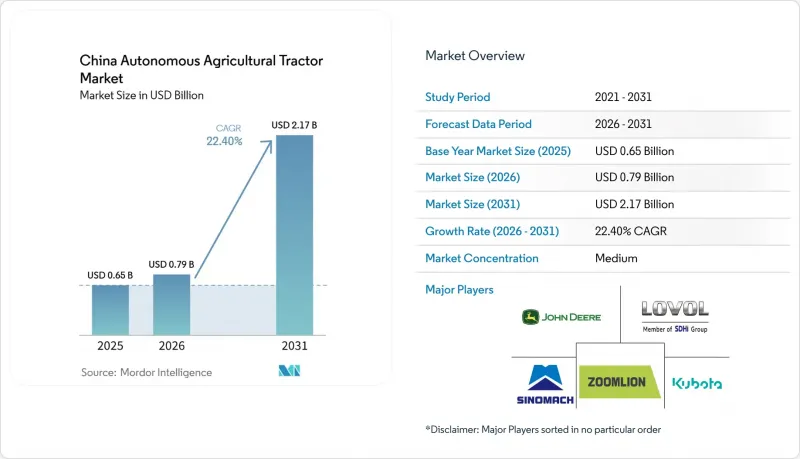
This report is Segmented by Horsepower (Up To 30 HP, 31-100 HP and Above 100 HP), by Automation Level (Fully Autonomous and Semi-Autonomous), by Drive Type (Diesel, Hybrid, and Battery-Electric), by Application (Tillage, Sowing, and More), by Component (GPS/GNSS, Lidar and Radar Modules, and More), and by Farm Size (Small, Medium, and Large). The Market Forecasts are Provided in Terms of Value (USD).
China Autonomous Agricultural Tractor Market Trends and Insights
Government-Led Smart Agriculture and BeiDou Deployment
The China autonomous agricultural tractor market is closely linked to the country's smart agriculture agenda and the adoption of BeiDou navigation technology. Government support for BeiDou-enabled autonomous equipment, together with standards governing automatic driving systems for agricultural machinery, provides equipment buyers with a clearer framework for procurement, certification, and subsidy eligibility. These policies also favor systems designed around domestic navigation infrastructure over products developed solely for foreign satellite-navigation platforms. The Ministry of Agriculture and Rural Affairs (MARA) and the Ministry of Industry and Information Technology (MIIT) continue to shape subsidy policies and priorities for intelligent agricultural equipment modernization.
Agricultural Labor Shortages and Rising Rural Labor Costs
The China autonomous agricultural tractor market addresses the challenge of securing workers during spring plowing and autumn harvest seasons. Rising labor costs and seasonal labor shortages are increasing farmers' willingness to adopt labor-saving technologies, particularly where agricultural extension services support technology adoption. Cooperative managers can therefore evaluate autonomous equipment based on its ability to reduce peak-season staffing risks, rather than annual wage costs alone. This strengthens the value proposition for tractors that can maintain consistent field operations while enabling operators to oversee multiple tasks. The benefits are most pronounced on larger farms, where higher equipment utilization can justify the initial investment.
High Upfront Cost and Uneven Return on Investment for Smallholders
A fully equipped autonomous tractor requires a substantial upfront investment, including sensors, control units, navigation software, and connectivity hardware. Although government subsidy programs help reduce acquisition costs for qualifying intelligent machinery, the remaining investment can still be difficult for small operators to recover through annual use. Large-field systems are also less suited to irregular plots, where travel and setup time reduce operational efficiency. Cooperative ownership and machinery as a service models can lower the entry barrier, but they do not eliminate all field-access challenges. As a result, adoption among smallholders is anticipated to progress more gradually than fleet deployment on larger farms.
Other drivers and restraints analyzed in the detailed report include:
- Precision Farming and Input Optimization Requirements
- Expansion of Large-Scale Farming and Agricultural Service Cooperatives
- Fragmented Farm Parcels and Limited Operating Economies of Scale
For complete list of drivers and restraints, kindly check the Table Of Contents.
Segment Analysis
The 31-100 HP class held 38.9% of the China autonomous agricultural tractor market share in 2025. This range is suited to rice, wheat, and corn operations and the field sizes found at state farms and established cooperatives. Existing chassis designs in this class can be paired with BeiDou RTK retrofit systems, giving farm operators a way to add automated guidance without replacing entire tractor fleets. Machines up to 30 HP serve small fields and orchards, but parcel fragmentation continues to limit their adoption even as retrofit packages become more widely available.
The above 100 HP segment is forecast to expand at a 23.4% CAGR between 2026 and 2031. Demand is supported by large grain farms in Heilongjiang, Inner Mongolia, and Xinjiang, where wide fields allow machines to cover more land per day. In September 2025, Zoomlion introduced the DX7004, a 1,200 HP hybrid tractor designed for large-area operations. The company stated that the model could cover 480 hectares per day, offering cooperative buyers a way to align tractor capacity with larger farm units. The shift from mid-range to higher-power procurement reflects the growing role of consolidated farms in the China autonomous agricultural tractor market.
Semi-autonomous systems held 67.6% of the China autonomous agricultural tractor market share in 2025. These systems reduce manual steering demands while retaining an operator for monitoring and field decisions. This arrangement requires less calibration and training than a fully autonomous configuration, making it suitable for cooperatives that are adding automation in stages.
Fully autonomous systems are forecast to expand at a 22.5% CAGR between 2026 and 2031. Buyers increasingly consider whether a tractor's technical architecture can support future upgrades, rather than evaluating only its initial autonomy level. Open-integration systems can alter lifetime cost calculations, as additional capabilities may be added throughout the tractor's operating life. National standards for autonomous driving systems provide a common framework for equipment certification and support eligibility for government incentive programs. This regulatory environment encourages a gradual transition from driver-assisted systems to more autonomous configurations. The near-term lead held by semi-autonomous systems is consistent with the limited availability of trained technicians and operators.
Complete Report Scope:
- By Horsepower
- Up to 30 HP
- 31-100 HP
- Above 100 HP
- By Automation Level
- Semi-Autonomous
- Fully Autonomous
- By Drive Type
- Diesel
- Hybrid
- Battery-Electric
- By Application
- Tillage
- Sowing
- Harvesting
- Orchard and Vineyard Operations
- By Component
- GPS/GNSS
- Sensors and Vision Systems
- Camera and Vision Systems
- LiDAR and Radar Modules
- Control and Navigation Software
- By Farm Size
- Small Farms (Less100 Hectares)
- Medium Farms (100-500 Hectares)
- Large Farms (More than 500 Hectares)
List of Companies Covered in this Report:
- YTO Group Corporation (China National Machinery Industry Corporation)
- Lovol Heavy Industry Co., Ltd.
- Zoomlion Heavy Industry Science and Technology Co., Ltd.
- Deere and Company
- CNH Industrial N.V.
- AGCO Corporation
- Kubota Corporation
- Yanmar Holdings Co., Ltd.
- TYM Corporation
- ISEKI & Co., Ltd.
- Shandong Wuzheng Group Co., Ltd.
- Jiangsu Yueda Intelligent Agricultural Equipment Co., Ltd. (Jiangsu Yueda Group Co., Ltd.)
- Changzhou Dongfeng Agricultural Machinery Group Co., Ltd.
- XAG Co., Ltd.
Additional Benefits:
- The market estimate (ME) sheet in Excel format
- 3 months of analyst support
TABLE OF CONTENTS
1 INTRODUCTION
- 1.1 Study Assumptions and Market Definition
- 1.2 Scope of the Study
2 RESEARCH METHODOLOGY
3 EXECUTIVE SUMMARY
4 MARKET LANDSCAPE
- 4.1 Market Overview
- 4.2 Market Drivers
- 4.2.1 Government-led smart agriculture and BeiDou deployment
- 4.2.2 Agricultural labor shortages and rising rural labor costs
- 4.2.3 Precision farming and input optimization requirements
- 4.2.4 Expansion of large-scale farming and agricultural service cooperatives
- 4.2.5 Small-plot autonomy enabled by retrofit and shared-use models
- 4.2.6 China-specific localization of autonomous agricultural machinery
- 4.3 Market Restraints
- 4.3.1 High upfront cost and uneven return on investment for smallholders
- 4.3.2 Fragmented farm parcels and limited operating economies of scale
- 4.3.3 Data governance, cybersecurity, and cross-border technology constraints
- 4.3.4 Limited local service, calibration, and autonomous-system maintenance capacity
- 4.4 Regulatory Landscape
- 4.5 Technological Outlook
- 4.6 Porter's Five Forces Analysis
- 4.6.1 Bargaining Power of Suppliers
- 4.6.2 Bargaining Power of Buyers
- 4.6.3 Threat of New Entrants
- 4.6.4 Threat of Substitutes
- 4.6.5 Intensity of Competitive Rivalry
5 MARKET SIZE AND GROWTH FORECASTS (VALUE)
- 5.1 By Horsepower
- 5.1.1 Up to 30 HP
- 5.1.2 31-100 HP
- 5.1.3 Above 100 HP
- 5.2 By Automation Level
- 5.2.1 Semi-Autonomous
- 5.2.2 Fully Autonomous
- 5.3 By Drive Type
- 5.3.1 Diesel
- 5.3.2 Hybrid
- 5.3.3 Battery-Electric
- 5.4 By Application
- 5.4.1 Tillage
- 5.4.2 Sowing
- 5.4.3 Harvesting
- 5.4.4 Orchard and Vineyard Operations
- 5.5 By Component
- 5.5.1 GPS/GNSS
- 5.5.2 Sensors and Vision Systems
- 5.5.3 Camera and Vision Systems
- 5.5.4 LiDAR and Radar Modules
- 5.5.5 Control and Navigation Software
- 5.6 By Farm Size
- 5.6.1 Small Farms (Less100 Hectares)
- 5.6.2 Medium Farms (100-500 Hectares)
- 5.6.3 Large Farms (More than 500 Hectares)
6 COMPETITIVE LANDSCAPE
- 6.1 Market Concentration
- 6.2 Strategic Moves
- 6.3 Market Share Analysis
- 6.4 Company Profiles (Includes Global Level Overview, Market Level Overview, Core Segments, Financials as Available, Strategic Information, Market Rank/Share, Products and Services, Recent Developments)
- 6.4.1 YTO Group Corporation (China National Machinery Industry Corporation)
- 6.4.2 Lovol Heavy Industry Co., Ltd.
- 6.4.3 Zoomlion Heavy Industry Science and Technology Co., Ltd.
- 6.4.4 Deere and Company
- 6.4.5 CNH Industrial N.V.
- 6.4.6 AGCO Corporation
- 6.4.7 Kubota Corporation
- 6.4.8 Yanmar Holdings Co., Ltd.
- 6.4.9 TYM Corporation
- 6.4.10 ISEKI & Co., Ltd.
- 6.4.11 Shandong Wuzheng Group Co., Ltd.
- 6.4.12 Jiangsu Yueda Intelligent Agricultural Equipment Co., Ltd. (Jiangsu Yueda Group Co., Ltd.)
- 6.4.13 Changzhou Dongfeng Agricultural Machinery Group Co., Ltd.
- 6.4.14 XAG Co., Ltd.
7 MARKET OPPORTUNITIES AND FUTURE OUTLOOK

