PUBLISHER: Mordor Intelligence | PRODUCT CODE: 2119151

PUBLISHER: Mordor Intelligence | PRODUCT CODE: 2119151
Expandable Microspheres - Market Share Analysis, Industry Trends & Statistics, Growth Forecasts (2026 - 2031)
According to Mordor Intelligence, the expandable microspheres market size was valued at USD 0.67 billion in 2025 and is estimated to grow from USD 0.72 billion in 2026 to reach USD 1.10 billion by 2031, at a CAGR of 8.85% during the forecast period (2026-2031).
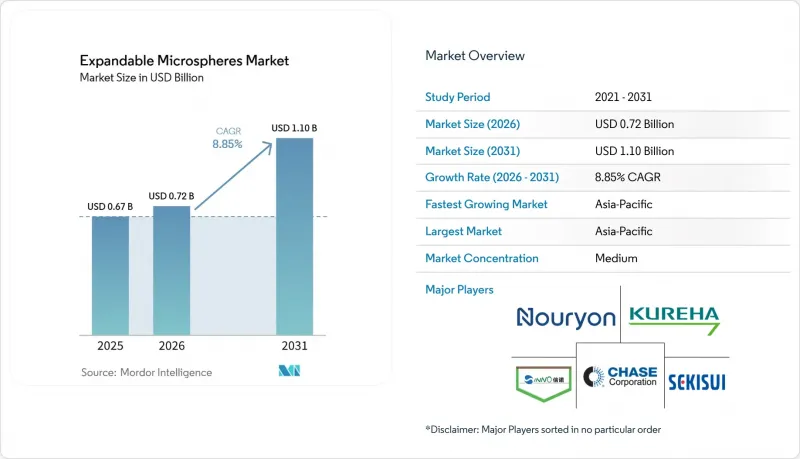
This report is Segmented by Type (Dry and Wet), Polymer Type (Polyacrylic Ester (PAE), Polyvinyl Acetate (PVA), and Vinyl Acetate Ethylene (VAE)), End-User Industry (Automotive, Construction, and More), and Geography (Asia-Pacific, North America, Europe, South America, and Middle-East and Africa). The Market Forecasts are Provided in Terms of Value (USD).
Global Expandable Microspheres Market Trends and Insights
Rising Demand for Lightweight Polymer-Modified Materials
The need to reduce product weight is driving demand for filler systems that preserve mechanical performance. Expandable microspheres can reduce part density by up to 40% at use levels of 1% to 2% by weight. This efficiency supports their use in polymer compounds where manufacturers seek lower weight without major process changes. Fuel economy requirements in the United States, China, and the European Union continue to reinforce the value of lighter vehicle components. Battery electric vehicles add further pressure to control mass, particularly in assemblies around battery systems. Nouryon states that Expancel HP 92 supports low density and pressure resistance in automotive underbody coatings, reflecting the performance requirements of these applications.
Growing Adoption in Thermal Insulation and Energy-Efficient Building Materials
Energy-efficient construction is increasing demand for insulation additives that can be incorporated into existing coatings, lightweight concrete, joint compounds, and wall panels. Expandable microspheres create closed-cell air structures that can lower thermal conductivity and reduce transport weight. This allows building material producers to improve thermal performance without redesigning the full construction system. The revised Energy Performance of Buildings Directive entered into force in May 2024 and sets requirements for new buildings and renovation activities across the European Union. These requirements support a longer procurement cycle for materials used in thermal insulation. The expandable microspheres market is also finding opportunities in intumescent coatings and thin thermal layers for prefabricated panels used in South and Southeast Asia.
Volatility in Raw Material Prices for Specialty Polymers and Blowing Agents
Expandable microsphere production depends on acrylonitrile, methacrylonitrile, and low-boiling hydrocarbons such as isobutane and isopentane. These inputs are exposed to petrochemical price movements, while specialty-grade intermediates have lower output than commodity monomers. European contract manufacturers and smaller Asian producers without nitrile feedstock integration can face greater margin pressure during commodity upswings. Price uncertainty can also delay customer qualification work when suppliers cannot provide stable multi-year pricing. The expandable microspheres market faces additional compliance costs in Europe under Commission Regulation (EU) 2023/2055 on synthetic polymer microparticles. The first obligations took effect on October 17, 2025, requiring wet-form microsphere suppliers to provide use and disposal information, with reporting requirements phased through 2027.
Other drivers and restraints analyzed in the detailed report include:
- Increasing Use of Automotive Interior Components for Weight Reduction and NVH Improvement
- Growing Demand for High-Performance and Low-Density Materials in Consumer Goods and Sports Equipment
- Processing and Temperature Limitations During Manufacturing and End-Use Applications
For complete list of drivers and restraints, kindly check the Table Of Contents.
Segment Analysis
Dry-type microspheres held 58.32% of the expandable microspheres market share in 2025. Their position reflects compatibility with extrusion, injection molding, and calendering, where free-flowing powders fit established compounding processes. Dry grades eliminate the need for solvent management during material handling and processing. They also support tighter particle-size control in applications with demanding incoming-material specifications. Automotive and aerospace formulations value this consistency where contamination control is important. The expandable microspheres market size for dry formats is further supported by the wide installed base of mainstream polymer processing equipment. Processors can incorporate these grades into familiar workflows with limited changes to material handling. These factors make dry grades suitable for applications that require dependable processing behavior.
Wet-type microspheres recorded the fastest growth within the type segment, at a 9.41% CAGR from 2026 to 2031. Water-based coatings and adhesives are expanding as formulators shift toward aqueous systems rather than solvent-borne alternatives. Wet slurries can provide more uniform expansion in thin films and help create a smoother cell structure at the substrate surface. Decorative paints, textiles, and paper coatings benefit from this surface consistency. The format is particularly relevant where consistent application across a broad coated surface is required. In March 2025, Nouryon launched Expancel XS200, an extra-small dry-grade microsphere for interior decorative paints. The launch indicates that smaller particle sizes are important in premium coatings, where surface finish and paint weight reduction are both relevant considerations. Producers without small-particle capabilities may face constraints in high-value decorative and specialty coating applications.
Complete Report Scope:
- By Type
- Dry
- Wet
- By Polymer Type
- Polyacrylic Ester (PAE)
- Polyvinyl Acetate (PVA)
- Vinyl Acetate Ethylene (VAE)
- By End-User Industry
- Automotive
- Construction
- Consumer Goods
- Sports and Leisure
- Packaging
- Textile
- By Geography
- Asia-Pacific
- China
- India
- Japan
- South Korea
- Rest of Asia-Pacific
- North America
- United States
- Canada
- Mexico
- Europe
- Germany
- United Kingdom
- France
- Italy
- Russia
- Rest of Europe
- South America
- Brazil
- Argentina
- Rest of South America
- Middle-East and Africa
- Saudi Arabia
- South Africa
- Rest of Middle-East and Africa
- Asia-Pacific
Geography Analysis
Asia-Pacific accounted for 39.65% of the market in 2025 and is forecast to grow at a 9.66% CAGR from 2026 to 2031. China combines a large automotive production base with an active rollout of electric vehicles. Its specialty chemical sector includes domestic microsphere producers that compete on price in standard-grade applications. India's construction activity supports demand for lightweight insulating materials. Japan and South Korea are centers of technology development and advanced-grade production. Matsumoto Yushi-Seiyaku, Sekisui Chemical, KUREHA Corporation, and Kumyang support the region's position in high-temperature and high-precision grades.
North America and Europe are the second- and third-largest geographic markets for expandable microspheres. Both regions have higher value-per-unit demand driven by premium automotive qualifications, environmental standards, and building renovation activity. North American demand includes automotive sealing compounds and construction insulation coatings in the United States and Canada. Nouryon operates an Expancel production facility in Green Bay, Wisconsin, which supports regional supply. Germany, France, and the United Kingdom are key European consumption centers for automotive and construction applications. European suppliers also face REACH documentation requirements, which favor firms with established product stewardship capabilities.
South America, the Middle-East, and Africa are smaller but developing demand areas. Brazil supports South American demand through automotive assembly and construction activity in its southeastern industrial belt. Nouryon maintains Expancel production capabilities in Brazil as part of its manufacturing network. In the Middle-East and Africa, near-term demand is driven by Saudi Arabia's construction activity and South Africa's automotive manufacturing base. Saudi Arabia's infrastructure programs are supporting the procurement of additives for lightweight building materials. South Africa contributes to automotive-grade demand through manufacturing activity in Gauteng and the Eastern Cape. Both regions remain less penetrated than larger manufacturing markets, leaving room for supplier investment.
- Chase Corp.
- Crerax Science and Technology Co. Ltd.
- DONGJIN SEMICHEM CO LTD.
- Hunan Farida Technology Co.,Ltd.
- Kumyang Co. Ltd.
- KUREHA CORPORATION
- Matsumoto Yushi-Seiyaku Co. Ltd.
- Nanjing Chemical Material Corp.
- Nouryon
- Qingdao Sinno Chemical Co.,Ltd
- SEKISUI CHEMICAL CO., LTD.
- Trelleborg
- Waytop Microspheres Co., Ltd
- Zhejiang Joysun Advanced Material Co., Ltd.
Additional Benefits:
- The market estimate (ME) sheet in Excel format
- 3 months of analyst support
TABLE OF CONTENTS
1 Introduction
- 1.1 Study Assumptions and Market Definition
- 1.2 Scope of the Study
2 Research Methodology
3 Executive Summary
4 Market Landscape
- 4.1 Market Overview
- 4.2 Market Drivers
- 4.2.1 Rising Demand for Lightweight Polymer-Modified Materials
- 4.2.2 Growing Adoption in Thermal Insulation and Energy-Efficient Building Materials
- 4.2.3 Increasing Use in Automotive Interior Components for Weight Reduction and NVH Improvement
- 4.2.4 Growing Demand for High-Performance and Low-Density Materials in Consumer Goods and Sports Equipment
- 4.2.5 Increasing Adoption in Sustainable Manufacturing Through Material and Energy Savings
- 4.3 Market Restraints
- 4.3.1 Volatility in Raw Material Prices for Specialty Polymers and Blowing Agents
- 4.3.2 Processing and Temperature Limitations During Manufacturing and End-Use Applications
- 4.3.3 Competition from Alternative Lightweight Fillers and Chemical Foaming Agents
- 4.4 Value Chain Analysis
- 4.5 Porter's Five Forces Analysis
- 4.5.1 Threat of New Entrants
- 4.5.2 Bargaining Power of Suppliers
- 4.5.3 Bargaining Power of Buyers
- 4.5.4 Threat of Substitutes
- 4.5.5 Competitive Rivalry
5 Market Size and Growth Forecasts (Value)
- 5.1 By Type
- 5.1.1 Dry
- 5.1.2 Wet
- 5.2 By Polymer Type
- 5.2.1 Polyacrylic Ester (PAE)
- 5.2.2 Polyvinyl Acetate (PVA)
- 5.2.3 Vinyl Acetate Ethylene (VAE)
- 5.3 By End-User Industry
- 5.3.1 Automotive
- 5.3.2 Construction
- 5.3.3 Consumer Goods
- 5.3.4 Sports and Leisure
- 5.3.5 Packaging
- 5.3.6 Textile
- 5.4 By Geography
- 5.4.1 Asia-Pacific
- 5.4.1.1 China
- 5.4.1.2 India
- 5.4.1.3 Japan
- 5.4.1.4 South Korea
- 5.4.1.5 Rest of Asia-Pacific
- 5.4.2 North America
- 5.4.2.1 United States
- 5.4.2.2 Canada
- 5.4.2.3 Mexico
- 5.4.3 Europe
- 5.4.3.1 Germany
- 5.4.3.2 United Kingdom
- 5.4.3.3 France
- 5.4.3.4 Italy
- 5.4.3.5 Russia
- 5.4.3.6 Rest of Europe
- 5.4.4 South America
- 5.4.4.1 Brazil
- 5.4.4.2 Argentina
- 5.4.4.3 Rest of South America
- 5.4.5 Middle-East and Africa
- 5.4.5.1 Saudi Arabia
- 5.4.5.2 South Africa
- 5.4.5.3 Rest of Middle-East and Africa
- 5.4.1 Asia-Pacific
6 Competitive Landscape
- 6.1 Market Concentration
- 6.2 Strategic Moves
- 6.3 Market Share (%)/Ranking Analysis
- 6.4 Company Profiles (includes Global Overview, Market Overview, Core Segments, Financials as available, Strategic Information, Products and Services, and Recent Developments)
- 6.4.1 Chase Corp.
- 6.4.2 Crerax Science and Technology Co. Ltd.
- 6.4.3 DONGJIN SEMICHEM CO LTD.
- 6.4.4 Hunan Farida Technology Co.,Ltd.
- 6.4.5 Kumyang Co. Ltd.
- 6.4.6 KUREHA CORPORATION
- 6.4.7 Matsumoto Yushi-Seiyaku Co. Ltd.
- 6.4.8 Nanjing Chemical Material Corp.
- 6.4.9 Nouryon
- 6.4.10 Qingdao Sinno Chemical Co.,Ltd
- 6.4.11 SEKISUI CHEMICAL CO., LTD.
- 6.4.12 Trelleborg
- 6.4.13 Waytop Microspheres Co., Ltd
- 6.4.14 Zhejiang Joysun Advanced Material Co., Ltd.
7 Market Opportunities and Future Outlook
- 7.1 White-Space and Unmet-Need Assessment

