PUBLISHER: Mordor Intelligence | PRODUCT CODE: 2119222

PUBLISHER: Mordor Intelligence | PRODUCT CODE: 2119222
India Government Super App Platforms - Market Share Analysis, Industry Trends & Statistics, Growth Forecasts (2026 - 2031)
According to Mordor Intelligence, the India government super app platforms market size is expected to increase from USD 1.02 billion in 2025 to USD 1.23 billion in 2026 and reach USD 3.20 billion by 2031, registering a CAGR of 21.07% over 2026-2031.
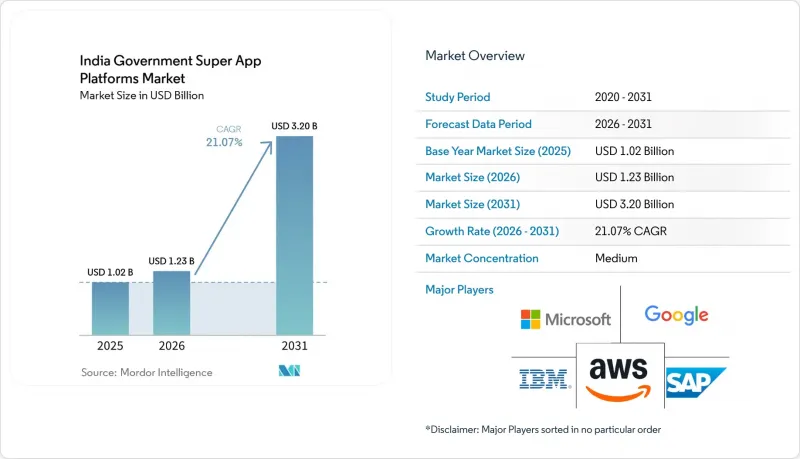
This report is Segmented by Platform (Native Mobile App, and Web and Progressive Web App), Deployment Type (Cloud, On-Premises, and Hybrid), Application (Citizen Services, Identity, Credentials, and Wallet Services, Payments, Fees, and Revenue Collection, and More), and End User (Central Government, and State or Provincial Government). The Market Forecasts are Provided in Terms of Value (USD).
India Government Super App Platforms Market Trends and Insights
Rising Demand for One-Stop Citizen Service Delivery
India's responsibility to deliver welfare, identity, and regulatory services at scale supports the demand for integrated public platforms. UMANG expanded from 166 services in 2017 to 2,572 by June 2026 and processed 796.69 crore cumulative transactions, indicating sustained use of consolidated service access. Kerala and Chhattisgarh have also introduced or expanded integrated state service platforms, adding a state procurement layer alongside central initiatives. This structure creates recurring requirements for vendors capable of supporting multiple departments, languages, and local operating conditions. The India government super-app platforms market also benefits from the requirement that new public digital services connect to established identity, payment, and document-verification rails. Integration requirements can make spending more durable because departments need compatible systems to deliver services at scale.
India Stack as the Digital Identity and Payments Foundation
Aadhaar, UPI, DigiLocker, and ABHA provide shared foundations for government-facing platforms, reducing the need for agencies to build separate identity and transaction systems. Aadhaar generated 144 crore numbers and recorded 2,707 crore authentication transactions in 2024-25, while UPI processed 21.70 billion transactions worth INR 28.33 lakh crore (USD 329.42 billion) in January 2026. The scale of these systems makes reliable integration more important than adding isolated front-end features. DigiLocker's Family ID coverage across Rajasthan, Maharashtra, Madhya Pradesh, and Uttar Pradesh extended its role from document storage to household eligibility verification. ABHA-linked records also support health-related service delivery, which increases the value of interoperable credential management. For the India government super app platforms market, vendors that can securely connect to these public systems have a clearer path to meeting government procurement requirements.
Legacy System Lock-In and Slow Core Modernization
Many state departments still rely on older databases, monolithic systems, and closed interfaces that are difficult to connect with newer platforms. Systems established during earlier e-governance programs often lacked interoperability requirements, leaving agencies with costly modernization work. This challenge is strongest where departments must retain existing records and service processes while adding real-time interfaces. Vendors that can use middleware, microservices wrappers, or modular implementation methods may be better placed than providers focused only on new installations. The India government super app platforms market can face delayed launches and higher support requirements when legacy systems require extensive tailoring. These projects can also pressure vendor margins because integration work continues after the initial platform deployment.
Other drivers and restraints analyzed in the detailed report include:
- AI-Enabled Proactive Services, Vernacular Interfaces, and Automated Case Routing
- Interoperability Across Center-State and Agency Systems
- Procurement Complexity Under GFR Rules and Multi-Agency Governance
For complete list of drivers and restraints, kindly check the Table Of Contents.
Segment Analysis
Native mobile apps are expected to hold 67.88% of the India government super app platforms market share in 2025. Their lead reflects smartphone-led access and their ability to provide offline functions, device-based security, and consistent authentication experiences. NCAER reported that 71.4% of internet users accessed the web only through mobile devices, while 20.4% of digital service users needed assistance from someone outside their household. These conditions support mobile designs that can store selected information locally and guide users through structured workflows. Native applications also remain suitable for users who repeatedly access municipal, welfare, transport, or payment services. Their continued role does not prevent agencies from supporting additional access channels.
Web and progressive web apps are projected to register a CAGR of 22.08% through 2031, the highest among platform formats. UMANG is available through a mobile application, a website, an interactive voice response system, and SMS, demonstrating the practical value of channel flexibility. Progressive web applications can help agencies serve users with older Android devices where downloading a large application is difficult. Browser-based delivery also supports voice interfaces and messaging links without requiring an app store installation. Chhattisgarh's Seva Setu and Andhra Pradesh's Mana Mitra illustrate the shift toward lightweight, channel-based access. The India government super app platforms market is likely to support both native and web-based delivery because citizen access conditions vary by device, literacy level, and network availability.
Cloud deployment is expected to hold 45.66% of the India government super app platforms market share in 2025. It has become a preferred model for new deployments because agencies can add capacity and security services without having to build every resource internally. MeitY's cloud framework guides public agencies in selecting hosting arrangements based on the sensitivity of the information involved. Managed cloud environments can help state information technology departments support fluctuating demand across services. They also allow providers to update software and security controls more consistently. On-premise infrastructure remains relevant for systems that require strict operational control or have complex migration paths.
Hybrid deployment is projected to grow at a CAGR of 21.89% through 2031. The 2026 cloud selection framework classifies Aadhaar, UPI, PAN, voter ID, and similar critical datasets as Category A information that must be stored on sovereign or government-controlled cloud infrastructure. This approach allows agencies to keep sensitive records in controlled environments while using scalable capacity for public-facing services where permitted. AWS India and Yotta Data Services announced a collaboration for NIC's Meghraj 2.0 initiative, which uses AWS Outposts for sensitive workloads within NIC data centers. The arrangement illustrates how a hybrid architecture can separate sensitive processing from peak-load service delivery. For the India government super app platforms market, this model creates opportunities for providers that can manage data controls, integration, and operational continuity together.
Complete Report Scope:
- By Platform
- Native Mobile App
- Web and Progressive Web App
- By Deployment Type
- Cloud
- On-Premise
- Hybrid
- By Application
- Citizen Services
- Identity, Credentials, and Wallet Services
- Payments, Fees, and Revenue Collection
- Social Benefits and Welfare Delivery
- Licensing, Permits, and Registrations
- Other Applications
- By End User
- Central Government
- State Or Provincial Government
List of Companies Covered in this Report:
- Infosys Limited
- Wipro Limited
- HCL Technologies Limited
- Tech Mahindra Limited
- Microsoft Corporation
- Google LLC
- Amazon Web Services, Inc.
- IBM Corporation
- Oracle Corporation
- SAP SE
- ServiceNow, Inc.
- Accenture plc
- Capgemini SE
- eGov Foundation
- Newgen Software Technologies Limited
- Persistent Systems Limited
- NIC e-Governance Services India Limited
- C-DAC (Centre for Development of Advanced Computing)
Additional Benefits:
- The market estimate (ME) sheet in Excel format
- 3 months of analyst support
TABLE OF CONTENTS
1 INTRODUCTION
- 1.1 Study Assumptions and Market Definition
- 1.2 Scope of the Study
2 RESEARCH METHODOLOGY
3 EXECUTIVE SUMMARY
4 MARKET LANDSCAPE
- 4.1 Market Overview
- 4.2 Market Drivers
- 4.2.1 Rising Demand For One-Stop Citizen Service Delivery Across Central And State Governments
- 4.2.2 India Stack (Aadhaar, UPI, DigiLocker, ABHA) As The Digital Identity And Payments Foundation
- 4.2.3 Interoperability Pressure Across Fragmented Centre-State And Inter-Departmental Agency Systems
- 4.2.4 AI-Enabled Proactive Services, Vernacular Interfaces, And Automated Case Routing
- 4.2.5 Cross-Agency Cost Compression Through Shared Platforms (PM GatiShakti, UMANG Expansion)
- 4.2.6 DPDP Act 2023 And National Data Sovereignty And Public-Control Requirements
- 4.3 Market Restraints
- 4.3.1 Legacy System Lock-In And Slow Core Modernization Across State-Level Departments
- 4.3.2 Procurement Complexity Under GFR Rules And Multi-Agency Centre-State Governance
- 4.3.3 Privacy, Consent, And Data Residency Constraints Under DPDP Act 2023
- 4.3.4 Digital Exclusion Risk In Rural, Low-Literacy, And Low-Connectivity Populations
- 4.4 Value Chain Analysis
- 4.5 Regulatory Landscape
- 4.6 Technological Outlook
- 4.7 Porter's Five Forces Analysis
- 4.7.1 Bargaining Power Of Buyers
- 4.7.2 Bargaining Power Of Suppliers
- 4.7.3 Threat Of New Entrants
- 4.7.4 Threat Of Substitutes
- 4.7.5 Competitive Rivalry
5 MARKET SIZE AND GROWTH FORECASTS (VALUE)
- 5.1 By Platform
- 5.1.1 Native Mobile App
- 5.1.2 Web and Progressive Web App
- 5.2 By Deployment Type
- 5.2.1 Cloud
- 5.2.2 On-Premise
- 5.2.3 Hybrid
- 5.3 By Application
- 5.3.1 Citizen Services
- 5.3.2 Identity, Credentials, and Wallet Services
- 5.3.3 Payments, Fees, and Revenue Collection
- 5.3.4 Social Benefits and Welfare Delivery
- 5.3.5 Licensing, Permits, and Registrations
- 5.3.6 Other Applications
- 5.4 By End User
- 5.4.1 Central Government
- 5.4.2 State Or Provincial Government
6 COMPETITIVE LANDSCAPE
- 6.1 Market Concentration
- 6.2 Strategic Moves
- 6.3 Market Share Analysis
- 6.4 Company Profiles (includes Global Level Overview, Market Level Overview, Core Segments, Financials as available, Strategic Information, Market Rank/Share, Products and Services, Recent Developments)
- 6.4.1 Infosys Limited
- 6.4.2 Wipro Limited
- 6.4.3 HCL Technologies Limited
- 6.4.4 Tech Mahindra Limited
- 6.4.5 Microsoft Corporation
- 6.4.6 Google LLC
- 6.4.7 Amazon Web Services, Inc.
- 6.4.8 IBM Corporation
- 6.4.9 Oracle Corporation
- 6.4.10 SAP SE
- 6.4.11 ServiceNow, Inc.
- 6.4.12 Accenture plc
- 6.4.13 Capgemini SE
- 6.4.14 eGov Foundation
- 6.4.15 Newgen Software Technologies Limited
- 6.4.16 Persistent Systems Limited
- 6.4.17 NIC e-Governance Services India Limited
- 6.4.18 C-DAC (Centre for Development of Advanced Computing)
7 MARKET OPPORTUNITIES AND FUTURE OUTLOOK
- 7.1 White-Space and Unmet-Need Assessment

