PUBLISHER: Mordor Intelligence | PRODUCT CODE: 2119244

PUBLISHER: Mordor Intelligence | PRODUCT CODE: 2119244
Smart City Communication Services - Market Share Analysis, Industry Trends & Statistics, Growth Forecasts (2026 - 2031)
According to Mordor Intelligence, the smart city communication services market size was valued at USD 38.98 billion in 2025 and estimated to grow from USD 45.22 billion in 2026 to reach USD 90.13 billion by 2031, at a CAGR of 14.79% during the forecast period (2026-2031).
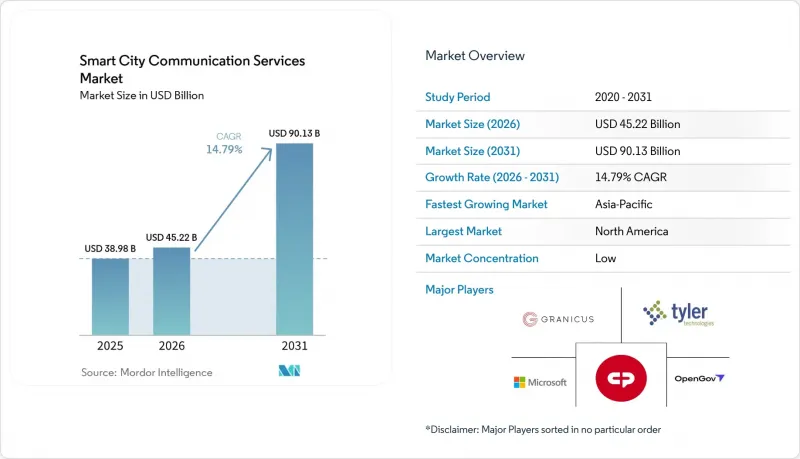
This report is Segmented by Communication Technology (Public Information, Citizen Engagement, and More), Application (Smart Governance, Smart Mobility, Sustainability and Environment, Urban Planning and Development, and Utilities), End User (Municipal and City Governments, Specialized Public Agencies, and More), and Geography. The Market Forecasts are Provided in Terms of Value (USD).
Global Smart City Communication Services Market Trends and Insights
Government-Funded Digital Governance and Smart City Programs
Government investment in urban digital infrastructure remains a durable source of demand for the Smart city communication services market. Spain launched the RedCyTI program in December 2025, providing EUR 89 million, USD 96.3 million, for 59 local smart city digitalization initiatives supported by the European Regional Development Fund. South Korea is running its 2026 AI City Innovation Technology Exploration Program with KRW 30 billion (USD 21.74 million) for AI-enabled urban transportation, environmental, and citizen safety services. In the United States, H.R. 4649 authorizes USD 100 million each year for smart city technology demonstration grants, including communication services. Such programs support multi-year procurement and reduce dependence on annual local budget decisions. This funding structure gives vendors clearer renewal opportunities while allowing cities to plan broader service platforms.
Cloud-Native, AI-Enabled, and Omnichannel Citizen Communication
The shift from separate government portals to connected communication platforms is reshaping supplier priorities in the Smart city communication services market. Granicus released its January 2026 platform update with Government Experience Agent capabilities and planned voice, SMS, and WhatsApp support, alongside a customer data platform for segmentation across email, service requests, and public meetings. CivicPlus launched 6 AI products under its CivicPlus Intelligence initiative for more than 12,000 government organizations that serve 340 million residents in the United States and Canada. The UK Government Digital Service launched GOV.UK Chat in May 2026, providing a government-controlled conversational channel within the GOV.UK app. These offerings shift attention toward channel coordination, resident preferences, and reliable handoffs to public service workflows. Cities that use several channels without shared data face a higher risk of duplicate messaging and uneven service quality.
Budget Constraints and Long Public Procurement Cycles
Budget pressure and prolonged procurement processes can slow deployment in the Smart city communication services market, especially where digital programs are not yet part of regular operating budgets. Bitkom identified permanent financing beyond project periods and innovation-friendly procurement as priority needs for smart cities in Germany. A gap between project grants and renewal funding can disrupt multi-year platform contracts. European Union and North American procurement cycles may take 18-36 months from defining requirements to launch. That timing can leave cities using older systems while vendor product plans move ahead. Rules intended to provide accountability can also favour established suppliers with prior public-sector references.
Other drivers and restraints analyzed in the detailed report include:
- Emergency Alerts and Real-Time Public Safety Messaging
- Measurable Citizen Experience and Service Adoption Outcomes
- Cybersecurity, Privacy, and Legacy Integration Risk
For complete list of drivers and restraints, kindly check the Table Of Contents.
Segment Analysis
Public Information and Awareness Services held 35.45% of Smart city communication services market share in 2025, making them the largest communication technology category. Legally required emergency alerts, official information portals, and government notification networks create stable demand for these services. Their contracts often run over multiple years because cell broadcast nodes, notification middleware, and mass messaging platforms require ongoing maintenance. The Smart city communication services market continues to rely on these authoritative channels during emergencies and routine public information campaigns. GOV.UK Chat handled more than 15,000 questions during its first weeks after the May 2026 launch, showing how official information services are becoming conversational while remaining government-controlled.
Citizen Engagement and Consultation Services (CECS) is projected to grow at a 16.36% CAGR from 2026 to 2031. Digital participation tools support consultation on local projects, service plans, and community priorities. Germany's Smart City Index 2025 found that 89% of surveyed cities used online participation platforms and 45% had deployed chatbots for citizen inquiries. Go Vocal operates across 14 countries, while Salt Lake City's deployment reached more than 10% of residents and supported more than 25 projects in its first year. Behavioural and Community Outreach Services support public health, sustainability, and neighbourhood campaigns. Their steadier development reflects demand for evidence that outreach changes behaviour rather than only generating interactions.
Complete Report Scope:
- By Communication Technology
- Public Information and Awareness Services
- Citizen Engagement and Consultation Services
- Behavioral and Community Outreach Services
- By Application
- Smart Governance
- Smart Mobility
- Sustainability and Environment
- Utilities and Resource Management
- Public Safety
- Urban Planning and Development
- By End User
- Municipal and City Governments
- Specialized Public Agencies
- Regional and National Government Bodies
- Public-Private Partnerships (PPPs) and Joint Ventures
- Other End Users
- By Geography
- North America
- United States
- Canada
- Mexico
- South America
- Brazil
- Argentina
- Rest of South America
- Europe
- Germany
- United Kingdom
- France
- Italy
- Spain
- Rest of Europe
- Asia-Pacific
- China
- Japan
- India
- South Korea
- Rest of Asia-Pacific
- Middle East and Africa
- Saudi Arabia
- United Arab Emirates
- South Africa
- Rest of Middle East and Africa
- North America
Geography Analysis
North America accounted for 38.42% of Smart city communication services market share in 2025. Mature civic technology procurement, high smartphone use, and federal and state digital requirements support regional demand. The U.S. Department of Justice finalized its ADA Title II web accessibility rule in 2024, with an April 26, 2027, deadline for local governments serving more than 50,000 people. This requirement makes accessibility spending a dated procurement priority, while T-Mobile's February 2025 New York City agreement supports public safety departments and first responders. California's AB-2474 also requires a statewide master contract for interoperable alert and early warning software by July 1, 2027.
Asia-Pacific is forecast to expand at a 16.05% CAGR from 2026 to 2031, the highest regional rate in the Smart city communication services market. Government-led smart city programs in India, Japan, and South Korea are creating repeated demand for digital service platforms. India launched the AI-powered Samadhan Didi voice chatbot in May 2026 so residents can register grievances in their preferred regional language. Tokyo's 2025 Smart City Plan aims for a Full Digital city hall by 2030, while South Korea's 2026 Smart City Data Hub project supports government data sharing for citizen communication platforms. These programs respond to language, scale, and access needs that differ across cities.
Europe maintains substantial demand through its Digital Decade goals and the eGovernment Benchmark, which assessed digital transformation across 100 key public services in 2025. Germany's Smart City Index 2025 found that 71% of municipal services were available online and 45% of cities used AI chatbots. Stuttgart launched its revised participation portal in April 2026 with SUMM AI plain-language translation and 12 language versions through DeepL. South America and the Middle East and Africa are earlier-stage regions, although Brazil's 2026 Cidades Mais Inteligentes call and Kuwait's long-term network agreement point to growing public commitment.
- Granicus, LLC
- CivicPlus, LLC
- CitizenLab NV
- Bang the Table Pty Ltd
- Social Pinpoint Pty Ltd
- PublicInput, Inc.
- Nextdoor Holdings, Inc.
- Tyler Technologies, Inc.
- OpenGov, Inc.
- Microsoft Corporation
- International Business Machines Corporation
- Cisco Systems, Inc.
- NEC Corporation
- Siemens AG
- Huawei Technologies Co., Ltd.
- Oracle Corporation
- Amazon Web Services, Inc.
- SAP SE
- Schneider Electric SE
- Honeywell International Inc.
Additional Benefits:
- The market estimate (ME) sheet in Excel format
- 3 months of analyst support
TABLE OF CONTENTS
1 INTRODUCTION
- 1.1 Study Assumptions and Market Definition
- 1.2 Scope of the Study
2 RESEARCH METHODOLOGY
3 EXECUTIVE SUMMARY
4 MARKET LANDSCAPE
- 4.1 Market Overview
- 4.2 Impact of Macroeconomic Factors on the Market
- 4.3 Market Drivers
- 4.3.1 Government-Funded Digital Governance and Smart City Programs
- 4.3.2 Shift to Cloud-Native, AI-Enabled, and Omnichannel Citizen Communication
- 4.3.3 Rising Need for Emergency Alerts and Real-Time Public Safety Messaging
- 4.3.4 Demand for Measurable Citizen Experience and Service Adoption Outcomes
- 4.3.5 Accessibility Compliance Deadlines Create Budgeted Spend
- 4.3.6 Misinformation Response and Trust Rebuilding Elevate Official City Channels
- 4.4 Market Restraints
- 4.4.1 Budget Constraints and Long Public Procurement Cycles
- 4.4.2 Cybersecurity, Privacy, and Legacy Integration Risk
- 4.4.3 Digital-Only Outreach Fatigue and Trust Gaps Reduce Participation Quality
- 4.4.4 Multilingual and Inclusive Communication Mandates Raise Delivery Complexity
- 4.5 Industry Value Chain Analysis
- 4.6 Regulatory Landscape
- 4.7 Technological Outlook
- 4.8 Porter's Five Forces Analysis
- 4.8.1 Threat of New Entrants
- 4.8.2 Bargaining Power of Buyers
- 4.8.3 Bargaining Power of Suppliers
- 4.8.4 Threat of Substitutes
- 4.8.5 Intensity of Competitive Rivalry
5 MARKET SIZE AND GROWTH FORECASTS (VALUE)
- 5.1 By Communication Technology
- 5.1.1 Public Information and Awareness Services
- 5.1.2 Citizen Engagement and Consultation Services
- 5.1.3 Behavioral and Community Outreach Services
- 5.2 By Application
- 5.2.1 Smart Governance
- 5.2.2 Smart Mobility
- 5.2.3 Sustainability and Environment
- 5.2.4 Utilities and Resource Management
- 5.2.5 Public Safety
- 5.2.6 Urban Planning and Development
- 5.3 By End User
- 5.3.1 Municipal and City Governments
- 5.3.2 Specialized Public Agencies
- 5.3.3 Regional and National Government Bodies
- 5.3.4 Public-Private Partnerships (PPPs) and Joint Ventures
- 5.3.5 Other End Users
- 5.4 By Geography
- 5.4.1 North America
- 5.4.1.1 United States
- 5.4.1.2 Canada
- 5.4.1.3 Mexico
- 5.4.2 South America
- 5.4.2.1 Brazil
- 5.4.2.2 Argentina
- 5.4.2.3 Rest of South America
- 5.4.3 Europe
- 5.4.3.1 Germany
- 5.4.3.2 United Kingdom
- 5.4.3.3 France
- 5.4.3.4 Italy
- 5.4.3.5 Spain
- 5.4.3.6 Rest of Europe
- 5.4.4 Asia-Pacific
- 5.4.4.1 China
- 5.4.4.2 Japan
- 5.4.4.3 India
- 5.4.4.4 South Korea
- 5.4.4.5 Rest of Asia-Pacific
- 5.4.5 Middle East and Africa
- 5.4.5.1 Saudi Arabia
- 5.4.5.2 United Arab Emirates
- 5.4.5.3 South Africa
- 5.4.5.4 Rest of Middle East and Africa
- 5.4.1 North America
6 COMPETITIVE LANDSCAPE
- 6.1 Market Concentration
- 6.2 Strategic Moves
- 6.3 Market Share Analysis
- 6.4 Company Profiles (includes Global Level Overview, Market Level Overview, Core Segments, Financials as available, Strategic Information, Market Rank/Share, Products and Services, Recent Developments)
- 6.4.1 Granicus, LLC
- 6.4.2 CivicPlus, LLC
- 6.4.3 CitizenLab NV
- 6.4.4 Bang the Table Pty Ltd
- 6.4.5 Social Pinpoint Pty Ltd
- 6.4.6 PublicInput, Inc.
- 6.4.7 Nextdoor Holdings, Inc.
- 6.4.8 Tyler Technologies, Inc.
- 6.4.9 OpenGov, Inc.
- 6.4.10 Microsoft Corporation
- 6.4.11 International Business Machines Corporation
- 6.4.12 Cisco Systems, Inc.
- 6.4.13 NEC Corporation
- 6.4.14 Siemens AG
- 6.4.15 Huawei Technologies Co., Ltd.
- 6.4.16 Oracle Corporation
- 6.4.17 Amazon Web Services, Inc.
- 6.4.18 SAP SE
- 6.4.19 Schneider Electric SE
- 6.4.20 Honeywell International Inc.
7 MARKET OPPORTUNITIES AND FUTURE OUTLOOK
- 7.1 White-Space and Unmet-Need Assessment

